
Sports
Caught on a sticky wicket, Ranil’s glorious chance to emerge a shining knight


by Rex Clementine
There are a lot of similarities between Sir Don Bradman and Ranil Wickremesinghe. Both men were immensely gifted. Breaking world records was child’s play for the finest batsman the world has seen, while the smartest politician the nation has seen is on the verge of equalling a world record after becoming the Prime Minister for the sixth time. The record is held by the former leader of the Christian Democratic Party, Giulio Andreotti, who was Italy’s Prime Minister on seven occasions.
Despite all his cricketing brilliance, Bradman was a very vindictive person. The dropping of Keith Miller in 1949 was inexplicable and can be put down to the fact that Bradman had an axe to grind with the greatest all-rounder at that time. Then, there’s also the case of Clarrie Grimmett, Australia’s best leg-spin bowler before World War II. He took 44 wickets in a five-match series in South Africa in 1936 but never played a Test again purely because he had a run-in with Bradman.
Ranil’s case is similar. He may not have had fallouts with party seniors, but he sidelined them fearing a challenge to leadership. Sirisena Cooray, Gamini Jayawickrama Perera and Karu Jayasuriya are cases in point. When the Presidential elections came around with his chances of winning slim, Ranil was more than happy to back an independent candidate rather than supporting someone from within the party for fear of losing the party leadership.
When G.R. Viswanath entered the scene in 1969, the Indian captain at the time, Tiger Pataudi, was quick to realize that this was a precious talent and moved down the batting order to allow the youngster to occupy the premium number four position. India benefited immensely as they never lost a Test match when Viswanath made a hundred. Ranil was never comfortable with such grooming strategies. As a result, the UNP has suffered immense setbacks.
Some are poking fun at our political system, given that Ranil had lost the last Parliamentary elections in an embarrassing fashion. He entered Parliament through the National List and today lives in Temple Trees!
At MCG, a drunk Aussie fan once asked Percy: Is it true that like monkeys, you Sri Lankans live on trees? Uncle Percy replied, ‘Yes, even our Prime Minister lives in Temple Trees!’
For the moment, people will not mind whether the democratic process had been followed or not in selecting Ranil as the PM as there are far worse concerns. Long queues in the quest for essentials and the skyrocketing cost of living loom as the greatest among them. Remember, when the Ashes was slipping away from England in 1981, Alec Bedser didn’t choose the team’s best player to rescue England. Instead, he picked Mike Brearley, one of the best brains in the game. For the record, Brearley never made a hundred in a Test match although he featured in 39 of them.
Like Brearley, Ranil could save our economy.
Brearley wasn’t the only captain cricket’s selectors had thrown into the deep end when faced with a crisis. Having lost the cream of players to Kerry Packer’s World Series Cricket in 1977, Australia’s selectors called up Bobby Simpson, who was retired for a decade then, to take up the leadership at the age of 41! Ranil, at the age of 73, is the oldest UNP Prime Minister, older than D.B. Wijetunga.
Now that Ranil has been entrusted with an unenviable task, he better deliver or suffer the fate of Geoff Boycott. England were eyeing a Test win in Christchurch in 1977 but captain Boycott was not helping the team’s cause as he was batting too slow. Ian Botham ran out his skipper and England went on to win. Unless Ranil delivers, and fast, it’s only a matter of time before he too is left stranded. In Boycott’s team, there were many captaincy aspirants like Graham Gooch, Bob Willis, Derek Randall, Bob Taylor and Botham himself. We have plenty in our ranks with Prime Ministerial ambitions like Sirisena, Senaratne, Siripala, Premadasa, Ranawaka, et al.
In previous instances when Ranil took on the baton, he gave up the fight rather meekly after impressive starts.
Mahela Jayawardene, hailed as one of the greatest captains the nation has produced, had a golden opportunity to beat Pakistan 2-0 in a series in 2012 but preferred to settle for a 1-0 win. Instead of going all guns blazing, MJ opted for a handshake, playing it safe in Pallekele where Sri Lanka had the game in hand. Similarly, Ranil took over in 2001 with the economy in dire straits. Having fixed some of the problems the country was facing, he was making significant progress when President CBK clipped his wings by taking over three key ministries. Instead of fighting tooth and nail, Ranil like Mahela took the blow on the chin and merely looked on. The rest, as they say, is history.
A captain needs to have the support of his team. You pity Andrew Strauss, who faced the embarrassment of his own teammate Kevin Pietersen passing on tips to South African fast bowlers by sending text messages in Afrikaans. The South Africa-born Pietersen was a sensation as a batsman but could be a loose cannon if not handled carefully, very much like S.B. Dissanayake. When Ranil appointed Dissanayake as the National Organizer of UNP, eyebrows were raised as SB was a die-hard SLFPer. He was just marking time in UNP, passing on valuable information to the opposition, and made a timely defection. Like Strauss, Ranil suffered in silence. No one else was to be blamed but himself.
Once in power, Ranil tends to develop a close-knit circle full of Royalists who are not much aware of the ground reality. That was also Sanga’s problem. Not that he was pulling for any Trinitians, but he had another weakness, heavily backing players from Perera Gardens. Allegations that the 2011 World Cup final was fixed is a cock and bull story. However, some players in that squad didn’t deserve to be there. Sanga’s agent had a significant say in team selections, very much like Ranil’s loyal Royalists had on the economy. Sanga’s agent and Ranil’s Royalists are a recipe for disaster.
Richie Benaud said that captaincy was the ability to think ahead of the play and not keep responding to what takes place. Ranil has this in abundance as he predicted the economic crisis months in advance. Had he been in power, we could have probably avoided the crisis as well. However, his problem is that like Brian Lara, he is snobbish and his inability to engage lesser mortals becomes a problem.
To his credit, when he was in power, Ranil did try to clean up cricket. Sidath Wettimuny was one of the best Presidents we have had at SLC in many years. Ranil gave his fullest backing when Sidath tried to change the SLC constitution with the backing of the ICC. Alas! Maithripala’s camp comprised those who had interests in cricket as well and they crushed those plans.
Now that Ranil is back, there’s new found hope for both the economy and cricket. He needs to rescue both.


Ali Khan the USA fast bowler of Pakistan origin, has claimed in a caption to a story on Instagram that he has been “denied” an Indian visa. USA are scheduled to play India in Mumbai on February 7, the opening day of the 2026 T20 World Cup.
Khan, who is currently in Colombo for a USA training camp, posted on Tuesday without giving any further details. ESPNcricinfo has approached the USA team manager for comment.
USA are yet to announce their squad for the 2026 T20 World Cup but it is expected the final 15 will be chosen from the 18 that are at the camp in Sri Lanka. It is understood that the squad will be picked by the USA coaching group, while the team administration and logistics are being overseen by the ICC, which took charge following the suspension of USA Cricket late last year.
Khan, 35, is one of three USA players of Pakistan origin currently at the camp in Colombo; Ehsan Adil – who has played three Tests for Pakistan – and Mohammad Mohsin are the other two. The ICC has made no official comment on the situation but is understood to be trying to facilitate the matter and is confident it will be resolved.
A number of associate teams in the tournament – Oman, UAE and Italy – will be looking on with interest, given their squads are likely to include a number of players of Pakistan origin, or with Pakistani nationality.
ESPNcricinfo understands that England’s two squad members of Pakistan heritage, Adil Rashid and Rehan Ahmed, are both still awaiting their visas. While the matter is expected to be resolved in time for the tournament, their situation is complicated by the need to apply in-person. Rehan is currently in Australia at the BBL, while Rashid is in Dubai.
Last September, the ICC had informed all participating teams that securing visas to India and Sri Lanka, the co-hosts of the T20 World Cup, would be the responsibility of the respective boards but it would facilitate paperwork if needed. In the case of USA, with the suspension of USAC, that responsibility would lie with the ICC.
Worsening diplomatic and political ties between India and Pakistan have made visas an complicated issue in recent years, even for players who are nationals of other countries. England’s Shoaib Bashir and Saqib Mahmood had faced delays in obtaining visas but were granted them eventually, as was the case with Australia’s Usman Khawaja. The visas for the Pakistan team were also delayed ahead of their travel to India for the 2023 ODI World Cup.
USA, who got a direct entry for the 2026 T20 World Cup after making the Super Eights stage in the 2024 tournament, are scheduled to play three of their four group A matches in India. Their first match is against defending champions India on the opening day (February 7) of the T20 World Cup in Mumbai, followed by Pakistan in Colombo (February 10) and then two matches in Chennai – against Netherlands (February 13) and Namibia (February 15).
[Cricinfo]
Under 19 Cricket
Kavith de Silva with a half century (78) and Hashmika Nethshan and Dasun Nethsara with valuable knocks of 40s helped Maris Stell post 270 runs against St. Aloysius’ on day one of the Under 19 cricket encounter at Karandeniya on Tuesday.
For St. Aloysius’ Dulsath Nimviru and Oshada Devinda took four wickets each.
Meanwhile the Under 19 Division I tier B match between Ananda and Isipatana ended in a no decision.
Match Scores
Maris Stella post 270 at Karandeniya
Scores
Maris Stella 270 all out in 79.1 overs (Hansaka Perera 29, Kavith de Silva 78, Hashmika Nethshan 45, Dasun Nethsara 41, Ameesha Fernando 25; Dulsath Nimviru 4/100, Oshada Devinda 4/68)
St. Aloysius’ 54 for 2 in 16 overs
(Gimhan Hansaka 34; Savindu Sathsara 2/15)
No decision at Ananda Mawatha
Scores
Ananda 204 for 9 decl. in 64.2 overs
(Danindu Sellapperuma 21, Himira Kudagama 43, Lithma Perera 28, Binara Umayanga 39, Rashan Dilaksha 29; Tharindu Naveen 2/21, Dasith Senal 3/56)
Isipatana 110 for 5 in 46 overs (Navindu Umeth 48, Dewshan Deneth 23; Himira Kudagama 4/23) (RF)
Latest News
Harmanpreet masterclass seals second-highest chase in WPL, Mumbai Indians go 8-0 against Gujarat Giants

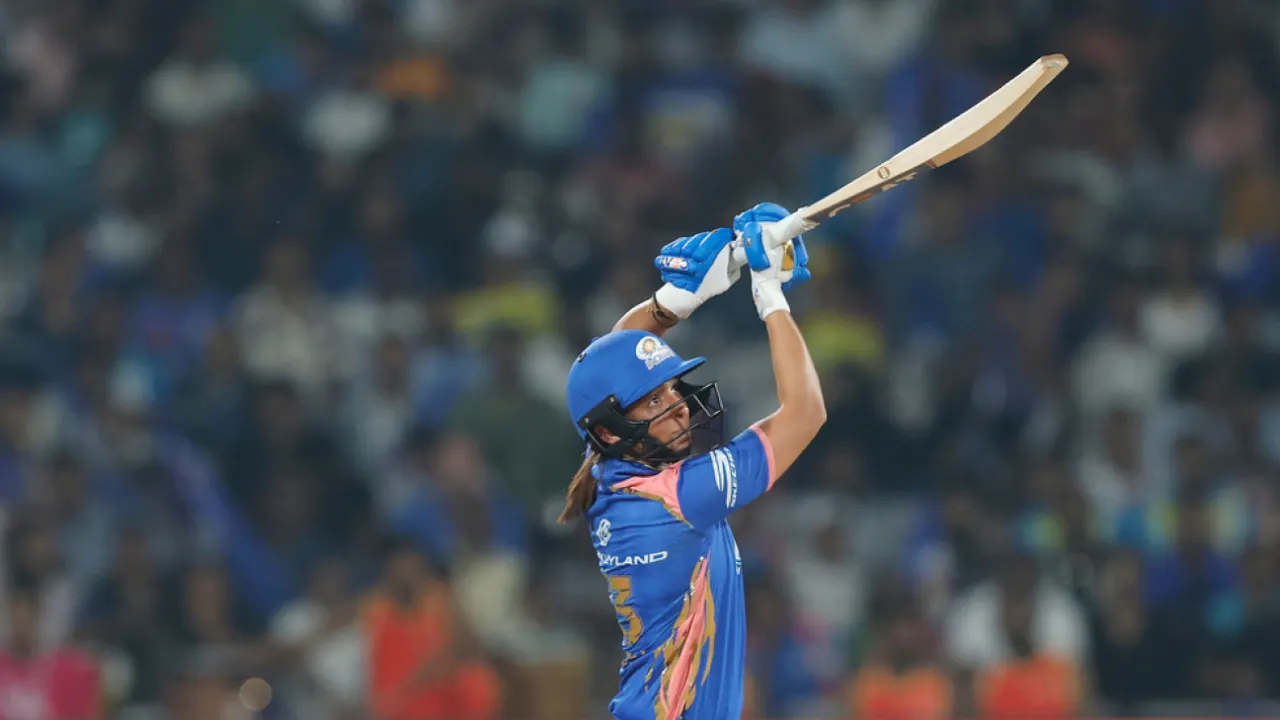
Captain Harmanpreet Kaur’s unbeaten 71 off 43 balls powered Mumbai Indians (MI) to a seven-wicket win over Gujarat Giants [GG], as they chased down 193, the second-highest successful chase in WPL history.
Harmanpreet paced the chase to near perfection, finding support from Amanjot Kaur and Nicola Carey, as MI extended their perfect head-to-head record against Giants to 8-0. MI also maintained their remarkable streak of never losing a WPL match when Harmanpreet scores a fifty, this being the 10th such instance.
Giants began briskly after being put in, with Sophie Devine and Beth Mooney taking on the returning Hayley Matthews for four boundaries in the second over. Devine got an early reprieve, when Shabnim Ismail induced an edge in the opening over and wicketkeeper G Kamalini put down the chance. The miss proved inconsequential as Ismail struck again in the third over, this time having Devine nick behind for 8, with Kamalini holding on.
With Anushka Sharma sidelined through injury, Kanika Ahuja was promoted to No. 3. She ensured the momentum did not dip, getting off the mark with a powerful drive through the covers, and combining with Mooney to inflict damage. After Mooney’s departure, she continued the same alongside Ash Gardner. The pair carried Giants to 99 for 3 at the end of 10th over. Gardner fell in the 10th over and Ahuja followed in the 11th, but Giants had laid a solid platform by then.
MI clawed their way back into the contest after Ahuja’s dismissal. Ayushi Soni, brought in for Anushka, struggled to find fluency, while her partner Georgia Wareham continued to find the gaps regularly. Soni was on 7 off 10 balls at the end of the 16th over when she retired out, becoming the first player in WOL to do so. The move paved the way for Bharti Fulmali, who ensured it paid dividends.
Fulmali survived two lbw appeals in the 17th over from Amanjot, both overturned in her favour. She then launched a late onslaught, taking on Carey with two fours and a six in the 19th, before going even harder in the final over. Fulmali smashed two fours and two sixes off Amanjot as Giants plundered 39 runs across the last two overs, finishing on 192.
Hayley Matthews returned to the top of the order after missing the first two matches with injury. Despite losing her opening partner Kamalini in the third over, she ensured MI made a positive start. However, her stay was short-lived, ending on 22 off 12 balls. That dismissal brought Harmanpreet and Amanjot together, and the pair began to rebuild.
Amanjot soon found her rhythm, unfurling a flurry of boundaries against Wareham and Tanuja Kanwar, while Harmanpreet ticked along at better than run-a-ball through the first 10 overs.
Once set, Amanjot shifted gears, taking on Renuka Singh and Gardner with a series of cleanly struck sixes. The breakthrough for Giants came through Devine, whose slower ball accounted for Amanjot and ended a 72-run partnership.
Harmanpreet, though, remained unfazed and continued to dictate terms, with Carey joining her at a stage when MI required 84 off 48 balls.
Carey swung the momentum decisively in the 16th over, hammering five boundaries off Renuka, who continued to struggle for accuracy. The over slashed the equation to 39 needed off 24 balls.
Harmanpreet soon brought up her half-century off 33 deliveries, and Giants compounded their woes with a series of fielding lapses, putting down three chances of her.
Harmanpreet made them pay, pouncing on the width offered by wayward bowling to keep the chase firmly on track. With four needed off five balls, she sealed the contest by hitting a boundary, through the gap between deep square leg and deep midwicket.
Brief scores:
Mumbai Indians Women 193 for 3 in 19.2 overs (Gunalan Kamalini 13, Hayley Maththews 22, Amanjot Kaur 40, Harmanpreet Kaur 71*, Nicola Carey 38*; Renuka Singh 1-39, Kashvee Gautam 1-33, Sophie Devine 1-29) beat Gujarat Giants Women 192 for 5 in 20 overs (Beth Mooney 33, Kanika Ahuja 35, Ashleigh Gardner 20, Georgia Wareham 43*, Ayushi Sani 11, Bharti Fulmali 36*; Shabnim Ismail 1-25, Hayley Maththews 1-34, Nicola Carey 1-36, Amelia Kerr 1-40 ) by seven wickets
[Cricinfo]

Showery condition over the island is expected to reduce from tomorrow (15th)

USA’s Ali Khan claims having been ‘denied’ India visa ahead of T20 World Cup

At least 28 dead as crane collapses onto train in Thailand

Fair weather will prevail except for a few showers in the Uva, Eastern, Western and Central provinces and in Galle, Matara and Rathnapura districts

Trump cancels US-Iran meetings, urges protesters to take over institutions

Govt. bows to pressure, shelves Grade 6 reforms

‘Dates have the highest sugar content to fight Coronavirus’

Sunday Island 27 December – Headlines

#SundayIsland 17th December – Headlines

Sunday Island – 28th March

Sunday Island Headlines – 21 March

Sunday Island – 21st February – Headlines
-

 Business4 days ago
Dialog and UnionPay International Join Forces to Elevate Sri Lanka’s Digital Payment Landscape
-
 News4 days ago
Sajith: Ashoka Chakra replaces Dharmachakra in Buddhism textbook
-

 Features4 days ago
The Paradox of Trump Power: Contested Authoritarian at Home, Uncontested Bully Abroad
-

 Features4 days ago
Subject:Whatever happened to (my) three million dollars?
-

 News3 days ago
Level I landslide early warnings issued to the Districts of Badulla, Kandy, Matale and Nuwara-Eliya extended
-

 News4 days ago
65 withdrawn cases re-filed by Govt, PM tells Parliament
-

 News3 days ago
National Communication Programme for Child Health Promotion (SBCC) has been launched. – PM
-

 Opinion6 days ago
The minstrel monk and Rafiki, the old mandrill in The Lion King – II