
News
Cardinals and bishops see funeral as befitting Benedict XVI’s personality

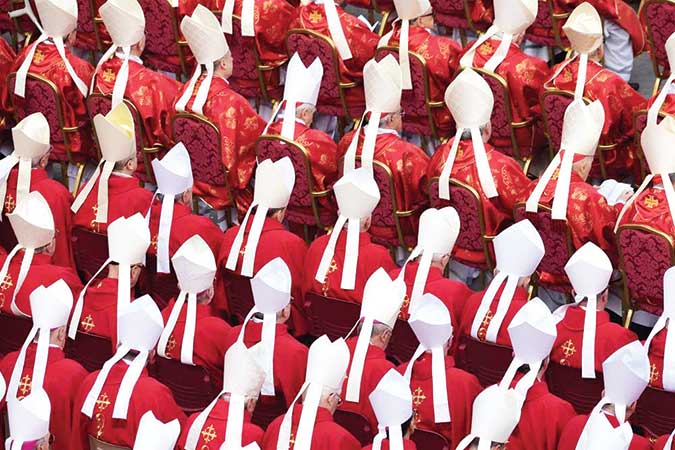
Bishops present at the funeral of Benedict XVI have highlighted the sobriety of the ceremony and the appropriateness of the liturgy, in a pope who paid special attention to the deep meaning of the liturgy. Thus, in declarations to Europa Press at the conclusion of the ceremony, Cardinal Juan José Omella, Archbishop of Barcelona and President of the Spanish Episcopal Conference (CEE), stressed that the funeral “was dignified and profound”. “A funeral is not to go launching rockets, but to go internalizing the great mystery of the resurrection of Jesus,” he stressed.
In this sense, he affirmed that “it has been a really prayerful context”. “It was what Benedict XVI always asked, that the liturgy leads us to the mystery, not folklore. And here we have lived the mystery of Christ, expressed in a liturgy that Ratzinger loved so much. Respectful, profound and with symbols”, he added.
Cardinal Omella emphasized that Pope Francis’ words “have placed us on the path that was Benedict’s”. “We are on our way to the Father’s house, we are witnesses of the good news of Jesus, and witnesses of hope,” he said.
In his opinion, if he could sum up Benedict’s life in one word, it would be “hope.” “And the Pope has given us today that cry of hope from the Gospel. In his words today he spoke of hope, welcome and mercy. And having the idea that we are witnesses here, we cannot live disincarnated from this world,” he stressed.
For his part, Spanish Cardinal Luis Ladaria, Prefect of the Congregation for the Doctrine of the Faith, also told Europa Press that his “feeling” is that the Lord is with them and that Pope Benedict “enjoys Him in heaven”. In addition, he has valued the work of Joseph Ratzinger as his predecessor for many years at the head of the Congregation.
Another Spaniard with a position in the Roman Curia, Luis Marin de San Martin, noted that, in his homily, the Pope reflected something fundamental in Benedict’s message: “the centrality of Christ.” “The entire Christian life, all the theological work of Joseph Ratzinger has Christ at the center,” added the undersecretary of the Synod of Bishops. The ceremony was very dignified. The fire was in the hearts of those present, not in the temperature,” he said, referring to the unseasonable morning experienced by the thousands of faithful present at the ceremony.
Marín de San Martín pointed out that “Benedict was a discreet, simple, humble man, but with the fire of Christ in his heart”. “I believe that all of us who participated have Christ in our hearts and we have lived a very intense moment, of solid spirituality, not so much fireworks but of experience, as has been the whole life of Joseph Ratzinger,” he said.
Meanwhile, the Archbishop of Burgos, Mario Iceta, another of the Spanish ecclesiastics present at the farewell to Benedict XVI, agreed that the Holy Father’s homily seemed to him “really beautiful, profound, with the elements that identify a pastor dedicated to his Church. He started from the Gospel, speaking of the care of the people of God. I liked it very much and I find it very accurate,” he said.
For the Archbishop of Burgos, the ceremony reflected the spirit of Pope Benedict, in the sense that it was “sober, profound and beautiful, with a very significant climate of gratitude and respect”. “Pope Benedict, in that care for the liturgy, in that living of the liturgy is today what we have lived in a simple and solemn way. The whole square was in that harmony of gratitude to God for the life and teaching of the Pope Emeritus,” he said.
Iceta also said that this ceremony meant for him “to accompany him in this last step in his journey on earth”. I have followed his magisterium very closely and I think it was a sign of affection and gratitude to God for the great gift of his life and the care of the Church during eight years as Pope and his immense dedication to the Church as a priest, as a theologian, as a professor,” he said. It has been a life fully dedicated to the Lord, with fidelity, humility and simplicity».
In addition, he considers that “intellectually he has been a giant of thought” and a reference to know the thought of the second half of the twentieth century and of the XXI century. In this sense, he sees in Ratzinger “merits to be declared doctor of the Church”. “His teachings have been broad and deep, and of encounter and dialogue with contemporary culture. It is not a timeless thought, but responds to the challenges that the world lives today. It is of an extraordinary theological and thought height”, he assured.
In this sense, the Italian Cardinal Claudio Maria Celli, president of the Council for Social Communications, emphasized his gratitude to the Pope Emeritus, because he was the man who called him to communication». “He gave me this task: when he launched the first tweet in the world he wanted me to be at his side. He was very conscious and very wise in knowing that you had to talk to people in today’s language, in the world of digital communications. He was a man of great wisdom, who knew how to guide the Church and to accompany her and, in this last time, to accompany her with his presence and prayer. It is the testimony of a man faithful to his word,” he said.
The also Italian Cardinal Fernando Filoni, Grand Master of the Order of the Holy Sepulchre of Jerusalem, pointed out that it was a “Christological” homily, very much in keeping with the celebration that was taking place. ” think it is very beautiful what he said about being in the hands of Jesus crucified, who welcomes him. This spiritual aspect is very significant, even more so in the context of what the death of a man who has spoken a lot about Jesus, and who now goes to meet him, really means,” he stressed.
For his part, the Uruguayan Guzmán Carriquiry agreed that «it was a solemn, simple ceremony”. “The atmosphere of silence and prayer throughout the ceremony was striking,” he said. Carriquiry, a Uruguayan layman who was vice-president of the Commission for Latin America and of the Council for the Laity, at the end of the funeral Mass for Benedict XVI, said he was “grateful to the Pope Emeritus and moved.”
“We had a personal friendship. He knew us, he knew the names of our children He will be a doctor of the Church, because he knew how to combine tradition with novelty, to introduce us to the great mystery of the faith. And we have experienced the relationship of continuity between his magisterium and that of Pope Francis,” he concluded. (EUROPA PRESS)



The landslide early warnings issued to the Districts of Kandy and Nuwara Eliya by the Landslide Early Warning Center of the National Building Research Organisation [NBRO] have been extended until 0600 hrs on the 14th of February 2026.
Accordingly,
The Level II [AMBER] landslide early warnings issued to the Divisional Secretaries Divisions and surrounding areas of Walapane and Nildandahinna in the Nuwara Eliya district and
the Level I [YELLOW] landslide early warnings issued to the Divisional Secretaries Division and surrounding areas of Pathahewaheta in the Kandy district have been extended till 0600AM on Saturday [14]

The Royal Navy of Oman Vessel “SADH” which arrived in Sri Lanka for replenishment purpose, departed the island on 12 Feb 26.
In accordance with naval tradition, the Sri Lanka Navy extended a customary farewell to the departing ship.

The Minister of Education, Higher Education and Vocational Education Prime Minister Dr. Harini Amarasuriya stated that aligning with the development activities carried out under the new education reforms, decisions at the rural level will not be taken from Colombo and plans should be sent based on the requirements of the rural level through the District Coordination Committees by structural committees. She further noted that all officials, from the Ministry of Education down to the school level, must commit to working efficiently and with a human-centered approach.
The Prime Minister made these remarks while addressing a discussion held with education authorities of the Hambantota District on Thursday [February 12] at the auditorium of the Hambantota District Secretariat regarding the new education reforms and prevailing issues in the education sector.
During the meeting, the Prime Minister provided an opportunity for education authorities including chief prelates of pirivenas, zonal education directors, teacher advisors, and principals to present the challenges they face and officials raised concerns including salary disparities among principals, developing school infrastructure, issues arising from the division between national and provincial schools, and uplifting pirivena education.
Further elaborating, Prime Minister stated:
“The new education reforms were initiated from 2025 through dialogue, consultations, and the collection of necessary data. As officials, you have extended your support to us during this process. We have embarked on a difficult and long journey, and we look forward to your continued cooperation.
We initiated these reforms in response to a strong social demand. Many have attempted such reforms at different times. Within our political vision, we understood clearly that if this country is to be rebuilt, an educational transformation is essential. The human resource is the most valuable resource of this country and it should be nurtured properly.
Solutions to many of the crises our country faces lie within the education system. Addressing the issues in economic challenges, social issues, drug abuse, violence, the breakdown of political culture, corruption, waste, and even the deterioration of human relationships all lie within the education.
In order to achieve the transformation we envision as a government, that an education transformation is necessary.
This education system should focus on reducing the pressures within the system, minimize school dropouts, increase employability, and instill confidence in children about their future.
There are disparities within the school system, between rural and urban schools, national and provincial schools, and difficult schools. This should not happen. All children must have equal opportunities.
Decisions regarding the establishment of schools or expansion of classes should not be political decisions. They must be decisions taken through Structural Committees. Those representatives understand their divisions, village economies, and population dynamics. Based on your decisions and assessments of needs, prepare the plans, discuss them with the District Coordination Committees, and submit them to us. We will then take steps to provide the necessary allocations and other support. We will not make decisions for the rural level while sitting in Colombo.
We are taking steps to minimize salary disparities. A Cabinet paper regarding the salary anomalies of principals has already been prepared for submission. Steps are also being taken to introduce new reforms in pirivena education through the Pirivena Committee of the Ministry of Education. We require the support of the chief prelates in this regard.
A significant number of teachers turn to human rights due to delays caused by inefficiency. Therefore, all officials from the Ministry of Education down to the schools must commit to working efficiently and in a humane manner”
The discussion was attended by Chief prelates of pirivenas, deputy ministers, Members of Parliament, zonal directors, principals, and other education sector officials.


[Prime Minister’s Media Division]

Landslide Early Warnings issued to the Districts of Kandy and Nuwara Eliya extended

Aryansh Sharma, Sohaib Khan power UAE to thrilling win over Canada

Royal Navy of Oman Vessel “SADH” departs island

Muzarabani, Bennett orchestrate famous Zimbabwe win

“We will not make decisions for rural level schools while sitting in Colombo” – PM

USA need to overturn history to beat Netherlands and stay alive

‘Dates have the highest sugar content to fight Coronavirus’

Sunday Island 27 December – Headlines

#SundayIsland 17th December – Headlines

Sunday Island – 28th March

Sunday Island Headlines – 21 March

Sunday Island – 21st February – Headlines
-
 Features6 days ago
My experience in turning around the Merchant Bank of Sri Lanka (MBSL) – Episode 3
-

 Business7 days ago
Zone24x7 enters 2026 with strong momentum, reinforcing its role as an enterprise AI and automation partner
-

 Business6 days ago
Remotely conducted Business Forum in Paris attracts reputed French companies
-
 Business6 days ago
Four runs, a thousand dreams: How a small-town school bowled its way into the record books
-

 Business6 days ago
ComBank and Hayleys Mobility redefine sustainable mobility with flexible leasing solutions
-
 Business3 days ago
Autodoc 360 relocates to reinforce commitment to premium auto care
-
 Midweek Review3 days ago
A question of national pride
-
 Business7 days ago
HNB recognized among Top 10 Best Employers of 2025 at the EFC National Best Employer Awards