
Foreign News
Benin coup thwarted by loyalist troops, president tells nation


Benin’s president has appeared on television to reassure citizens of the West African nation that the situation was now “totally under control” following an attempted coup earlier in the day.
“I would like to commend the sense of duty demonstrated by our army and its leaders, who have remained… loyal to the nation,” Patrice Talon said, looking calm during the live evening broadcast.
The government said it had thwarted the mutiny hours after a group of soldiers declared a takeover on national television.
Later in the afternoon, huge explosions were heard in Cotonou, Benin’s largest city and seat of government. They were thought to have been the result of an air strike.
Prior to the explosions, flight-tracking data showed that three aircraft had entered Benin’s airspace from neighbouring Nigeria before returning home.
A spokesman for Nigeria’s president later confirmed that its fighter jets had gone in to “take over the airspace to help dislodge the coup plotters from the national TV and a military camp where they had regrouped”.
There have been a series of coups in West Africa before Sunday’s thwarted attempt in Benin, heightening fears that the security of the region could worsen.
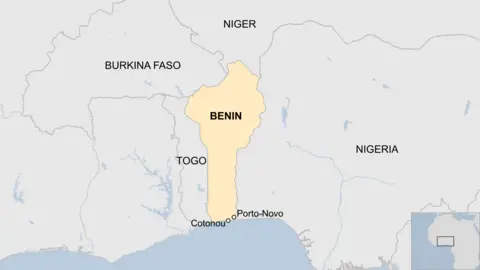
Benin, a former French colony, has been regarded as one of Africa’s more stable democracies. But Talon has faced accusations of suppressing criticism of his policies.
The nation is one of the continent’s largest cotton producers, but ranks among the world’s poorest countries.
Nigeria, Benin’s large neighbour to the east, has described the coup attempt as a “direct assault on democracy”.
“This commitment and mobilisation enabled us to defeat these opportunists and avert disaster for our country. This treachery will not go unpunished,” he added.
“I would like to reassure you that the situation is completely under control and therefore invite you to go about your business peacefully this evening.”
It is not clear if there have been casualties, but the president expressed his condolences “to the victims of this senseless adventure, as well as to those still being held by fleeing mutineers”.
Earlier, government spokesperson Wilfried Leandre Houngbedji told news agency Reuters that 14 people had been arrested in connection with the attempted coup.
A journalist in Benin told the BBC that, of those reportedly arrested, 12 are believed to have stormed the offices of the national TV station – including a soldier who had previously been sacked.
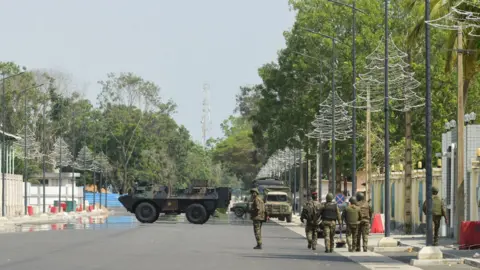
Eyewitnesses told the BBC gunfire was heard near the presidential residence early on Sunday morning, as a group of soldiers announced on national TV that they were suspending the constitution.
They also said some journalists working for the state broadcaster had been held hostage for a few hours.
The French and Russian embassies urged their citizens to remain indoors, while the US embassy’s advice was to stay away from Cotonou, especially the area around the presidential compound.
The rebel soldiers, led by Lt Col Pascal Tigri, justified their actions by criticising Talon’s management of the country, complaining first about his handling of the “continuing deterioration of the security situation in northern Benin”.
Benin’s army has suffered losses near its northern border with insurgency-hit Niger and Burkina Faso in recent years, as jihadist militants linked to Islamic State and al-Qaeda spread southwards.
The soldier’s statement cited “the ignorance and neglect of the situation of our brothers in arms who have fallen at the front and, above all, that of their families, abandoned to their sad fate by Mr Patrice Talon’s policies”.
The rebels also hit out at cuts in health care, including the cancellation of state-funded kidney dialysis, and taxes rises, as well as curbs on political activities.
Talon, who is regarded as a close ally of the West, is due to step down next year after completing his second term in office, with elections scheduled for April.
A businessman known as the “king of cotton”, he first came to power in 2016. He promised not to seek a third term, despite Benin’s current two-term limit for presidencies, and has endorsed Finance Minister Romuald Wadagni as his successor.
Talon has been praised by his supporters for overseeing economic development, but his government has also been criticised for suppressing dissenting voices.
In October, Benin’s electoral commission barred the main opposition candidate from standing on the grounds that he did not have enough sponsors.
Last month, constitutional amendments were passed by MPs, including the creation of a second parliamentary chamber, the Senate.
Terms for elected officials were extended from five to seven years, but the presidential two-term limit remained in place.
Sunday’s attempted coup comes just over a week after Guinea-Bissau’s President Umaro Sissoco Embaló was overthrown – though some regional figures have questioned whether this was staged.
In recent years, West Africa has also seen coups in Burkina Faso, Guinea, Mali and Niger, prompting concerns about the region’s stability.
Russia has strengthened its ties with these Sahel countries over recent years – and Burkina Faso, Mali and Niger have left the West African regional bloc Ecowas to form their own group, the Alliance of Sahel States.
News of the attempted takeover in Benin was hailed by several pro-Russian social media accounts, according to BBC Monitoring.
Ecowas and the African Union (AU) have both condemned the coup attempt.
A contingent from Ecowas’s standby force is to be deployed to preserve the “constitutional order and the territorial integrity of the Republic of Benin”, the regional bloc has said in a statement.
AU Commission chair Mahmoud Ali Yousouf reiterated the pan-African organisation’s “zero tolerance stance toward any unconstitutional change of government, regardless of context or justification”.
[BBC]

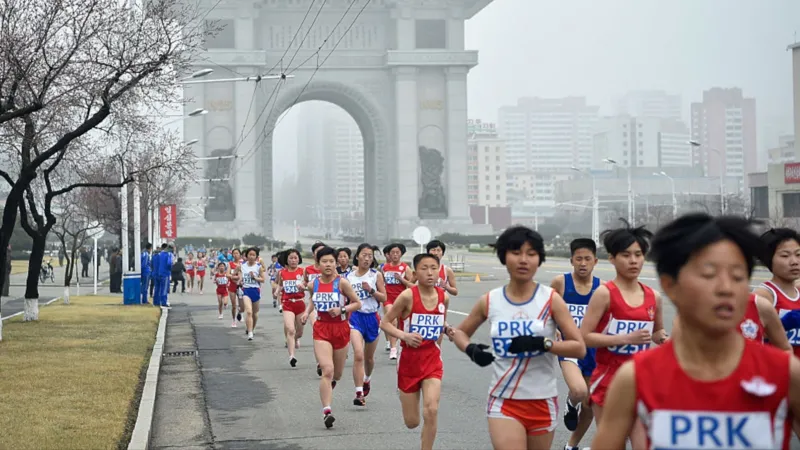
North Korea has cancelled the Pyongyang marathon for unspecified reasons, a tour agency linked to the event has said.
British-owned Koryo Tours, which describes itself as the official partner of the marathon, said on Monday that it had received notice of the cancellation from North Korea’s athletics association.
A message it attributed to the association said the marathon was being cancelled “due to some reasons”.
The annual event was established in 1981 to celebrate the birth of North Korea’s founding leader Kim Il Sung. The 2026 race was set to take place on 5 April.
The message, purportedly from the North Korea athletics association’s general secretary, thanked “all the Elite Marathoners and Amateur Runners of the world who are interested in Pyongyang International Marathon”.
The message gave no further explanation on what the reasons for the cancellation were.
Koryo Tours said it understood the decision was final and had been taken “at a level above the organisers of the event itself”.
It said it would be seeking clarification on the circumstances surrounding the decision.
The tour company added that neither organisers nor event partners were involved in making the decision, and said it recognised “this announcement will be disappointing to many runners who had already registered or were planning to participate”.
Koryo Tours, based in Beijing, China, offers several marathon packages to foreigners, departing from Beijing, Shanghai and Shenyang.
Packages start from €2,190 ($2,529; £1,894) for 2.5 nights in the North Korean capital, Pyongyang, including a marathon place and “highlights” of the capital and tickets were sold out this year, according to the agency’s website.
It said all deposits paid will be returned and runners have the option to retain their deposit for a future event or North Korea tour.
A date for the 2027 marathon has not yet been set.
The event had only returned last year after it was suspended for five consecutive years due to the Covid pandemic.
It is open to both amateur and some professional athletes and offers several race distances – 5km (3.1 miles), 10km (6.2 miles), half marathon (21.1km; 13.1 miles) or full marathon (42.2km; 26.2 miles).
[BBC]
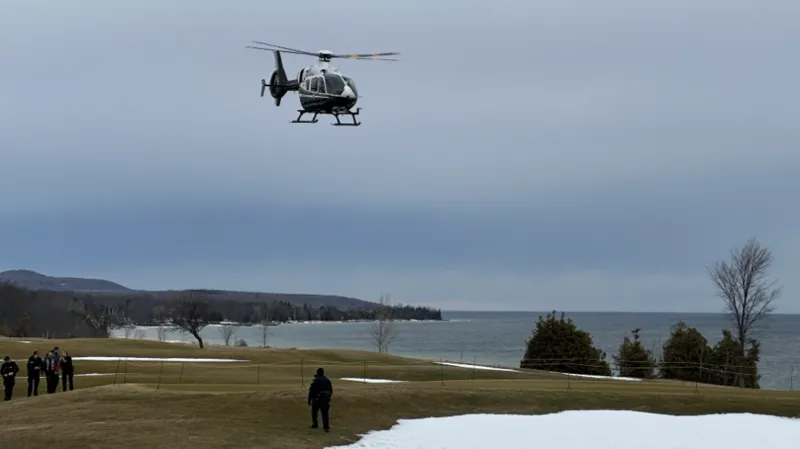
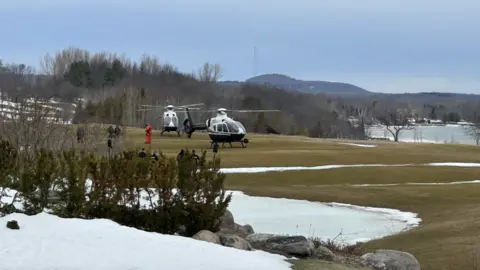
Twenty-three people have been rescued by helicopter crews in Ontario, Canada, after the ice shelf they were standing on broke, sending the group floating into Lake Huron.
Ontario Provincial Police said on social media that the rescue began around noon (16:00 GMT) on Sunday after “winds and current moved the ice shelf away from shore” approximately 2km (1.2 miles).
The rescue involved two helicopters making multiple trips to pluck people off the shelf as it continued to fracture into more pieces in the Owen Sound, about 200km north-west of Toronto.
One member of the group said that he only realised the ice he was fishing on had detached from shore when he noticed that his GPS showed him moving.
Members of the rescued group described harrowing moments, with several of them becoming partially submerged in the cold waters as they sought out the thickest ice on the floe, or sheet.
“I looked at my GPS. We were moving,” fisherman Kevin Fox wrote, identifying himself on Facebook as one of those who were caught up in the incident. “I turned around and saw waves forming behind us.”
He said that he and several others started running towards a route that they hoped still connected to shore.
“We decided to run toward one side of the bay, but when we got there the ice had already separated from shore. We turned and ran the other way, but the ice there was breaking apart too,” he wrote.
Some started phoning their families, said Fox, adding: “It’s something I will never forget – seeing grown men crying while saying goodbye to the people they love.”
Fellow fisherman Alfie How told The Owen Sound Sun Times that they eventually “just sat down as a group and said this could be the end”.
Fox told the paper that the rescue occurred during high wind, and the group was concerned that the helicopters would not be able to fly.
“It was being eroded,” Fox said. “It kept getting smaller, and smaller.”
Police say several members of the group suffered hypothermia, but that everyone was expected to make a full recovery.
“Great teamwork and a quick response by all involved,” police added.
Last month in the US state of Vermont, police rescued a group of ice skaters who had also become trapped on floating ice.
Using kayaks and ferry boats, rescuers brought the group back from the icy Lake Champlain.
Officials warn that ice fishing conditions can change rapidly during the relatively warm daylight hours.
[BBC]

At least 23 people have been killed in Nairobi after heavy rain overnight caused severe flooding in Kenya’s capital city.
Police said about 30 people had been rescued but many others drowned after being swept into rivers – some have been electrocuted.
Kenya’s military has been deployed to help people trapped inside their cars as police described widespread damage to properties as well as road closures.
Several flights bound for Nairobi Airport had to be cancelled or diverted to the coastal city of Mombasa.
“The torrential rains have led to significant flooding, unfortunately resulting in 23 fatalities so far, the destruction of property, road closures, and the displacement of residents,” police said in a statement on Saturday afternoon.
[BBC]

Heat Index at ‘Caution level’ at some places in the Western, Sabaragamuwa, Southern and North-western provinces and in Monaragala and Mannar districts

Showers or thundershowers will occur at several places in the Western and Sabaragamuwa provinces and in Galle, Matara, Kandy and Nuwara-Eliya districts after 2.00 pm.

Power sector reforms jolted by 40% pay hike demand

UN scientific research ship here amidst ban on such vessels

Prez assures energy supplies for the time being

Historic address by BASL President at the Supreme Court of India

‘Dates have the highest sugar content to fight Coronavirus’

Sunday Island 27 December – Headlines

#SundayIsland 17th December – Headlines

Sunday Island – 28th March

Sunday Island Headlines – 21 March

Sunday Island – 21st February – Headlines
-

 News6 days ago
University of Wolverhampton confirms Ranil was officially invited
-

 News5 days ago
Peradeniya Uni issues alert over leopards in its premises
-

 News6 days ago
Female lawyer given 12 years RI for preparing forged deeds for Borella land
-
 News3 days ago
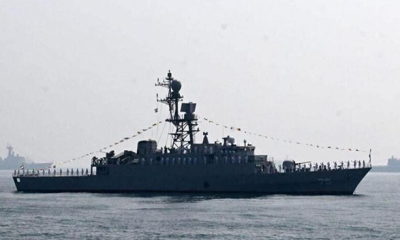
Repatriation of Iranian naval personnel Sri Lanka’s call: Washington
-
 News6 days ago
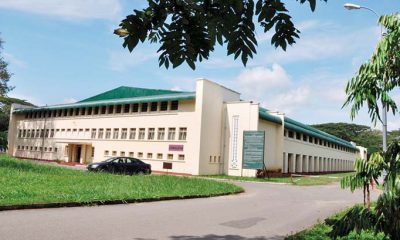
Library crisis hits Pera university
-

 News5 days ago
Wife raises alarm over Sallay’s detention under PTA
-

 News6 days ago
‘IRIS Dena was Indian Navy guest, hit without warning’, Iran warns US of bitter regret
-
 Latest News6 days ago
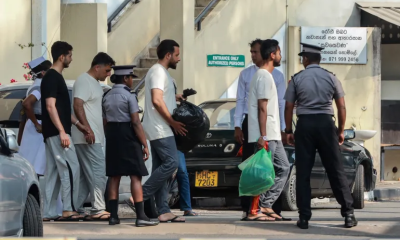
Sri Lanka evacuates crew of second Iranian vessel after US sunk IRIS Dena