
Foreign News
Beijing subway crash leaves 102 with broken bones


A rush hour collision between two subway trains in Beijing has left 102 people with broken bones, Chinese state media reported.
More than 500 people were sent to hospital after the incident, which occurred at about 19:00 local time (11:00 GMT) on Thursday. The trains collided during heavy snowfall while going downhill on the Changping subway line.
As of Friday morning, 423 people have been discharged from hospital.
While such accidents are not common on the Chinese capital’s transport network, snowstorms reportedly led to slippery tracks.
This then caused a ‘signal degradation’ which led the first train to brake suddenly, China Daily reported, citing Beijing transport authorities. The following train was unable to brake in time while coming down the icy tracks, causing it to slam into the rear of the first train.
The impact caused the last two carriages of one of the trains to detach. It is unclear which train was decoupled
Images and footage posted online show commuters crowded in carriages, left in the dark due to power cuts. A few were seen using emergency hammers to smash out windows for some fresh air.
In a clip posted on Chinese social media network Weibo, a woman who appears to have fainted is seen lying across several train seats.
Sixty-seven people remain in hospital for treatment, while 25 are “under observation”, reports said. There were no deaths.
The incident sparked furious comments from Chinese netizens. Some were shocked by the number of injuries, while others lamented the inconvenience caused by the collision.
“Does Beijing Subway have no maintenance staff? No routine inspection?… Are we taking the lives of hundreds of people too lightly,” wrote a Weibo user. Beijing Subway, owned by the municipal government, operates the 27 subway and rail lines that run through the city.
Beijing Subway apologised for the incident, adding that the company will cover the medical bills of those injured.
Given the current “extreme weather”, the operator has also instructed that trains traveling above ground be driven in manual mode and for intervals between trains to be widened. The section of the subway line affected by the incident – spanning three stations – was closed on Friday.
Road, rail and air transport have all been disrupted by snowfall in Beijing.
Temperatures are expected to plummet across northern China in the coming days. Meteorological authorities warned that temperatures will fall by 8C to 12C in most parts of the country from Thursday through Sunday. This means the temperature in Beijing could dip below -20C over the weekend.
In some cities, authorities have shut schools and suspended train services.
(BBC)











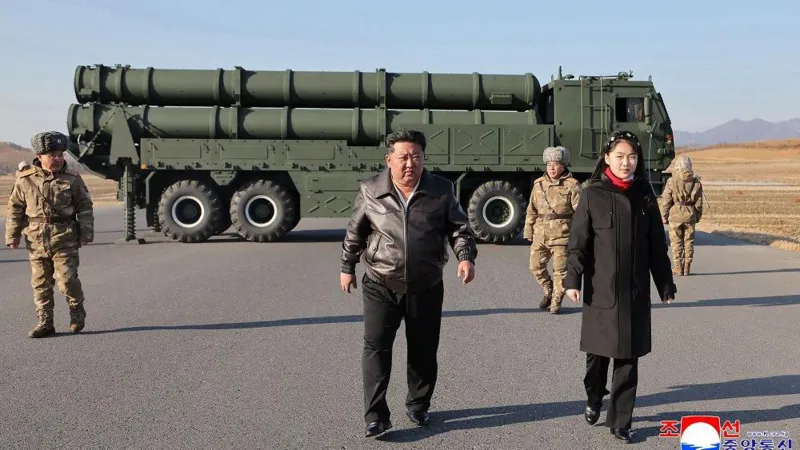
North Korean leader Kim Jong Un has selected his daughter as his heir, South Korea’s spy agency told lawmakers on Thursday.
Little is known about Kim Ju Ae, who in recent months has been pictured beside her father in high-profile events like a visit to Beijing in September- her first known trip abroad.
The National Intelligence Service (NIS) said it took a “range of circumstances” into account including her increasingly prominent public presence at official events” in making this assessment.
The NIS also said it would keep close tabs on whether she will attend the North’s party congress later this month – its largest political event that is held once every five years.
The party Congress is where Pyongyang is expected to give more details about priorities like foreign policy, war planning and nuclear ambitions for the next five years.
On Thursday lawmaker Lee Seong-kwen told reporters that Ju Ae, who was previously described by the NIS as being “trained” to be a successor, was now at the stage of “successor designation”.
“As Kim Ju Ae has shown her presence at various events, including the founding anniversary of the Korean People’s Army and her visit to the Kumsusan Palace of the Sun, and signs have been detected of her voicing her opinion on certain state policies, the NIS believes she has now entered the stage of being designated as successor,” Lee said.
Ju Ae is the only known child of Kim Jong Un and his wife, Ri Sol Ju. The NIS believes Kim Jong Un has an older son, but this son has never been acknowledged nor shown on North Korean media.
News of Ju Ae’s existence first emerged through an unlikely source: the American basketball player Dennis Rodman, who revealed to The Guardian newspaper back in 2013 that he “held baby Ju Ae” during a trip to the secretive state.
Ju Ae – who is believed to be 13 – made her first appearance on state television in 2022. She was shown inspecting North Korea’s latest intercontinental ballistic missile while holding her father’s hand.
She has since made frequent appearances on on state media, softening her father’s image of a ruthless dictator. She accompanied him to Beijing for China’s largest-ever military parade, where she was seen stepping off his armoured train at Beijing Railway Station.
She is often seen wearing her hair long, which is forbidden for her peers, and wearing designer clothes, which are out of reach for most in her country.
Another lawmaker, Park Sun-won said the role Ju Ae had taken on during public events indicated that she has started to provide policy input and is being treated as the de facto second-highest leader.
The North Korean power had passed down the three generations of the Kim family, and it is widely believed that Kim Jong Un will pass on the throne to Ju Ae.
In recent months, she was shown standing taller than her father, walking beside him, rather than following him.
In North Korea, where photos published by the state media are believed to carry a great symbolic weight, it is rare for individuals other than Kim Jong Un to be positioned equally prominently in the frame.
Although the South Korean spy agency now believes Ju Ae is the designated heir, it still raises questions.
It is puzzling why Ju Ae, a daughter, would be selected as the heir above an older son in North Korea’s deeply patriarchal society.
Many defectors and analysts had previously dismissed the idea of a woman leading North Korea as an unlikely scenario, referring to the country’s entrenched traditional gender roles. But Kim Jong Un’s sister – Kim Yo Jong – does offer a precedent for female authority in the regime.
Kim Yo Jong currently holds a senior position in the Central Committee of the Workers’ Party of Korea, and is reported to have influence over her brother.
However, it is also a mystery why Kim Jong Un, who is still young and appears relatively healthy, is already designating a 13-year-old child as his heir now.
It is unclear what changes Ju Ae’s succession may bring to North Korea.
Many North Koreans hoped that Kim Jong Un, a Western-educated young man, would open their country up to the outside when he succeeded his father.
Yet such hope was unfulfilled. Whatever plans this teenager may have for her country, she would likely have the singular power to shape it however she likes.
[BBC]
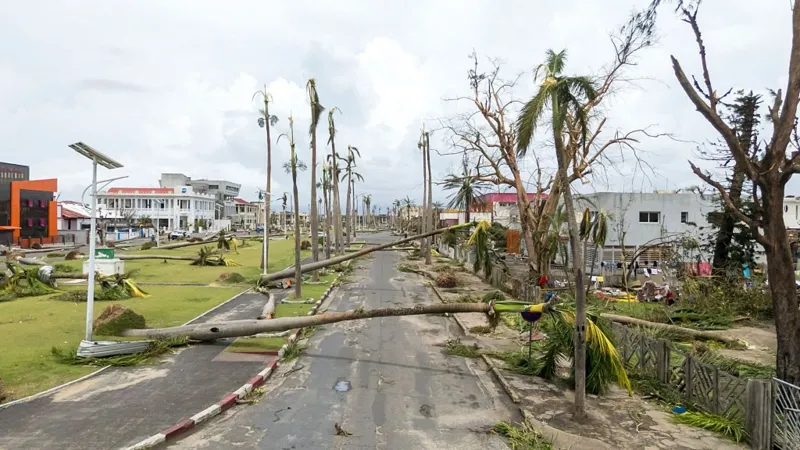
At least 31 people have died after a powerful cyclone struck Madagascar, says the disaster authority in the Indian Ocean island.
Cyclone Gezani made landfall on Tuesday, hitting the island’s main port, Toamasina. Madagascar’s disaster management office said there was “total chaos” – reporting that houses collapsed in the impact zone, where the bodies were found.
Neighbourhoods were plunged into darkness as power lines snapped, while trees were uprooted and roofs ripped off.
“What happened is a disaster, nearly 75% of the city of Toamasina was destroyed,” the country’s military leader Colonel Michael Randrianirina, who seized power in October, told the AFP news agency.
“The current situation exceeds Madagascar’s capabilities alone,” he added.
The cyclone’s landfall is likely to have been one of the most intense recorded around the city in the satellite era, according to the CMRS cyclone forecaster on France’s Reunion island, AFP reports.
The National Office for Risk and Disaster Management said many were killed when houses collapsed. Cyclone Gezani hit Toamasina – the country’s second-largest city – with winds reaching 250 km/hour (155 mph).
“It’s total chaos, 90% of house roofs have been blown off, entirely or in part,” the head of disaster management at the Action Against Hunger aid agency, Rija Randrianarisoa, told AFP.
Madagascar’s disaster management office has evacuated dozens of injured people and hundreds of residents from a district around Toamasina, home to 400,000 people.
Residents in and around Toamasina described scenes of chaos as the cyclone made landfall. “I have never experienced winds this violent… The doors and windows are made of metal, but they are being violently shaken,” Harimanga Ranaivo told the Reuters news agency.
Gezani is the second cyclone to hit Madagascar this year. It comes 10 days after tropical cyclone Fytia killed 14 and displaced over 31,000 people, according to the UN’s humanitarian office.
Ahead of the cyclone’s arrival, officials shuttered schools and rushed to prepare emergency shelters.
Madagascar’s meteorological service said on Wednesday morning that Gezani had weakened to a moderate tropical storm and had moved westward inland, about 100km (60 miles) north of the capital, Antananarivo.
“Gezani will cross the central highlands from east to west today, before moving out to sea into the Mozambique Channel this evening or tonight,” the service said.
Cyclone season in the Indian Ocean around Madagascar normally lasts from November to April and sees around a dozen storms each year, AFP reports.
[BBC]
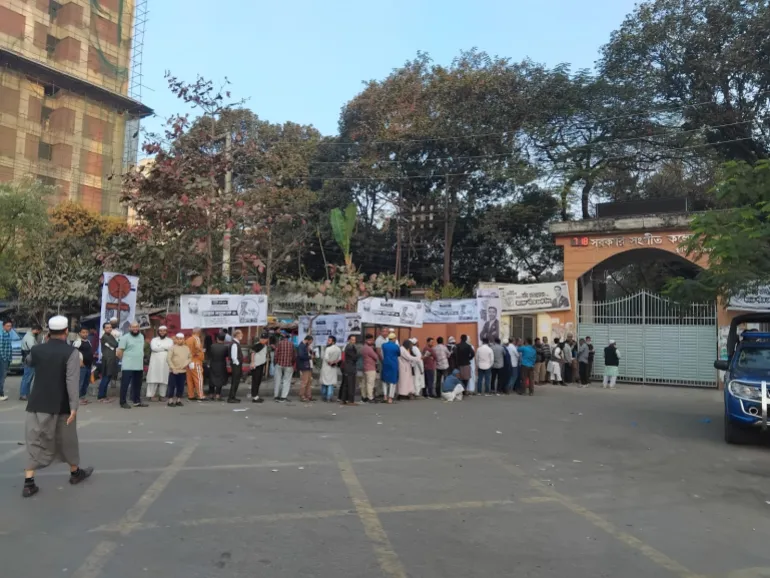
Nearly 127 million eligible voters are heading to the polls in Bangladesh, in a key test of the country’s return to democracy after a student-led uprising toppled longtime leader Sheikh Hasina in August 2024.
The vote is a direct contest between the Bangladesh Nationalist Party (BNP) and a Jamaat-e-Islami led coalition of 11 parties, which includes the National Citizens Party (NCP), formed by youth activists instrumental in ousting Hasina.
Corruption, inflation, employment and economic development are the main issues deciding the election in the world’s eighth most populous nation.
Besides the parliamentary election, the country is holding a referendum on the National Charter 2025 – a document drafted by the interim government led by Muhammad Yunus, setting the foundation for future governance.
[Aljazeera]

Prime Minister meets delegation from the European External Action Service

Moscas star as Italy dismantle Nepal for first World Cup win

Kim Jong Un chooses teen daughter as heir, says Seoul

Newly appointed ADB Country Director to Sri Lanka and delegation meet PM

School student transport services are being regulated

Shanaka and Rathnayake blow Oman away with frenetic half-centuries

‘Dates have the highest sugar content to fight Coronavirus’

Sunday Island 27 December – Headlines

#SundayIsland 17th December – Headlines

Sunday Island – 28th March

Sunday Island Headlines – 21 March

Sunday Island – 21st February – Headlines
-

 Features5 days ago
My experience in turning around the Merchant Bank of Sri Lanka (MBSL) – Episode 3
-

 Business6 days ago
Zone24x7 enters 2026 with strong momentum, reinforcing its role as an enterprise AI and automation partner
-

 Business5 days ago
Remotely conducted Business Forum in Paris attracts reputed French companies
-

 Business5 days ago
Four runs, a thousand dreams: How a small-town school bowled its way into the record books
-

 Business5 days ago
ComBank and Hayleys Mobility redefine sustainable mobility with flexible leasing solutions
-

 Business2 days ago
Autodoc 360 relocates to reinforce commitment to premium auto care
-

 Business6 days ago
HNB recognized among Top 10 Best Employers of 2025 at the EFC National Best Employer Awards
-

 Midweek Review2 days ago
A question of national pride