
Sports
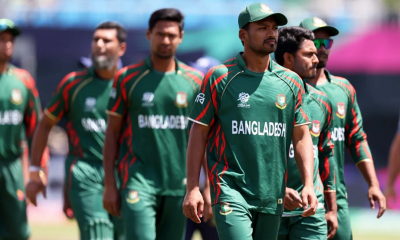
Bangladesh prepare for the ‘unknown’ ahead of T20 WC

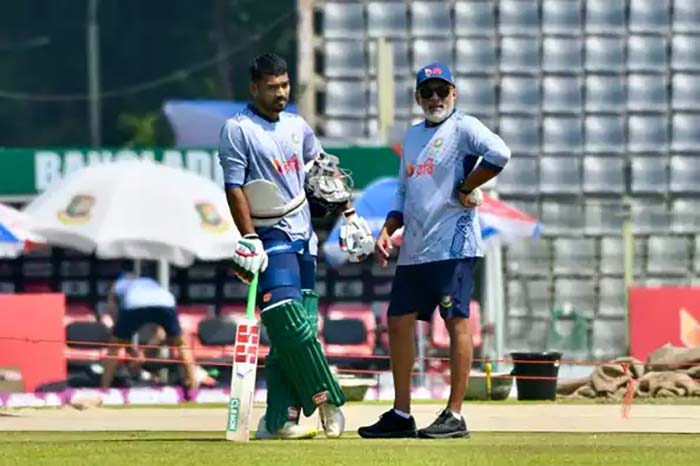
Bangladesh head coach Chandika Hathurusingha said on Friday that they are trying to prepare as well as they can for the forthcoming T20 World Cup as there are lot of unknown factors. The decision to put some more grass on the surface in the Sylhet International Cricket Stadium for the three-match T20I series against Sri Lanka was largely due to the unpredictability factor especially in the United States.
Bangladesh are scheduled to take on Sri Lanka in Dallas on June 7 and South Africa on June 10 while the next two games of the group phase will be played in West Indies.
“What we are looking at is the combination for World Cup, how the individuals fit in and understanding the game plan and be comfortable. The other thing I mentioned is that we want to play on good wickets because we don’t know what we get in America and we play two very important games in America and nobody has any clue because there is not much data behind it,” Hathurusingha told reporters ahead of the series deciding third game at the SICS on Friday.
“What I understand is that New York has a drop-in wicket prepared on Adelaide and they are going to drop in there hopefully expectation is something similar to what Australian pitches are. There’s little feedback from NSW Cricket about Dallas. Washington Freedom played there. I spoke to their GM when I was in Australia. Our recollection from St Vincent is the last Test we played there,” he said.
“So we are preparing as well as we can for these unknown factors,” he said adding that playing in good wickets is also helping their bowling unit shift their mindset considering they are now learning to bowl with a different approach.
“One thing we realized is that we are playing in different kind of pitches now and in this series there is more grass and more carry and we want to play on wickets that are conducive to high scoring to get us understand what is acceptable and what areas we need to improve in bowling because it’s a mindset shift as well because when you are bowling on certain wickets 150 as a winning score. You expect to bowl in a certain way and if you bowl in these sort of pitches you are going at eight runs an over it is very good. 160 you saw the other day was not a par score and even 200 after losing four wickets in power play we nearly got there and we really need to understand those factors as well so I am pretty pleased with the way our bowling unit is shaping up,” he said.
Ahead of the final T20I, Hathurusingha said that he is pleased with the way his charges came back after the defeat in the opening game. “You are talking about the last game I thought we almost played a perfect game. Pleasing thing for me is how we quickly learnt from the first game,” he said.
He also added that both Soumya Sarkar and Litton Das admitted that they have made mistakes in the opening game but came back strongly in the following game with a 63-run stand. “Both of them put their hands up after the first game that their approach was wrong and they will work on it and played good cricket. I am old enough to understand that people make mistakes. Look at the start we got, 63 in Powerplay. T20 is amazing. As long as they are playing for the team and contributing for the team, that’s what we want.”
Chandika pointed out that he is impressed with Jaker Ali and Mahmudullah while Shoriful Islam is also becoming a leading bowler for them with each passing game. “Mahmudullah brings a lot of experience. He played the BPL with a lot of maturity. He is playing with a lot of freedom which I said in a previous interview. When I saw him in the World Cup, he is so much at-ease with his game and himself. He is playing beautifully now.
“It is very refreshing to see what Jaker can do. I only saw him in this BPL. He is very calm which is really nice to see. It is one quality you need from someone who bats at No 5, 6 or 7. Most of the times you have to do certain things with limited time. It was really pleasing to see what he can do. It gave us a lot of confidence as a team.
“We know that Shoriful had a very good BPL and I think he came up with the same confidence to bowl in these matches as well. What happened was in the first game due to dew, the ball didn’t swing as it did in the BPL and he had to adjust very quickly for the second game so that was very pleasing to see the way he bowled in the second game. Every game he is growing into a leading bowler for us with Taskin and Fizz there is another one we can bank on.”
(Cricbuzz)







Not many are giving Sri Lanka a fighting chance in this World Cup after being handed a 3-0 whitewash by England on the eve of the tournament. Yet, with a core that has been together for five years and the comfort of home conditions under their spikes, they will quietly fancy sneaking into the second round at the very least. The campaign gets underway on Sunday when they lock horns with Ireland at the RPS.
After the opener, the former champions shift base to Kandy where Oman await on February 12, followed by the heavyweight bout against Australia. They then return to Colombo to face Zimbabwe in the final group fixture. Apart from the Aussies, the other three sides sit below Sri Lanka in the rankings, reason enough for the hosts to believe they can punch above their recent weight.
Ideally, the team would have liked to go in with a settled deck. The chopping and changing of selectors and captain has hardly gone down well with the public, although Charith Asalanka’s excesses left the authorities with something of a Hobson’s choice. Whether they should have held their nerve until the World Cup was done and dusted instead of twisting the knife remains a question that refuses to go away.
Dasun Shanaka, the man recalled to replace Asalanka, has been around this block before and rarely set the field alight as leader. What he brings to the table is well known, as are his frailties with the bat, particularly against wrist spin. Should he fail to strike form, the selectors may be forced into a 2014-style déjà vu, leaving the captain cooling his heels outside the playing XI. The trouble is, there is no obvious skipper in waiting to take the reins if that storm breaks.
The panel has also copped flak for plucking Dhananjaya de Silva out of thin air. It is widely believed his recall came at the behest of a fast-bowling guru who has now begun offering batting sermons as well. That is precisely why a selection committee needs a spine of its own, rather than dancing to every passing tune.
Sri Lanka had been making steady, if unspectacular, strides in white ball cricket without exactly setting the stage ablaze. Their blueprint was clear, big runs from Pathum Nissanka at the top, Matheesha Pathirana creating mayhem with his slingy darts and a spin attack marshalled by Wanindu Hasaranga. With that backbone, a few rubs of the green might have made them serious dark horses. Instead, they pressed the panic button with the World Cup on the doorstep and now appear a touch disjointed and disoriented.
What tilts the scales in their favour is a gentle runway – fixtures against Ireland and Oman before they enter the sharp end against Australia. For now, the fans seem to have voted with their feet, but one statement win over the Aussies could have them flocking back in droves. After all, it’s a funny old game.
by Rex Clementine


Ten years on from their improbable run to the World T20 final in Kolkata, England return to India with quiet expectation. While controversy swirls around their captain, Harry Brook, and what he did and did not get up to outside a nightclub on Halloween, the team that he oversees has found some stillness in the eye of the storm. With 10 wins in their last 11 completed T20Is, they are as ready as they can be for the challenge that lies ahead.
So too, for that matter, are their opening-night opponents. Eighteen months ago in St Vincent, Nepal came within a whisker of a stunning upset against the eventual World Cup finalists, South Africa. They return to the T20 World Cup stage with a battle-hardened unit, forewarned of the pressures but with proof of their worthiness, and with two successful seasons of the Nepal Premier League under their belts to rehearse those big-match moments.
Like England, they arrive on an impressive run of recent form, albeit six wins out of six against the likes of Kuwait, Japan and Qatar in September’s qualifying tournament isn’t exactly apples and pears. Nevertheless, they are here on merit, and very much on the rise, with a young, established captain in Rohit Paudel, and an attacking array of bowlers including the nippy Karan KC. A maiden international against England will be a proud moment in their development, but there’s no reason to believe they should be daunted.
England have endured enough Associate hiccups down the years to take nothing for granted. But their confidence for this campaign won’t simply be derived from their run of recent form. Their range of contributors has arguably been the most heartening aspect, with their spinners finding form and impact throughout the Sri Lanka series, including the back-up offerings of Will Jacks and Jacob Bethell, while their batting has shown depth, power and versatility ever since the summer, when – against South Africa at Old Trafford – they recorded the first 300-plus total in a Full Members’ T20I.
Brook would love to be able to parade England’s T20I form as proof of their progress since he took over as white-ball captain. Unfortunately, those issues of team culture will not go away in what he admits has been a ‘horrendous’ few weeks for him, which means this is perhaps not the ideal moment for his overdue return to India. Unusually for a modern-day superstar, Brook is a relative stranger in these parts. He missed England’s last tour on compassionate grounds, and is currently serving a two-year ban from the IPL for reneging on his deal with Delhi Capitals. His solitary season, for Sunrisers Hyderabad, consisted of 90 runs in ten innings … and a startling 55-ball hundred against KKR, after which he missed his chance to endear himself to the locals by hitting out instead at his critics. He’ll doubtless have similar urges in the coming weeks, if he gets half a chance. It promises to be eventful, one way or another.
Sandeep Lamichhane has endured his own off-field controversies, of a significantly more serious variety. In November 2023 he was convicted of rape and jailed for eight years, but his sentence was overturned on appeal the following May, just in time for his recall for Nepal’s 2024 T20 World Cup campaign (though he was unable to secure a visa for the US and so missed their opening two games). He was already their best-known player, thanks to a cunning repertoire of legbreaks and googlies that have earned him nearly 250 T20 career wickets at little more than a run a ball. For all England’s strengths, spin remains their glaring weakness, and he’s a seasoned campaigner who will know how to exploit it.
True to form, England named their XI on the eve of the match. Phil Salt is fit again after a back spasm in Pallekele, and will open once again alongside Jos Buttler. Tom Banton keeps his place at No.4, ahead of Ben Duckett, while left-arm seamer Luke Wood gets an early outing ahead of Jamie Overton.
England: Phil Salt, Jos Buttler (wk), Jacob Bethell, Tom Banton, Harry Brook (capt), Sam Curran, Will Jacks, Liam Dawson, Jofra Archer, Adil Rashid, Luke Wood.
Nepal warmed up for this contest with two emphatic wins over UAE and Canada, with Aasif Sheikh impressing with a hard-hitting fifty from the top of the order in the latter contest.
Nepal (probable): Aasif Sheikh (wk), Kushal Bhurtel, Rohit Paudel (capt), Dipendra Airee, Aarif Sheikh, Gulsan Jha, Karan KC, Sompal Kami, Sandeep Lamichhane, Lalit Rajbanshi/Nandan Yadav, Sher Malla
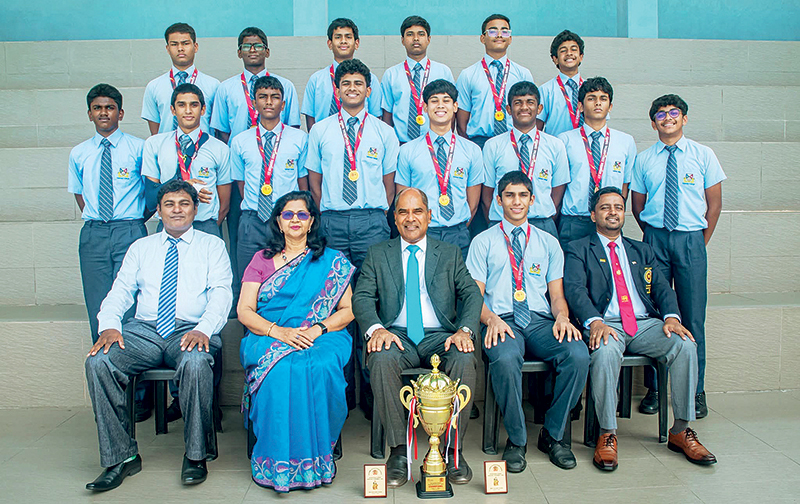
Gateway College once again stamped their dominance on the schools basketball arena by emerging Champions at the International Schools Under-17 basketball tournament organised by Colombo International School. In a remarkable achievement, this victory marks the fifth consecutive time that Gateway College lads have clinched this prestigious trophy.
Gateway delivered a flawless campaign, displaying tactical maturity, defensive resilience and attacking flair from the group stages right through to the final.
In the group matches, Gateway set the tone early with emphatic victories: A dominant 65–27win against Gateway College, Kandy and a convincing 62–24 triumph over British School in Colombo (BSC).
Carrying this momentum into the knockout stages, Gateway continued their relentless form. In the quarter-finals, they outplayed Horizon College International with a solid 50–25victory, followed by an impressive 75–40 win against Elizabeth Moir School (EMS) in the semi-finals.
The high-intensity final, played at the Olympus Indoor Stadium, Malabe, saw Gateway College Colombo face hosts Colombo International School (CISC). Gateway won 79-64.
Dulain Theverapperuma, of Gateway was named Best Defensive Player while Navidu Waduwavala, was declared Most Valuable Player.

Health authorities on high alert over Nipah Virus threat

Free Media Movement demands govt. accountability on free speech issues

Opposition alleges Govt deliberately delaying PC polls

After stormy build up, Sri Lanka look for calm waters

Rebuilding Sri Lanka: 78 Years of Independence and 78 Modules of Reform

Our diplomatic missions success in bringing Ditwah relief while crocodiles gather in Colombo hotels

‘Dates have the highest sugar content to fight Coronavirus’

Sunday Island 27 December – Headlines

#SundayIsland 17th December – Headlines

Sunday Island – 28th March

Sunday Island Headlines – 21 March

Sunday Island – 21st February – Headlines
-

 Business1 day ago
Zone24x7 enters 2026 with strong momentum, reinforcing its role as an enterprise AI and automation partner
-

 Business5 days ago
SLIM-Kantar People’s Awards 2026 to recognise Sri Lanka’s most trusted brands and personalities
-

 Business6 days ago
All set for Global Synergy Awards 2026 at Waters Edge
-
 Business1 day ago
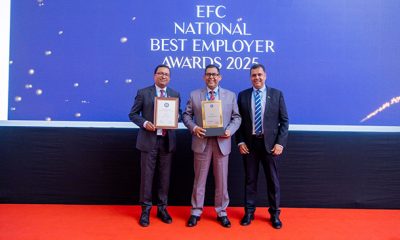
HNB recognized among Top 10 Best Employers of 2025 at the EFC National Best Employer Awards
-

 Business5 days ago
API-first card issuing and processing platform for Pan Asia Bank
-

 Editorial3 days ago
All’s not well that ends well?
-

 Business1 day ago
GREAT 2025–2030: Sri Lanka’s Green ambition meets a grid reality check
-

 Features3 days ago
Phew! The heat …