
News
AUKUS threat to countries like Sri Lanka, says China’s Ambassador


AUKUS, a trilateral security pact among Australia, the United Kingdom and the United States, would create a security risk for Sri Lanka and others in the region, Qi Zhenhong, Chinese Ambassador to Sri Lanka said in a statement.
He added that this move was a violation of the Non-Proliferation of Nuclear Weapons Treaty (NPT) which many countries entered into in the 1970s.
Zhenhong said that Australia’s construction of nuclear submarines violated the commitments it made when signing the South Pacific Nuclear Free Zone Treaty, and also will cause serious breaches in the efforts of ASEAN countries to build a nuclear weapon-free zone and the Indian Ocean to create a “Zone of Peace”. In addition, AUKUS attempts to engage in maritime hegemony, might lead to a new round of regional arms race, thus undermining the precious peace situation in the region and casting a shadow over the security, stability and prosperity in the region
“Nuclear submarines frequently entering the Indian Ocean will escalate the nuclear arms race or some hegemonies ganging up in clique and forcing small and medium-sized countries to take sides, will inevitably bring huge security risks to Sri Lanka. Therefore, the international community, especially regional countries, should pay serious attention to and resolutely oppose this bad behaviour, which seriously undermines regional peace and stability, accelerate the arms race, and undermines international nuclear non-proliferation efforts. We should bring the hanging Sword of Damocles back into its sheath, and jointly safeguard international peace, security and stability,” he said.
Given below are excerpts of his statement: “Recently, the United States, Britain and Australia announced the establishment of AUKUS, a trilateral security pact which will provide Australia with at least eight nuclear-powered submarines. This is like holding up a “Sword of Damocles” on the heads of countries in the Pacific-Indian Ocean regional countries, which has aroused widespread doubts and deep concerns from the international community, and a great threat of nuclear proliferation, arms race and more unstable regional and international security situation.
“Firstly, the move is a serious violation of the spirit of the Treaty on the Non-Proliferation of Nuclear Weapons (NPT) which brings great risks of nuclear proliferation. The NPT which entered into effect in 1970 is regarded as the cornerstone of the global nuclear non-proliferation regime by the international community. However, the Treaty lacks clear provisions regarding the transfer of nuclear reactors for submarines, and the safeguards system of the International Atomic Energy Agency (IAEA) is unable to verify whether the relevant materials are used to develop nuclear weapons. The United States, Britain, and Australia had exploited these weaknesses. In addition, the American and British nuclear submarines use weapons-grade highly enriched uranium with an abundance of over 90%. Exporting nuclear submarines to Australia means that a large number of highly sensitive nuclear materials and technologies are transferred without the effective safeguard of IAEA, which will inevitably bring the risk of proliferation of nuclear technologies and nuclear materials. On September 17th, the Indonesian government issued a statement stressed the importance of Australia’s commitment to continue meeting all of its nuclear non-proliferation obligations, and called on Australia to maintain its commitment towards regional peace, stability and security.
“Secondly, this move may induce a new round of arms race, which will undermine regional prosperity and stability. As a country straddling the Indian Ocean and the Pacific Ocean, Australia’s construction of nuclear submarines in defiance of the world completely violates the commitments it made when signing the South Pacific Nuclear Free Zone Treaty, and also will cause serious breaches in the efforts of ASEAN countries to build nuclear weapon-free zone and the Indian Ocean to create a “Zone of Peace”. In addition, AUKUS attempts to engage in maritime hegemony, which may introduce a new round of regional arms race, thus undermining the precious peace situation in the region and casting a shadow over the security, stability and prosperity in the region. Russian President Vladimir Putin said the AUKUS, a security partnership between Australia, Britain and the United States, “undoubtedly” undermines regional stability. Indonesian Foreign Minister Retno Marsudi said that Indonesia does not want an escalating arms race and power projection in the region that will threaten security and stability. Meanwhile, Malaysian Prime Minister Datuk Seri Ismail Sabri Yaakob expressed Malaysia’s stance on AUKUS when he received a telephone call from Australian Prime Minister Scott Morrison, saying it would be a “catalyst for a nuclear arms race in the Indo-Pacific region. As a country within ASEAN, Malaysia holds the principle of maintaining ASEAN as a Zone of Peace, Freedom and Neutrality, and urges all parties to avoid any provocation and arms competition in the region.”
“Thirdly, this move promotes a barefaced “double-standard” and forms racist “small clique”. The United States and Britain launched the notorious Iraq War on the unwarranted charge of suspecting the development of weapons of mass destruction, and do not allow Iran and North Korea to possess nuclear weapons, but turn a blind eye to the development of nuclear weapons by their ally Israel and provide nuclear submarines to another ally Australia. Under the barefaced “double-standard”, they piece together the “Anglo-Saxon” military cooperation clique with racism and cold war color, and wantonly played and trampled on international rules. According to the Atlantic Monthly, AUKUS is in effect a new “Anglo” military alliance. “The three nations have fought together for most of the past 100 years and are core members of the Five Eyes intelligence-sharing alliance. The announcement (of AUKUS) only reinforces its belief in the difference between Europe and the Anglo-Saxon world.”
“China believes that nuclear weapons, the Sword of Damocles hanging over mankind, should be completely prohibited and thoroughly destroyed over time to make the world free of nuclear weapons. China has always maintained its nuclear power at the lowest level required by national security, and has always made every effort to maintain the international non-proliferation system and actively promoted the multilateral arms control process. The establishment of a small security clique by the United States, Britain and Australia, frantically probing at the edge of nuclear proliferation, opening the Pandora’s Box of the arms race, and undermining peace and stability in the Pacific and Indian Ocean regions, is a reversal of history trend, which has already been widely questioned and condemned by the international community including its own country and neighboring countries.
“Recently, an American nuclear submarine crashed in the South China Sea and went unreported, a hit and run accident sending out a very realistic warning. Although no nuclear leakage caused by this accident has been confirmed yet, its nature is very serious, and there are great hidden dangers in nuclear proliferation and nuclear safety, which will lead to a nuclear disaster if it is not done well. Sri Lanka is located at the center of Indian Ocean. No matter, its nuclear submarines frequently entering the Indian Ocean, the nuclear arms race escalating, or some hegemonies ganging up in clique and forcing small and medium-sized countries to take sides, it will inevitably bring huge security risks to Sri Lanka. Therefore, the international community, especially regional countries, should pay serious attention to and resolutely oppose this bad behavior, which seriously undermines regional peace and stability, accelerate the arms race, and undermines international nuclear non-proliferation efforts. We should bring the hanging Sword of Damocles back into its sheath, and jointly safeguard international peace, security and stability.”

Latest News
Heat Index at Caution level’ in the Northern, North-central, North-western, Western and Southern provinces and in Trincomalee district.


Warm Weather Advisory
Issued by the Natural Hazards Early Warning Centre
Issued at 3.30 p.m. on 12 April 2026, valid for 13 April 2026.
Heat index, the temperature felt on human body is likely to increase up to ‘Caution level’ at some places in the Northern, North-central, North-western, Western and Southern provinces and in Trincomalee district.
The Heat Index Forecast is calculated by using relative humidity and maximum temperature and this is the condition that is felt on your body. This is not the forecast of maximum temperature. It is generated by the Department of Meteorology for the next day period and prepared by using global numerical weather prediction model data.

Effect of the heat index on human body is mentioned in the above table and it is prepared on the advice of the Ministry of Health and Indigenous Medical Services.
ACTION REQUIRED
Job sites: Stay hydrated and takes breaks in the shade as often as possible.
Indoors: Check up on the elderly and the sick.
Vehicles: Never leave children unattended.
Outdoors: Limit strenuous outdoor activities, find shade and stay hydrated.
Dress: Wear lightweight and white or light-colored clothing.
Note:
In addition, please refer to advisories issued by the Disaster Preparedness & Response Division, Ministry of Health in this regard as well. For further clarifications please contact 011-7446491.

On the apparent northward relative motion of the sun, it is going to be directly over the latitudes of Sri Lanka from 05th to 15th of April in this year.
The nearest areas of Sri Lanka over which the sun is overhead today (13th) are Pesalai, Mankulam and Nedunkerny about 12:11 noon.
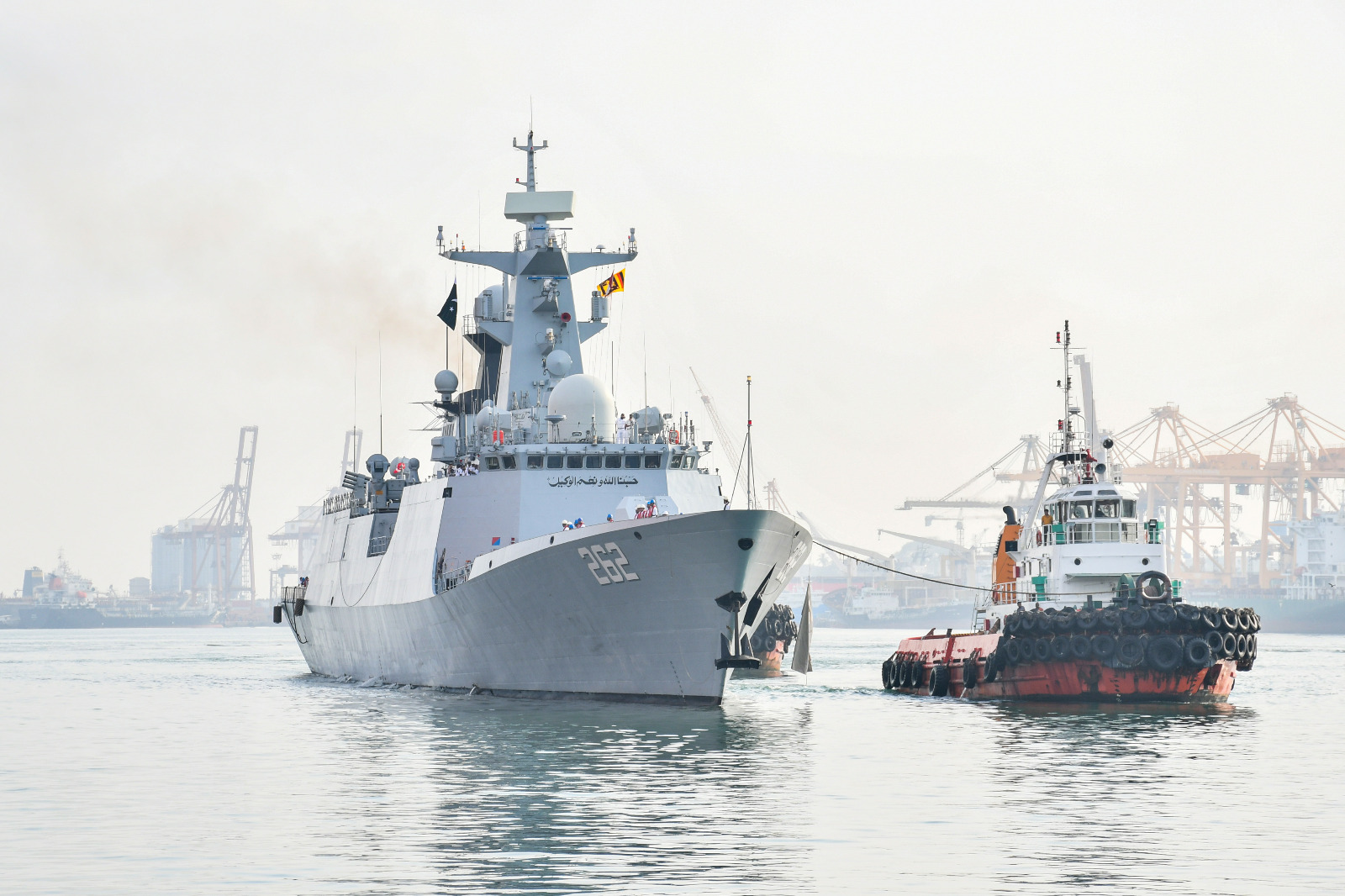
The Pakistan Navy Ship (PNS) TAIMUR and ASLAT arrived at the Port of Colombo on a goodwill visit on 12 Apr 26.
The visiting ships were welcomed by the Sri Lanka Navy in
compliance with naval traditions.
The duo of ships is commanded by Captain NIAMAT SAEED KHAN (PNS TAIMUR) and Captain NADIR MATEEN AFRIDI (PNS ASLAT).
Meanwhile, the ships are expected to conduct a Bilateral Naval Exercise LION STAR V with the Sri Lanka Navy in Colombo seas.

Salt and Patidar power RCB past Mumbai Indians

Prasidh, Buttler set up comfortable win for Gujarat Titans

Heat Index at Caution level’ in the Northern, North-central, North-western, Western and Southern provinces and in Trincomalee district.

Showers above 75 mm are likely at some places in the Western, Sabaragamuwa, Central, Southern and North-western provinces.

Sun directly overhead Pesalai, Mankulam and Nedunkerny about 12:11 noon

PNS TAIMUR & ASLAT arrive in Colombo

‘Dates have the highest sugar content to fight Coronavirus’

Sunday Island 27 December – Headlines

#SundayIsland 17th December – Headlines

Sunday Island – 28th March

Sunday Island Headlines – 21 March

Sunday Island – 21st February – Headlines
-

 News6 days ago
Lankan-origin actress Subashini found dead in India
-

 News4 days ago
AG: Coal procurement full of irregularities
-

 News1 day ago
CEB orders temporary shutdown of large rooftop solar systems
-

 Business3 days ago
Israeli attack on Lebanon triggers local stock market volatility
-

 Business4 days ago
Hayleys Mobility introduces Premium OMODA C9 PHEV
-

 Business3 days ago
HNB Assurance marks 25 years with strategic transformation to ‘HNB Life’
-

 News6 days ago
UN Regional Director launches SL’s first Country Gender Equality Profile during official visit
-

 News6 days ago
Dialog Launches ‘GanuDenu QR’, Making Cashless Transfers Free for All with eZ Cash and Dialog Finance