

News
Assistance welcome, but no one can negotiate with Israel on our behalf – Palestine

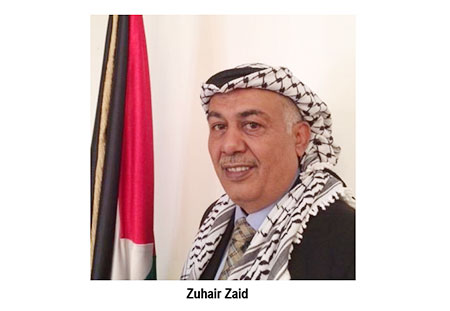
The Palestinian Ambassador to Sri Lanka, Dr.Zuhair Zaid referring to the UAE’s decision to normalise relations with Israel, said yesterday ” We haven’t given anyone a mandate to negotiate or to speak or to take any responsibility on our behalf. We are mature enough to handle our affairs. As usual, our brothers – Arabs and Muslims can help and support us, but not to handle our future, because no one knows the Israeli’s brutal occupation better than us . We are suffering due to Israelis crimes on a daily basis.”
The Ambassador said that Israeli leaders especially Netanyahu and the Americans saying that Israel’s annexation of Palestinian lands was still on the table, was a means of postponing a permanent resolution to the crisis. “Last month Israel demolished 30 houses in Jerusalem alone, That is one family home on a daily basis.”
What the UAE has done, was a harsh betrayal of Jerusalem and the holy places there, especially Al Aqsa Mosque. It has been enlisted to help corrupt leaders in the US and Israel in the coming elections, he added.




The Sri Lanka Coast Guard launched an operation to clear the oil spill caused by the crash of a Sri Lanka Air Force Bell 212 helicopter into the Maduru Oya Reservoir, during a training flight on 09 May 2025.
The efforts to clear the oil spill are ongoing and will continue today, 10 May.


Bell 212 accident during passing out parade kills six military personnel, injures six others
A Bell 212 helicopter, belonging to the Sri Lanka Air Force (SLAF), crashed into the Maduru Oya reservoir yesterday morning, killing six forces personnel and injuring six others. The helicopter was on a routine mission in support of a Special Forces passing-out parade when it encountered technical difficulties and attempted an emergency landing.
The crash occurred at approximately 8:17 a.m., after the helicopter took off from the SLAF Base Hingurakgoda, at 6:47 a.m., and picked up Army personnel in Maduru Oya around 7:08 a.m. According to the SLAF, the aircraft was conducting a heli-rappelling drill as part of a military demonstration when it suffered a technical malfunction shortly after takeoff.
The aircraft was carrying 12 individuals—six from the Army and six from the Air Force, including two pilots. Initial rescue efforts led to all passengers being retrieved alive and transported to the Aralaganwila Regional Hospital, with eight later transferred to the Polonnaruwa General Hospital due to the severity of their injuries.
Despite emergency medical care, six of the personnel succumbed to their injuries—four Army Special Forces soldiers and two Air Force members. Among the deceased were helicopter gunmen and elite Special Forces troops.
In the wake of the tragedy, both the Army and Air Force have launched separate investigations to determine the cause of the crash. Air Force Commander Air Marshal Bandu Edirisinghe has appointed a nine-member inquiry committee, while Army Commander Lieutenant General Lasantha Rodrigo confirmed that expert teams have been dispatched to the crash site to gather evidence.
Air Force spokesperson Group Captain Eranda Geeganage said the crash occurred during a drill demonstration at the training school and that the exact cause of the accident remains unknown at this time.The remaining six injured personnel are still receiving treatment, with their conditions being closely monitored.
By Norman Palihawadane

Nearly half a century has passed since the Catholic Church last had an Italian Pope. In the hallowed corridors of the Vatican, as the Conclave began deliberations to elect a successor to Pope Francis, several Italian names were whispered with increasing frequency. Chief among them was Cardinal Pietro Parolin, the Vatican’s Secretary of State, a seasoned diplomat, and well-known among the electors. Others, like Cardinals Pierbattista Pizzaballa and Matteo Zuppi, also had their share of admirers.
Yet, when the white smoke rose above the Sistine Chapel, it was not an Italian who emerged. Instead, the Cardinals turned to an unheralded American – Robert Francis Prevost, a canon law professor and lifelong missionary – electing him as successor to St. Peter. He has taken the name Pope Leo XIV.
Though born in the United States, Pope Leo’s spiritual and pastoral heart lies in Peru, where he spent much of his life in missionary service. His elevation comes as a surprise to many as he had been made a Cardinal just two years earlier, appointed by Pope Francis himself. A relative newcomer in the College of Cardinals, he was seen by many as a wildcard – yet perhaps that’s exactly what the Church needed.
At 69, Pope Leo is poised for what could be a lengthy pontificate – time enough, perhaps, to carry forward the reforms initiated by his predecessor. It’s no secret that Pope Francis saw in him a leader fit for the challenges of global Catholicism. When Prevost returned from Peru to head the Augustinian Order – a role he held for 12 years – it was Francis who sent him back across continents, appointing him Bishop of Chiclayo and entrusting him with pastoral care once more in Peru.
Those close to the new Pontiff describe him as deeply spiritual, a steady hand, and a bridge-builder, qualities sorely needed in a Church increasingly split between traditionalists and reformists. He is expected to offer a more measured, balanced approach on key issues, fostering dialogue rather than division.
In many ways, this Conclave echoed the dramatic scenes of October 1978, when an unknown outsider from Poland – Karol Wojtyla – was chosen as Pope John Paul II. Like then, the Cardinals have once again looked beyond the obvious front-runners. But, unlike 1978, when it took eight ballots to break the deadlock and settle on a compromise, this time it took just four.
That speed speaks volumes. The Cardinals were not merely settling – they were convinced that here’s the man to take the Church forward. In Cardinal Prevost, they found a shepherd capable of steering the Church through a time of transition, someone who could temper Franciscan reform with pastoral wisdom and unite a divided flock under the banner of faith and humility.
By Rex Clementine



-

 Opinion7 days ago
Remembering Dr. Samuel Mathew: A Heart that Healed Countless Lives
-

 Business5 days ago
Aitken Spence Travels continues its leadership as the only Travelife-Certified DMC in Sri Lanka
-

 Latest News4 days ago
NPP win Maharagama Urban Council
-
 Business5 days ago
LinearSix and InsureMO® expand partnership
-

 Business3 days ago
John Keells Properties and MullenLowe unveil “Minutes Away”
-

 Features7 days ago
Trump’s economic missiles are boomeranging
-

 Latest News7 days ago
The Heat index is likely to increase up to ‘Caution level’ at some places in Eastern, Northern, North-central and North-western provinces and in Monaragala and Hambantota districts.
-

 Business4 days ago
NDB Bank partners with Bishop’s College to launch NDB Pixel awareness