
News
Artificial reefs: Sri Lanka minister dismisses Indian concerns, says ban bottom trawling first


ECONOMYNEXT – Dismissing objections raised by Indian fisherman against Sri Lanka’s artificial reef project, State Minister of Fisheries Kanchana Wijesekara said India must ban the destructive practice of bottom trawling instead.
Fisherfolk in Tamil Nadu have objected to a Sri Lankan initiative to submerge discarded buses in the island’s northern waters in an effort to create an artificial reef. Twenty such buses were submerged near the Delft Island off Jaffna on June 11. The New Indian Express reported July 16 that experts in India have called the move irresponsible while fishing communities have expressed fears that the buses would drift underwater into India’s territorial waters affecting their fishing industry.
Defending the project, State Minister Wijesekara said it was the result of years of study.
“It is not irresponsible project but one that is globally proven and practiced. We don’t accept their claims or the statements they are making,” he said.
According to Wijesakara, this is the fourth phase of a project initiated about six months ago by the Department of Fisheries and Aquatic Resources to cultivate artificial reefs around Sri Lanka.
The first phase was in Trincomalee, while the second and third phases were carried out in Galle and Matara respectively. The fourth phase, this time in the country’s northern waters, is ongoing.
Marine research in Sri Lanka is carried out by the National Aquatic Resources Research and Development Agency (NARA), which is currently dealing with the aftermath of the X-Press Pearl shipping disaster, one of Sri Lanka’s worst ecological disasters in history.
“For about two to three years, NARA and the Department of Fisheries have been studying how we can develop artificial reefs for fish spawning. That is the main idea behind this project. Similar projects have been done all over the world, even in developed countries. Sri Lanka is the first country in the region to do it,” said Wijesekara.
“We did a couple of underwater museum galleries as well,” he added.
Responding to claims made by the Indian fishermen and experts, the minister said they’re probably baseless, as artificial reef building has been tried globally.
Marine conservationists worldwide have, indeed, attempted to construct artificial reefs with varying degrees of success. Large steel structures such as shipwrecks are considered suitable, while smaller unsecured structures are considered less so.
“If a scientific agency is saying this is an irresponsible move, then they probably don’t have scientific research to back it. The most irresponsible act of the Indian marine research institute is not banning bottom trawling. This is a banned and illegal practice globally which damages marine environment and reserves,” said Wijesekara.
Indian fishermen encroaching into Sri Lankan waters in the north has been a long-drawn issue, as has the alleged robbing of Sri Lanka’s marine resources thanks to bottom trawling.
Fishing vessels from South India had got into the habit of straying over the Indo-Lanka maritime border during a 30 year civil war when Sri Lanka fishermen were banned from entering the Northern waters – a practice that didn’t quite end with the war.
Wijesekara said that despite requests made on numerous occasions to stop bottom-line trawling by Indian fishermen, nothing has been done to minimise it, while Sri Lanka banned the practice entirely in 2017.
“I don’t know who these fishermen are that are objecting to [the reef project], but I assume they engage in bottom trawling. Their concern might be that the submerged vehicles would affect their fishing gear. But this is a 100% scientifically proven method; it doesn’t cause any damage to the sea bed,” he said.
“This will create more artificial fish spawning spaces and coral beds so I urge our Indian counterparts to make a move on banning bottom trawling instead and to consider its impact to the ocean,” he added.
According to US National Oceanic and Atmospheric Administration, an artificial reef is a manmade structure that may mimic some of the characteristics of a natural reef.
These are often made by submerged shipwreck, oil rigs, gas platforms and other offshore structures.
Marine resource managers also create artificial reefs in underwater areas that require a structure to enhance the habitat for reef organisms, including soft and stony corals and the fishes and invertebrates that live among them, the National Oceanic and Atmospheric Administration said on its website.
Materials used to construct artificial reefs have included rocks, cinder blocks, and even wood and old tires. Nowadays, several companies specialise in the design, manufacture, and deployment of long-lasting artificial reefs that are typically constructed of limestone, steel, and concrete.


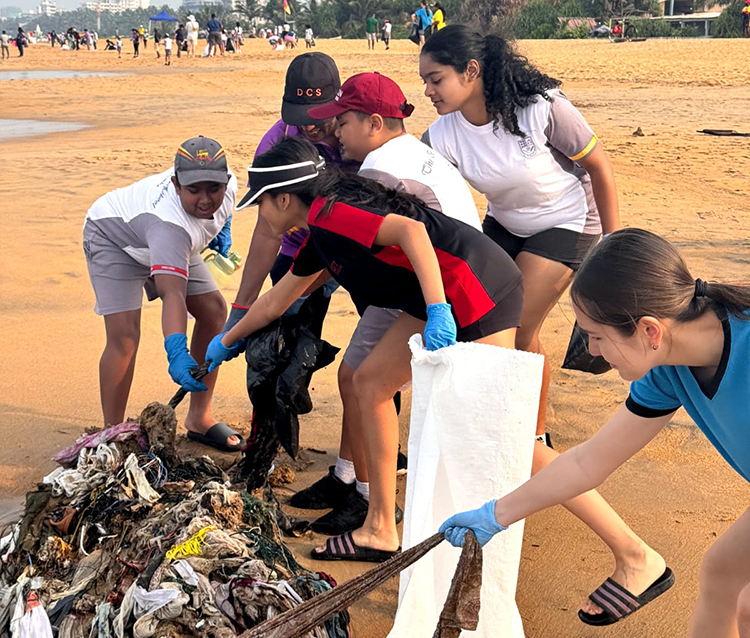
The shoreline of Dehiwala beach witnessed a stong display of unity and environmental responsibility as the British School in Colombo (BSC) came together for the school’s second beach clean-up this academic year, BSC said in a statement.
It said: What made this clean-up especially meaningful was the way it brought together the entire BSC family, irrespective of differences in age, class, or role. Junior School and Senior School students, parents, teachers and staff worked side by side with a shared purpose.
Thanks to the dedication and enthusiasm of all 100 participants, the clean-up achieved remarkable results.

Nagoya, Jan. 29 (Jiji Press)—Sri Lankan detainee Wishma Sandamali’s life could have been saved at three different times before she died at an immigration facility in Japan in 2021, a doctor said in a court hearing on Wednesday.
Wishma’s death at the facility in Nagoya, Aichi Prefecture, resulted from a combination of factors including dehydration and starvation, the doctor, Masamune Shimo, said in the Nagoya District Court hearing on a damages lawsuit filed by her bereaved family against the Japanese government over her death.
Dehydration and starvation had reduced Wishma’s blood circulation and led to a vitamin B1 deficiency, which caused her to develop beriberi heart disease, Shimo said, citing diet and nursing records as well as urine and blood test results. He said she fell into shock, ultimately leading to death from multiple organ failure.
Shimo said the first life-saving opportunity was when a urine test showed abnormal values indicating a state of starvation, roughly three weeks before Wishma’s death. “It is standard to perform a blood test and provide an intravenous drip” when such results appear, he said.
The doctor also pointed out that Wishma’s blood pressure had become unmeasurable and abnormal deep breathing was observed two days prior to and on the day of her death.

The Colombo High Court yesterday ordered that the case filed by the Commission to Investigate Allegations of Bribery or Corruption (CIABOC) against former Minister of Fisheries Rajitha Senaratne and two others for allegedly causing a loss to the government when the Mutwal Fishery Harbour was leased to a private company in 2014—be reconvened on April 29.
The case was called yesterday (29) before Colombo High Court Judge Mohamed Mihal.
During the proceedings, the judge asked whether the defence lawyers for the accused expected to raise objections regarding the amended charges.
The defense lawyers responded that they intend to raise any objections at the appropriate stage.
Following this, the High Court Judge directed that the case be reconvened for examination on April 29.
The case was filed by the Bribery Commission, alleging that between August 1 and November 1, 2014, the accused committed the offence of corruption by influencing the Board of Directors of the Fisheries Harbour Corporation to lease the Mutwal Fisheries Harbour to a private company for an amount lower than its proper value.

Listen to workers

BSC in beach clean up

Sri Lanka, the Stars,and statesmen

Lankan detainee’s death could have been prevented on 3 occasions: Doctor

Corruption case against Rajitha to be reconvened on April 29

Navam Maha Perahera traffic plan

‘Dates have the highest sugar content to fight Coronavirus’

Sunday Island 27 December – Headlines

#SundayIsland 17th December – Headlines

Sunday Island – 28th March

Sunday Island Headlines – 21 March

Sunday Island – 21st February – Headlines
-
 Business4 days ago
ComBank, UnionPay launch SplendorPlus Card for travelers to China
-

 Business5 days ago
ComBank advances ForwardTogether agenda with event on sustainable business transformation
-
 Opinion5 days ago
Conference “Microfinance and Credit Regulatory Authority Bill: Neither Here, Nor There”
-

 Business1 day ago
Climate risks, poverty, and recovery financing in focus at CEPA policy panel
-

 Opinion4 days ago
Luck knocks at your door every day
-

 Business6 days ago
Dialog Brings the ICC Men’s T20 Cricket World Cup 2026 Closer to Sri Lankans
-

 News5 days ago
Rising climate risks and poverty in focus at CEPA policy panel tomorrow at Open University
-

 Business1 day ago
Bourse positively impacted by CBSL policy rate stance