
News
Anticipating sharp increase in visitor arrivals, Japan boosts facilities at two key entry points here

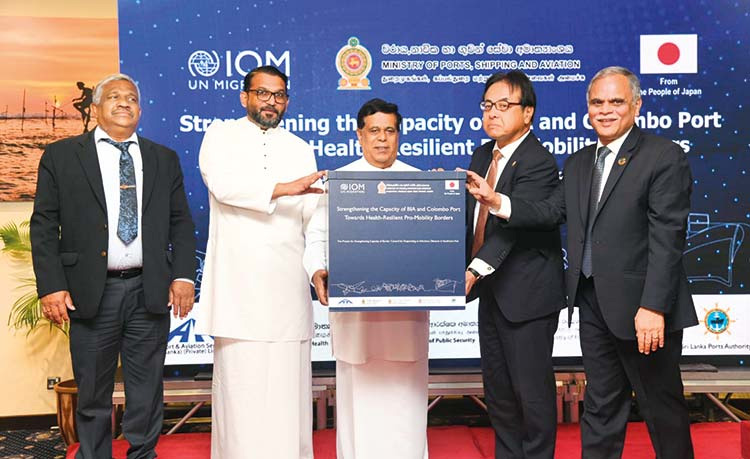
In the absence of government initiative, Japan has provided USD 8.4 mn to strengthen facilities at two key Points of Entry (PoE), namely the Bandaranaike International Airport (BIA) and the Colombo Port to be future-ready for responding to any public health emergencies such as pandemics and infectious diseases.
The funding has been provided through the International Organization for Migration (IOM) to strengthen PoE facilities in Sri Lanka and the Maldives.
The Japanese Embassy and the IOM, in a joint press release issued yesterday (15), said that a decision was made to strengthen PoEs against the backdrop of almost 1.5 million visitor arrivals and 7.5 million passenger turnovers recorded in 2023. Asserting that Sri Lanka is on its way to recovery, stability, and growth after the Easter Sunday attacks, the COVID-19 pandemic, and the devastating economic crisis in 2022, the statement said as cross-border travel was expected to rise rapidly in the coming months, strengthening PoEs to ensure smooth functioning of them without any closure was of paramount importance.
The handing over the first part of the equipment took place recently at the BIA. Under this initiative, the BIA and Colombo Port are set to receive cutting-edge equipment and facilities, including advanced baggage scanners, full body scanners, Automated Border Control (ABC) gates equipped with a Face Recognition System (AFRS), full-page e-passport scanners, and biometric-based access control systems. Additionally, the project renovates approximately 150 washrooms at BIA with sensor-operated, touchless equipment providing hygienic benefits for passengers, crew, and staff.
At the event, the Ambassador of Japan to Sri Lanka, Mizukoshi Hideaki stated “I am proud to reaffirm Japan’s unwavering commitment to the recovery, growth, and development of Sri Lanka. Our support extends particularly to the enhancement of PoE, with a special focus on BIA and Colombo Port. Through this initiative, Japan aims to fortify PoE capabilities, ensuring seamless management of future emergencies, especially during pandemics.”
In addition, the project will provide much-needed medical equipment, and renovate and equip the isolation room at the BIA, in line with International Health Regulations (IHR), alongside enhancements to both the BIA and the Colombo Port waste disposal capabilities.
A four-story office building will be constructed for the Port Health Service at Colombo Port and 25 Sri Lankan Diplomatic Missions will receive biometric enrollment workstations enabling linking up with the Department of Immigration and Emigration to speed up passport issuance for Sri Lankans living overseas. For a greater outcome, the project will provide comprehensive training and staff capacity building to strengthen border health compliance in line with international standards enabling swift response to public health emergencies.
This project is implemented by IOM under the guidance of the Ministry of Ports, Shipping and Aviation in close coordination with the Airport and Aviation Services Sri Lanka Limited (AASL), Sri Lanka Ports Authority, the Department of Immigration and Emigration, and the Ministries of Health and Foreign Affairs.
Commenting on the occasion, the Chief of Mission of the International Organization for Migration for Sri Lanka and the Maldives, Sarat Dash stated that “IOM strongly believes that strengthening the PoE is an investment for the future. The focus of the project extends beyond physical infrastructure and encompasses efforts for the economy, security, and digital landscape. IOM feels privileged to be a part of this project of national significance and is grateful for the support extended by all stakeholders for its successful implementation.”



The National Water Supply and Drainage Board (NWSDB) on Friday said the largest groundwater source discovered in Sri Lanka so far had been identified during tube-well drilling near the Pitabeddara Police Station.
Indrajith Gamage, geologist in charge of the Southern Province, said the source recorded a continuous flow of about 10,000 litres (10 cubic metres) per minute, marking the first instance in the country where a groundwater source of that magnitude had been found.
He noted that the previous largest groundwater source was discovered in the Madhu area, which recorded a flow of about 7,000 litres per minute.
According to the NWSDB, the tube well was drilled following geological studies of rock layers and the identification of underground water through fractures in rock strata using specialised technical instruments.
The Board said steps would be taken to distribute water from the newly discovered source to residents facing shortages in Pitabeddara, Morawaka and surrounding areas.

The Ceylon Chamber of Commerce has formally handed over its historical records to the National Archives Department, entrusting over a century of the nation’s commercial history to the country’s official custodians of heritage.
The archive, spanning from the CCC’s founding in 1839 to 1973, includes correspondence, meeting minutes, reports, ledgers, and publications that chronicle the development of trade, enterprise, and industry in Sri Lanka. Together, the records provide a rare and detailed account of the island’s economic evolution and the role of its business community in shaping national progress.

The Ministry of Defence said on Friday (13) that arrangements had been made to repatriate to Iran the bodies of 84 sailors who died aboard the IRIS Dena, which sank in the southern seas off Sri Lanka.
A special aircraft carrying the bodies departed from Mattala Rajapaksa International Airport on Friday, the Ministry said, adding that the repatriation was carried out in coordination with the Embassy of Iran in Sri Lanka.
The remains had been kept in two mobile cold-storage units at the Galle National Hospital before being transported to Mattala by lorry following a court order. Forty-five bodies were moved in the morning, while the remaining 39 were transported later in the day.
Earlier this month, the Iranian naval vessel suffered an incident about 40 nautical miles off Port of Galle while carrying around 180 personnel. Thirty-five rescued sailors were admitted to the Karapitiya Teaching Hospital, while 84 bodies were subsequently recovered.
Following the incident, Pete Hegseth confirmed that the Iranian vessel had been sunk in international waters by a torpedo fired from a submarine of the United States Navy.
Showers will occur at several places in the Western, Sabaragamuwa, Central, North-western and Uva provinces and in Galle, Matara, Mannar and Anuradhapura districts after 2.00 pm.

Lanka discovers largest groundwater source

Lanka’s commercial legacy preserved in National Archives

Bodies of 84 Iranian sailors flown home

Kirsten brings pedigree, but Sri Lanka must fix the system

Barrels vs bombs

‘Dates have the highest sugar content to fight Coronavirus’

Sunday Island 27 December – Headlines

#SundayIsland 17th December – Headlines

Sunday Island – 28th March

Sunday Island Headlines – 21 March

Sunday Island – 21st February – Headlines
-

 News6 days ago
Repatriation of Iranian naval personnel Sri Lanka’s call: Washington
-

 Features6 days ago
Winds of Change:Geopolitics at the crossroads of South and Southeast Asia
-

 News5 days ago
Prof. Dunusinghe warns Lanka at serious risk due to ME war
-

 Sports4 days ago
Royal start favourites in historic Battle of the Blues
-

 Sports3 days ago
The 147th Royal–Thomian and 175 Years of the School by the Sea
-

 News3 days ago
Historic address by BASL President at the Supreme Court of India
-

 News4 days ago
CEBEU warns of operational disruptions amid uncertainty over CEB restructuring
-

 Business4 days ago
BOI launches ‘Invest in Sri Lanka’ forum