
Features
Another string to your bow

By Usvatte-aratchi
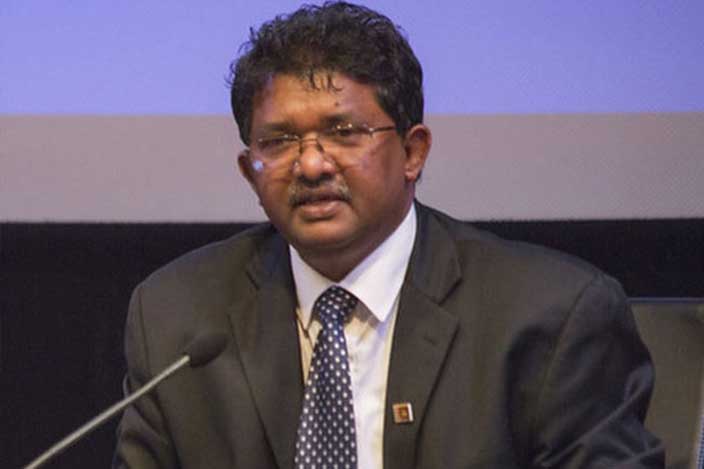
Professor Anura Manatunga, the Director General of Archaeology, who would not take any more, resigned from that prestigious post soon after hectoring by a powerful but amateur historian. Why would he not take it anymore? He would not because he could not fire an arrow against the Teflon-clad armour of an executive president whilst retaining his dignity. Yet, the professor had another string to his bow, which most senior public servants lack. He was on secondment from a prestigious professorship at Kelaniya.
He went back to his well-guarded fortress, the University of Kelaniya. Here is in practice the value of autonomy in a university. (It is not without interest that universities sought and secured autonomy from lay and clerical authority, at the same time as rulers built fortresses [burg as in Hamburg] and castles to seek safety from invading enemies. Heavy canon put paid to that military technique.)
It is my contention that many a senior public servant is unarmed against predatory politicians because there is no alternative source of income or wealth to fall back on: that proverbial second string. I suspect that most public servants understand well their obligations to the public. They see clearly enough when a politician plunders the wealth of the public or breaks the law in other ways. But he himself rose out of poverty, only the other day. He married that pleasant girl, next to whom he sat in the history lectures and knew that she did not carry any wealth with her.
Their two bright children were both in Moratuwa and would graduate with degrees in electrical engineering. The reasonably comfortable quarters on Keppetipola Mawatha and the chauffeured car came with his promotion to the current position. To risk the wrath of the dim-witted minister now is to sail a boat on the high seas in the way of a 200-kilometre speed wind in a cyclone.
Sujatha was mad as hell when she heard about the plunder that the minister had planned. She shouted that they quit their jobs and joined the Aragalaya forthwith. They had six years to retire with a pension and their daughter would not graduate for another three years. They still did not have a place to live in, were Sarath to lose his current job. Were they to be devoured by Scylla of a minister or Charybdis of economic disaster, as Ganeya would have put it in the anthropology class?
Many greyheads nod with tales of senior public servants, when their hair was yet jet black, who stood up to corrupt politicians and served the public with much valour and acceptance. They decry the timidity of present-day equals. Those greyheads fail to realise that public servants of yore had more than one string to their bow. They were bright children of reasonably well-off parents who lived in Colombo, Jaffna or other towns and not in Kebitigollewa or Pitabaddera.
They still owned enough land on which their children could build a small house. Besides, Namal very wisely had married Swarna, whose parents had gifted her a house in Horton Place, Colombo together with 50 acres of VP tea in Galaha, with a pleasant and well-furnished little bungalow. Unlike Sarath (of the earlier story), Namal did not have to buy his own furniture. (Among snooty upper-class blokes in Britain, it was not uncommon to refer to the poverty of poorer colleagues by referring to their own inherited residences and those that new comers had to acquire.) Public servants in that regime were armed with more than one string to their bow.
The comparable second string now is to be seconded for service in the government from a university professorship. That was the second string that Professor Manatunga used. Of course, a minister, who dropped out of school before Grade 8, could send that string to smithereens. Among the splendid achievements of free education is widening opportunities to NEAR equality in our society.
More than 50 percent of those who enter universities are women; more than 50 percent of middle-level public servants are women; there is a huge mixing up of people from different parts of this country because education had introduced mobility. (However, one must keep in mind the ossification of settlements following conflicts among ethnic groups in the second half of the 20th century.) Among the ignominious outcome of free education, is the emergence of a dominant coterie of poorly educated politicians, who have plundered the wealth of this land and its people, to reduce them to mendicants on the international scale.
Who would expect that citizens who were reasonably well educated would have elected to authority, time after time, men who had demonstrated that they were incompetent, corrupt and otherwise criminal? Incompetence is demonstrated in the monumentally wasteful investments. Wasteful large-scale investments are partly a means to corruption: you cannot collect 10 billion (US) dollars by raising the wages of hospital nurses, but you can if you buy six wide-bodied Airbus planes or if you construct an international conference centre in the wilderness.
Those same well-educated public servants have not been either active enough or smart enough to bring to justice any of these uneducated politicians or any of their errant educated colleagues. We have brought these misfortunes on ourselves at the cost of trillions of rupees spent over a long period of time, teaching generations of people. There must be something wrong with the education we bought at such tremendous cost.
(Contrast that ignominy with the glories of education policies in India the output of which rules many large corporations both at home and the world over, head some of the best universities, university faculties and departments and run inter governmental organisations at the highest levels. This is besides a fast-growing economy in that huge economy. There was a long time, not too long ago, when many people here and even Nobel Prize winning economists and policy makers overseas sang hosannas to education policies in Sri Lanka and decried those in India. We keep enmeshed in trivialities.) There has been no worthwhile rage over the failures of our schools and universities, which have us to this piteous pass.



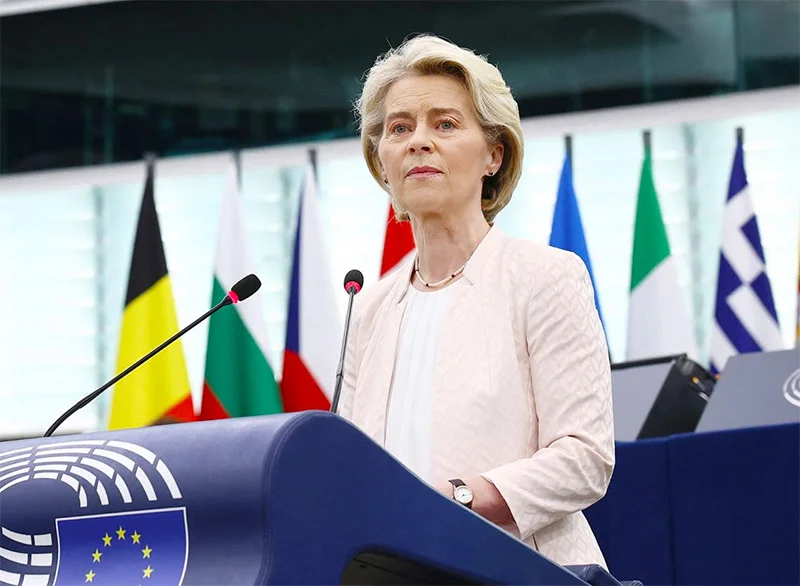
 European Commission President Ursula von der Leyen addressing the World Economic Forum in Davos, Switzerland on Tuesday put forward the EU’s viewpoint on current questions in international politics with a clarity, coherence and eloquence that was noteworthy. Essentially, she aimed to leave no one in doubt that a ‘new form of European independence’ had emerged and that European solidarity was at a peak.
These comments emerge against the backdrop of speculation in some international quarters that the Post-World War Two global political and economic order is unraveling. For example, if there was a general tacit presumption that US- Western European ties in particular were more or less rock-solid, that proposition apparently could no longer be taken for granted.
For instance, while US President Donald Trump is on record that he would bring Greenland under US administrative control even by using force against any opposition, if necessary, the EU Commission President was forthright that the EU stood for Greenland’s continued sovereignty and independence.
In fact at the time of writing, small military contingents from France, Germany, Sweden, Norway and the Netherlands are reportedly already in Greenland’s capital of Nook for what are described as limited reconnaissance operations. Such moves acquire added importance in view of a further comment by von der Leyen to the effect that the EU would be acting ‘in full solidarity with Greenland and Denmark’; the latter being the current governing entity of Greenland.
It is also of note that the EU Commission President went on to say that the ‘EU has an unwavering commitment to UK’s independence.’ The immediate backdrop to this observation was a UK decision to hand over administrative control over the strategically important Indian Ocean island of Diego Garcia to Mauritius in the face of opposition by the Trump administration. That is, European unity in the face of present controversial moves by the US with regard to Greenland and other matters of contention is an unshakable ‘given’.
It is probably the fact that some prominent EU members, who also hold membership of NATO, are firmly behind the EU in its current stand-offs with the US that is prompting the view that the Post-World War Two order is beginning to unravel. This is, however, a matter for the future. It will be in the interests of the contending quarters concerned and probably the world to ensure that the present tensions do not degenerate into an armed confrontation which would have implications for world peace.
However, it is quite some time since the Post-World War Two order began to face challenges. Observers need to take their minds back to the Balkan crisis and the subsequent US invasions of Afghanistan and Iraq in the immediate Post-Cold War years, for example, to trace the basic historic contours of how the challenges emerged. In the above developments the seeds of global ‘disorder’ were sown.
Such ‘disorder’ was further aggravated by the Russian invasion of Ukraine four years ago. Now it may seem that the world is reaping the proverbial whirlwind. It is relevant to also note that the EU Commission President was on record as pledging to extend material and financial support to Ukraine in its travails.
Currently, the international law and order situation is such that sections of the world cannot be faulted for seeing the Post World War Two international order as relentlessly unraveling, as it were. It will be in the interests of all concerned for negotiated solutions to be found to these global tangles. In fact von der Leyen has committed the EU to finding diplomatic solutions to the issues at hand, including the US-inspired tariff-related squabbles.
Given the apparent helplessness of the UN system, a pre-World War Two situation seems to be unfolding, with those states wielding the most armed might trying to mould international power relations in their favour. In the lead-up to the Second World War, the Hitlerian regime in Germany invaded unopposed one Eastern European country after another as the League of Nations stood idly by. World War Two was the result of the Allied Powers finally jerking themselves out of their complacency and taking on Germany and its allies in a full-blown world war.
However, unlike in the late thirties of the last century, the seeming number one aggressor, which is the US this time around, is not going unchallenged. The EU which has within its fold the foremost of Western democracies has done well to indicate to the US that its power games in Europe are not going unmonitored and unchecked. If the US’ designs to take control of Greenland and Denmark, for instance, are not defeated the world could very well be having on its hands, sooner rather than later, a pre-World War Two type situation.
Ironically, it is the ‘World’s Mightiest Democracy’ which is today allowing itself to be seen as the prime aggressor in the present round of global tensions. In the current confrontations, democratic opinion the world over is obliged to back the EU, since it has emerged as the principal opponent of the US, which is allowing itself to be seen as a fascist power.
Hopefully sane counsel would prevail among the chief antagonists in the present standoff growing, once again, out of uncontainable territorial ambitions. The EU is obliged to lead from the front in resolving the current crisis by diplomatic means since a region-wide armed conflict, for instance, could lead to unbearable ill-consequences for the world.
It does not follow that the UN has no role to play currently. Given the existing power realities within the UN Security Council, the UN cannot be faulted for coming to be seen as helpless in the face of the present tensions. However, it will need to continue with and build on its worldwide development activities since the global South in particular needs them very badly.
The UN needs to strive in the latter directions more than ever before since multi-billionaires are now in the seats of power in the principle state of the global North, the US. As the charity Oxfam has pointed out, such financially all-powerful persons and allied institutions are multiplying virtually incalculably. It follows from these realities that the poor of the world would suffer continuous neglect. The UN would need to redouble its efforts to help these needy sections before widespread poverty leads to hemispheric discontent.

 Hi! This week I’ve come up with tips to brighten up your skin.
* Turmeric and Yoghurt Face Pack:
You will need 01 teaspoon of turmeric powder and 02 tablespoons of fresh yoghurt.
Mix the turmeric and yoghurt into a smooth paste and apply evenly on clean skin. Leave it for 15–20 minutes and then rinse with lukewarm water
Benefits:
Reduces pigmentation, brightens dull skin and fights acne-causing bacteria.
* Lemon and Honey Glow Pack:
Mix 01teaspoon lemon juice and 01 tablespoon honey and apply it gently to the face. Leave for 10–15 minutes and then wash off with cool water.
Benefits:
Lightens dark spots, improves skin tone and deeply moisturises. By the way, use only 01–02 times a week and avoid sun exposure after use.
* Aloe Vera Gel Treatment:
All you need is fresh aloe vera gel which you can extract from an aloe leaf. Apply a thin layer, before bedtime, leave it overnight, and then wash face in the morning.
Benefits:
Repairs damaged skin, lightens pigmentation and adds natural glow.
* Rice Flour and Milk Scrub:
You will need 01 tablespoon rice flour and 02 tablespoons fresh milk.
Mix the rice flour and milk into a thick paste and then massage gently in circular motions. Leave for 10 minutes and then rinse with water.
Benefits:
Removes dead skin cells, improves complexion, and smoothens skin.
* Tomato Pulp Mask:
Apply the tomato pulp directly, leave for 15 minutes, and then rinse with cool water
Benefits:
Controls excess oil, reduces tan, and brightens skin naturally.

 That’s precisely what 25-year-old Hansana Balasuriya has in mind – shooting for the stars – when she was selected to represent Sri Lanka on the international stage at Miss Intercontinental 2025, in Sahl Hasheesh, Egypt.
The grand finale is next Thursday, 29th January, and Hansana is all geared up to make her presence felt in a big way.
Her journey is a testament to her fearless spirit and multifaceted talents … yes, her life is a whirlwind of passion, purpose, and pageantry.
Raised in a family of water babies (Director of The Deep End and Glory Swim Shop), Hansana’s love affair with swimming began in childhood and then she branched out to master the “art of 8 limbs” as a Muay Thai fighter, nailed Karate and Kickboxing (3-time black belt holder), and even threw herself into athletics (literally!), especially throwing events, and netball, as well.
A proud Bishop’s College alumna, Hansana’s leadership skills also shone bright as Senior Choir Leader.
She earned a BA (Hons) in Business Administration from Esoft Metropolitan University, and then the world became her playground.
Before long, modelling and pageantry also came into her scene.
She says she took to part-time modelling, as a hobby, and that led to pageants, grabbing 2nd Runner-up titles at Miss Nature Queen and Miss World Sri Lanka 2025.
When she’s not ruling the stage, or pool, Hansana’s belting tunes with Soul Sounds, Sri Lanka’s largest female ensemble.
What’s more, her artistry extends to drawing, and she loves hitting the open road for long drives, she says.
This water warrior is also on a mission – as Founder of Wave of Safety,
Hansana happens to be the youngest Executive Committee Member of the Sri Lanka Aquatic Sports Union (SLASU) and, as founder of Wave of Safety, she’s spreading water safety awareness and saving lives.
Today is Hansana’s ninth day in Egypt and the itinerary for today, says National Director for Sri Lanka, Brian Kerkoven, is ‘Jeep Safari and Sunset at the Desert.’
And … the all-important day at Miss Intercontinental 2025 is next Thursday, 29th January.
Well, good luck to Hansana.

Two dead and several missing in New Zealand landslides

England succumb to spin-bowling choke as Sri Lanka go 1-0 up

U – 19 World Cup: Why a slow chase was better than a fast one for Pakistan against Zimbabwe

Mendis’ 93 not out lifts Sri Lanka to 271 for 6, despite Rashid three-for

We didn’t get justice from ICC: Bangladesh sports advisor

Indonesian Naval Ship ‘KRI SULTAN ISKANDAR MUDA – 367’ arrives in Colombo

‘Dates have the highest sugar content to fight Coronavirus’

Sunday Island 27 December – Headlines

#SundayIsland 17th December – Headlines

Sunday Island – 28th March

Sunday Island Headlines – 21 March

Sunday Island – 21st February – Headlines
-

 Editorial5 days ago
Illusory rule of law
-
 News6 days ago
UNDP’s assessment confirms widespread economic fallout from Cyclone Ditwah
-
 Editorial6 days ago
Crime and cops
-
 Features5 days ago
Daydreams on a winter’s day
-

 Editorial7 days ago
The Chakka Clash
-
 Features5 days ago
Surprise move of both the Minister and myself from Agriculture to Education
-

 Features4 days ago
Extended mind thesis:A Buddhist perspective
-
 Features5 days ago
The Story of Furniture in Sri Lanka