
Latest News
Akash Deep, Bumrah ensure India successfully avoid follow-on


Australia, who were down to just two front-line pacers, saw more overs taken out of the game by rain and had their victory push thwarted by solid half-centuries from KL Rahul (85) and Ravindra Jadeja (77) as well as a dogged unbeaten 39-run stand for the last wicket between Akash Deep and Jasprit Bumrah that helped India avoid the follow-on. India ended the day still 193 adrift of Australia’s 445 but Australia will now have a maximum of 98 overs, weather permitting, to close out India’s innings, build a quick lead and then give their Hazelwood-less bowling attack enough time to push for victory.
In the absence of their fast bowling partner, Pat Cummins and Mitchell Starc toiled for 18.5 and 16 overs respectively on the fourth day and might have even paved the doors for victory with a little bit of luck. Cummins was denied off the very first ball of the day’s play when Rahul, resuming on 33, edged a length ball only for Steve Smith to put down a regulation chance at second slip.
Viewed with the benefit of hindsight, it turned out to be a pivotal moment in the day for India, whose batting travails in a heavily-truncated third day’s play meant they already faced a tough prospect to get to 246 – the magic number that would force Australia to bat again and ensure further time taken away from the game. India recovered from almost being 51 for 5 before eventually being reduced to 74 for 5 inside that first hour of play.
Captain Rohit Sharma, the other overnight batter, was made to pay for his first mistake after being worked over by Cummins in his probing five-over burst. The Australia skipper played with the out-of-form Rohit’s weight transfers by bowling a sharp, short ball before a follow-up full delivery, which as it turned out wasn’t full enough for the drive. Sensing a rare scoring opportunity, Rohit reached for it and feathered an edge to the ‘keeper with the ball still only 23 overs old.
It was then that Rahul and Jadeja got together to stitch India’s best partnership of the innings. Both batters batted with great control with Rahul, in particular, continuing to make good decisions after getting into good positions with his technique. He picked only the really full deliveries for his shots as well as favouring the square drive to the more expansive variant towards extra cover. He waited for the bowlers to bowl straighter to him, which he then flicked, tucked away or on-drove.
As has been the case through the series, batting got significantly easier once the ball was more than 30-overs-old and Rahul and Jadeja added risk-free runs before the 67-run stand was ended against the run of play by Smith, who atoned for his earlier drop by anticipating and leaping to his right to hold on to Rahul’s attempted cut off Nathan Lyon.
Jadeja set about putting together another half-century stand with Nitish Reddy as Australia now faced a race against time with only 13.2 overs of play possible through the middle session during which time Jadeja, playing his first game of the series, got to his 22nd Test match fifty. The seventh-wicket pair managed to see off a Starc spell after 67-minute rain delay but weren’t as lucky against Cummins, who produced a nip backer to Reddy that dislodged his bails via an inside edge. At that stage, India still needed 51 to avoid the follow on with only the three fast bowlers left to partner Jadeja.
India had Siraj batting at No.9 and Jadeja’s decision to leave him to face six deliveries from Starc proved to be a mistake as the left-arm quick found the outside edge of the tailender for a sharp catch behind the stumps. Jadeja tried to farm the strike with Bumrah and managed to add a six off Lyon followed by a fortuitous four off Cummins before a well laid out short ball plan ended the all-rounder’s innings on 77, with Cummins grabbing his fourth wicket.
At that stage India were still 33 runs away from making Australia bat again, but Deep and Bumrah held firm against a two-man pace attack that was now visibly crumbling under the bowling loads it had undertaken. Bumrah got inside the line to a Cummins bouncer and pulled him for a six before starting to calmly nudge singles in the gaps. Deep added another crucial boundary by slashing Starc over the cordon.
India had come to within 14 runs off the follow-on mark when Cummins was forced to go back to Lyon to replace Starc. The Australia captain willed himself on to keep bowling from the other end in search of the last wicket, which would have brought him another five-fer, and ended up conceding seven runs off his 20th over. In his 21st, he was edged over the cordon for a four by Deep which took India past the important milestone. As if to celebrate the moment, which was marked with much gusto in the Indian dressing room, Deep slogged Cummins for a six over deep mid-wicket before the umpires took the player off for bad light.
Brief scores:
India 252/9 (KL Rahul 84, Ravindra Jadeja 77; Pat Cummins 4-80) trail Australia 445 (Travis Head 152, Steve Smith 101; Jasprit Bumrah 6-76) by 193 runs.

| Date | Match |
|---|---|
| May 3 | 1st ODI |
| May 6 | 2nd ODI |
| May 9 | 3rd ODI |
| May 12 | 1st T20I |
| May 14 | 2nd T20I |
| May 15 | 3rd T20I |
[Cricbuzz]

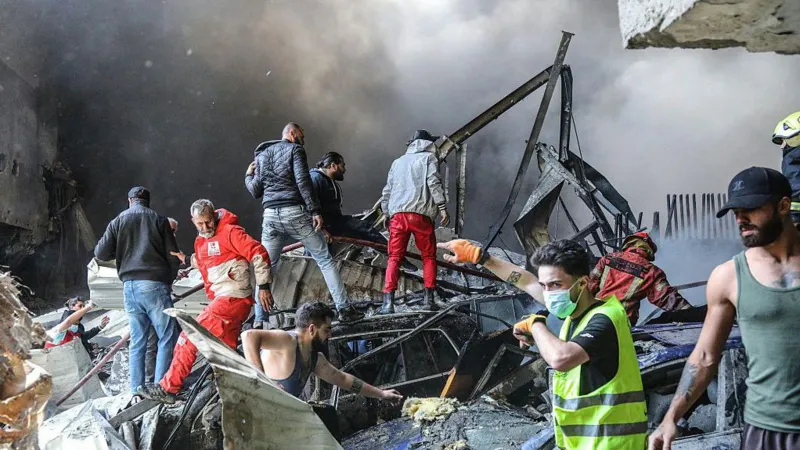
Israeli Prime Minister Benjamin Netanyahu has ordered his government to begin direct talks with Lebanon, he said in a statement on Thursday.
Netanyahu said the talks would focus on the disarmament of Hezbollah, the Iran-backed Lebanese political and militant group, and establishing peaceful relations.
A US State Department official confirmed it would host a meeting next week “to discuss ongoing ceasefire negotiations with Israel and Lebanon”.
Lebanese officials called for a ceasefire before the talks begin, but Netanyahu in a subsequent address to residents of northern Israel said: “There is no ceasefire in Lebanon.”
The Israeli military continued to strike Lebanon on Thursday – targeting what it described as Hezbollah rocket launch sites in the south. It also issued a new evacuation warning for residents in the southern suburbs of the capital, Beirut.
The head of the World Health Organization (WHO), Tedros Adhanom Ghebreyesus, said on X that this included the Jnah area, which includes two major hospitals.
“At this time, no alternative medical facilities are available to receive approximately 450 patients from the two hospitals (including 40 patients in the ICU), rendering their evacuation operationally unfeasible,” he said.
Among those being treated at the hospitals, Tedros added, were some of the 1,150 people that Lebanon’s health ministry said were wounded in Wednesday’s massive wave of Israeli strikes. At least 303 people were killed.
Tedros also said that the headquarters of the Ministry of Public Health, which “hosts five shelters accommodating more than 5,000 people”, is in the evacuation area.
That ceasefire began with confusion over whether Lebanon, Israel’s second front, was to be included. Iranian officials and mediators from Pakistan said it was, US and Israeli officials said clearly that it was not.
Amid the confusion, the wave of Israeli strikes on Lebanon – the heaviest since the conflict began six weeks ago – prompted Iran to declare that Israel was break8ng the terms of the ceasefire, once again halt passage of shipping through the Strait of Hormuz, and to threaten retaliatory strikes.
Israel’s military continues to occupy a large part of the south of Lebanon, where it has destroyed villages in recent days. Without a commitment to a temporary ceasefire at least, it is not clear how productive talks could proceed between the two sides.
(BBC)

Brazil bowler Laura Cardoso takes 9 Lesotho wickets in record-breaking T20 win

Zimbabwe Women set for maiden tour of Pakistan

Bangladesh advance match timings to save energy

PM on inspection tour of newly renovated Colombo Central Bus Stand

Israel to hold direct talks with Lebanon but no ceasefire, Netanyahu says

Sun directly overhead Nagawilluwa, Galgamuwa, Sigiriya, Palugasdamana and Mankerni about 12:11 noon today (10)

‘Dates have the highest sugar content to fight Coronavirus’

Sunday Island 27 December – Headlines

#SundayIsland 17th December – Headlines

Sunday Island – 28th March

Sunday Island Headlines – 21 March

Sunday Island – 21st February – Headlines
-

 Features6 days ago
Ranjith Siyambalapitiya turns custodian of a rare living collection
-

 News5 days ago
Global ‘Walk for Peace’ to be held in Lanka
-

 News4 days ago
Lankan-origin actress Subashini found dead in India
-

 Features6 days ago
Beyond the Blue Skies: A Tribute to Captain Elmo Jayawardena
-

 News1 day ago
AG: Coal procurement full of irregularities
-

 Features6 days ago
Aspects of Ceylon/Sri Lanka Foreign Relations – 1948 to 1976
-

 Business2 days ago
Hayleys Mobility introduces Premium OMODA C9 PHEV
-

 Sports2 days ago
DS to face St. Anthony’s in ‘Bridges of Brotherhood’ cricket encounter