
News
AG urged to set up new mechanism to monitor HR violations

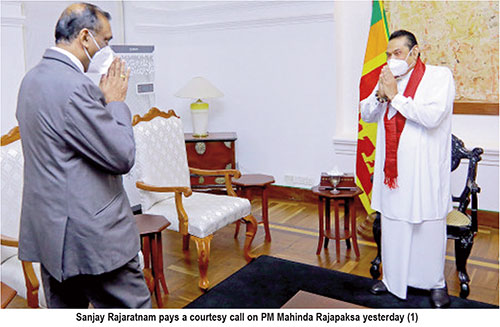
Sanjay Rajaratnam pays a courtesy call on PM Mahinda Rajapaksa yesterday (1)
The newly appointed Attorney General Sanjay Rajaratnam, PC, assumes duties at a critical time with the United Nations High Commissioner for Human Rights (UN-HCHR) having got the special mandate of the 46th session of the United Nations Human Rights Council (UN-HRC) in March this year to set up a special mechanism to monitor Sri Lanka’s alleged human rights violations and alleged war crimes during the final phase of the separatist war that ended in 2009, former PA National List MP M.M. Zuhair, PC says.
Zuhair, who served the AG’s department as a State Counsel and later as Senior State Counsel at a time it was comparatively smaller, said so in response to The Island query regarding the growing challenge on the human rights front.
Zuhair has sent us the following response to our queries: “The office of the Attorney General of Sri Lanka has a 137 year history, beginning from Sir Francis Fleming on 1st January 1884. The Attorney General carries with him unique responsibilities though the world outside sees him as exercising exclusive powers. He is the principal law officer of the State, legal adviser to the President of the Republic, the Speaker of Parliament and the executive, having specific Constitutional powers, duties and functions, advocate of the supremacy of the Constitution and the rule of law, having powers to initiate criminal proceedings and present indictments, the leader of the Bar with specified rights to be heard in all courts and defender of the State in civil proceedings. He is a member of the executive but functions independently of the executive in all legal matters, subject however to the jurisdiction of the Courts in specified issues.
The report of the High Commissioner for Human Rights has drawn special attention of the UN HRC to several significant matters relating to Sri Lanka. They include inter alia ‘reversal of Constitutional safeguards’, ‘majoritarian and exclusionary rhetoric, ‘new and exacerbated human rights concerns’, ‘impunity in emblematic cases’, etc. The UN HCHR has in the report taken a further step by requesting Member States, in addition to taking steps of referral of Sri Lanka to the International Criminal Court (ICC) to actively pursue “investigations and prosecution of international crimes committed by all parties in Sri Lanka before their own national courts, including under accepted principles of extraterritorial or universal jurisdiction” (emphasis mine).
The report also points out that “Member States can also apply targeted sanctions, such as asset freezes and travel bans against State officials and other actors credibly alleged to have committed or be responsible for grave human rights violations or abuses…” The addition of the two special procedures may be due to, the referral to ICC very likely being vetoed in the Security Council!
Another critical development is that a resolution is already before the United States Congress recommending the US to explore investigations and prosecutions pursuant to the recommendations of the UN HCHR. The proposed resolution is wide enough to pursue inter alia the two courses of actions referred to earlier at the Member State level of the US government. This would also encourage other traditional allies of the US to join hands with similar Member State level approvals, without recourse to any further UN HRC approval!
So the time has come for the new Attorney General Sanjay Rajaratnam PC to set up a special high level unit in the department to handle the man-made tsunami that will very likely rattle the country on the legal and economic fronts much sooner than the HRC process.
Amongst the matters in the UN HCHR’s list are the alleged “erosion of the judiciary and key institutions responsible for the promotion and protection of human rights; … policies that adversely affect the right to freedom of religion or belief; increased marginalization of persons belonging to the Tamil and Muslim communities; surveillance and intimidation of civil society; … arbitrary detentions”, etc.
Another matter is the need to address the undertaking given to repeal the Prevention of Terrorism (Temporary Provisions) Act (PTA) enacted in 1979 and replace same with a new law in line with accepted human rights norms. The controversial law itself provides for a maximum detention of 18 months, whereas a large number of persons arrested under the PTA over the Mawanella Buddha statue damaging case as well as over the Easter Sunday attacks have been kept in remand for over two years, in violation of the PTA’s maximum period of one and a half years, through a process arguably violative of the human rights of the suspects.
There are many persons in remand who could have been enlarged on bail with the consent of the Attorney General and against whom the alleged material is weak and insufficient for prosecution. There are still others who ought to have been discharged because they have had nothing to do with 21/4 attacks. The PTA provides in section 19, that the bail provisions of other written laws (excluding the Bail Act as provided in the Bail Act) will not be applicable only to persons convicted under the PTA. But suspects are not granted bail by Magistrates Court, in violation of the bail provisions in the Code of Criminal Procedure Act read with section 19 of the PTA itself, with Courts insisting on AG’s consent as required by another provision in the PTA, which is in conflict with section 19.
The UN HCHR could review likely human rights violations by the alleged unreasonable refusal of the Attorney General and the Courts to consent to bail in weak cases. These are areas that must be addressed forthwith by the Attorney General’s special unit to prevent officers and their families being adversely affected by Member States’ targeted actions, particularly because indictments are delayed, largely because of incomplete investigations!
Another matter that will require the immediate attention of the new Attorney General who counts over 34 years in the department is the continuing arrests of persons with alleged links to one suicide bomber or the other without any evidence of their being party to or in any way conspired, prepared, aided and/or abetted in the 21/4 attacks. Suicide bombers may have had links with persons of all communities for years before the Easter attacks. Those numbers can run into several thousands. But they do not become suspects in the 21/4 attacks by any legal yardstick merely because they had at some point crossed the future bombers. These arrests may be perceived as illegal arrests targeting the minorities.
The 48th Attorney General will certainly address the matters that come before him from the national interest perspective and not from any minoritarian angle! My interest is limited to securing justice within the rule of law for the country and for all its people.” (SF)



The situation report issued by the Disaster Management Center at 0600hrs today [5th December] confirms that 486 persons have died and another 341 persons are missing after the devastating weather conditions in the past week.
171,778 persons have been displaced and have taken refuge at 1,231 safety centers established by the government.


Media organisations have denounced Deputy Minister of Public Security and Parliamentary Affairs Sunil Watagala after he urged law enforcement authorities to use emergency regulations to take action against those posting allegedly defamatory content about the President and senior ministers on social media.
The Sri Lanka Working Journalists Association (SLWJA) yesterday issued a strongly worded statement condemning Watagala’s remarks, warning that they posed a direct threat to freedom of expression and media rights, particularly at a time when the country is struggling through a national disaster.
Watagala made the controversial comments on 2 December during a meeting at the Malabe Divisional Secretariat attended by government officials and Deputy Media Minister Dr. Kaushalya Ariyarathna. During the discussion, the Deputy Minister claimed that a coordinated effort was underway to spread distorted or false information about the disaster situation through physical means, social media, and even AI-generated content. He also alleged that individuals based overseas were contributing to such activity.
According to the SLWJA, Watagala went further, directing police officers present at the meeting to treat those posting such content “not merely as suspects but as offenders” and to take action against them under emergency regulations currently in force.
The SLWJA accused the government of abandoning the democratic principles it once campaigned on, noting that individuals who publicly championed free speech in the past were now attempting to clamp down on it. The association said this was not an isolated incident but part of a pattern of growing state pressure on journalists and media platforms over the past year.
It warned that attempts to criminalise commentary through emergency powers especially during a disaster constituted a grave violation of constitutional rights. The union urged the government to respect democratic freedoms and refrain from using disaster-related powers to silence criticism.
In a separate statement, Internet Media Action (IMA) also expressed “strong objection” to Watagala’s comments, describing them as a “serious threat to freedom of expression”, which it said is a fundamental right guaranteed to all Sri Lankan citizens.
The IMA said Watagala’s assertion that “malicious character assassination attacks” were being carried out against the President and others through social media or other media channels, and that such acts should attract severe punishment under emergency law, represented “an abuse of power”. The organisation also criticised the Deputy Minister’s claim that false opinions or misrepresentations whether physical, online, or generated by AI could not be permitted.
Using emergency regulations imposed for disaster management to suppress political criticism amounted to “theft of fundamental rights”, the statement said, adding that the move was aimed at deliberately restricting dissent and instilling fear among social media users.
“Criticism is not a crime,” the IMA said, warning that such rhetoric could lead to widespread intimidation and self-censorship among digital activists and ordinary citizens.
The group demanded that Watagala withdraw his statement unconditionally and insisted that freedom of expression cannot be curtailed under emergency laws or any other legal framework. It also called on the government to clarify its stance on the protection of fundamental rights amid increasing concerns from civil society.

Archbishop of Colombo, Cardinal Malcolm Ranjith, has called on Sri Lankans to observe this Christmas with compassion and restraint, as the nation continues to recover from one of its worst natural disasters in recent memory.
In his message, the Colombo Archbishop has highlighted the scale of the crisis, noting that more than 1.5 million people have been displaced, while an “uncounted number” remain buried under debris in the hill country following landslides and severe flooding.
“It is a most painful situation,”
he has written acknowledging the difficulty of celebrating a season traditionally associated with joy while thousands are mourning lost loved ones, living in refugee centres, or left with nothing but the clothes they were wearing.
The Cardinal has urged the faithful to temper excessive celebrations and extravagance, instead focusing on helping those affected. “Celebrate, by all means, yes, but make it a moment of spiritual happiness and concern for the needs of those who suffer,” he said. “Assist as much as possible those who lost their loved ones, their homes, and their belongings.”
He has called for a Christmas marked by love, sharing, and solidarity, describing it as an opportunity to make the season “a deeply spiritual and joyful experience.”

Hope holds firm as West Indies drag New Zealand into fifth-day battle

Ireland among countries boycotting Eurovision after Israel allowed to compete

Putin says Russia will take Donbas by force or Ukraine’s troops will withdraw

486 dead, 341 missing, 171,778 displaced as at 0600hrs today [05]

Showers above 75 mm are likely at some places in the Western and Sabaragamuwa Provinces and in Galle and Matara districts

Media slams govt.’s bid to use Emergency to silence critics

‘Dates have the highest sugar content to fight Coronavirus’

Sunday Island 27 December – Headlines

#SundayIsland 17th December – Headlines

Sunday Island – 28th March

Sunday Island Headlines – 21 March

Sunday Island – 21st February – Headlines
-
 News5 days ago
Weather disasters: Sri Lanka flooded by policy blunders, weak enforcement and environmental crime – Climate Expert
-
 Latest News6 days ago
Level I landslide RED warnings issued to the districts of Badulla, Colombo, Gampaha, Kalutara, Kandy, Kegalle, Kurnegala, Natale, Monaragala, Nuwara Eliya and Ratnapura
-
 Latest News6 days ago
INS VIKRANT deploys helicopters for disaster relief operations
-
News2 days ago
Lunuwila tragedy not caused by those videoing Bell 212: SLAF
-
 Latest News6 days ago
Department of Irrigation issues Critical flood warning to the Kelani river basin
-
 Latest News4 days ago
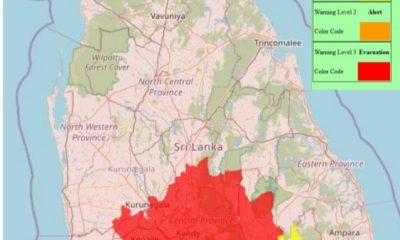
Level III landslide early warnings issued to the districts of Badulla, Kandy, Kegalle, Kurunegala, Matale and Nuwara-Eliya
-
 News6 days ago
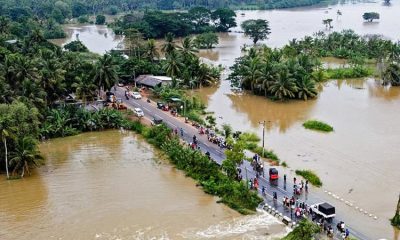
Country reels under worst weather in living memory
-

 Editorial6 days ago
Needed: Action not rhetoric