
Sports
After thorny run-in, Australia hope for smooth start to title defence

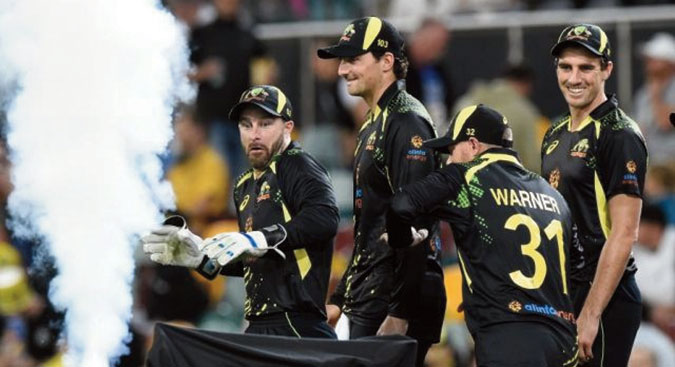
In many ways, Australia’s preparation for their T20 title defence has felt like a contradiction. In all probability the XI that takes the field at the SCG on Saturday (weather permitting) will be the one that has appeared likely for quite some time, with Tim David replacing Steven Smith from the last T20 World Cup.
So while that projects a sense of a stability, there is a lot else that has been going on that would suggest a build-up that has been far from ideal. It has included managing injuries to key allrounders Mitchell Marsh and Marcus Stoinis, plus back-up bowlers Ashton Agar and Kane Richardson; a significant amount of travel, including a week-long trip to India; the debate around David Warner’s captaincy ban, which national selector George Bailey made no secret was becoming a frustratingly drawn-out affair, and the appointment of Pat Cummins as ODI captain along with the debate around one of Australia’s leading sponsors.
Most recently an old golf club snapped in Josh Inglis’ hand on the second hole at the La Perouse course in Sydney, badly cutting the wicketkeeper and ruling him out of the tournament. In itself it is not the most damaging injury the squad could have been dealt on the eve of the tournament – Inglis would not have been in the starting XI – but it left an unwanted conversation about who should be the replacement and its implications (Warner as wicketkeeper, perhaps?). Inglis was also a very versatile batting understudy.
On the field Australia would have been beaten 3-0 by England if it wasn’t for rain in Canberra, after which Aaron Finch made comments about fatigue in the squad after the lengthy build-up. A number of players have felt they have had matches they didn’t need, but then on the other hand there have been one or two lingering form questions, although Finch made timely runs against India at the Gabba.Glenn Maxwell remains the one who has yet to put in a significant contribution with the bat this season – although he, too, looked to be getting going against India – but he is being backed to come good when it really matters.
“I think it looks a lot different on the inside than it does on the outside,” head coach Andrew McDonald said of the build-up. “We have a task at hand and that’s to get the players ready for the first game.
“Probably the thing that’s consumed us the most has been injured players returning and you’ve seen in the lead-up that we’ve had to not take certain players to certain fixtures because of the risks of injury, so that’s been our big discussion to get the eleven players who will play that first game to the start line. The medical team has done a fantastic job. So we’ve had our own, probably internal, battles as opposed to what’s been happening on the outside.”
The injury concerns over Marsh (ankle) and Stoinis (side) were the most critical to Australia’s build-up given their overs are vital to balance the side since it moved to seven batters and four bowlers. McDonald conceded losing one or both of the allrounders “was real” for a period of time over recent weeks, which led to their extended use of Cameron Green at the top of the order after his success in India, in turn leading to the unusual sight of Finch batting in the middle. In the end Green has found his way into the squad, but as Inglis’ replacement.
Marsh may still not be right to bowl in the opening game against New Zealand and there are lingering concerns over Stoinis being able to back up in a tight schedule, particularly when travel is included – Australia, as hosts, play each group game at a different venue. In the balance of their side, Maxwell becomes as important for his bowling as his batting.
Yet, despite all of that, if Australia can put their expected XI on the park, it looks very strong. David has brought more power and finishing ability to the middle order, Warner has played some sparkling innings leading into the tournament, Marsh still looks at home at No.3, Matthew Wade has had a prolific 12 months as a finisher, and it’s hard to pick holes in the four frontline bowlers with Adam Zampa and Josh Hazlewood particularly dominant in the format.
The big selection call has been to move Smith aside from the first-choice XI, although McDonald reiterated there could be a role for him during the tournament. While Smith has shed the ‘Mr Fix-It’ tag, there is still the question of how Australia respond if they are in early trouble against the new ball, but McDonald was confident others could do that role.
“The term ‘hitters’, those players have a few extra layers than just being able to hit the ball over the ropes,” he said. “They do have some power but they do have some craft as well.”
All this does not mention the opposition themselves on Saturday, the well-drilled New Zealand side who were the other finalists last year and have a terrific record in global events. However, there is a thought that they are side that has, perhaps, passed its peak while they have not beaten Australia in any format in their country since 2011. The hosts are probably not too disappointed to be starting against them.After a long build-up that has not all been smooth, it is what happens at the SCG that matters. The prospect of rain and a shortened game brings further jeopardy. No men’s team has yet to defend the T20 World Cup and there is very little room for a mistake.
(Cricinfo)









After two heartbreaks, it was third time lucky for Desert Vipers as they broke the final hoodoo, defeating MI Emirates by 46 runs to claim their maiden ILT20 title in Dubai.
The win was headlined by captain Sam Curran, who held the Vipers innings together with an unbeaten 74 off 51 balls. He was helped by Max Holden (41 off 32) and Dan Lawrence (23 off 15) as Vipers notched up an impressive 182 for 4 in their 20 overs.
MIE never got their chase going, losing wickets at regular intervals. Naseem Shah was at his fiery best, picking up 3 for 18 in his four overs, while Usman Tariq curbed the runs in the middle overs, returning 2 for 20. David Payne also picked up 3 for 42, all three of his wickets coming in an over, as MIE were bowled out for 136 in 18.3 overs. It was fitting that the most consistent team of the season took home the title.
Vipers’ win means that ILT20 has now had a different winner in each of the first four seasons – Gulf Giants, MIE, Dubai Capitals and now Vipers.
Fakhar Zaman didn’t take time to go after Shakib Al Hasan, depositing him over wide long-on second ball of the innings. MIE were sloppy with their fielding, and both Fakhar and Jason Roy cashed in. After Fakhar collected a boundary off first ball off AM Ghazanfar, Roy hit left-arm quick Muhammad Rohid for back-to-back fours as Vipers raced to 34 for 0 after three overs. But Fazalhaq Farooqi helped MIE hit back with a double-wicket opening over.
Roy first flat-batted a short-of-a-length delivery straight to short midwicket before Farooqi cleaned up Fakhar with a peach of an inducker that pitched just outside off and swung back in breaching the opener’s defenses. Curran took five balls to get off the mark but closed out the powerplay in style with three straight fours off Farooqi as Vipers reached 59 for 2 in six overs.
While Holden took his time to settle, Curran kept the scorecard ticking. He pulled offspinner Tajinder Singh twice through midwicket before guiding Kieron Pollard past short third. Holden, going just about a run-a-ball, found his groove as well as he took Tajinder inside out over covers and then planted him over long-on as Vipers raced past 100 in the 12th over.
Mystery spinner Arab Gul broke the 89-run third-wicket stand by accounting for Holden but Lawrence ensured the momentum wasn’t lost. He smoked Gul over covers second ball before Curran reached his fifty off 39 balls as Vipers eyed a late push. That came via a 21-run 18th over with Curran and Lawrence sending Romario Shepherd over the fence three times. Vipers collected 46 runs off the last four overs to breach the 180-mark.
Muhammad Waseem, MIE’s star of the ILT20, started the chase briskly. He clubbed Payne over deep midwicket, while Andre Fletcher sent fast bowler Khuzaima Tanveer straight down the ground for six. Though Fletcher fell, mistiming Naseem to deep midwicket, Waseem kept going. He pulled Naseem through midwicket and then edged Curran past the wicketkeeper. But a flurry of wickets dented MIE’s chase.
Naseem struck for the second time when his pacy indipper had Tom Banton’s bat turning in his hand for a simple catch to Curran at mid-on for 7. Tanveer then got the prized scalp of his countryman Waseem, who in a bid to steer the ball fine, could only manage a thick edge to the wicketkeeper as MIE stumbled to 46 for 3 in six overs. Tariq then got into the act, sending back Sanjay Krishnamurthi. Having managed just 2 off 8, Krishnamurthi tried to pull Tariq over deep midwicket but could only manage a miscue and Hassan Nawaz completed a stunning diving catch low to his right.
With the required rate touching close to 11, it was down to the two experienced heads Shakib and Pollard to try and conjure some magic. They added 60 off 45 balls, but Vipers maintained their lines, not giving much away on a surface which had something for the bowlers throughout. With the required rate almost 14 at the start of the 16th over, Shakib tried to haul Tariq over long-on but failed to generate enough power with Tanveer doing the rest.
Pollard fell six balls later and with that went MIE’s chances of a second title. Payne picked up three wickets in an over before Tanveer closed the chase, sparking wild celebrations in the Vipers dugout. MIE lost their last six wickets for just 22 runs in 3.3 overs to go down in a heap.
Brief scores:
Desert Vipers 182 for 4 in 20 overs (Fakhar Zaman 20, Janson Roy 11, Sam Curran 74*, Max Holden 41, Dan Lawrence 23; Fazalhaq Farooqi 2-33, Arab Gul 1-14) beat MI Emirates 136 in 18.3 overs (Muhammed Waseem 26, Andre Fletcher 10, Shakib Al Hasan 36, Kieron Pollard 28, Tajinder Singh 12; Naseem Shah 3-18, Davi Payne 3-42, Khuzaima Tanveer 2-22, Usman Tariq 2-20) by 46 runs
(Cricinfo)
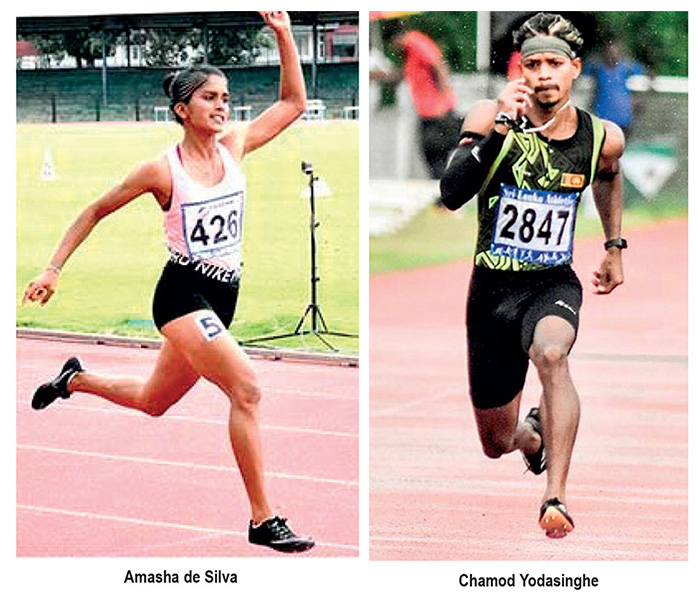
Sprinters Chamod Yodasinghe and Amasha de Silva claimed the 60m titles as the likes of Nimali Liyanarachchi and Lakshika Sugandi remained unchallenged in their respective pet events at the season opening National Short Track Championship held at the Sugathadasa Stadium 200metres track on Saturday.
Yodasinghe blazed to a 6.68 seconds finish to win the men’s 60 m final while Amasha clocked 7.55 seconds to win the women’s event after returning a time of 7.58 seconds in the heats. M.P.P. Silva and Meron Wijesinghe fiished second and third respectively in the men’s final.
In the absence of veterans Kalinga Kumarage and Anura Dharshana, Isuru Lakshan took the men’s 400 metres title in a time of 48.15 seconds, while emerging talent Kalhara Indupa finished second in a time of 49.24 seconds.
The corresponding women’s event was sans all top athletes and was won by WHM Fernando (58.97).
In the 60 metres hurdles Roshan Ranatunga (7.90secs) and veteran Lakahika Sugandi (8.69secs) were the undisputed champions.
The women’s 800 metres witnessed a close finish with veteran Nimali Liyanarachchi winning the contest in a time of 2:12.43 seconds. Ajantha Kumari (2:12.47) and Madushani Dilrukshi (2:12.85) finished second and third respectively.
Former Walala Central athlete Shehan Dilranga took the men’s 800 metres in a time of 1:52.49 seconds as experienced campaigners Harsha Karunaratne and Rusiru Chathuranga were conspicious by their absence. Pansilu Giridara (1:52.76) fiished a close second while Sanjaya Srinath finished third.
Madushani Herath had little competition in winning the women’s long lump (6.21m) and the triple jump (13.23m). A.P. Krishandan (7.50m) and Pasindu Malshan (16.11m) were the winners of the men’s long jump and triple jump respectively.
R.P. Gamage (women’s high jump – 1.71m), S.A.T Dasun (men’s high jump -2.13m), O.T. Chandrasekara (women’s shot put- 12.03m), Subeendrakumar Mithunraj (men’s shot put – 14.79m), R.A.D.H. Kumara (men’s 3000m – 8:50.50 secs) and Rasara Wijesuriya (women’s 3000m – 9:29.38 secs) were the winners of the other events.
by Reemus Fernando ✍️

Bangladesh will ask the ICC to relocate their T20 World Cup matches from India to Sri Lanka, after Kolkata Knight Riders were instructed to release Mustafizur Rahman as a result of deteriorating political ties between Bangladesh and India.
The BCB is expected to write to the ICC to raise their concerns about player safety in Kolkata, where Bangladesh are scheduled to play their first three matches of the World Cup next month.
Following the BCB’s emergency meeting of board directors over Zoom on Saturday, the media committee chairman Amzad Hussain told ESPNcricinfo: “We have three matches of the T20 World Cup in Kolkata, so we will write to the ICC regarding what has happened today.”
Bangladesh’s sports adviser Asif Nazrul said that he has doubts about the team’s safety in India, after the BCCI cited “recent developments” in their explanation for Mustafizur’s removal from the IPL, adding that he will instruct the BCB to write to the ICC about moving their matches to Sri Lanka.
“I have asked the BCB to explain the entire matter to the ICC,” Nazrul wrote on his official Facebook page. “The board should inform that where a Bangladeshi cricketer cannot play in India despite being contracted, the entire Bangladeshi cricket team cannot feel safe going to play in the World Cup. I have also instructed the Board to request that Bangladesh’s World Cup matches be held in Sri Lanka.”
Nazrul added that he has requested the country’s information and broadcasting ministry to stop showing the IPL in Bangladesh.
Following the BCCI’s instructions, KKR confirmed that they have released Mustafizur from their squad for the 2026 IPL. KKR had acquired the left-arm fast bowler’s services for 9.2 crore in the IPL auction last month, though they faced a backlash for their selection in the last few days from Indian spiritual and political leaders.
Interestingly, the BCB had announced their home schedule for 2026 on Friday, including white-ball matches against India, a series that was postponed from 2025.
Bangladesh’s T20 World Cup matches are scheduled to be held in Kolkata and Mumbai, with their opening fixture against West Indies at Eden Gardens on February 7.
[Cricinfo]

PM lays foundation stone for seven-storey Sadaham Mandiraya

Showers will occur at times in the Eastern and Uva provinces and in Nuwara-Eliya, Matale, Polonnaruwa, and Mullaittivu districts

Curran, bowlers lead Desert Vipers to maiden ILT20 title

PUCSL and Treasury under IMF spotlight as CEB seeks 11.5% power tariff hike

Bellana says Rs 900 mn fraud at NHSL cannot be suppressed by moving CID against him

First harvest of rice offered to Dalada Maligawa

‘Dates have the highest sugar content to fight Coronavirus’

Sunday Island 27 December – Headlines

#SundayIsland 17th December – Headlines

Sunday Island – 28th March

Sunday Island Headlines – 21 March

Sunday Island – 21st February – Headlines
-

 News3 days ago
Health Minister sends letter of demand for one billion rupees in damages
-

 News15 hours ago
Private airline crew member nabbed with contraband gold
-

 Features7 days ago
It’s all over for Maxi Rozairo
-
 News6 days ago
Leading the Nation’s Connectivity Recovery Amid Unprecedented Challenges
-

 Opinion5 days ago
Remembering Douglas Devananda on New Year’s Day 2026
-

 News7 days ago
Dr. Bellana: “I was removed as NHSL Deputy Director for exposing Rs. 900 mn fraud”
-

 News6 days ago
Dons on warpath over alleged undue interference in university governance
-

 Features7 days ago
Rebuilding Sri Lanka Through Inclusive Governance