
Features
After the elephant charge, exploring the parks around Arugam Bay

by Dianthi S. U. Wijeratne
(Continued from last week)
The following morning looked gloomy with an overcast sky. The sounds of the birds were the same as on any other day. The river looked quite full. Most probably it had rained upstream, since the water looked like chocolate milk. Fortunately we had taken drinking water, which was used for cooking purposes. We had to be satisfied with the river water to wash ourselves. After a quick breakfast, the damage caused by the elephant was inspected. It was small wonder that nothing had happened to either engine. The mechanic who was brought from the village confirmed this, much to our relief.
It rained almost the entire day. It was miserable being in the campsite. In addition to all we had gone through, I found a garuda, which is a giant-sized centipede about six inches in length, crawling on our tent. It had rained so hard that some of the tents were falling apart as the earth to which they were tethered with spikes was soft and the roof of the tents was heavy with collected water. One tent was so full of water that certain personal belongings were floating inside. Even though it was miserable being at the campsite we had no choice but to wait till the police report regarding the accident was taken for insurance purposes.
The following day we decided to pack up and return home one day earlier. The police officers had told my husband that our vehicle had been about the twenty-fifth that had been damaged by elephants. We were later informed that the elephant, which damaged our vehicle, was being referred to as “Mitsubishi”, after the make of our pick-up.
After that fateful day I decided never to go to Wasgamuwa again, and none of us has been there since. Having nightmares about elephants chasing me is nothing new since that day. I doubt my ever wanting to go there again. With the experience we had, I personally think it would be a good idea for park officials to hand over flares to trackers to be used in an emergency.
National Parks around Arugam Bay
Having checked the maps for a couple of days and after consulting others, a decision was made to go to Arugam Bay through Tanamalwila. Though it was a longer route, the drive was supposed to be easier than via Belihul Oya. Seventeen of us, including three children, set off in three vehicles just before 3.30 am on our long journey on July 20, 2002. Traveling to these war-torn areas, which were out of bounds for 20 years, was made possible as a result of the on-going peace process.
On reaching Udawalawe we stopped at the causeway to watch a herd of elephants in the National Park grazing in the morning sun. Later on, as it became warmer, the herd gradually retreated into the jungle. Having broken journey and flexing our muscles at Udawalawe, we proceeded to our destination, of course breaking journey several times in between. There were people in our party who had never been to Arugam Bay all their lives. I was told that I had been to the place at a very young age but have no memories of it.
Lahugala
Eight miles before Potuvil is Lahugala National Park. I have visited the place as a child with my parents and brother. At the time I remember having stayed in the bungalow overlooking Lahugala tank. There were two rooms in the bungalow, one of which my elder brother and I shared. I also remember my brother waking me up early morning to show me elephants, which usually feed on beru grass. I was so sleepy that I found it difficult to keep my eyes open, but somehow managed to keep awake.
We were too scared to walk to the other room to wake our parents. We, therefore, kept an eye on the elephants, for which the tank was famous, till the sun came out. Lo and behold, was I not angry with my brother for having woken me up early and having kept me awake for so long, only to find that we had been staring at some huge rocks!
On our recent trip in July 2002, we learned that this bungalow had been demolished during the height of the war, with a few walls remaining. The rocks that were visible many years ago, were all covered with large trees that were growing around them. An army camp had been set up by the main road nearby. On our visit there were no barricades on the access road, but I am sure a couple of years ago no vehicles would have been allowed to pass the camp without permission, and hardly anyone would have dared to go that way either.
We were lucky to see quite a large herd of elephants in the far corner of Lahugala tank. At Kitulana tank, the other reservoir close by, we again managed to spot a few elephants feeding on the same type of grass.
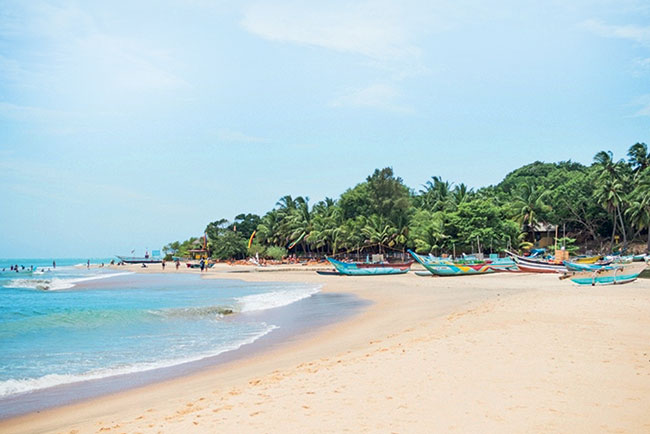
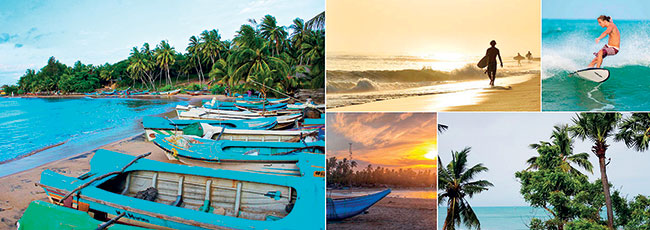
By lunchtime we reached Arugam Bay which has been internationally selected as one of the best places in the world for wind surfing. There were quite a number of tourists who were surfing and it was a welcome sight after all these years of hardship and war. The view of the beach was really enticing, and a sea bath in the bay is a must.
Magul Maha Vihare
After lunch at the hotel, where we were served the largest prawns I have ever seen, we again visited Lahugala National Park. Having watched a few elephants at Lahugala, we visited the nearby Magul Maha Vihare. A Buddhist monk explained to us that this was the place where King Kavantissa had married Vihara Maha Devi. Its very name, magul implies a marriage. Apparently the princess had been floated alone in a boat at sea by her father, the king, at Kelaniya in order to safeguard his capital from the wrath of the gods.
The princess survived the trip. King Kavantissa had been informed that a princess was drifting round Kirinda near Yala. On hearing this the king had gone to a village and asked the villagers ko Kumari?, which meant, “where is the princess?” That village was hence referred to as Komari and the name has survived to this day. The king then went to Sangamankanda, which was the village next to Komari, whence he could access the beach. There he was told that the princess had drifted away and was in ara gamey, meaning “that village”. Hence the name Arugam was coined. Sangamankanda is only 10 miles away from Arugam Bay.
The monk also showed us the unique moonstone found there, which had a mahout etched on every other elephant. According to him there is no other moonstone in the country which shows a mahout on elephant back.
Likewise, he said that another unique factor was the stone border seen around the magul maduwa where the king and princess were married. Generally, such borders depict figures with large protruding abdomens, known as bahirawayas, but this one had a lion alternating with a punkalasa, which is a pot with coconut flowers. This is considered a sign of prosperity. The entire magul maduwa is of stone.
There is another place that carries the same name and the same legend that King Kavantissa was married there. It is situated on the track that runs from Yala to the temple at Situlpahuwa. Like the temple near Lahugala, this monument too is in thick jungle, where once we saw a large elephant feeding a few yards from the monastery.
However, this Magul Maha Vihare has no significant archaeological remains. There is a rock cave with a drip ledge above, which signifies an ancient monastery, the refuge of monks who lived a spartan life led by meditation. The priest at the temple near Lahugala told us that his Magul Maha Vihare was the real one.
Kudimbigala hermitage
The next morning we set off through Panama to Kumana, which is about 23 miles away. There were vast paddy fields on either side of the road before and after crossing the bridge over Hada Oya. Then one enters the thick jungle. The route we took was a seasonal pilgrim path from Potuvil to Kataragama. The pilgrims cross Kumbukkan Oya at Kumana, and entering Block 2 of Ruhuna National Park, reach Kataragama during the season.
On the way, we visited the famous Kudimbigala hermitage. It was a fair climb to the top. On the way, in rock caves, there were a couple of small rooms known as kuti used by individual monks to meditate. There were ponds, dagabas, and a few other ruins to be seen. The monk who met us said that terrorists had blasted the library and destroyed all the books that were in it. The three dagabas on three different rocks had been broken into and treasures stolen by vandals within 100 days of the start of the peace process.
The same vandals had poured coconut oil, which had been kept there for pilgrims to light lamps with, on a limestone Buddha statue. This act of theirs had destroyed the appearance of the statue but not the faith. An unusual finding was the presence of a fresh water well on top of the mountain.
Hanging on a tree was a bell made of a hollow log. A strip of wood about two inches wide and three to four feet long, fashioned out of a hollow log, lay by the side of the path. While we were on top of the mountain with the priest, it was time for the monks’ lunch. One of the monks thumped a similar bell that was hung in a comer with a piece of wood in a slow motion and gradually increased the tempo, followed by a decreasing sound. This was an indication to the rest of the monks who were meditating that it was time for alms. That was also an indication for us to take our leave.
Kumana
We passed Okanda Murugan temple. There were hundreds of devotees seen at this temple. They were cooking their own food in very large pots and pans.
We came across the famous Bagura plains near Kumana. It was a vast extent of land which had been famous for deer, but we did not have the pleasure of seeing a single. The drought was so severe that very little water was seen anywhere. In the party that accompanied me, only my father had been to Kumana before, and therefore only he knew what was where. Kumana was famous for birds, but we saw only a few of them.
The road was in a pretty poor condition, and this made the journey very tiring. We finally came to the former Kumana campsite. We were surprised to see two buildings namely a kovil or Hindu temple built on the bank of Kumbukkan Oya and a sales outlet nearby, which had not been there some years ago.
We traveled a little further down Kumbukkan Oya and had our lunch. The water in the river was stationary as in a lake, for its mouth (moya kata) had been blocked with sand due to the drought. It was a serene sight, with the thick jungle on either side and the blue sky reflected off the still waters.
One could just imagine how the campers of days gone by would have enjoyed their stay here. Of course, the water that remained was too stagnant for a bath, though it was most inviting to wash off one’s tiredness. After lunch we turned back to return to Arugam Bay. On the way at dusk we saw around ten jackals in a pack running back and forth across the road, probably looking for food. I managed to spot five elephants during the entire trip. My father informed me later that he had been to Kumana on several occasions, but he had never seen an elephant. I was quite pleased with myself on hearing this.
We noticed farmers burning logs on the side of the road near the paddy fields. These fields cover a large area and extend as far as the eye could see. I understand that a group of owners get together and light similar fires right round the paddy field in order to prevent elephants from destroying the crop.
I did a more recent trip to Kumana in the latter part of December 2002. While returning at night, I noticed a tusker feeding in a paddy field, while the house in which the owners lived was quite close by.
This was just outside Arugam Bay. When questioned why she did not chase away the elephant, the woman in the house mentioned that in that case the tusker would pull down her hut. Fortunately for her, the elephant was disturbed by our vehicles, and he jumped over the barbed wire fence and left the field.
(To be continued)
(Excerpted from Jungle Journeys in
Sri Lanka edited by CG Uragoda)






 The world’s most powerful military swoops into Venezuela, in the dead of night, captures a sitting President, and spirits him away to face drug trafficking charges in New York. The entire operation, complete with at least 40 casualties, was announced by President Trump as ‘extraordinary’ and ‘brilliant.’ You’d think global financial markets would panic. Oil prices would spike. Stock markets would crash. Instead, something strange happened: almost nothing.
Oil prices barely budged, rising less than 2% before settling back. Stock markets actually rallied. The US dollar remained steady. It was as if the world’s financial markets collectively shrugged at what might be the most brazen American military intervention since the 1989 invasion of Panama.
But beneath this calm surface, something far more significant is unfolding, a fundamental reshaping of global power dynamics that could define the next several decades. The story of Trump’s Venezuela intervention isn’t really about Venezuela at all. It’s about oil, money, China, and the slow-motion collapse of the international order we’ve lived under since World War II. (Figure 1)

The Oil Paradox
Venezuela sits on the world’s largest proven oil reserves, more than Saudi Arabia, more than Russia. We’re talking about 303 billion barrels. This should be one of the wealthiest nations on Earth. Instead, it’s an economic catastrophe. Venezuela’s oil production has collapsed from 3.5 million barrels per day in the late 1990s to less than one million today, barely 1% of global supply (Figure 1). Years of corruption, mismanagement, and US sanctions have turned treasure into rubble. The infrastructure is so degraded that even if you handed the country to ExxonMobil tomorrow, it would take a decade and hundreds of billions of dollars to fix.
This explains why oil markets barely reacted. Traders looked at Venezuela’s production numbers and basically said: “What’s there to disrupt?” Meanwhile, the world is drowning in oil. The global market has a surplus of nearly four million barrels per day. American production alone hit record levels above 13.8 million barrels daily. Venezuela’s contribution simply doesn’t move the needle anymore (Figure 1).
But here’s where it gets interesting. Trump isn’t just removing a dictator. He’s explicitly taking control of Venezuela’s oil. In his own words, the country will “turn over” 30 to 50 million barrels, with proceeds controlled by him personally “to ensure it is used to benefit the people of Venezuela and the United States.” American oil companies, he promised, would “spend billions of dollars” to rebuild the infrastructure.
This isn’t subtle. One energy policy expert put it bluntly: “Trump’s focus on Venezuelan oil grants credence to those who argue that US foreign policy has always been about resource extraction.”
The Real Winners: Defence and Energy
While oil markets stayed calm, defence stocks went wild. BAE Systems jumped 4.4%, Germany’s Rheinmetall surged 6.1%. These companies see what others might miss, this isn’t a one-off. If Trump launches military operations to remove leaders he doesn’t like, there will be more.
Energy stocks told a similar story. Chevron, the only U.S. oil major currently authorised to operate in Venezuela, surged 10% in pre-market trading. ExxonMobil, ConocoPhillips, and oil services companies posted solid gains. Investors are betting on lucrative reconstruction contracts. Think Iraq after 2003, but potentially bigger.
The catch? History suggests they might be overly optimistic. Iraq’s oil sector was supposed to bounce right back after Saddam Hussein fell. Twenty years later, it still hasn’t reached its potential. Afghanistan received hundreds of billions in reconstruction spending, most of which disappeared. Venezuela shares the same warning signs: destroyed infrastructure, unclear property rights, volatile security, and deep social divisions.
China’s Venezuela Problem
Here’s where the story gets geopolitically explosive. China has loaned Venezuela over $60 billion, since 2007, making Venezuela China’s biggest debtor in Latin America. How was Venezuela supposed to pay this back? With oil. About 80% of Venezuelan oil exports were going to China, often at discounted rates, to service this debt.
Now Trump controls those oil flows. Venezuelan oil will now go “through legitimate and authorised channels consistent with US law.” Translation: China’s oil supply just got cut off, and good luck getting repaid on those $60 billion in loans.
This isn’t just about one country’s debt. It’s a demonstration of American power that China cannot match. Despite decades of economic investment and diplomatic support, China couldn’t prevent the United States from taking over. For other countries considering Chinese loans and partnerships, the lesson is clear: when push comes to shove, Beijing can’t protect you from Washington.
But there’s a darker flip side. Every time the United States weaponizes the dollar system, using control over oil sales, bank transactions, and trade flows as a weapon, it gives countries like China more reason to build alternatives. China has been developing its own international payment system for years. Each American strong-arm tactic makes that project look smarter to countries that fear they might be next.
The Rules Are for Little People
Perhaps the most significant aspect of this episode isn’t economic, it’s legal and political. The United States launched a military operation, captured a President, and announced it would “run” that country indefinitely. There was no United Nations authorisation. No congressional vote. No meaningful consultation with allies.
The UK’s Prime Minister emphasised “international law” while waiting for details. European leaders expressed discomfort. Latin American countries split along ideological lines, with Colombia’s President comparing Trump to Hitler. But nobody actually did anything. Russia and China condemned the action as illegal but couldn’t, or wouldn’t, help. The UN Security Council didn’t even meet, because everyone knows the US would just veto any resolution.
This is what scholars call the erosion of the “rules-based international order.” For decades after World War II, there was at least a pretense that international law mattered, that sovereignty meant something. Powerful nations bent those rules when convenient, but they tried to maintain appearances.
Trump isn’t even pretending. And that creates a problem: if the United States doesn’t follow international law, why should Russia in Ukraine? Why should China regarding Taiwan? Why should anyone?
What About the Venezuelan People?
Lost in all the analysis are the actual people of Venezuela. They’ve suffered immensely. Inflation is 682%, the highest in the world. Nearly eight million Venezuelans have fled. Those who remain often work multiple jobs just to survive, and their cupboards are still bare. The monthly minimum wage is literally 40 cents.
Many Venezuelans welcomed Maduro’s removal. He was a brutal dictator whose catastrophic policies destroyed the country. But they’re deeply uncertain about what comes next. As one Caracas resident put it: “What we don’t know is whether the change is for better or for worse. We’re in a state of uncertainty.”
Trump’s explicit focus on oil control, his decision to work with Maduro’s own Vice President, rather than democratic opposition leaders, and his promise that American companies will “spend billions”, all of this raises uncomfortable questions. Is this about helping Venezuelans, or helping American oil companies?
The Bigger Picture
Financial markets reacted calmly because the immediate economic impacts are limited. Venezuela’s oil production is already tiny. The country’s bonds were already in default. The direct market effects are manageable. But markets might miss the forest for the trees.
This intervention represents something bigger: a fundamental shift in how powerful nations behave. The post-Cold War era, with its optimistic talk of international cooperation and rules-based order, was definitively over. We’re entering a new age of imperial power politics.
In this new world, military force is back on the table. Economic leverage will be used more aggressively. Alliance relationships will become more transactional. Countries will increasingly have to choose sides between competing power blocs, because the middle ground is disappearing.
The United States might win in the short term, seizing control of Venezuela’s oil, demonstrating military reach, showing China the limits of its influence. But the long-term consequences remain uncertain. Every country watching is drawing conclusions about what it means for them. Some will decide they need to align more closely with Washington to stay safe. Others will conclude they need to build alternatives to American-dominated systems to stay independent.
History will judge whether Trump’s Venezuela gambit was brilliant strategy or reckless overreach. What we can say now is that the comfortable assumptions of the past three decades, that might not be right, that international law matters, that economic interdependence prevents conflict, no longer hold.
Financial markets may have yawned at Venezuela. But they might want to wake up. The world just changed, and the bill for that change hasn’t come due yet. When it does, it won’t be measured in oil barrels or bond prices. It will be measured in the kind of world we all have to live in, and whether it’s more stable and prosperous, or more dangerous and divided.
That’s a question worth losing sleep over.
(The writer, a senior Chartered Accountant and professional banker, is Professor at SLIIT, Malabe. The views and opinions expressed in this article are personal.)

Bob (not his real name) who worked in a large business organisation was full of new ideas. He went out of his way to help his colleagues in difficulties. His work attracted the attention of his superiors and they gave him a free hand to do his work. After some time, Bob started harassing his female colleagues. He used to knock against them in order to kick up a row. Soon he became a nuisance to the entire staff. When the female colleagues made a complaint to the management a disciplinary inquiry was conducted. Bob put up a weak defence saying that he had no intention to cause any harm to the females on the staff. However, he was found guilty of harassing the female colleagues. Accordingly his services were terminated.
Those who conducted the disciplinary inquiry concluded that Bob was a psychopath. According to psychologists, a psychopath is a person who has a serious and permanent mental illness that makes him behave in a violent or criminal way. Psychologists believe that one per cent of the people are psychopaths who have no conscience. You may have come across such people in films and novels. The film The Silence of the Lambs portrayed a serial killer who enjoyed tormenting his innocent victims. Apart from such fictional characters, there are many psychopaths in big and small organisations and in society as well. In a reported case Dr Ahmad Suradji admitted to killing more than 40 innocent women and girls. There is something fascinating and also chilling about such people.
People without a conscience are not a new breed. Even ancient Greek philosophers spoke of ‘men without moral reason.’ Later medical professionals said people without conscience were suffering from moral insanity. However, all serial killers and rapists are not psychopaths. Sometimes a man would kill another person under grave and sudden provocation. If you see your wife sleeping with another man, you will kill one or both of them. A world-renowned psychopathy authority Dr Robert Hare says, “Psychopaths can be found everywhere in society.” He developed a method to define and diagnose psychopathy. Today it is used as the international gold standard for the assessment of psychopathy.
No conscience
According to modern research, even normal people are likely to commit murder or rape in certain circumstances. However, unlike normal people, psychopaths have no conscience when they commit serious crimes. In fact, they tend to enjoy such brutal activities. There is no general consensus whether there are degrees of psychopathy. According to Harvard University Professor Martha Stout, conscience is like a left arm, either you have one or you don’t. Anyway psychopathy may exist in degrees varying from very mild to severe. If you feel remorse after committing a crime, you are not a psychopath. Generally psychopaths are indifferent to, or even enjoy, the torment they cause to others.
In modern society it is very difficult to identify psychopaths because most of them are good workers. They also show signs of empathy and know how to win friends and influence people. The sheen may rub off at any given moment. They know how to get away with what they do. What they are really doing is sizing up their prey. Sometimes a person may become a psychopath when he does not get parental love. Those who live alone are also likely to end up as psychopaths.
Recent studies show that genetics matters in producing a psychopath. Adele Forth, a psychology professor at Carleton University in Canada, says callousness is at least partly inherited. Some psychopaths torture innocent people for the thrill of doing so. Even cruelty to animals is an act indulged in by psychopaths. You have to be aware of the fact that there are people without conscience in society. Sometimes, with patience, you might be able to change their behaviour. But on most occasions they tend to stay that way forever.
Charming people
We still do not know whether science has developed an antidote to psychopathy. Therefore remember that you might meet a psychopath at some point in your life. For now, beware of charming people who seem to be more interesting than others. Sometimes they look charismatic and sexy. Be wary of people who flatter you excessively. The more you get to know a psychopath, the more you will understand their motives. They are capable of telling you white lies about their age, education, profession or wealth. Psychopaths enjoy dramatic lying for its own sake. If your alarm bells ring, keep away from them.
According to the Psychiatric Diagnostic Manual, the behaviour of a psychopath is termed as antisocial personality disorder. Today it is also known as sociopath. No matter the name, its hallmarks are deceit and a reckless disregard for others. A psychopath’s consistent irresponsibility begets no remorse – only indifference to the emotional pain others may suffer. For a psychopath other people are always ‘things’ to be duped, used and discarded.
Psychopathy, the incapacity to feel empathy or compassion of any sort or the least twinge of conscience, is one of the more perplexing of emotional defects. The heart of the psychopath’s coldness seems to lie in their inability to make anything more than the shallowest of emotional connections.
Absence of empathy is found in husbands who beat up their wives or threaten them with violence. Such men are far more likely to be violent outside the marriage as well. They get into bar fights and battling with co-workers. The danger is that psychopaths lack concern about future punishment for what they do. As they themselves do not feel fear, they have no empathy or compassion for the fear and pain of their victims.
karunaratners@gmail.com
By R.S. Karunaratne

A positive feature of the government that is emerging is its responsiveness to public opinion. The manner in which it has been responding to the furore over the Grade 6 English Reader, in which a weblink to a gay dating site was inserted, has been constructive. Government leaders have taken pains to explain the mishap and reassure everyone concerned that it was not meant to be there and would be removed. They have been meeting religious prelates, educationists and community leaders. In a context where public trust in institutions has been badly eroded over many years, such responsiveness matters. It signals that the government sees itself as accountable to society, including to parents, teachers, and those concerned about the values transmitted through the school system.
This incident also appears to have strengthened unity within the government. The attempt by some opposition politicians and gender misogynists to pin responsibility for this lapse on Prime Minister Dr Harini Amarasuriya, who is also the Minister of Education, has prompted other senior members of the government to come to her defence. This is contrary to speculation that the powerful JVP component of the government is unhappy with the prime minister. More importantly, it demonstrates an understanding within the government that individual ministers should not be scapegoated for systemic shortcomings. Effective governance depends on collective responsibility and solidarity within the leadership, especially during moments of public controversy.
The continuing important role of the prime minister in the government is evident in her meetings with international dignitaries and also in addressing the general public. Last week she chaired the inaugural meeting of the Presidential Task Force to Rebuild Sri Lanka in the aftermath of Cyclone Ditwah. The composition of the task force once again reflects the responsiveness of the government to public opinion. Unlike previous mechanisms set up by governments, which were either all male or without ethnic minority representation, this one includes both, and also includes civil society representation. Decision-making bodies in which there is diversity are more likely to command public legitimacy.
Task Force
The Presidential Task Force to Rebuild Sri Lanka overlooks eight committees to manage different aspects of the recovery, each headed by a sector minister. These committees will focus on Needs Assessment, Restoration of Public Infrastructure, Housing, Local Economies and Livelihoods, Social Infrastructure, Finance and Funding, Data and Information Systems, and Public Communication. This structure appears comprehensive and well designed. However, experience from post-disaster reconstruction in countries such as Indonesia and Sri Lanka after the 2004 tsunami suggests that institutional design alone does not guarantee success. What matters equally is how far these committees engage with those on the ground and remain open to feedback that may complicate, slow down, or even challenge initial plans.
An option that the task force might wish to consider is to develop a linkage with civil society groups with expertise in the areas that the task force is expected to work. The CSO Collective for Emergency Relief has set up several committees that could be linked to the committees supervised by the task force. Such linkages would not weaken the government’s authority but strengthen it by grounding policy in lived realities. Recent findings emphasise the idea of “co-production”, where state and society jointly shape solutions in which sustainable outcomes often emerge when communities are treated not as passive beneficiaries but as partners in problem-solving.
Cyclone Ditwah destroyed more than physical infrastructure. It also destroyed communities. Some were swallowed by landslides and floods, while many others will need to be moved from their homes as they live in areas vulnerable to future disasters. The trauma of displacement is not merely material but social and psychological. Moving communities to new locations requires careful planning. It is not simply a matter of providing people with houses. They need to be relocated to locations and in a manner that permits communities to live together and to have livelihoods. This will require consultation with those who are displaced. Post-disaster evaluations have acknowledged that relocation schemes imposed without community consent often fail, leading to abandonment of new settlements or the emergence of new forms of marginalisation. Even today, abandoned tsunami housing is to be seen in various places that were affected by the 2004 tsunami.
Malaiyaha Tamils
The large-scale reconstruction that needs to take place in parts of the country most severely affected by Cyclone Ditwah also brings an opportunity to deal with the special problems of the Malaiyaha Tamil population. These are people of recent Indian origin who were unjustly treated at the time of Independence and denied rights of citizenship such as land ownership and the vote. This has been a festering problem and a blot on the conscience of the country. The need to resettle people living in those parts of the hill country which are vulnerable to landslides is an opportunity to do justice by the Malaiyaha Tamil community. Technocratic solutions such as high-rise apartments or English-style townhouses that have or are being contemplated may be cost-effective, but may also be culturally inappropriate and socially disruptive. The task is not simply to build houses but to rebuild communities.
The resettlement of people who have lost their homes and communities requires consultation with them. In the same manner, the education reform programme, of which the textbook controversy is only a small part, too needs to be discussed with concerned stakeholders including school teachers and university faculty. Opening up for discussion does not mean giving up one’s own position or values. Rather, it means recognising that better solutions emerge when different perspectives are heard and negotiated. Consultation takes time and can be frustrating, particularly in contexts of crisis where pressure for quick results is intense. However, solutions developed with stakeholder participation are more resilient and less costly in the long run.
Rebuilding after Cyclone Ditwah, addressing historical injustices faced by the Malaiyaha Tamil community, advancing education reform, changing the electoral system to hold provincial elections without further delay and other challenges facing the government, including national reconciliation, all require dialogue across differences and patience with disagreement. Opening up for discussion is not to give up on one’s own position or values, but to listen, to learn, and to arrive at solutions that have wider acceptance. Consultation needs to be treated as an investment in sustainability and legitimacy and not as an obstacle to rapid decisionmaking. Addressing the problems together, especially engagement with affected parties and those who work with them, offers the best chance of rebuilding not only physical infrastructure but also trust between the government and people in the year ahead.
by Jehan Perera

Showery condition over the island is expected to reduce from tomorrow (15th)

USA’s Ali Khan claims having been ‘denied’ India visa ahead of T20 World Cup

At least 28 dead as crane collapses onto train in Thailand

Fair weather will prevail except for a few showers in the Uva, Eastern, Western and Central provinces and in Galle, Matara and Rathnapura districts

Trump cancels US-Iran meetings, urges protesters to take over institutions

Govt. bows to pressure, shelves Grade 6 reforms

‘Dates have the highest sugar content to fight Coronavirus’

Sunday Island 27 December – Headlines

#SundayIsland 17th December – Headlines

Sunday Island – 28th March

Sunday Island Headlines – 21 March

Sunday Island – 21st February – Headlines
-

 Business4 days ago
Dialog and UnionPay International Join Forces to Elevate Sri Lanka’s Digital Payment Landscape
-
 News4 days ago
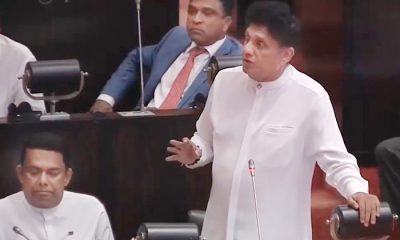
Sajith: Ashoka Chakra replaces Dharmachakra in Buddhism textbook
-

 Features4 days ago
The Paradox of Trump Power: Contested Authoritarian at Home, Uncontested Bully Abroad
-

 Features4 days ago
Subject:Whatever happened to (my) three million dollars?
-

 News3 days ago
Level I landslide early warnings issued to the Districts of Badulla, Kandy, Matale and Nuwara-Eliya extended
-

 News4 days ago
65 withdrawn cases re-filed by Govt, PM tells Parliament
-

 News3 days ago
National Communication Programme for Child Health Promotion (SBCC) has been launched. – PM
-

 Opinion6 days ago
The minstrel monk and Rafiki, the old mandrill in The Lion King – II