
News
Admonishes the system “lacked a sense of crisis”


Immigration Services Agency of Japan releases final report on the death of a Sri Lankan woman
The Immigration Services Agency of Japan on Tuesday (10) released a final report on the death of a Sri Lankan woman at a regional detention centre in central Japan, pointing to the lack of a proper medical response after she said she was feeling unwell and stating that the facility “lacked a sense of crisis and failed to accurately grasp the circumstances as an organisation,” said a report published by the Japanese daily The Mainichi.
The report filed from Tokyo said: The Sri Lankan woman, Wishma Sandamali, then 33, died at the Nagoya Regional Immigration Services Bureau in Aichi Prefecture on March 6, after she complained of nausea and numbness starting on Jan. 15 and her condition subsequently deteriorated. She had been detained at the facility since August last year after overstaying her visa since January 2019. She first came to Japan in 2017 as an international student.
The final report acknowledged that Wishma died of illness, but stated that the detailed process leading up to her death could not be determined as several factors likely played a role. The report said the regional immigration bureau’s medical response to her complaint of feeling unwell and the notable changes in her physical condition was insufficient, and presented measures for improvement to prevent a recurrence of similar incidents.
The Immigration Services Agency has admonished the then head and deputy head of the Nagoya Regional Immigration Services Bureau, and gave strict warnings to a security supervisor and another official.
The final report delved into the Nagoya immigration bureau’s medical response system. It pointed out that the detention centre had a limited medical arrangement in which it was allowed to assign a part-time internal medicine doctor only twice a week. The report then stated that senior bureau officials ought to have properly gotten a grasp of Wishma and other detainees’ physical conditions and their requests for medical examinations, and deliberated and called for the necessary responses, but that the officials failed to develop such a system.
The report revealed that many of the guards at the bureau suspected that Wishma’s complaints about poor health were “an exaggerated appeal to be granted provisional release,” raising issues for future investigation such as staff education and the assignment of interpreters to understand detainees’ physical conditions through communication.
During her detention, Wishma twice filed a request for provisional release, but her wishes were not granted. The final report said the bureau “should flexibly grant provisional release” to those with poor health conditions. As Wishma had claimed that she was subject to violence from a former partner, the report cited the need to reflect on the fact that the local bureau failed to investigate whether she was a victim of domestic violence. It also cited the need to share the content of appeals from detainees’ supporters as something that must be addressed.
In light of these points at issue, the final report produced improvement plans in order for the bureau to “advance reforms to make it an internally and externally reliable organization that respects human rights.” Specifically, the report cited measures such as the reform of all workers’ awareness, boosting its medical system, and ensuring appropriate judgment on provisional release in light of foreign detainees’ health conditions.
The agency’s investigation team probing the background to Wishma’s death conducted a total of 139 interviews with 63 individuals concerned, and also sought opinions from external specialists.


A Book on Poetry that covers the recent Historical Challenges like the Tsunami, Cyclone and the Economic Depression in Sri Lanka.
The Book Launch will be held at Vinodh Senadeera Hall, St Thomas College, Mt Lavinia on March 29th Sunday at 5.00 pm.

FAST-TRACK YOUR FUTURE AFTER O/L
Liyana Weedagamaarachchi, now a third-year Marketing Management undergraduate (University of Plymouth, UK) at NSBM Green University and a trainee at a leading marketing agency, reflects on the journey that began with the NSBM Foundation Programme.
“My journey at NSBM began with the NSBM Foundation Programme, the pathway that shaped my transition from a school leaver to university life. I joined the Foundation Programme immediately after completing my G.C.E. Ordinary Level (O/L) examinations.
The Foundation Programme didn’t just prepare me academically; it prepared me for life. I gained confidence, learned to manage my time, and developed skills that would carry me through my undergraduate degree. It gave me a head start and put me on track to graduate with an Honours degree and enter the global job market two years ahead — by the age of 21.
Beyond academics, NSBM provided countless opportunities for personal growth. I joined clubs, participated in student-led initiatives, and discovered leadership opportunities I never imagined. I had the privilege of serving as President of the Marketing Circle, and now as President of the Association of Business Management. I also discovered my voice through the NSBM Media Club.
Leading teams, organizing events, collaborating with industry partners and connecting with talented peers, all these experiences at NSBM taught me teamwork, leadership, problem-solving, and honed my skills.
Most importantly, I did all this while maintaining strong academic performance. NSBM taught me balance, resilience, and self-confidence. Every challenge I faced and every opportunity I embraced prepared me for the world beyond the university.
Joining the Foundation Programme was the step that set my entire university journey in motion. It equipped me with the tools and confidence to shape my future.”
Now, it’s your time to fast-track your future after O/L.
Registrations are now open for the 2026 March Intake of NSBM Foundation Programme!
NSBM Green University, Mahenwatta, Pitipana, Homagama
Call us: 011 544 5000 Email: inquiries@nsbm.ac.lk Web: www.nsbm.ac.lk

News
Ceylon Chamber of Commerce entrusts over a century of business history to the National Archives

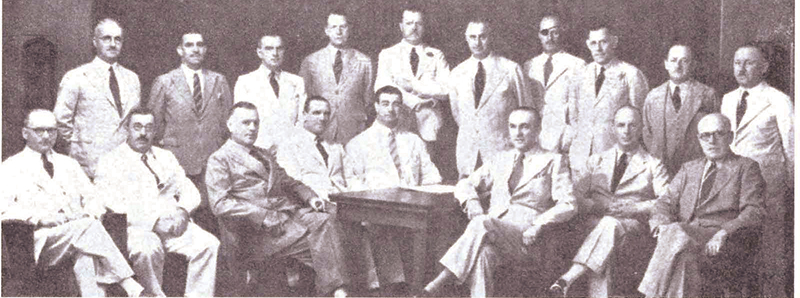
The Ceylon Chamber of Commerce has formally handed over its historical records to the National Archives Department of Sri Lanka, placing over a century of the nation’s commercial history into the care of the country’s official custodians of heritage.
The historical archive being handed over spans from the Chamber’s founding in 1839 to 1973, and includes correspondence, meeting minutes, reports, ledgers, and publications that chronicle the development of trade, enterprise, and industry in Sri Lanka. Together, these records provide a rare and detailed account of how the island’s economy evolved and how its business community helped shape national progress.
The Ceylon Chamber of Commerce was established on 25 March 1839 on the principle that the interests of commerce and trade are best advanced when merchants unite and cooperate in matters affecting the common good. At the time, Ceylon was among the earliest regions in Asia to establish a chamber of commerce, alongside counterparts in Bengal, Bombay, Madras, Canton, Penang, and Singapore.
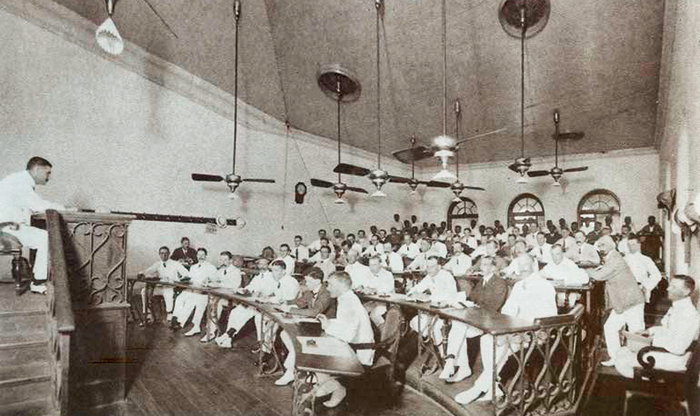
1883 First Public Tea Auction Held in Colombo

Chamber Office Bearers and Staff at the building in Lower Chatham Street, Fort shortly before the move to the new building at Navam Mawatha

Old CCC Building
From its earliest years, the Chamber played a central role in organising and guiding trade. It played a central role in establishing and growing the export economy built on commodities such as coffee, cinnamon, coconut oil, tea, and rubber, and hosted the island’s renowned tea and rubber auctions. It also developed rules and standards for trading practices, helping create an environment of trust and reliability that enabled Sri Lanka’s commerce to thrive.
Beyond facilitating trade, the Chamber was also instrumental in shaping the island’s infrastructure and connectivity. In 1858, it successfully urged the government to accept India’s proposal to link Ceylon to the Madras telegraph line, giving the island its first cable connection to the outside world. The Chamber also advocated for a government-owned Colombo–Kandy railway to connect the coast with the interior and continued to press for extensions stage by stage as the network expanded into the hill country and beyond.

Earliest dated record from 1839
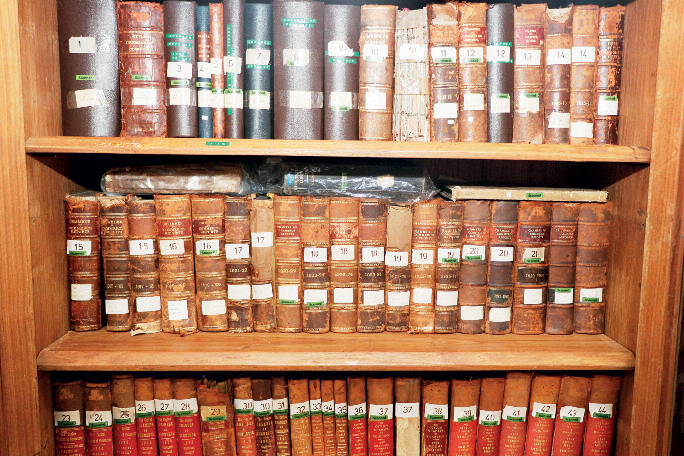
Historical Records
One of the Chamber’s most consequential interventions was in its advocacy to develop Colombo as the island’s principal port. At a time when the government was considering developing the Galle harbour, the Chamber argued strongly for Colombo instead, citing its larger cargo hinterland and the navigational hazards posed by rocks in the Galle harbour. It further recommended the construction of docks and a protective breakwater, proposals that ultimately led to Colombo emerging as one of the leading ports in the region.
Over the years, the Chamber also played a key role in establishing and supporting institutions that shaped Sri Lanka’s business environment. These include the Employers’ Federation of Ceylon, which helped structure industrial relations in the country, the Mercantile Service Provident Society, an early initiative promoting labour welfare, and the Sri Lanka Institute of Directors, which has contributed to strengthening corporate governance and leadership within the private sector.
It also established mechanisms to strengthen the broader business environment, including the CCC-ICLP Alternative Dispute Resolution Centre, created together with the Institute for the Development of Commercial Law and Practice, to provide arbitration and mediation services for commercial disputes. Earlier in its history, the Chamber also developed one of the country’s first codes of ethics to guide fair and responsible trading – standards of integrity that the Chamber continues to uphold to this day.
The records now entrusted to the National Archives document the debates, decisions, successes, and challenges that shaped generations of Sri Lanka’s business community. Through letters, reports, minutes, and accounts, the archive offers insight into the people, ideas, and enterprises that helped build the country’s economy.
At the symbolic handover of the archives to the Director General of the National Archives Department, Dr Nadeera Rupesinghe, Chairperson of the Ceylon Chamber, Mr Krishan Balendra noted that ‘today we are doing something that, at first glance, might look like simply passing on old documents and books. But in truth, we are passing on nearly two centuries of a nation’s commercial heartbeat. These records are the living memory of a nation’s trade, enterprise, and industry. By entrusting them to the National Archives Department, we are ensuring that researchers, students, and citizens will have access to this heritage, learning from the ingenuity, foresight, and courage of the people who came before us, and the legacy they left in every business, every trade route, every handshake that built this country.’
Accepting the handover, Dr Rupesinghe said, ‘the Department of National Archives hosts the memory of a nation, and we are very happy that historic records of the Ceylon Chamber, which denote the history of Sri Lanka’s business community is being entrusted to our care’.
The handover marks a significant moment in recognising the role of commerce in the story of Sri Lanka and safeguarding the institutional memory of one of the country’s oldest and most influential organisations.

From culture to empowerment: Indonesia’s vision for Sri Lanka

Nestlé Lanka celebrates 120 years of ‘Good Food, Good Life’ in Lanka

Nepal’s Mirage of Change

Ranjith Fernando celebrates cricketing journey with Hob Nails to Spikes

Sampath Bank and Apartner Bring Digital Payments to Sri Lanka’s Growing Condominium Sector

Sarath Silva googly gives CBK year less than expected, Helping Hambantota

‘Dates have the highest sugar content to fight Coronavirus’

Sunday Island 27 December – Headlines

#SundayIsland 17th December – Headlines

Sunday Island – 28th March

Sunday Island Headlines – 21 March

Sunday Island – 21st February – Headlines
-

 News6 days ago
Repatriation of Iranian naval personnel Sri Lanka’s call: Washington
-
 Features6 days ago
Winds of Change:Geopolitics at the crossroads of South and Southeast Asia
-

 News5 days ago
Prof. Dunusinghe warns Lanka at serious risk due to ME war
-

 Sports4 days ago
Royal start favourites in historic Battle of the Blues
-

 Sports3 days ago
The 147th Royal–Thomian and 175 Years of the School by the Sea
-

 News3 days ago
Historic address by BASL President at the Supreme Court of India
-

 News4 days ago
CEBEU warns of operational disruptions amid uncertainty over CEB restructuring
-

 Business4 days ago
BOI launches ‘Invest in Sri Lanka’ forum