
Sports
A champagne exit from Lord’s


36th Anniversary of Sri Lanka’s first ever Test match at Lord’s – Part 3
by Rohan Wijeyaratna
The story of this match will serve as a testament not only to the abilities of the 1984 Sri Lankan team, but also to the long cricketing tradition established through the commitment of many generations of past Ceylon cricketers, the country’s wonderful nurseries – the schools, the indefatigable coaches and the clubs that dot the island. All of them played an unseen hand in moulding the Sri Lankan sporting pedigree; an outpouring of which was seen on the first two days at Lord’s. Even though it appeared at the start that there would be only one winner and the game would be one-sided, by the end of day two many were of the view that the most agreeable cricket they witnessed during the entire summer was played on the first two days of this Test at Lord’s and the more deserving side was now on the ascendancy. Denis Compton when I met him at the end of day two put things in perspective. “You chaps today taught us how to bat” he said with disarming candour. There could have been no greater praise, coming from probably England’s finest post war batsman. Others of note – including Tom Graveney expressed similar sentiments. These were indeed heady days for all those who were from the Sri Lankan camp, be they players or spectators alike.
End of two epic innings
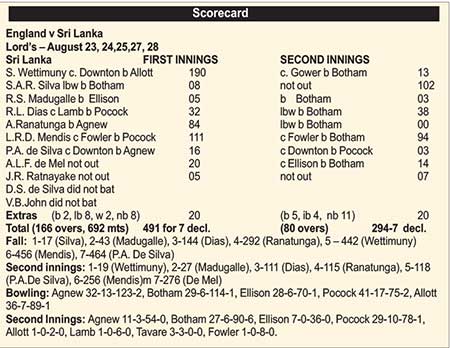
There was greater purpose and hurry seen in the Sri Lankan approach when play resumed on Day three. Mendis heaved at anything and everything, while Wettimuny was happy, playing away from his body and relying on his previous day’s form and eye. Something had to give, and it did. Wettimuny forcing Allott on the off from where he stood, managed to deflect a catch behind. That announced the end of an epic feat of endurance which lasted altogether, 642 minutes. It was till then, the longest innings ever in a Test match at Lord’s, and served as the cornerstone upon which the entire innings was built. Shortly thereafter, Mendis heaved at Pocock and holed out to Fowler at long-on. With each of those exits, the crowd rose, as a mark of their appreciation of two magnificently contrasting styles of play which lit up Lord’s in the two preceding days. The applause was long and sustained.
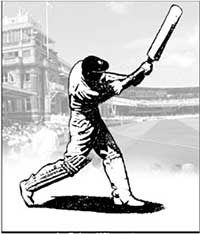
The Sri Lankan intention now appeared plain as pikestaff. De Mel being no mug with the bat, dealt some mighty blows while little Aravinda on his Test debut produced a stroke filled short burst before Mendis declared at 491 for 7. It was the highest ever score by a team playing their maiden Test in England. The closure left Sri Lanka 20 minutes of bowling before lunch.
Posterity might have been better served had the Lankans registered 500 in their very first Test outing at Lord’s, but the decision to close was not without an attacking intent. England were low in form and down in spirit, and to attack them with the new ball on either side of lunch, would give the Lankans their best chance of grabbing some early wickets. Or so they thought.
England’s first requirement was making 292 to avoid the embarrassment of a follow-on. After Fowler had escaped a near catch in the gully to the very first ball from De Mel, Vinothen John bowled a lot of tripe from the other end. It was embarrassing to watch a string of full tosses being delivered at a time when the calling was to put the batsmen under pressure. At lunch, England profiting from this unexpected windfall, were 32 for 0, after 5 overs of rapid batting. With ‘DS’ not making an appearance due to an ankle injury, bleak times portended for the Lankans.
Wretchedly out of form ….
Shortly after resumption, Fowler departed, slicing a catch to second slip. That heralded the most extraordinary passage of play in the match. Vinothen John had by now settled down while De Mel kept steaming in, giving all he got. But they both were far from menacing. The third seamer Ratnayake was largely innocuous, while D.S. de Silva making his appearance only after lunch, bowled his stock-in- trade top spinners nursing a sprained ankle. Against an attack so debilitated, Tavare and Broad went into near slumber. What followed was perhaps the most forgettable passage of play seen in a Lord’s Test for a long time. In 27 dreary overs between lunch and tea, England advanced by 49 runs, with Broad making 19 of them. Together with Tavare, the pair prodded and pushed with infuriating ordinariness, while making the Sri Lankan bowlers seem twice as threatening as they actually were. The batsmen were so out of touch, they allowed ample time and opportunity for a hopelessly ill tuned Sri Lankan attack to find its feet and some rhythm. Tavare having batted toothlessly for 20 overs, advanced to 12 by tea and when he finally went shortly after resumption for 14, he left behind the memory of a man who was so wretchedly out of form, he could hardly hit the ball outside the square.
Woodcock said it all….
 Broad not to be outdone was similarly comatose. While surviving two close lbw decisions from a tireless De Mel, he was twice dropped into the bargain. Gower the new man in, was only marginally better. By close of play 29 overs after tea, the pair had added only 58 runs more to England’s teatime score. The crowd expressed their disapproval unreservedly with some heavy barracking rarely heard at Lord’s. The two sessions since lunch had produced only 107 runs against an attack that was out of fitness and out of form. England were 139 for 2 by the close, with only 105 runs coming off their last 56 overs. John Woodcock writing in the ‘Daily Telegraph’ said “No self-respecting club side would have been content with the way England batted”. And that said it all.
England had the whole of the rest day to digest all the scorn heaped upon them in all forms of the media and bar room conversations. And if one thought there would be a reformed approach to entertain the sparse crowd on Monday, they were mistaken. In fact, by the end of the 4th day, it was generally felt that those who had stayed away from the cricket had been wise; they hadn’t missed much at all.
Lacked imagination
When play resumed on day four Broad and Gower played as though their intention was to bat out the entire day; never mind the prevailing crowd sentiment. England made 71 in the morning session for the loss of Broad shortly before lunch. When De Mel removed Gower with the second new ball shortly after lunch and Botham soon followed, England were 218 for five; still some distance away from avoiding the follow on.
England averted that ignominy through a Lamb – Ellison partnership which realised 87 priceless runs together. Lamb grassed by the keeper when on 36, went on to complete his 4th Test hundred of the summer and when Ellison went for 41, the tireless De Mel accounted for both Downton and Allott in successive balls. With the exit of Pocock and then Lamb off the last ball of the day England were all out for 370, and were trailing Sri Lanka by 121 runs with one more day to go.
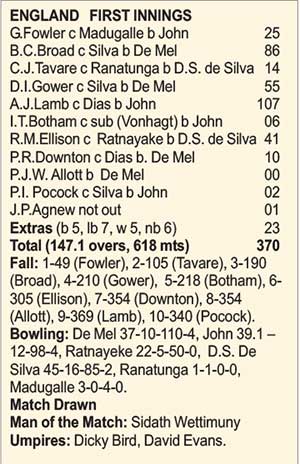 Had England the imagination or desire to give themselves the slightest sniff at a possible chance of victory, they might have rotated the strike and pushed up the run rate, allowing themselves the opportunity to declare sometime after the follow on was averted. But Gower ‘s intransigence and lack of enterprise had been a feature throughout the match. Accordingly, Sri Lanka went into the fifth day, knowing full well the game would only be one of academic interest. Allott pulling a muscle left the proceedings after only one over, while Agnew’s front foot was eternally at odds with the popping crease. This meant that Pocock had to manfully bear the brunt of the attack, along with Botham who was finally reduced to bowling off spin to men adept at playing them in their sleep. That he captured six of the seven wickets to fall may not fully reflect the merit of his performance, although initially, he found some rhythm and swing and snaked a few past the defense of some of the early batsmen. During this effort, Botham surpassed both Fred Trueman and Lance Gibbs’ Test wicket hauls and became the third in line, behind Dennis Lillee and Bob Willis in the all time highest wicket takers’ list at the time. With the 80th over bowled, Sri Lanka declared, to bring to a close a game which was meandering without purpose. It was an ending the tired Englishmen embraced with open arms and a huge sigh of relief.
Near twin centuries
But that ending came not before another show-piece effort from Mendis who came within a whisker of making twin centuries in his debut Test at Lord’s. Had he done so he would have joined the famous George Headley as only the second in the game’s history to do so. Mendis biffed the bowling with such gay abandon, he made 94 in 97 balls in just over two hours of batting, while reducing Botham to bowling off spin off just two paces, as the effort of a run up wasn’t worth it. Apart from Mendis, the white-helmeted Amal Silva contributed to the score with an unbeaten 102. It was his maiden first class hundred and in only his second Test match.
Unprecedented publicity
No one would deny Sri Lanka’s magnificent showing at Lord’s added considerably to their rising cricketing stock. In fact, no amount of Ambassadors or Politicians could have matched or done more to get their country such creditworthy mention in every single major English newspaper and every single BBC World Service news bulletin for the better part of a week. Had they a more penetrative attack and had their fielding been consistently sharper, the Lankans might have pulled off an improbable win and added to England’s woeful record of losing every single Test match that summer. Though drawn, England were at the receiving end for most of the match and deserved the sobriquet of possibly, the weakest Test team among the seven Test playing nations at the time. While it was an unforgettable Test match for the Sri Lankans, for England the experience was a bolt out of the blue and brought down the curtain on a most forgettable summer.




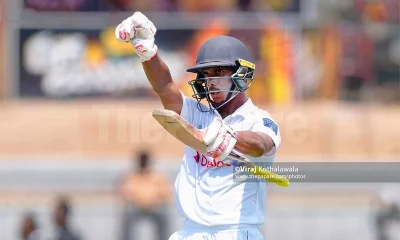


Open batsman Aveesha Samash produced a superb century to power St. Joseph’s College to a commanding first-day total against Prince of Wales College in their Under 19 Division I Tier ‘A’ semi-final encounter at the D.H.H. Ground, Madampella on Monday.
Samash top scored with a brilliant 122 runs, striking 14 fours and three sixes, as the Josephians piled up an imposing 354 in their first innings.
Asked to take first lease of the wicket, St. Joseph’s suffered an early setback, losing two wickets for just 16 runs. However, Samash steadied the innings with a crucial third wicket partnership alongside Pamoda Dalpadado. The pair added a valuable 173 runs to turn the match in favour of the Josephians.
Batting for more than thirty overs together, Samash played the aggressor’s role while Dalpadado provided steady support, ensuring the Joes rebuilt strongly and maintained control of the contest. Dalpadado contributed a well-compiled 64 before being caught by Rusandu Silva off the bowling of Oshan Maneesha, who emerged as the pick of the Prince of Wales bowlers.
Samash continued his fluent innings to reach a well-deserved century before being dismissed after laying a solid platform for his side.
Following their departures, Chethina Kavinda added a useful 34 while Nushan Perera accelerated the scoring with an entertaining 60 off 68 balls, which included nine boundaries and a six, helping the Josephians reach their formidable total of 354.
For Prince of Wales, Oshan Maneesha led the bowling effort with good support from Nethul Anuhas and Rusandu Silva, who claimed two wickets each.
At stumps on the opening day, the Cambrians safely negotiated one over each from Nushan Perera and Vishwa Peiris without losing a wicket, beginning their reply cautiously.
Scores:
St. Joseph’s 354 all out in 78.3 overs (Aveesha Samash 122, Pamoda Dalpadado 64, Nushan Perera 60, Chethina Kavinda 34; Oshan Maneesha 4/91, Nethul Anuhas 2/83, Rusandu Silva 2/39).
Prince of Wales
3 for no loss in 2 overs. (RF)

Sri Lanka made an impressive start on the opening day of the ITF Asia Under-14 Development Championship finals as five local players recorded victories at the Sri Lanka Tennis Association courts on Monday.
The tournament, which will run until April 19, features young tennis talent from fourteen Asian nations competing for honours. Teams from Hong Kong, India, South Korea, Kazakhstan, Indonesia, Kyrgyzstan, Malaysia, Nepal, Myanmar, Syria, Chinese Taipei, Uzbekistan, Thailand and hosts Sri Lanka are taking part in the championship.
Sri Lanka’s girls produced a strong showing in the first round with three convincing victories. Navya Banagala delivered a dominant performance to defeat Leisan Laksova of Kazakhstan 6-1, 6-0. Sahansa Damsiluni also impressed as she overcame M. Akramov of Uzbekistan 6-4, 6-2. Dinethma Ekanayake completed the successful outing for the girls with a comfortable 6-0, 6-2 win against Vin Miyo Aye of Myanmar.
In the boys’ competition, Buvindu Jayawardhne fought back strongly after losing the first set to beat Nepal’s Bishwo Dallakot 4-6, 6-2, 6-2. Chirath Subasinghe added another victory for the hosts with a convincing 6-4, 6-0 win over Aung Zay of Myanmar.
With five players progressing after the opening round, Sri Lanka enjoyed a promising start to the championship as the young national hopefuls look to make their mark against some of Asia’s emerging tennis talent.

Arrangements have been made to conduct the 71st National Billiards Championship 2026 sponsored by Automobile Association of Ceylon (AAC) and conducted by the Billiards & Snooker Association of Sri Lanka.
It is the fourth consecutive year that the sponsors have come forward to bear the cost of the championship.
The organisers envisage that there will be around 100 players taking part from around the country. The Championship will constitute of three segments, namely, district, the all Island and finally the national segment.
The 16 seeded players who played the Nationals last year will play for laurels this year too. In addition, the All Island level matches will comprise the players relegated from the last year Nationals and players who will be selected from the districts at this year’s tournament.
The matches will be played at the billiards parlor of the Association and the final matches will take place at the Automobile Association of Ceylon tables.
Affiliated clubs from the entire country are entitled ti enter for this year’s tournament. Most of the entries are expected from the tri forces players.
The proud record that billiards have established in the country dates back to 1973 where M J M Lafir annexed the World ‘s Billiards Championship played in India.

SJB: Litro, Laugfs making a killing by selling old stocks at inflated prices

UN Regional Director launches SL’s first Country Gender Equality Profile during official visit

Programme to expand cadet corps in schools to promote national reconciliation

50,000 litres of hoarded fuel seized in raids

Samash smashes century as Joes post 354

‘Tap expertise, not just capital’: A practical path for Sri Lanka’s economy

‘Dates have the highest sugar content to fight Coronavirus’

Sunday Island 27 December – Headlines

#SundayIsland 17th December – Headlines

Sunday Island – 28th March

Sunday Island Headlines – 21 March

Sunday Island – 21st February – Headlines
-

 News5 days ago
2025 GCE AL: 62% qualify for Uni entrance; results of 111 suspended
-

 Features2 days ago
Ranjith Siyambalapitiya turns custodian of a rare living collection
-

 News2 days ago
Global ‘Walk for Peace’ to be held in Lanka
-

 Business6 days ago
Hour of reckoning comes for SL’s power sector
-

 Editorial5 days ago
Search for Easter Sunday terror mastermind
-

 Opinion4 days ago
Hidden truth of Sri Lanka’s debt story: The untold narrative behind the report
-
Editorial6 days ago
Ideological confusion and identity crisis
-

 Opinion5 days ago
Is there hope for Palestine?