
News
India and China exchange comprehensive disengagement proposals after 50 years

BY S VENKAT NARAYAN,
Our Special Correspondent
NEW DELHI, October 17:
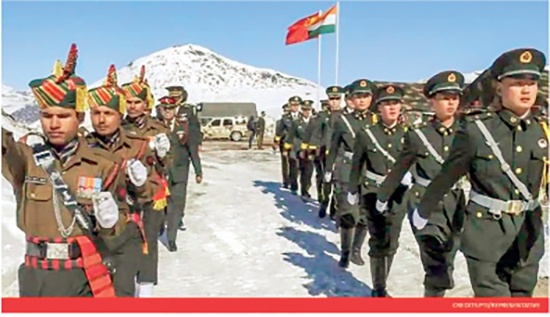
Perhaps for the first time since India and China fought a bloody war in the Himalayas in 1962, the two Asian giants appear to be engaged in discussing serious proposals for disengagement their armies along the Line of Actual Control (LAC).
After seven rounds of meetings between Indian and Chinese military commanders in eastern Ladakh, the two sides have exchanged serious proposals for disengagement that are currently being studied by the top echelons of the Indian government.
Though sources are tight-lipped about the development, it is believed that India is looking for a “comprehensive” disengagement that covers all the friction points along the LAC and addresses future problems.
While discussions on disengagement have been on for some time, the current discussion is seen as a serious movement between the two sides. The proposals have been discussed in the China Study Group in their last meeting and are still being deliberated.
That something serious is afoot was hinted at by Indian External Affairs Minister Dr Subrahmanyam Jaishankar on Thursday. Addressing an online conclave, he said: “Discussions are on, what is going on is something confidential between us and the Chinese,” he said when the moderator at the Bloomberg India Economic Forum pressed him to give a clear status of the border situation.
“There is not very much that I am in a position to say in public. I certainly do not want to prejudge it,” he added.
India-China LAC is 4,057 km-long. Over a period of time, China has agreed that there are 23 areas of dispute needing resolution.
There is no certainty that this could lead to a breakthrough, but it is a significant development and comes after India acquired tactical advantages on the heights around Pangong Tso, thus changing the equations on the ground.
It comes after the government decided to send senior Ministry of External Affairs (MEA) official Naveen Srivastava to the border talks. Srivastava was a surprise introduction in the sixth round, and in the seventh, the Chinese foreign ministry too sent its representative.
The development also acknowledges a bitter reality — of deep winter setting which is already imposing human costs on both sides.
The MEA’s official readout after the last round described the talks as “positive and constructive”, adding that it was the second time both sides had issued a joint statement, indicating convergence.
“This is the second joint press release issued after the one issued after the previous round. The two sides have a better understanding of each other’s positions. Disengagement is a complex process that requires redeployment of troops by each side towards their regular posts on their respective sides of the LAC,” the MEA had said.
The talks so far have been successful in setting in place local steps to avoid confrontation and flare-ups. What they are now talking about is a deeper disengagement. India has made it clear that de-escalation (troops and equipment returning to their bases) could take place only after a full disengagement from all friction points.
India would like to retain the military advantages that it has taken in the area. It’s not yet clear how the disengagement process will be worked out. India would be keen to avoid a Doklam-like situation, where the Chinese built up after the disengagement in the stand-off areas.



Prime Minister Dr. Harini Amarasuriya stated that the upcoming 2027 Budget will place priority on waste management, waste reduction and recycling, emphasising that what should be left for future generations is not contaminated soil or seas filled with plastic, but a clean and green environment where they can breathe freely and live healthy lives.
The Prime Minister made these remarks while delivering the keynote address at the 3rd International Conference on “Plastic, Innovation and Environmental Sustainability”, organised by The Open University of Sri Lanka, held today (30 September) at the Cinnamon Lakeside Hotel, Colombo.
Held under the theme “Eco-Friendly Innovations,” the conference focused on minimising environmental damage caused by plastic waste, introducing environmentally friendly alternatives, developing circular economy models and promoting sustainable waste management. Addressing the conference, the Prime Minister further pointed out that plastic pollution is not merely an environmental issue, but a global challenge directly linked to the climate crisis.
The Prime Minister emphasised that the uncontrolled accumulation and disposal of waste poses a serious threat to both public life and the environment, and that the destruction of natural resources in the name of economic development cannot be considered meaningful development. The Prime Minister stated that several major projects are planned to be implemented under the Clean Sri Lanka national programme, including the “Pivithuru Purawara” National Waste Management Project, which will be implemented during the 2027–2029 period at a cost of Rs. 34 billion.
The Prime Minister further stated that the project aims to minimise the disposal of non-biodegradable waste, including plastic, into the environment, while expanding recycling and compost production. She also emphasised that laws and regulations alone are insufficient to ensure environmental protection, and that a sense of responsibility towards the environment must be cultivated through the education system itself. The Prime Minister also stated that steps are being taken through the new education reforms to practically integrate environmental education, plastic and waste management, and circular economy concepts into the school curriculum. She added that the “Green Schools” concept will be promoted at school level, encouraging children to adopt “Zero Waste” practices from an early age. In addition, the Prime Minister called on universities and researchers to adopt an interdisciplinary approach, bringing together fields such as engineering and social sciences, in order to develop practical and innovative solutions to these challenges.
The occasion was attended by the Vice Chancellor of The Open University of Sri Lanka Senior Professor P. M. P. C. Thilakarathne, Professor J. M. A. Manathunga, Professor Banduni Athapattu, Professor Alex Lin, members of the academic panel, local and international researchers, officials of the Ministry of Environment, and a group of university students were also present at the occasion. Prime Minister’s Media Division
[Prime Minister’s Media Division]
Court of Appeal issues warrant for monk’s arrest
by Shamindra Ferdinando
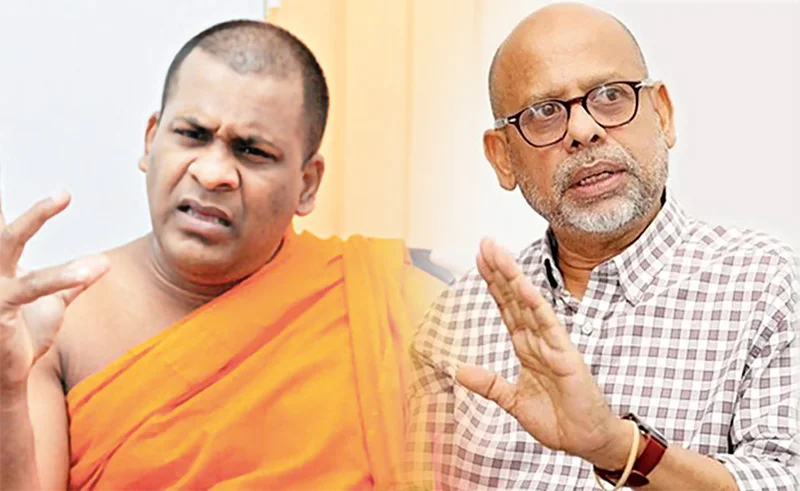
Civil society activist Gamini Viyangoda on Monday (28) lambasted the NPP government for its failure to act promptly on the Supreme Court cancelling the presidential pardon granted to the General Secretary of Bodu Bala Sena (BBS) Galagodaatte Gnanasara.
Addressing a gathering at the Sri Lanka Foundation to mark the launch of ‘Rajapaksha Samagama’ and ‘Pasku Praharaye Thoththa Babala’ by Lasantha Ruhununuge and Tharindu Uduwaragedara and M.F.M., Faseer, Viyangoda alleged that President Dissanayake’s government was also acting in a manner partial to Gnanasara Thera, the way all previous governments had done.
The NPP should be ashamed of its pathetic failure to act swiftly and decisively, immediately after the Supreme Court revoked President Maithripala Sirisena’s pardon. Viyangoda said that the government owed an explanation as to why law enforcement authorities couldn’t apprehend Gnanasara, following the announcement made on 14 Sept. “For two weeks what were they doing,” he asked.
Ven. Gnanasara was sentenced, in 2018, for a six-year period for contempt of court and intimidating Sandya Eknaligoda, the wife of Prageeth Eknaligoda who disappeared in 2010. But, President Sirisena pardoned him before the convicted monk completed one year of his six-year term.
Viyangoda said that Ven. Gnanasara had openly moved about freely, launched a book and acted as if the Supreme Court ruling didn’t have any impact. Every minute Gnanasara stayed in the open it was an affront to the Supreme Court, Viyangoda said, accusing the government of shielding a wrongdoer.
Referring to certain incidents during the Yahapalana time, Viyangoda revealed that he personally sought the then Prime Minister Ranil Wickremesinghe’s direct intervention to have Ven. Gnanasara, hiding at a faraway temple, apprehended. “I met Wickremesinghe at Temple Trees. When I raised the failure on the part of police to apprehend Gnanasara, Wickremasinghe immediately called Sagala Ratnayake, who was in charge of public security at that time. Ratnayake promised to take the monk to custody the following day. The next day, Gnanasara surrendered through a lawyer.”
Viyangoda alleged that the Wickremesinghe government had shielded Vem. Gnanasara. The Wickremesinghe-Sagala Ratnayaka duo did that in style, he said, accusing the present government, too, of doing the same.
The Court of Appeal yesterday (29) issued a warrant for the arrest of Gnanasara Thera and ordered that he be produced before the court on 1 Oct.
The court further directed that the warrant be executed through the Inspector General of Police.
This happened when a motion filed by the Attorney General, seeking an order to enforce the prison sentence imposed on Gnanasara Thera, was taken up before the Court of Appeal.
The motion was heard before a Court of Appeal bench, comprising Justices Mayadunne Corea and Lakmali Karunanayake.
President’s Counsel Anura Meddegoda, appearing for Gnanasara Thera, told the court that his client was resting due to illness and requested a date to study the motion and make submissions.
But State Counsel Sajith Bandara declared that the matter concerned a criminal case and requested that the court issue a warrant if the accused failed to appear before the court.

Colombo’s bus priority lane rule returned today, 29 September, as a pilot programme across the city and nearby areas. It applies from 6 a.m. to 9 a.m. and from 4 p.m. to 7 p.m. daily. The renewed operation covers seven designated lanes, meant to cut delays and make public transport more predictable.
Transport Minister Bimal Rathnayake said officials would monitor the trial to assess its effect on congestion and public transport efficiency. Police have told all officers to take legal action against violators. Drivers may enter a lane only in unavoidable cases, such as emergencies, exceptionally heavy traffic, or to cross it when turning.
The Lanka Private Bus Owners’ Association has welcomed the move, and Metro Bus is adding five new routes.
The rule has been revived before, and past efforts struggled with enforcement, so the pilot project’s results will matter.
(Image courtesy Hiru)

Waste management and recycling to receive priority in the 2027 Budget – PM

Rain stays away as India and Sri Lanka look for fair contest to enter final

Gold winner Tharanga gets brand-new Honda Vezel from SLAAJ

Showers above 50 mm are likely at some places inthe Uva, Eastern and Central provinces and in Polonnaruwa and Mullaittivu districts after 1.00 p.m.

Civil society activist accuses govt. of favouring Ven. Gnanasara

More cops than cones

‘Dates have the highest sugar content to fight Coronavirus’

Sunday Island 27 December – Headlines

#SundayIsland 17th December – Headlines

Sunday Island – 28th March

Sunday Island Headlines – 21 March

Sunday Island – 21st February – Headlines
-
 Latest News7 days ago
Showers above 100 mm are likely at some places in the Western, Sabaragamuwa, Central and North-western provinces and in Galle and Matara Districts
-

 Editorial7 days ago
Crimes punished and unpunished
-

 Features6 days ago
Beyond traditional jobs: Why Sri Lanka needs to facilitate the gig economy
-

 Editorial5 days ago
Birth of a bad law
-

 News3 days ago
Police remove Thileepan statue in Jaffna
-
 Latest News6 days ago
Kusal, Wellalage star as Sri Lanka defend 322 in Headingley thriller
-

 News5 days ago
TIN mandatory for key transactions from Nov. 1
-

 News7 days ago
IMF: Sri Lanka on course for 2027 market return