
Life style
SAROJINI JAYAWICKRAMA

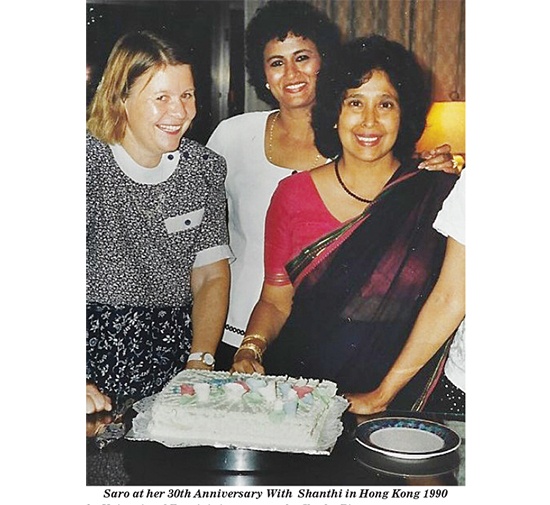
Memories …
Though memories are many and pleasant, they are difficult to recall in her absence. Six years have passed, but it seems like six months. Saro was the sheer embodiment of elegance, beauty, intelligence, and friendliness all rolled into one.
I first met her at the then beautiful campus in Peradeniya. That was about the time that the Vice-Chancellor, at the behest of her parents, had admonished her, warning her that she will be sent down if she and her future husband Nihal were to be found together within the campus! Well, with the passage of time, matters had cooled down, and I joined Nihal and Saro with her roommate, a relative of mine, on the dance floor at our graduation in 1962.
Ever since then, it was my delightful privilege to call them my friends. Though we were living oceans apart, we never lost touch ever over the next six decades. I always looked to enjoy their company and never missed a chance to visit them. It is, of course, the intercontinental telephone calls that kept our friendship alive.
I remember the long hours spent chatting at their Park Road flat in Colombo, often accompanied by dinner. It was always pleasant conversation about the affairs of the State. Saro, though mild-mannered, would never fail to express strong views and frequently warn us whenever she knew almost intuitively that we were naive in our analysis of the politics or politicians.
Shanthi and I have visited them on three occasions while they were in Hong Kong. There, they had a gorgeous flat overlooking the harbour and the skyline beyond. I distinctly remember being seated on the balcony some ten floors up the skyscraper watching the boats go by. It was heaven on earth. We went down to the boat club to have lunch and enjoy the waterside scene. On another occasion, we took an enjoyable boat ride to visit Macau. Saro guided Shanthi through the narrow lanes in the open-air shopping market. Once, they arranged a flat of one of their colleagues who was away for us to occupy while we were there nearly a week. That was in 1995 and happened to be the 30th wedding anniversary of Saro and Nihal. We celebrated the event together with some friends, including our mutual friend, the eminent journalist, Neville De Silva and his wife Sunetha.
While in Hong Kong, Saro used her time to earn a Master’s degree and a Ph.D. in English and a Diploma in Education. All that she achieved while teaching English Literature at the University of East Asia in Macau. That speaks for her tenacity and the yearning for knowledge. Much later, we were delighted to get an autographed copy of her thesis published as a book. A seminal work on Robert Knox’s writings on Ceylon, which displayed her mastery of English literature and the history of Ceylon.
During a summer vacation they visited us in Vienna, where we were then based. Shanthi had his nephew, who was living near us, vacate his apartment so that Saro and Nihal would have a comfortable stay as Nishana and Sharanya accompanied them. They had company as our two sons Chaminda and Janaka, were also visiting us from the United States during their vacation. We spent a few pleasant days visiting the famed palaces and churches in Vienna and Salzburg and dining at famous Viennese Heurigen in the Grinzing wine country. Then we were off to Prague, where we toured the famed Prague castle and took a pleasant walk from Wenceslas Square to the historic museum and dined by the Charles River.
I believe Saro enjoyed the time they spent in Hong Kong. Just as they moved there following Nihal’s escapades with governance in Sri Lanka as an indispensable administrator and adviser to Mrs. Bandaranayake, resulting in the loss of his civic rights along with Mrs. Bandaranayake; they moved out of Hong Kong having been the most sought after adviser and advocate for Human Rights for the local residents following the return of Hong Kong to China by the British.
I did visit them at their next home in Germany, where Nihal was based as the Executive Director of Transparency International, the anti-corruption agency. The couple of nights spent with them were equally pleasant as always, with engaging banter over Saro’s culinary creations. Then they moved to London, where Saro was lecturing at the Open University. Shanthi and I had visited at least twice and enjoyed the usual hospitality.
Of all the visits, the most memorable was when Saro and Nihal visited us in New York in 1993. They were then living in Canada where Nihal was occupying the prestigious Sallows Chair of Human Rights at the University of Saskatchewan. Shanthi had met with a serious car accident and broken both her ankles. Following surgery, she was home with the expectation of at least three months in bed before she would be ready to walk. After about three weeks, she was undergoing a strict physiotherapy regimen and other treatments when they arrived. After a couple of days, Saro and Shanthi were chatting, and the next thing I saw was Shanthi walking out of the room with the help of Saro and Daya, our household help! Later I learned that it was the encouraging words of Saro that Shanthi got the courage to take baby steps months ahead of schedule. The vision of that scene keeps repeating in my mind every so often, even after so many years since the incident.
In his latest incarnation, Nihal began working as a Senior Consultant for the U.N. Expert Group of Judges working on Judicial Ethics and Human Rights and found that he could be based anywhere. It is no surprise that both of them, who always had their heart and soul in Sri Lanka, moved back to base in Colombo. Whenever we were in Colombo, we have visited them as usual in their Queens Court apartment.
The warning that happy days were coming to an end arrived with the shocking news that Saro was diagnosed with the dreaded disease. Though we knew that she was receiving the best medical care in London, Shanthi and I were distressed to hear the news. We kept in touch with Nihal and hoped that she would be soon back to her usual cheery person. Knowing that a brew made of a Brazilian herbal plant had helped a couple of our friends, we arranged to send some for her use. Regretfully, by the time it arrived, Saro had left us.
It is equally sad that Sharanya, just like her mother, having earned a Ph.D. and been a University Lecturer, was struck down by cancer and left us to join Saro at a very young age.
There is birth, and there is death, two acts to a complex play called life, and between them is an interval which should be enjoyed. I believe Saro did just that and went with no regrets!
–Shanthi & Nandi.
Dr Nandasiri (Nandi) Jasentuliyana was the Director of the UN Office for Outer Space Affairs in New York, and Deputy Director-General, United Nations, Vienna.



June has long been celebrated as the month of brides, a season synonymous with romance, elegance and new beginnings . In Sri Lanka, where wedding are cherished as family occasions, every bride dreams of looking her absolute best on her special day. Few names in Sri Lanka are so closely associated with bridal beauty as Ramani Fernando, a pionear of Sri Lanka’s hair and beauty industry whose expertise has transferred countless brides over the decades. She has become a trusted authority on bridal styling, beauty trends and the act of creating timeless wedding looks. In this interview, Ramani Fernando shares her insights on the enduring appeal of June weddings, evolving bridal trends, and how today’s bride can achieve confidence and elegance on their big day!
(Q) Why is June traditionally known as the month of brides?
(A) June has long been associated with weddings because, historically, it was considered a month of prosperity, happiness, and new beginnings. In many cultures, it was believed to be an auspicious time to start married life. Over the years, this tradition has continued, making June one of the most popular wedding months around the world.
(Q) What makes June bridal unique in Sri Lanka?
(A) In Sri Lanka, June weddings often combine elegance with the beauty of the season. Brides tend to choose softer, lighter looks that complement the warm weather, while still embracing our rich cultural traditions. It’s a beautiful balance of timeless bridal glamour and modern sophistication.
(Q) What are the biggest beauty trends you are seeing this year in terms of dressing, hair, and makeup?
(A) This year, we are seeing a move towards effortless elegance. Brides are choosing natural, radiant makeup that enhances their features rather than masking them. Hairstyles are softer, with textured buns, romantic waves, and elegant ponytails. In fashion, classic silhouettes with modern details such as delicate embellishments and clean lines are very popular.
-

- Timeless elegance, unforgettable beginnings

Radiating grace, beauty and joy
(Q) How have bridal hairstyles and makeup evolved over the years?
(A) When I first started, bridal looks were much more structured, with heavier makeup and very intricate hairstyles. Today, brides prefer a more natural and personalised approach. The focus is on enhancing individuality while ensuring the bride looks timeless, both in person and in photographs.
(Q) How can brides balance tradition and contemporary beauty trends?

Radiant bride in yellow

Where elegance meets expertise – Ramani’s signature touch for modern brides
(A) The key is to stay true to who you are. I always encourage brides to respect traditions that are meaningful to them while incorporating modern elements that reflect their personality. A bride should feel authentic, comfortable, and confident rather than simply following trends.
(Q) Beyond makeup and hair, what helps a bride feel confident on her wedding day?
(A) Confidence comes from preparation, self-belief, and being surrounded by people who genuinely support you. When a bride feels comfortable in her own skin, is well-rested, and knows she is loved, that confidence shines through far more than any beauty treatment ever could.
(Q) How has the bridal industry changed since you first started your career?
(A) The bridal industry has evolved tremendously. Brides today have access to global inspiration, through social media, and are much more informed about beauty, fashion, and styling. There is also greater emphasis on personalisation, allowing every bride to create a look that reflects their unique story and personality.
(Q) What has been your most memorable bridal transformation?
(A) It is difficult to choose just one because every bride is special. However, the most memorable transformations are often those where a bride sees herself in the mirror and becomes emotional— not because she looks different, but because she feels like the very best version of herself. Those moments stay with me forever.
(Q) What continues to inspire you after decades in the bridal industry?
(A) The joy of being part of one of the most important days in a person’s life continues to inspire me. Every bride brings a new story, a new dream, and a new vision. Seeing the happiness, confidence, and excitement on a bride’s face is what keeps my passion alive even after all these years.
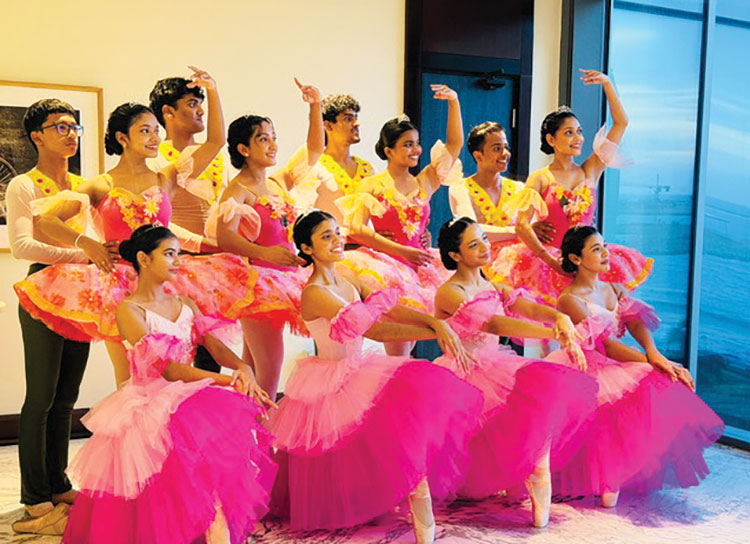
From Moscow to Colombo
The Russian Classical Ballet concert “Once upon a silver stage, conducted by the Russian School of Ballet and dancing, will be presented on June 27, 2026,at Sri Lanka’s iconic Nelum Pokuna Mahinda Rajapakse theatre Colombo with grandeur, This significant event will provide students with the opportunity to showcase their talent to thier proud parents. The School, which started with four little girls wanting to be prima ballerinas, celebrates its success and achievements of 25 years in its Silver Jubilee celebrations at this remarkable event.
(Q) What can audiences expect from this year’s ballet concert?
(A)We are expecting Russian Classical Ballet enthusiasts, parents, Diplomats and Ballet critics.
(Q) How does this performances differ from previous productions?
(A) The Russian School is celebrating its 25th anniversary in Sri Lanka, and the teachers have prepared a mesmerizing performance of Russian Classical Ballet to celebrate and to make the occasion memorable
(Q) What are the highlights of the programme?
(A) Over 700 students from age 4 to 45 years will be on one stage showcasing their talents on Russian Classical Ballet who are currently taking lessons at The Russian School of Ballet & Dancing
(Q) What challenges were involved in bringing such a large scale production to the stage?
(A) Training such a large number of students with variation of age is a challenge. We also face a challenge when it comes to accommodate the students in a Theatre in Sri Lanka. We have to perform the same show twice to make amends for that challenge
(Q) The school is celebrating a significant milestones. How has the journey evolved are the past 25 years?
(A) It is a wonderful progress, for a school which initiated with four little girls and standing tall and strong with 700 students maintaining it’s standards by the management, teacher, students and parents support.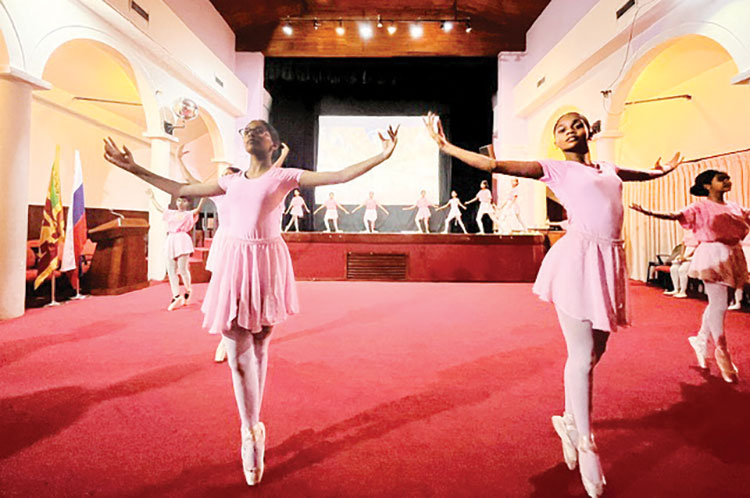
(Q) How has interest in ballet grown among Sri Lankan students over the years?
(A) It’s an amazing interest. We are conducting classes from Monday to Saturday, weekdays from 2.00pm to 6.00pm and Saturdays from 8.00am to 6.00pm, with 12 teachers working through the week. We also maintain a waiting list with at least 500 students annually. We have a huge demand for the art of Russian Classical Ballet in Sri Lanka, not only in Colombo, but outstation, too. We can only accommodate the students for Russian Classical Examination annually with the Vaganova syllabus
(Q) What role does Russian ballet training play in shaping young dancers?
(A) The training does not only shape them in dancing and techniques. They also shape the qualities, discipline and talentsof students from their childhood, especially for little girls to become ladies.
(Q) What makes Russian classical ballet unique compared to other dance forms?
(A) Russian Classical Ballet is an old form of dance and which is highly athletic, expressive and strictly disciplined style of Ballet that originated in the 18th century in Russia which is also the most prominent dance form in the world today. We are privileged to be able to learn and share the art form in Sri Lanka through the Cultural Section of The Embassy of Russian Federation in Sri Lanka to the Ballet lovers.
(Q) How does the school contribute to cultural ties between Sri Lanka and Russia?
(A) The school constantly shares it’s knowledge with Sri Lankan ballet lovers and enthusiastic though examinations, concerts, dance recitals, performances and universities. The Russian Cultural Centre in Colombo has brought down Bolshoi Dancers, Russian Classical Ballets. Younust Dancers. Classical Music Performers many times to Sri Lanka since late the1990s.
Over 1500 students annually examined for Russian Classical Ballet graded exams in Sril Lanka under the guidance of Dr Oxana Karnovich.
(Q) How does ballet help bridge cultural boundaries?
(A) Ballet is an universal art which speaks its own language. Ballet connect different cultures, facilitate cross-cultural communication, and foster mutual understanding.
(Q) Are there plans for international collaborations or performances abroad?
(A) Yes. We are already collaborated with the National Ballet Academy in Moscow under the patronage of Dr Oxana Karnovich -Oxana Karnovich of the Moscow State Academy of Choreography. Holding the position of Senior Lecturer at the Department of Choreography and the History of Ballet at the Moscow State Academy of Choreography, Dr Oxana Karnovich chaired the examinations, while imparting invaluable knowledge and expertise to aspiring dancers as well as our brilliant and growing staff of teachers. Oxana is also an Associate Professor at the Department of Vocal Art and Opera in the Moscow State Institute of Music. With a Ph.D. in Art History and Criticism, her extensive academic background enriches the knowledge and expertise of both our students and teachers, highlighting the dedication to preserve the artistic heritage of ballet.
By Zanita Careem
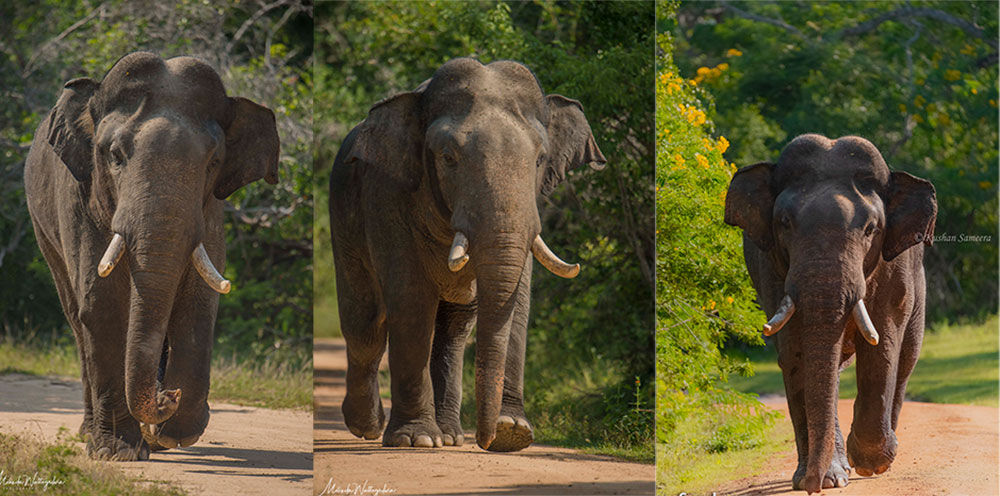
In the vast wilderness of southern Sri Lanka, where ancient forests merge with open grasslands and seasonal waterholes sustain an abundance of wildlife, few elephants have captured the imagination of nature lovers quite like Sando (T011).
A giant among giants, Sando is not merely another tusker roaming the forests of Ruhuna. He is a symbol of strength, dominance, resilience and mystery.
For years, his annual movements through the forests, bordering the Yala National Park, were eagerly anticipated by wildlife enthusiasts, safari operators, photographers and conservationists.
His arrival often signalled the beginning of a period of heightened excitement, within the park, where visitors hoped to catch a glimpse of one of Sri Lanka’s most iconic wild elephants.
Today, however, Sando’s whereabouts remain unknown.
His disappearance for nearly three years has sparked concern, speculation and heartbreak among those who have followed his remarkable journey through the wilderness. Yet despite the uncertainty, many refuse to abandon hope that the giant tusker still roams the forests of Ruhuna, hidden deep within landscapes rarely visited by humans.
According to wildlife enthusiast Chamdika Lakmal of Wild Tuskers of Sri Lanka, Sando represents one of the finest examples of Sri Lanka’s remaining wild tuskers.
He told The SundayIsland: “Sando is unlike most elephants we see in the southern region. His physical appearance, stature and confidence make him truly exceptional. Whenever he appeared, people knew they were witnessing a remarkable animal.’’
Sando primarily inhabited Blocks 3 and 4 of the Ruhuna National Park. During his annual musth period, usually between January and March, he undertook a well-documented journey through Buttala, Gonagan Ara and Galge before entering Yala National Park’s Block 1. These movements became familiar to many wildlife observers who followed his seasonal travels, year after year.
The annual migration was more than just a movement from one location to another. It was a dramatic display of nature’s hierarchy. Musth is a period of heightened testosterone levels in bull elephants, making them more aggressive and dominant. During this time, Sando transformed into an even more imposing figure.
Estimated to be between 35 and 45 years old, he was widely regarded as one of the most powerful bulls in the region. His immense size and fearless demeanour ensured that few rivals challenged him directly.
One of the most famous episodes, associated with Sando, involved a confrontation with Gamunu, another legendary tusker of Yala. The encounter reportedly resulted in Gamunu losing one of his tusks, further cementing Sando’s reputation as a dominant force among Sri Lanka’s wild elephants.
For many observers, however, Sando’s appeal extended beyond his strength.
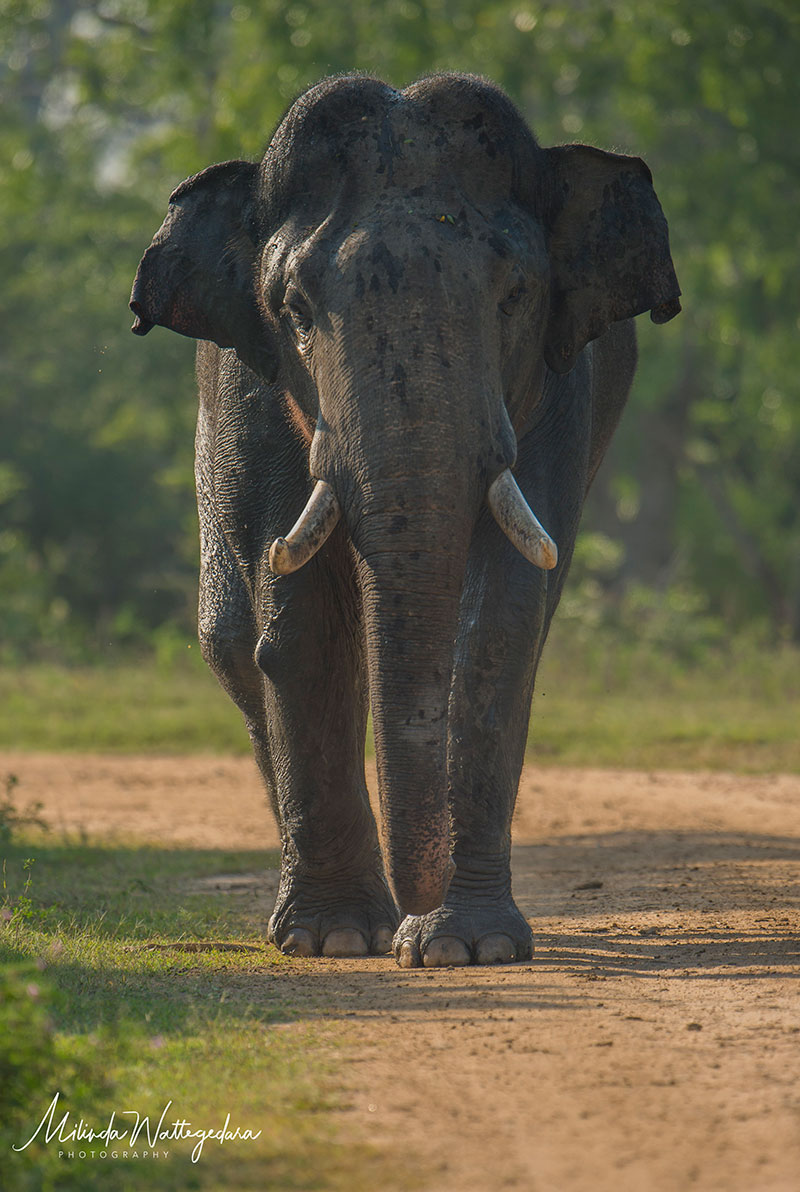
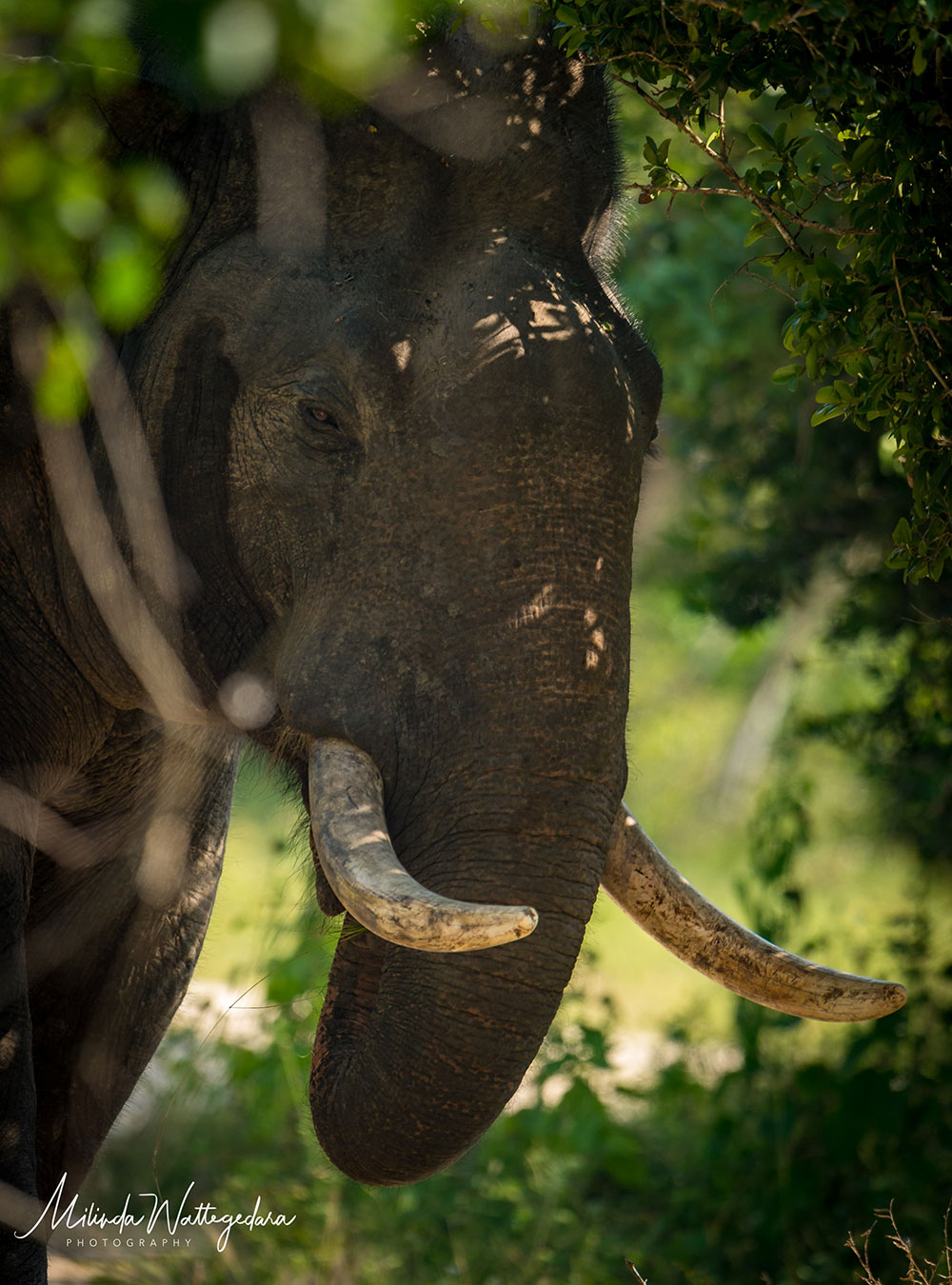
Unlike the typical “Ruhunu Getaw” elephants commonly seen in the southern dry zone, Sando possessed a distinctive physique. His body proportions and overall appearance gave him the look of an ancient war elephant, the kind depicted in historical chronicles carrying kings and warriors into battle.
“Whenever you looked at him, you felt as if you were seeing a living relic from Sri Lanka’s ancient past,” Chamidika said. “He had an extraordinary presence that photographs could never fully capture.”
Sri Lanka’s tuskers are themselves a rarity. Wildlife experts estimate that only a small percentage of the country’s male elephants possess tusks. This makes animals such as Sando particularly valuable from both ecological and cultural perspectives.
Historically, tuskers occupied a special place in Sri Lankan society. They featured prominently in religious ceremonies, royal processions and folklore. Even today, they remain powerful symbols of national heritage.
Their rarity, however, also makes them vulnerable.
Throughout Sri Lanka, wild elephants continue to face numerous threats, including habitat fragmentation, human-elephant conflict, poaching and accidental deaths. Expanding agricultural activities, infrastructure development and increasing human settlements have placed growing pressure on elephant habitats.
For tuskers, the risks can be even greater.
Their ivory makes them attractive targets for poachers, despite strict wildlife protection laws. Across Asia and Africa, ivory poaching has devastated elephant populations, and conservationists remain vigilant against similar threats in Sri Lanka.
These concerns intensified earlier this year when wildlife officials discovered the carcass of a tusker in the Kotiyagala area. The animal’s tusks had reportedly been removed by poachers. News of the discovery spread rapidly among wildlife enthusiasts.
Because Sando had not been seen for such a long period, many feared the worst. Could the carcass belong to the missing giant?
The possibility sent shockwaves through Sri Lanka’s wildlife community.
For many photographers and safari operators who had spent years documenting Sando, the prospect was devastating. Social media platforms were flooded with expressions of concern and calls for further investigations.
Yet the mystery deepened.
A year earlier, skeletal remains, believed to belong to a tusker, had also been discovered near Buttala. Once again, fears emerged that Sando’s fate had finally been uncovered.
However, officials from the Department of Wildlife Conservation later determined that the skull was significantly smaller than what would be expected from an elephant of Sando’s size. The remains, therefore, could not be conclusively linked to the missing tusker.
For conservationists, this finding offered a glimmer of hope.
Despite the absence of confirmed sightings, there have been occasional reports from remote sections of Yala and surrounding forests describing a large tusker bearing a striking resemblance to Sando. None of these observations have been verified, but they continue to fuel optimism among wildlife enthusiasts.
According to Chamidika, history provides reasons to remain hopeful.
“There have been several instances where dominant bulls disappeared from their known ranges for many years before returning unexpectedly. Until there is definitive evidence, we should not assume the worst.”
Indeed, wildlife records contain numerous examples of mature bulls vanishing from familiar territories only to reappear years later.
Such behaviour may be linked to changes in habitat use, competition, food availability or breeding opportunities. Elephants are highly intelligent and adaptable animals capable of travelling vast distances through landscapes that remain inaccessible to people.
As August approaches, anticipation once again builds among those who know Sando’s traditional routes. Reports from Athiliwewa, Pelwatta, Gonagan Ara and Buttala will be monitored closely for any sign of the missing giant.
For now, Sando’s story remains one of Sri Lanka’s most compelling wildlife mysteries.
His disappearance has highlighted not only the challenges facing elephant conservation but also the deep emotional connection many Sri Lankans share with their wildlife.
In an era when biodiversity is under increasing pressure, the fate of a single tusker has become symbolic of a much larger struggle to protect the nation’s natural heritage.
Whether Sando eventually emerges from the forests of Ruhuna or remains forever a mystery, his legacy is already secure. He represents the wild spirit of Sri Lanka’s elephants—powerful, resilient and endlessly captivating.
Until definitive evidence proves otherwise, conservationists, safari guides, photographers and elephant lovers across the country will continue to hope that somewhere in the vast wilderness of the south, the warrior tusker of Ruhuna still walks unseen, carrying with him one of the greatest untold stories of Sri Lanka’s wild places.
By Ifham Nizam

ICC launches post-pregnancy return-to-play guidelines

Chamari Athapaththu: ‘I think I’m a failure as a captain’

Navy’s prompt search and rescue mission saves lives at sea

UK’s Starmer resigns as prime minister

President chairs discussion on providing swift solutions to challenges in apparel sector

Schools close as more than half of France under red heat alerts

‘Dates have the highest sugar content to fight Coronavirus’

Sunday Island 27 December – Headlines

#SundayIsland 17th December – Headlines

Sunday Island – 28th March

Sunday Island Headlines – 21 March

Sunday Island – 21st February – Headlines
-

 News7 days ago
Beijing Capital Airlines to resume flights to Colombo signalling boost to tourism
-
 Features6 days ago
Killing of Colombo’s ancient trees — a warning on UN’s World Desertification Day – 17 June
-

 News4 days ago
Creditor receives USD 2.5 mn as Lankan public bears loss from theft of Treasury funds
-

 News3 days ago
Creditor not yet paid
-

 News3 days ago
Consumers bearing 22% tax burden despite 18% VAT claim: Dr. Harsha de Silva
-

 Opinion5 days ago
Beyond diagnosis: A strategic design for 7% growth by 2029 (Part I)
-

 Opinion7 days ago
Fifty years after Soweto uprising
-

 Sports7 days ago
Catch every moment of the 2026 FIFA World Cup free on the Dialog PLAY App