
Features
Death and tourism on the island of Bali – A true short story

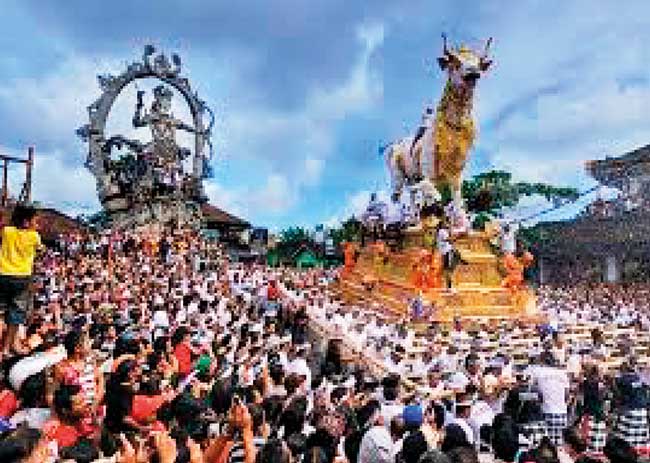
by Ernest Macintyre
Bali, named by Trip Advisor as the world’s top destination in its Traveller’s Choice award, in January 2021, is the only Hindu-majority province in Indonesia, with 86.9% of the population being of this ancient Indian way of life and death commonly called religion. That is why a Balinese funeral, of rich or poor is conducted as a complex ritual of “theatrical” process by people who have to be paid as “performers.
I knew nothing of all this, when in 1990 with a few friends who had also migrated to Australia, we took a trip to relax and enjoy the famous pleasure resort of Bali.
We stayed at the Kuta Beach Hotel. One morning as I strolled around aimlessly in the main reception area, I happened to see a notice inside a glass fronted cupboard which immediately held my attention.It stated that on the next day there would be a funeral ceremony in the village area of close by Ubud. Tourists, for the payment of fifty American dollars each, would be incorporated into the funeral process. Arrangements were to be at the hotel reception desk.
I walked to the reception area and told the manager that I was interested. He called me into his office to explain this unusual offer to tourists. I reproduce from memory a reconstruction of what he said.
” You see , these funerals are in very poor families. They don’t have the money for what has to be done at a funeral. So, they even keep the bodies in some place, till they can collect the money for the religious ceremonies for the funeral, and the bodies start decaying. This is in an island that earns so much from tourism and the hotel business .So some hotel owners got this plan going. They knew that today’s tourists are very different from long ago. Those days they came from their cold countries just to soak in the sun, lying on our beaches, and drinking cool beer. Today’s tourists are not only younger but very interested to get to know about the country they are touring. The hotel managers thought the religious ceremonies of the funerals would attract tourists. You see sir, the religious ceremonies for the dead, cannot be avoided whether families are rich or poor. They have to be done for the blessings and the future lives of the dead. These sad ceremonies are performed by hired men and women, they have to be paid. They are acting, but they also have sympathy for the dead “.
My mind went back to the crying women at Negombo funerals with their elusive transition from acting to feeling.
“The plan has worked, even five or six tourists each paying fifty American dollars is more than enough for these poor families to have the funeral ceremonies”.
I interjected, “Do the tourists go also to the funerals of other families, richer people?”
“No. They will not allow tourists to take part, the poor have the tourists because they need them.”
“Are you saying that we would be intruders, if not for our money?”
“No, not at all. We have reports that the sensitive tourists who go to these poor funerals integrate so humanly that the families of the dead feel their joining to be a blessing “
“I will join tomorrow “, I decided. After I made my payment he said, ” There are a few things to tell you”
” The dead person is a middle-aged woman, whose husband had died many years earlier. She is survived by two young daughters.”
He said that a van organized by the hotel would arrive at 8.30 am the next morning. There would be the driver and an interpreter. There are six of you, Americans and British. I would be the only Asian.
We would be taken to a room in the hotel and there given a white cloth to wear over our western clothes. Also, a large white shirt without a collar to wear over our upper body. The interpreter will then make some small coloured marking on each forehead. This costume we cannot make compulsory, but so far, all tourists have agreed. Those tourists who want to partake in the funerals are today’s tourists who see death as part of the lives they are touring to experience.
“How does this interpreter work” I asked.
I was coming to that. The other five who will be your companions tomorrow morning, had been told that at the funeral they will be requested to just speak one or two lines in English. All the other five have agreed and the lines they will speak have already been sent to the interpreter, who is a Balinese graduate, in English, from University of Sydney. He will translate these to Bahasa Indonesia, and at the funeral after you speak, he will explain to the mourners in their language.
By doing this the tourists become a part of the mourning people.
For Asian tourists the tourist board have requested that the say their lines in their Asian language and tell the interpreter what it means, and he will convey it to the mourners.
This unnerved me. I was an Asian but a deeply colonized one. My ability with Sinhala and Tamil was colloquial and scanty.
I spent the rest of the morning in my room, working out what lines I would recite at the funeral, so that the hotel manager could send it to the interpreter with my English translation. I first thought of the Tamil ” Anndandu thorum alludu perandalum maandevar varuvaro?”, which roughly conveyed is ” You may cry and roll on the ground, but the dead will never come back” or a more sophisticated transformation , may be Hamlet’s “The undiscovered country from whose bourn no traveller returns”
I abandoned this for it had depressing closure, it seemed to run against the openness of Hindu philosophy.After about an hour I settled on a simple line in Sinhala, which said enough and remained open as in Buddhism.
I went down and handed it to the office manager.The others in our Sri Lankan group had already made other arrangements, so I would not have their company at the funeral.
On the way back from the manager’s office, I met Aoife Maoilriain a young Irish woman, I had got to know in the hotel. She too was one of the other five who would be “touring” the funeral tomorrow. Aoife was a teacher at the University of Dublin. She was very keen and deeply interested about this unexpected part of tourism, she told me. And also sad she said, for she had planned to visit the village area around Ubud, and now she’ll be doing it in very different circumstances.
Tomorrow morning came. They were all in the van, clothed in the white native costumes and the markings on their foreheads. The interpreter, who now had studied all the words they would say, ready to convey to the Balinese mourners, greeted them. Soon they were at the funeral location. It was a small hut, with a compound in front. The benches and chairs for the congregation, which had been hired with the money from the six tourists, were in this compound. The two daughters sat separate from the other mourners, and in front of them a low platform on which their mother’s body lay, covered in white cloth. Only her face was visible. The folk priest started the proceedings.
The time came for the six tourists to offer their words. The first, John Hoskins, had adapted lines from John Donne’s old English poem.
“Each human’s death diminishes me,
Though a tourist I’m also mankind.Therefore, I do not ask to know
For whom the bell tolls,
It tolls for me.”
The interpreter explained to the congregation.
It was then my turn, and I made my one-line Sinhala offering. The Sinhala I knew was colloquial and very little, but I had been in the cast of Henry Jayasena’s
“Hunuwataya Kathawa” for seven years, before I migrated to Australia. I played the drunken priest who dominated a funeral scene, and had learnt, rote like, to speak lines from Sinhala literature. As if accomplished in Sinhala I delivered the line . The single short English line which the accomplished Jayasena had translated from ” The Caucasian Chalk Circle”.

” Maage dhayabara avamugal amuthani, minisunge irananame monatharang vividhakaravia hakidha, ekek marrie akige rudhria seelata wela, dhoo denna unusuma, watagena andanawa.”– “My dear funeral guests, how varied are the fates of humans, one laid down with her blood now cold, two daughters weeping, warmly, around her.”
The interpreter conveyed to the mourners, the openness of the short line, that invites ponder.
The last of our six tourist speakers was the Irish woman I mentioned earlier. I looked at Aoife Maoilriain just as she was about to give her offering. The woman was visibly in a state of great feeling, as she rose from her seat.
And then, we all gasped softly, as Aoife burst into song, singing the lines from the enduring Irish folk song ” Galway Bay” , which she had creatively adapted for this moment. In moving Celtic intonation she sang:
“And if there is going to be a life hereafter
And faith I know there’s going to be
I want by God, to meet this woman there
I just missed, on this island of Baalee.
We could see and feel that the whole congregation was transfixed, without knowing the meaning of the words. The power of music. As with ” Dhanno Budunge” sung with feeling, with people who don’t know any Sinhala. Though he did, the interpreter had no need to say in Bahasa Indonesia what the moving adaptation of the Irish song meant.
It was at this moment that I felt the hotel owners and the tourist board had made a far-seeing judgement. Today’s tourists are too varied to be singly classified as seeking ordinarily meant sensual pleasures .
We moved on with the congregation with various rituals on the way, till we reached the cremation site. The final ritual and the body was offered to the flames. The two daughters though composed were weeping profusely. The flames rose upwards bright and strong, in contrast to the two girls with bodies bent.
Soon we were back in our van, to the hotel. It was mostly silence all the way. Only the Irish woman Aoife spoke just as we came to our destination.
“Tomorrow the hotel has organized our beach carnival”, she reminded, speaking casually.



Harshitha Samarawickrema was 14 when Sri Lankan women’s cricket first pricked the national consciousness. She had already been playing cricket for her school, Gothami Balika Vidyalaya, but had largely pursued cricket merely for the sake of playing a sport, and also because she had enjoyed watching the men’s team play. But watching Sri Lanka defeat England in a thriller at the 2013 World Cup stirred up a deeper yearning.
“I’d watched all of the matches at that World Cup actually – that was the first time those kind of matches were telecast,” Samarawickrama said once. “That’s when I decided I was going to play and win matches for Sri Lanka one day.”
That victory against England was a new dawn for Sri Lanka’s women for two reasons. First up it was the highest-profile victory on their ledger until then, marking an unexpected high point in a World Cup in which little was generally expected of the team. But it also marked the rocket-powered arrival of Chamari Athapaththu, who top-scored with 62 to help set up the chase.
Thirteen years later, Samarawickrama has not only fulfilled her promise to herself, she has also helped Sri Lanka bring to life the promise of that 2013 campaign. Athapaththu, who has since has become the superstar around which Sri Lanka’s cricket orbits, has never known a more consistent batting collaborator than Samarawickrama. In T20Is, the pair have put on 1,202 runs together – easily the best for Sri Lanka. Though both are lefties who revel in pressure, that’s about where the similarities end – Athapaththu having grown up idolising the big-hitting of Sanath Jayasuriya, while Samarawickrama had been a disciple of the Kumar Sangakkara school of left-handed batting. (Samarawickrama still tries to replicate that famous bent-kneed cover drive, though she invariably sprinkles a little of of her own flair to the endeavour.) Oppositions have found this combination difficult to contend with, Athapaththu commanding through the legside and brutal on errors of length, while Samarawickrama flits around the crease and carves boundaries through cover and point.
It has been clear for years now that Sri Lanka’s chances in pretty much any match depend primarily on Athapaththu runs. But Samarawickrama’s advance as a T20 batter has now opened up a new frontier in the team’s batting performance. Ideally, what Sri Lanka want is not merely big runs from their captain, but a strong partnership between Athapaththu and Samarawickrama. In victories, the Athapaththu-Samarawickrama stand averages 41.38.
More tellingly, a good Samarawickrama innings has become as reliable a predictor of a strong Sri Lanka showing as a good Athapaththu innings. In T20I wins, Athapaththu averages 40.18 and strikes at 131, in comparison to 17.94 and a strike rate of 94 in losses. Samarawickrama’s corresponding numbers are even more stark. In Sri Lanka victories, Samarawickrama averages 44.08 with a strike rate of 109. In losses those numbers are 16.94 and 87. Other Sri Lanka batters have leveled up in recent years too – Kavisha Dilhari, Nilakshika Silva and Hasini Perera having become more frequent contributors, while 20-year-old Vishmi Gunaratne has also showed promise. But 11 years into her international career, Samarawickrama now has a serious body of work.
Samarawickrama had been modest in the shortest format in 2025, but she arrives at the Women’s T20 World Cup 2026 having had a good six months. Against Bangladesh in April, Samarawickrama had cracked 61 off 35, then 49 off 29, in back-to-back matches that Sri Lanka won (Samarawickrama was top-scorer on both occasions). This was in addition to having put up good numbers in the ODI series that preceded the T20Is. Her 36 not out off 34 in a comfortable warm-up win against Netherlands suggests she is still riding on that form.
This is the first T20 World Cup in which serious runs are expected of Samarawickrama, and if history is much to go by, she is not the sort to be daunted by occasion. Samarawickrama’s finest moments as a Sri Lanka cricketer had come in their most-celebrated win of all, in the Asia Cup final of 2024, against India. Typically, that chase of 166 in Dambulla had been propelled by an 87-run Athapaththu-Samarawickrama stand, but when Athapaththu was dismissed, Samarawickrama ensured she remained at the crease until the winning moments, hitting 69 not out off 51, ultimately collecting the Player-of-the-Match award.
If 2013 was a new dawn inspiring a fresh generation of Sri Lanka cricketers, 2024 was the year in which the team hammered its stake into the ground, breaking through into an entirely new galaxy of recognition and acclaim at home. Frequently batting in the shadow of Athapaththu, but always charting her own path, Samarawickrama has grown into a leader.
[Cricinfo]

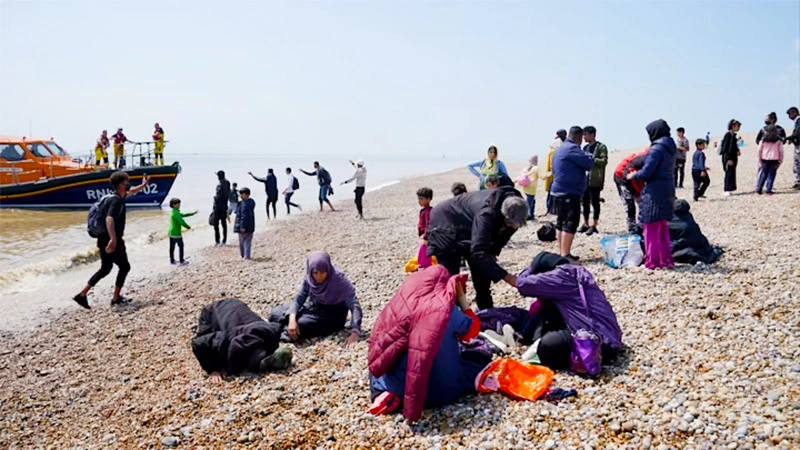
 The announcement by the US authorities of an anti-migrant stance during a recent commemoration in France of the epochal D-Day Landings of June 6, 1944, ought to strike impartial observers as a supreme irony. Whereas what should have been expected was a vibrant celebration of the beginning of the process of Western Europe freeing itself decisively from Nazi or fascist control during the crucial stages of World War Two, this was not to be.
What the world heard instead was a call to contemporary Western Europe to arm itself against a seemingly rising and threatening migrant presence in the region. In other words, the migrant must be despised and ‘shown the door’.
Instead of a commemoration that rejoiced in the flourishing of liberal democracy and its values what one got was a strong affirmation of fascism and racial chauvinism. US Defense Secretary Pete Hegseth vented his spleen against the migrant or foreigner presence in Europe reportedly thus: ‘Sadly today different European beaches are stormed by different dangerous ideologies.’ To ‘beaches in Spain and Italy and Greece and Bulgaria, boats and men arrive. When will European capitals do something about that invasion?’
While at the outbreak of World War Two it was Nazi Germany that was doing the invading and bringing some principal European countries under its suzerainty, this time around we are being given to understand that it’s migrants to the West who are seeking to colonize the latter. It goes without saying that such inflammatory rhetoric would have the deleterious effect of keeping racial tensions alive in the West and jeopardize all possibilities of the countries concerned cementing and maintaining social stability.
The Trump administration gives the impression of taking a leaf from the politically underdeveloped regions of the South to keep the US polity stable and united. In South Asia, for instance, we are not short of ambitious demagogues who use what is referred to as the ‘race card’ to gather unto themselves a following and thereby further their political fortunes. By seeking to stir and sustain anti-migrant hysteria, the Trump administration is also essentially replicating Nazi Germany’s policy of anti-Semitism. That is, fascism is very much alive in the US under President Trump.
Such efforts at churning racial hysteria at this juncture in the US should not come as a surprise. For all intents and purposes, the Trump administration is nowhere near achieving its aims in West Asia, for instance, in the short term. It has failed to bring Iran down to its knees, as it hoped to do, but is adopting the expedient of keeping the world guessing and confused on what it is doing in the region, since it cannot withdraw from the theatre in a hurry without losing face.
While perhaps working out an escape strategy the Trump administration it seems, is hoping to maintain its following at home intact and silent by playing on their racial biases and insecurities. Hence, the anti-foreigner campaign.
Simultaneously, the Trump administration will need to keep a close eye on how economic pressures on the domestic front are panning out. Anti-administration sentiments first break to the surface at meal tables. On this score, the news cannot be good because the average US family’s spending power ought to be shrinking on account of rising energy and oil prices. Consequently, it would not be a bad idea to keep the attention of the US consumer diverted by adeptly playing ‘the race card’; once again, lessons from intellectually bankrupt Southern politicians are coming in handy.
To be sure such comparisons many politicians in vibrantly democratic countries would find quite unflattering. But the stark truth is that racism cannot be tolerated in civilized societies and those politicians who resort to it risk being branded as racists of the first degree. In fact they could be seen as being on par with the likes of German dictator Adolph Hitler and his close collaborators.
However, on the question of migrant policy the Trump administration would likely be at polar opposites with the most vibrant of liberal democracies of the West. This will be the case with the UK, France and Italy for instance. The latter continue to keep their doors open to legal migrants and they are likely to view a virtual blanket ban on migrants as reprehensible.
Moreover, in the foremost democracies of the West debates are vibrantly ongoing on the need to keep racism or any hint of it completely outlawed in the public plane. There is the case of the UK, for instance, where the authorities continue to emphatically pinpoint their adherence to the principle of anti-racism in the conduct of public affairs.
One proof of the above was the parliamentary debate relating to the killing of 18-year-old Henry Nowak in Southampton. Police handling of the victim came in for sharp scrutiny by particularly the opposition in the House of Commons but there seemed to be a consensus over the main political divide that the matter should not be politicized.
Moreover, the UK authorities stressed in the House the government’s strict adherence to the policy of non-racism. It was also pointed out that British institutions set up to manage racism at the national, county and neighbourhood levels, for example, were very much intact. In fact, Sri Lanka could gain considerably by studying and implementing locally, legislation modeled on the relevant UK laws if it is in earnest when it speaks of ‘reconciliation’.
Accordingly, it is highly unlikely that Western Europe would ‘cave in’, so to speak, to US pressure on issues related to migration. The liberal democracies of Western Europe in particular would remain for the foreseeable future migrant-welcoming, multi-ethnic and plural democracies.
Nor is it likely that Western Europe would be passively receptive to US demands that it drastically increases its defense spending to meet the latter’s aims. Within the Western fold the EU is remaining committed to backing Ukraine, for instance, in its ongoing armed resistance to the Russian invasion and it is not giving any indication of being deferent to US pressure.
However, although tensions would continue to bristle within US-Western Europe relations on the above and numerous other matters of contention it would be far too premature to announce a parting of company between the two sections of the West. In that sense, the post-World War Two order remains essentially intact. There are still many things in common between the two, particular on the economic plane, that will ensure the continuance of the partnership.
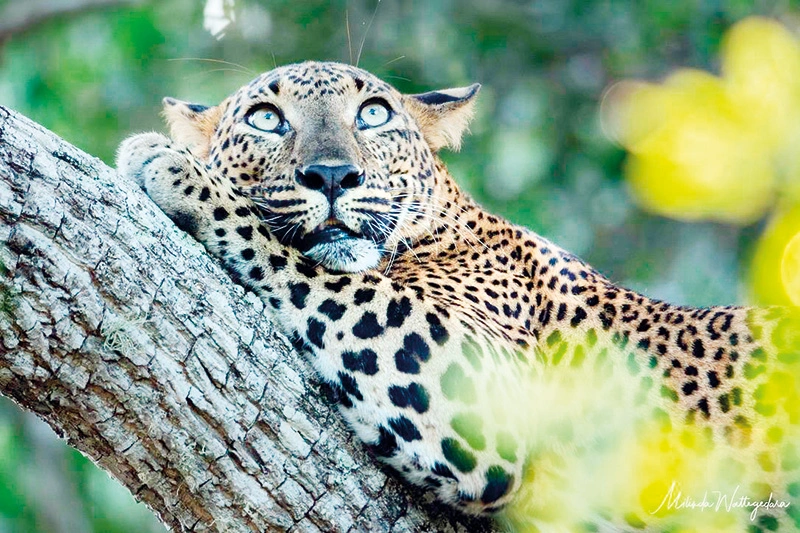
The first rays of dawn creep over the ancient rocks of Yala. The Indian Ocean glimmers in the distance, and the wilderness slowly awakens. Somewhere amid the scrub jungle, a pair of amber eyes scans the landscape.
For wildlife conservationist and leopard researcher Milinda Wattegedara, moments such as these have defined more than a decade of dedication to one of Sri Lanka’s most iconic creatures—the Sri Lankan leopard.
What began as fascination evolved into a remarkable conservation journey that has transformed the understanding of Yala’s leopard population and placed Sri Lanka firmly on the global wildlife research map.
“Long before I ever lifted a camera, leopards had already captured my imagination,” says Wattegedara. “What fascinated me was not merely their beauty but the complexity of their lives—their hunting strategies, movements, reproductive behaviour and their remarkable ability to adapt to changing environments.”
That fascination led to the birth of the Yala Leopard Diary in 2013, an ambitious long-term project dedicated to documenting individual leopards and unraveling the mysteries surrounding their lives.
For many visitors, a leopard sighting is a fleeting thrill. For Wattegedara and his team, every encounter is a chapter in an ongoing scientific story.
“Each photograph was never the end of an encounter,” he explains. “It was the beginning of deeper questions. How did a particular leopard use the landscape? How did its behaviour change with the seasons? What environmental pressures shaped its decisions?”
These questions drove years of meticulous fieldwork. Every sighting was carefully recorded with details including location, habitat, behaviour, date and time. Photographs were analysed to identify individual animals through unique spot patterns, allowing researchers to distinguish one leopard from another with remarkable accuracy.
What followed was groundbreaking.
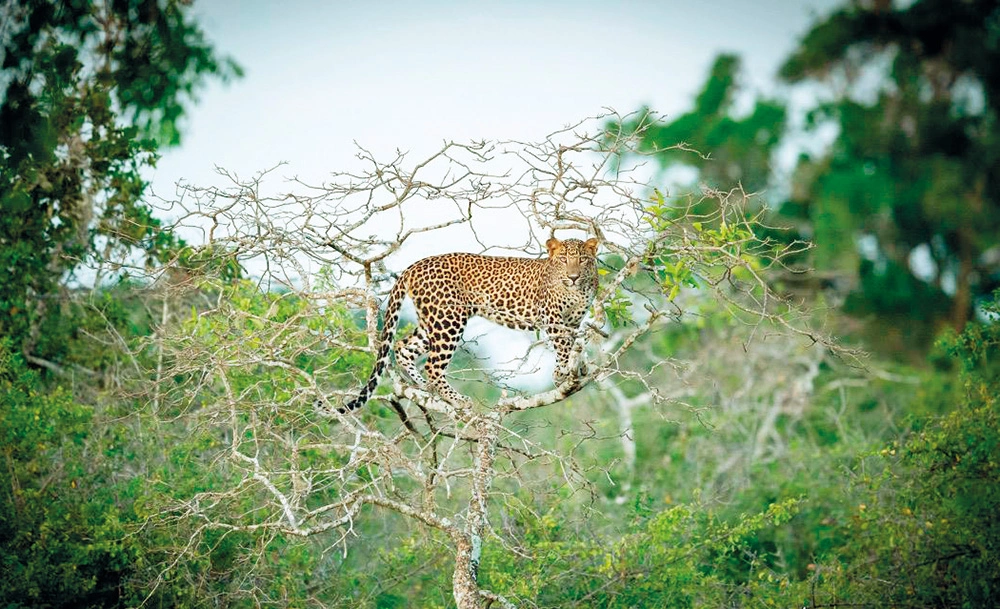
YF77 “Shelly” pauses in quiet observation, embodying the alertness
and grace that define Yala’s leopard population.
From 2013 to 2026, the Yala Leopard Diary identified an astonishing 189 individual leopards within the Yala Block 1. The research revealed a leopard density of approximately 0.524 leopards per square kilometre, making Yala one of the highest leopard-density landscapes ever recorded anywhere in the world.
Such findings have elevated Yala’s status among global wildlife researchers.
Nestled between the Indian Ocean and a mosaic of habitats, ranging from rocky outcrops to dense scrub forests, Yala offers an ecological stage unlike any other.
Here, leopards are photographed silhouetted against ocean horizons, perched atop ancient granite formations, resting on tree branches and stalking prey across sunlit grasslands.
The images tell stories of extraordinary lives.
There is Haminee, a devoted mother navigating the challenges of raising cubs in a competitive landscape. There is Lucas, one of Yala’s most frequently documented males, striding confidently across the Gonalabba Plains with the vast ocean forming an unforgettable backdrop.
There is Ruki demonstrating the species’ incredible strength by hoisting prey onto branches, and Shelly, quietly surveying her surroundings in a moment of feline vigilance.
Together, these individuals have become familiar characters in a living wilderness drama.
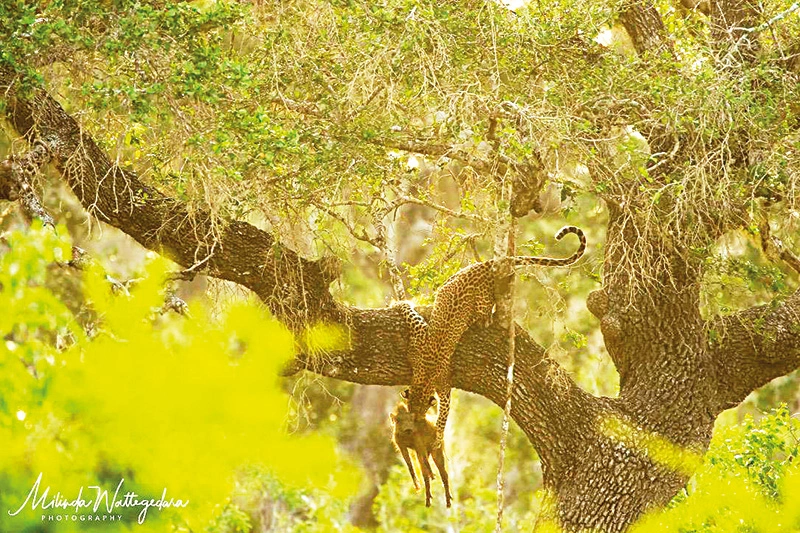
YM31 “Ruki” secures prey on a branch, illustrating the remarkable strength and coordination of the Sri Lankan leopard.
Recognising the immense value of long-term documentation, Wattegedara joined forces with fellow researchers Dushyantha Silva, Raveendra Siriwardana and Mevan Piyasena to establish the Yala Leopard Centre in 2020.
Located at the Palatupana entrance to the Yala National Park, the centre is believed to be the world’s first information facility dedicated exclusively to leopards.
“The centre serves as a repository of knowledge, accumulated through years of observation and research,” Wattegedara says. “Our goal is to connect visitors with the science behind conservation and foster a deeper appreciation of these magnificent animals.”
The project’s impact extends far beyond Sri Lanka’s borders.
Research arising from the Yala Leopard Diary has been published in internationally recognised scientific journals. One study introduced an innovative framework for identifying individual leopards, while another documented an extraordinary and previously unrecorded case of a leopard cub being consecutively adopted by two different adult females—first a relative and later an unrelated leopardess.
The discovery attracted international scientific attention and highlighted the complexity of leopard social behaviour.
Yet for Wattegedara, the most important lesson remains one of humility.
“One conclusion has become increasingly clear,” he reflects. “Our understanding of these leopards remains far from complete. We are only beginning to understand how they live, adapt and persist in one of Sri Lanka’s most dynamic protected landscapes.”
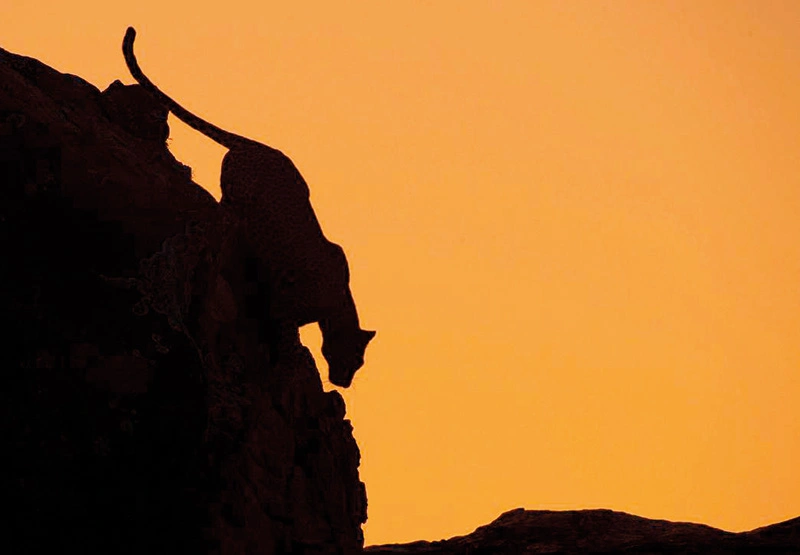
YF15 “Hope” descends Rukvila Rock at dawn, showcasing the agility and adaptability of Yala’s leopards.
His words underscore an essential conservation truth: the more we learn about nature, the more mysteries emerge.
As Sri Lanka navigates growing environmental challenges, the Yala Leopard Diary stands as a shining example of what sustained observation, scientific curiosity and public engagement can achieve.
Beyond the stunning photographs and remarkable sightings lies something even more valuable—a growing body of knowledge capable of informing future conservation decisions and ensuring that future generations inherit a wilderness where leopards continue to roam free.
For more than a decade, Wattegedara and his colleagues have followed the tracks of Yala’s elusive predators through dust, rain and scorching heat.
Their work has revealed that every leopard has a story, every sighting has significance and every photograph can contribute to conservation.
And perhaps, most importantly, it has reminded us that the golden ghosts of Yala still have many secrets left to share.
By Ifham Nizam
Sri Lanka look to their bowlers against big-hitting West Indies

Edgbaston takes center stage as England, Sri Lanka kick off T20 World Cup

Trump says US will hit Iran ‘very hard tonight’

Firefighters on scene at Pentagon during ‘hazardous materials incident’

Samarawickrama’s rise gives Sri Lanka a second pillar

Prabhsimran, Gaikwad, Tilak score fifties in DLS loss to Afghanistan A

‘Dates have the highest sugar content to fight Coronavirus’

Sunday Island 27 December – Headlines

#SundayIsland 17th December – Headlines

Sunday Island – 28th March

Sunday Island Headlines – 21 March

Sunday Island – 21st February – Headlines
-
 Features7 days ago
Power crept into the Sangha and is now tearing it apart
-

 Features7 days ago
Kondachchi wind farm and battery storage project to boost energy security, says Power Ministry Secretary
-
 News5 days ago
Women’s T20 World Cup 2026 warm-up: Chamari Athapaththu’s 94 helps Sri Lanka beat Pakistan
-

 Features7 days ago
Saudi Arabia sets new benchmark in Hajj management as 1.7 million pilgrims complete sacred journey
-

 News6 days ago
Asst. Manager, security officer arrested over Rs 30 mn snatch at Horana PB branch
-

 Editorial4 days ago
Probe Sallay’s complaint
-

 News5 days ago
Lankan-Canadian inducted to Toronto Sports Hall of Fame
-
 News2 days ago
Local firms move millions of dollars overseas for phantom imports: Govt.