
Sports
Babar, Rizwan fifties power Pakistan to third T20 World Cup final

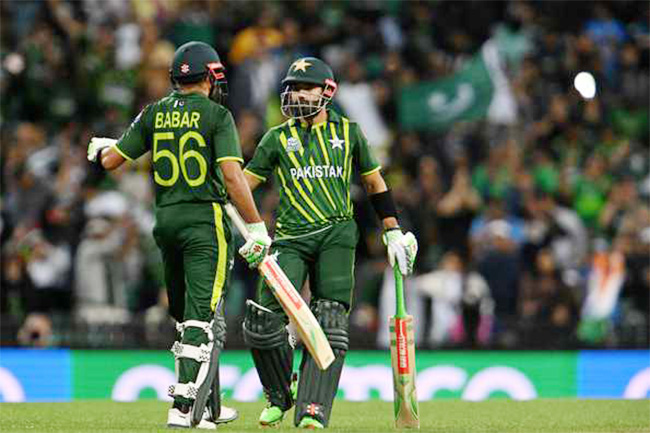
Led by half-centuries from Babar Azam and Mohammad Rizwan, Pakistan powered to the final of the ICC Men’s T20 World Cup 2022, at the back of a dominating all-round display against New Zealand at the Sydney Cricket ground, where they registered a seven-wicket win, on Wednesday.
Electing to bat, New Zealand were restricted to 152 for 4 on a slow, turning pitch, despite Daryl Mitchell’s unbeaten 35-ball 53. Run-scoring was difficult and against a disciplined bowling attack and a spirited fielding performance, New Zealand managed to score only 10 boundaries and two sixes.
In response, Pakistan asserted their dominance early on with a 105-run opening stand between Babar and Rizwan, with both the batters stroking fifties. Even as New Zealand managed to pull Pakistan back slightly towards the end, Babar’s side managed to reach the target with five balls to spare.
Pakistan dominated right from the start. A quintessential Shaheen Afridi first over where Finn Allen’s pads were always under threat with the incoming delivery. An inside edge saved him once but Afridi had the pads hitting the middle of middle stump eventually.
Kane Williamson and Devon Conway’s cautious approach allowed the Pakistan pacers to be on the offensive at all times, and yet escape not have to prove expensive. By the end of the powerplay, they had conceded only 38 runs, losing Conway to a fine throw by Shadab Khan off the last ball, which caught him short of the crease.
Williamson and Mitchell added 68 runs for the fourth wicket but not before losing Glenn Phillips early, offering Mohammad Nawaz an easy return catch. On the used pitch that was slow and low and turned considerably, with the bowlers operating cleverly to the dimensions of the field – ranging from 65 to 80 meters – run scoring wasn’t easy. The harder the batters tried, the more they struggled.
Despite that, Mitchell and Williamson – who combined to stroke only 4 boundaries and 2 sixes in 77 balls – managed to pick 33 runs from Shadab Khan’s spell, the most expensive figures for the leggie in this tournament. While Mitchell kept picking the twos and score at fairly decent pace, Williamson struggled to go too far beyond run-a-ball before eventually falling in the 17th over while looking to play a scoop and getting cleaned up by Afridi.
Neesham and Mitchell picked some quick runs towards the end, adding 35 runs in the last 22 balls, with the latter bringing up his half-century to help New Zealand to a slightly below-par 152 for 4.
Quite unlike New Zealand, Pakistan asserted their dominance with the bat in the powerplay, an approach that Rizwan stated was intentional given that the pitch was expected to slow down. It could have been a different story had Conway pouched the outside edge induced by Boult when Babar was yet to get off the mark. But that opportunity was lost, so was the opportunity to run him off the next ball.
After a couple of quiet overs, Babar and Rizwan cut loose against Lockie Ferguson in the third over, stroking him for three boundaries. While Babar struggled early on, Rizwan kept a healthy scoring rate. By the end of the powerplay, Pakistan had wiped off 55 runs from the target and even Babar had found his groove.
Even as there was turn and the pitch was slow, Babar and Rizwan had adjusted well to the conditions and the pace and went on to stitch a 105-run stand in 76 balls before Babar holed out to long on.
Mohammad Haris was troubled by the slower balls and failed to make adequate connections. Off the first 17 balls, several edged, he managed to score only 17 runs. To complicate matters, Rizwan fell while attempting to free his arms and slash at an angling away delivery from Boult, caught at deep point. It brought the game down to 21 runs in the last three overs, and then fur
ther reduced to 19 in 15 – with a new batter and a struggling Haris in the middle. However, a couple of clean hits from Haris – a drive through extra cover for a boundary and a pull for a six, brought the equation down to 8 runs from the last two overs.
Mitchell Santner bowled a fine penultimate over, created three wicket-taking opportunities – before having Haris dismissed off the final ball, but left Pakistan with needing only two off the last over.











Hossam Abdelmaguid scored the winning penalty as Egypt made history by beating a dogged Australia 4-2 on penalties to reach the World Cup last 16.
A tense affair on Friday in which Egypt and their off-colour captain Mohamed Salah wasted the better chances had ended 1-1 after 120 minutes in Texas.
Lionel Messi’s Argentina loom next for Egypt, as long as the reigning champions avoid a massive upset against tournament debutants Cape Verde in their last-32 encounter.
The Pharaohs will celebrate anyway, having reached this stage of a World Cup for the first time ever.
Australia coach Tony Popovic threw on experienced goalkeeper Mathew Ryan for the penalty shootout in a last-gasp gamble.
Shooting towards the Egypt fans and whistles raining down, defender Harry Souttar blazed the first penalty over to put the Socceroos on the immediate back foot.
The next five players all scored, including Salah with the coolest of penalties, before 18-year-old Australia defender Lucas Herrington hit the bar.
Abdelmaguid kept his nerve to send Egypt through to leave Salah in tears of joy and break Australia hearts
Emam Ashour had given seven-time African champions Egypt the lead from a header after 13 minutes at the air-conditioned home of the Dallas Cowboys.
The early goal put the onus on a shot-shy Australia, who scored only twice in the group phase, to attack in front of a crowd of 70,000.
With Salah mostly ineffective following injury in Egypt’s last game, the Socceroos equalised 10 minutes after half-time when Mohamed Hany headed into his own net.
Both sides sensed history, neither having won a knockout game before at a men’s World Cup, and they went to extra time after some late Egypt pressure.
With nothing to divide them, they went to penalties.
Popovic’s side had nearly taken the lead with less than five minutes gone as Cristian Volpato – who switched to Australia from Italy on the eve of the World Cup – rattled the top of the crossbar.
Egypt, who won a World Cup match for the first time in the group phase when they beat New Zealand 3-1, looked nervy at the back.
Slightly against the run of play, Hossam Hassan’s men took the lead.
Australia forward Nestory Irankunda failed to pick up Ashour, who headed home at the back post from a cross by Karim Hafez for his second goal of the tournament.
The Socceroos had their first shot on target 10 minutes before the break when full-back Aziz Behich fired tamely at goalkeeper Mostafa Shobeir.
His father, Ahmed, played in goal for Egypt at the 1990 World Cup.
The 34-year-old talisman Salah, who came into the match after a hamstring strain, made little impact in an attritional first 45 minutes.
The half ended with Jordan Bos, one of the fastest players at the tournament, in a heap after a robust flying challenge from Rabia.
The wing-back had to be helped from the pitch and was replaced at half-time by Kai Trewin in a blow to Australian hopes.
Seconds after the restart it should have been 2-0 when Egypt’s Manchester City attacker Omar Marmoush slid the ball off-target from close range.
Egypt’s coach had said he was wary of Australia’s physical approach, and so it proved as Hany headed under pressure into his own net from an in-swinging Socceroos free-kick.
It was Hany’s second own goal of the tournament.
Former Liverpool superstar Salah remained a peripheral figure but was involved in the buildup as Australian stopper Patrick Beach saved athletically deep in added time to keep out Ramy and force another 30 minutes.
Egypt finished normal time the stronger and Salah fired well over early in extra time on his weaker right foot, with penalties looking increasingly inevitable.
Salah, though, was to prove more reliable in the shootout as Egypt triumphed.
Egypt will face the winner of the last-32 match between Argentina and Cape Verde in Atlanta in the next round on Tuesday.
(Aljazeera)
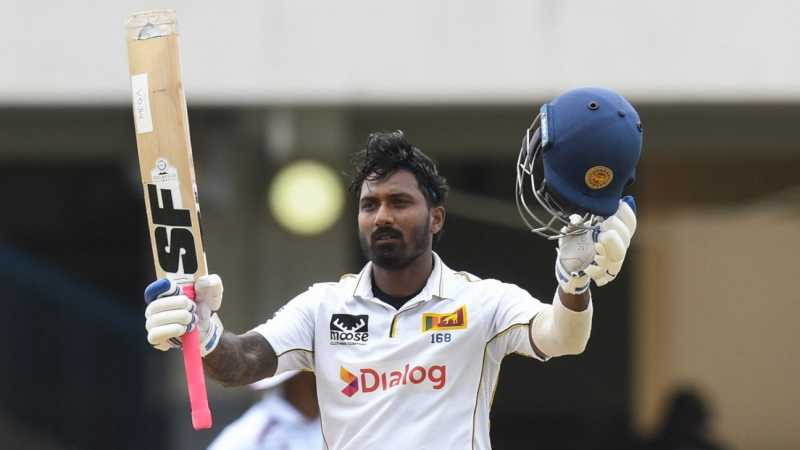
A pair of wickets in the final half hour play brought the West Indies back into the game, but prior to that it was Lahiru Udara who had led Sri Lanka’s redemption arc as the opener fell 12 runs short of a maiden Test double-ton as day one of this second Test wound to a close at North Sound.
At 32 years of age, Udara has had to bide his time to make his way into the Test side, and it was just his luck that Sri Lanka’s Test schedule shrunk considerably just as he made his debut last June. Then in the Caribbean, he might not have got a look in, but an injury to Pathum Nissanka opened the door, and like Amir Jangoo in the first Test he took his chance with both hands.
Udara’s epic 188 off 248 all but ensured that the visitors ended the day in precisely the sort of commanding position they would have envisioned when they opted to bat – only partially sullied by those late strikes.
His innings came primarily across two major stands. The first was of the record-breaking variety, as Udara and Kamindu Mendis (84 off 120) struck 215 off just 255 deliveries. It was Sri Lanka’s highest-ever partnership in the Caribbean and very nearly their highest ever against West Indies in Tests. It also came after their side had stumbled to 25 for 2.
The second was less brisk but equally as important, as Dhananjaya de Silva joined Udara in the middle to stitch together a stand of 93 off 179. This one had come just as West Indies had begun to put together a much more disciplined display with the ball in the final session – efforts that had for large parts seemed destined to go without reward.
But the perseverance from the hosts belatedly paid off, first as a tiring Udara – he had received treatment earlier in the session on his lower back – top-edged to deep fine leg, before the other set batter, Dhananjaya, edged through to the slips after a gritty 33 off 90.
The latter wicket also brought about another cause for celebration for West Indies, as it meant that Jayden Seales reached 100 Test wickets, becoming the second-fastest West Indian bowler to do so in terms of deliveries bowled – Ian Bishop heads the list.
Seales’ and his team-mates’ jubilant celebrations were representative of catharsis, but also revealed the frustration that had been building up until that point, as Sri Lanka rode their luck but also pressed home the advantage for much of the game. They will however now feel they have restored some parity on a day that was largely dominated by the visitors.
Scores:
Sri Lanka 338 for 5 in 83 overs (Lahiru Udara 188, Kamindu Mendis 84; Shamar Joseph 2-60) vs West Indies
(Cricinfo)

B Sai Sudarshan had retired hurt during the first four-day fixture between Sri Lanka A and India A, but returned to action with an unbeaten century on day two of the second game at Galle. He was unbeaten on 104 at stumps, and giving him company was Devdutt Padikkal, who was 94 not out.
Sai Sudharsan and Padikkal’s partnership was unbroken on 181 for the second wicket, leaving India A only another 119 runs behind Sri Lanka A’s first-innings total of 366.
India A had started positively, with Sai Sudharsan and his opening partner Aman Mokhade bringing up their half-century stand off just 63 balls. While Sai Sudharsan had hit five boundaries until that stage, Mokhade had hit four. But offspinner Keshara Nuwantha broke the stand at 66 when he had Mokhade caught for 38.
Despite the loss, Sai Sudharsan and Padikkal kept India A going by steadily chipping into the hosts’ total. The runs kept coming at a steady pace for the visitors, who had, earlier in the day, bagged the last five Sri Lanka A wickets for just 61 runs.
Sri Lanka A had resumed on 288 for 5, with their captain Sahan Arachchige unbeaten on 83. He hit the second ball of the day, bowled by Gurnoor Brar, for four, but the fast bowler broke the sixth-wicket partnership on 35 when he had Chamika Gunasekara caught behind for 13 in the 92nd over. Arachchige, meanwhile, reached his century in the 94th over. He kept Sri Lanka A ticking in a steady eighth-wicket stand with Dilum Sudeera after Saransh Jain got Nuwantha for 1.
Sudeera contributed a handy 20 before Jain had him lbw in the 109th over, before Grunoor wrapped up the innings in the next over. He dismissed Arachchige for 127 and last batter Asanka Manoj two balls later to bowl Sri Lanka A out in 110 overs. That was lunch, and both Gurnoor and Jain finished with four wickets each. India A then carried the momentum into the next two sessions of the day.
Scores:
India A 247 for 1 in 63 overs (B Sai Sudharsan 104*, Devdutt Padikkal 94*; Keshara Huwantha 1-63) trail Sri Lanka A 366 in 110 overs (Nuwanidu Fernando 44, Sahan Arachchige 127, Anjala Bandara 42; Gurnoor Brar 4-77, Saransh Jain 4-92, Yash Thakur 2-46) by 119 runs
[Cricinfo]

Anguished families left to identify Venezuela quake victims at makeshift morgue

Ukrainian suspect hunted by police after Monaco bomb attack was ‘disguised as a man’

Showers in the Western, Sabaragamuwa and North-western provinces and in Galle, Matara, Kandy, Nuwara-Eliya, Anuradhapura and Mannar districts.

Colombo Law Society objects to judges’ retirement age move

Freedom 250: US Embassy celebrates America’s 250th Independence Day through magic of American cinema

CA dismisses application filed by Yoshitha seeking to quash conspiracy charge in money laundering case

‘Dates have the highest sugar content to fight Coronavirus’

Sunday Island 27 December – Headlines

#SundayIsland 17th December – Headlines

Sunday Island – 28th March

Sunday Island Headlines – 21 March

Sunday Island – 21st February – Headlines
-

 News5 days ago
LAWASIA warns against ad hoc initiative to increase judges’ retirement ages
-

 News7 days ago
Another 1,132 Sri Lankan Personnel to be deployed for United Nations Peacekeeping Missions
-

 News4 days ago
Chamuditha to seek removal of injunction on Youtube programme
-

 Features4 days ago
Climate action to bring South Asia together
-

 Features6 days ago
People’s Bank expands digital banking network with 125th cheque deposit kiosk
-

 News1 day ago
SLAF conducts successful rescue mission under UN command in Central African Republic
-

 News4 days ago
CPRP alleges another death in custody, seeks protection for witness
-

 Midweek Review3 days ago
H’tota port’s strategic status remains focal point of geopolitical scrutiny