
Business
British Prime Minister Sunak Britain’s Obama Moment?

by Vijaya Chandrasoma
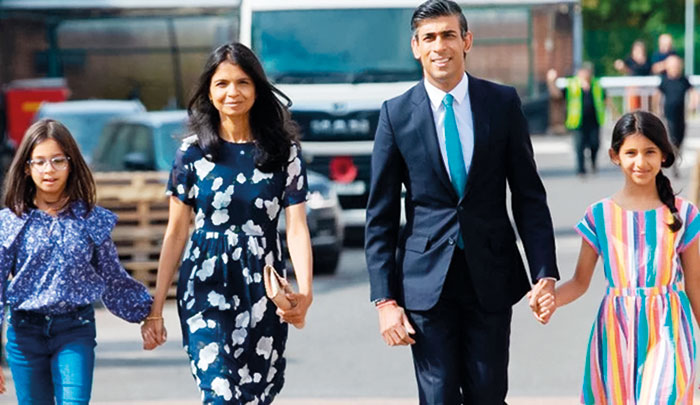
The parallels between the recent rise to premiership of the United Kingdom of Rishi Sunak and the election to the presidency of the United States of Barack Obama in 2008 bear a few similarities. They also represent the differences in the circumstances by which leadership could be achieved in two of the leading democracies in the world; similarities and differences both personal and national.The main personal and national similarity is that both Sunak and Obama were the first heads of state of countries never previously been so adorned by men of colour. They were both young when they took on the mantle of leadership. Sunak is 42-years old now. Obama was 47 when he was first elected to the presidency.
They are both highly educated. Sunak got his first degree at Worcester College, Oxford and an MBA on a Fulbright Scholarship at Stanford University in California. Obama earned his degrees from the Universities of Columbia and Harvard Law School. They are both extremely good-looking. In fact, Sunak is known as Dishy Rishi, and Obama has always been considered to be attractive by the opposite sex. Coincidentally, both their fathers were born and raised in Kenya, though of different ethnicities. And, probably most importantly, each have the great good fortune of being blessed with two lovely daughters.
Sunak being elevated to be the occupant of No. 10, Downing Street would have that infamous Indian hater, Winston Churchill spinning violently in his grave. He was the first British Prime Minister to vociferously bemoan the disintegration of the British Empire, especially its crown jewel, India. Obama’s election to the US presidency would have evoked a similar upheaval in the grave of Jefferson Davis, the first and only President of the Confederate States from 1861 till the end of the Civil War in 1865, who publicly decried the Emancipation Proclamation, by which Lincoln granted freedom to all slaves in the United States of America.
The similarities seem to end there. Although they both had brilliant academic careers, the routes which got them their education differed greatly both in family circumstances and the systems of education in England and the United States.
Sunak is a first generation Britisher, born in Southampton in 1980; his parents were of Indian origin, having emigrated to England from East Africa in the 1960s. His father was a doctor and his mother ran her own pharmacy; good upper middle-class stock able to send their son to Winchester College, one of the leading – and most expensive – private schools in England and then to the University of Oxford.
Obama is a first generation American, born in Hawaii, to a Kenyan father and a white American woman from Kansas. Barack Obama Snr. won a scholarship to study in America. He met his wife, Obama’s mother, while they were both studying at the University of Hawaii. Obama’s parents divorced in 1964, when he was two years old. After his graduation from the University of Hawaii, Obama Snr. went on to Harvard to study for a doctoral program in economics. He went back to Kenya after completing his Master’s degree, to become a senior economist in the Kenyan government.
Junior’s mother remarried another foreign student from Indonesia, and Barack spent a couple of his formative years at a government-run school in Jakarta. He returned to Hawaii in 1971, lived with his grandparents and graduated from an elite preparatory academy in Honolulu. He then attended Occidental College in Los Angeles, transferred to Columbia University in New York, where he received a Bachelor’s Degree in Political Science. Barack went on to Harvard Law School for his Juris Doctor (JD). After a few years of study of literature and philosophy, while serving as a writer and editor for a publisher, he decided to enter politics in 1985, serving as a community organizer in Chicago. He was elected to the US Senate in 2004.
A career totally different from that of Sunak, who, after Stanford and Oxford, worked at Goldman Sachs and then moved onto Hedge Fund management. He entered politics, being elected as an MP to a safe Conservative seat in north Yorkshire in 2015. Sunak had a rapid rise in the Conservative Party, being appointed as Chancellor of the Exchequer (Finance Minister) by Boris Johnson in 2020.
Their wives could not be more different. Michelle Robinson was the descendant of African slaves, who grew up as part of a working-class family in a poor neighbourhood in the South Side of Chicago. The family lived in a one-roomed apartment. She shared her “bedroom” – which was the living room split down the center – with her brother. Michelle’s father, Fraser Robinson, suffered from multiple sclerosis, worked as a city pump operator, and never missed a day of work. He ingrained into his children the values of achievement through hard work. Michelle excelled in her secondary education, and then followed her brother, Craig with a scholarship to Princeton University. She went on to get her law degree at Harvard University, returned home to Chicago, where she met Barack. They were married in 1992 when Obama was working as a community organizer for the Democratic Party in the South Side of Chicago.
Sunak’s wife, Akshata Murthy, is the daughter of Indian billionaire, Narayan Murthy, the founder of Infosys, who has often been dubbed as the Bill Gates of India. She went on to study economics and French at a private liberal college in Claremont, California. She met Sunak while they were both studying at Stanford. She is the heiress to a fortune, worth billions. They were married in a simple but elegant ceremony in Bangalore in 2009. Rishi Sunak is said to be the richest politician in Britain.

At least, he was a rich man before he became the Prime Minister, unlike many Sri Lankans who held that coveted office. From rags to red sashes is the thought that comes to mind when talking about our politics.As for their religions, Sunak is a practicing Hindu, Obama is a Christian. England pays no heed to one’s religion as a requirement for any job, including Prime Minister. In fact, when a reporter questioned a British Prime Minister in the 90s about his religion, I may be wrong but I think it was Blair, his response was “that’s none of your bloody business.”
As we all know, it would be impossible to win the US presidency without placing one hand on the Bible, the other holding an AR15 military style rifle. Sunak and Obama inherited near recession economies. Obama rose to the challenge, and ran a progressive, scandal free, two-term administration, which saw a thriving economy, ending with 72 months of growth and the lowest unemployment figures in history. Through the Affordable Care Act (Obamacare), he gave health-care insurance to over 30 million hitherto uninsured Americans. All this achieved despite a hostile and confrontational Republican majority in Congress.
Time will only tell what economic and political strategies Sunak will use to pull Britain out of its current economic malaise. Being a lifelong Conservative, these will almost certainly not be the progressive measures which helped Obama to get out of the near recession he inherited from Bush.
Sunak is a Conservative, at a time when both his Party and the British economy are fractured. He doesn’t represent change, hope or success against the odds as Obama did a decade ago. A formidable task of rescue awaits him, for which his seven-year career in national politics has hardly prepared him. The truncated nature of his period as Prime Minister – the next British general election will be held no later than January 2025 – won’t give him sufficient time to address, much less solve the immediate problems facing the British economy. Also, with a divided Conservative Party, the task of remaining in power over the next two years, and so avoiding the possibility of No. 10 Downing Street having a revolving door, highlighted by the recent departures of Boris Johnson and Liz Truss, will be formidable.In any event, Ms Truss can truthfully boast that her 44 days as the British Prime Minister spanned two monarchies!
Mr. Sunak has one advantage over the Americans, in racism against minorities and coloured people. Britain and America were both apologetically racist as late as in the 1960s. Though racism still exists in Britain, it has evolved to be far more muted. I have no doubt that there are white supremacists longing for the good old days when Britain ruled the world. But it certainly has not grown into the virulent post-Trump, racist monstrosity that represents fascism and white supremacy currently dominating the United States.
Britain surely will not have a Hitler moment that is threatening to destroy democracy. They have, by and large, racially evolved and accepted the diverse reality of their country. In any event, Sunak is more British than the British. His ultimate departure from office will not end in the pathological resentment and fear in America, caused by Obama’s successful presidency, which has led to the racial violence by white Americans terrified of losing the centuries-long privileges they have enjoyed.
We will know the fate of America’s future at the midterm elections on November 8. My most fervent hope, against all polls, is that a sufficient majority of decent American people will understand the real and present danger to the nation presented by Trump and his white supremacist cult; that they will come out in droves and vote to wipe out an armed, violent and bigoted Republican Party.
Whatever the result will be, whichever Party will be elected to control one or both Houses in Congress on November 8, it is certain that there will be widespread allegations of voter fraud with the inevitable violence in the streets. That political violence has already begun with the recent brutal, Trump-motivated attack on Speaker Pelosis’s 82-year-old husband in San Francisco.
As Sonia Sodha, London Observer columnist writes, “Ultimately, I am not sure it is any less bigoted to apply benevolent rather than malevolent stereotypes to Asian and black people. It undermines the goal of a society where the colour of someone’s skin isn’t worth commenting on because it genuinely no longer matters…. when we understand that our common humanity encompasses the good and the bad.”
That indeed is the noble goal, the achievement of which, on present form, is in the long-distant future for the United States of America. If ever. But hopefully doable in the United Kingdom as they continue to emulate the progressive, socially and economically just policies of developed nations in Europe and beyond.



Samagi Spice Exports (Pvt) Ltd is set to introduce SPICEUP, a new Sri Lankan beverage brand, at its grand launch on Saturday 17 October 2026 at the University of Ruhuna, Matara.
With a history dating back to 1969, Samagi Spice is taking a new step in its business journey by expanding beyond traditional spice exports into value added consumer products.
Through SPICEUP, the company aims to connect Sri Lanka’s internationally recognized cinnamon heritage with contemporary beverage innovation, creating a distinctive identity in the country’s beverage market.
The SPICEUP range will feature a variety of products, including Original, Cream Soda, Power, GO, Cool, Burn, Memo+ and Zingy. Designed to offer consumers a range of refreshment experiences, the products will be available in two packaging formats: cans and plastic bottles, catering to different consumer preferences and occasions.
At the heart of the initiative is the potential of true Ceylon cinnamon as a value-added ingredient in the beverage industry. Rather than limiting cinnamon to its traditional uses, SPICEUP seeks to explore new opportunities for bringing this iconic Sri Lankan spice into everyday consumer experiences.
The initiative also highlights the broader potential of transforming the country’s agricultural resources into innovative products with commercial value.
The launch ceremony will be attended by legendary Sri Lankan cricketer Sanath Jayasuriya as the Chief Guest, alongside representatives from the Export Development Board (EDB), Industrial Development Board (IDB), Cinnamon Research Academy and other industry stakeholders.
A major highlight of the occasion will be the official unveiling of the SPICEUP product range, followed by the launch of the brand’s official website. The event will also feature the signing of a Memorandum of Understanding (MoU) between Samagi Spice Exports and the University of Ruhuna, marking an important step towards strengthening collaboration between industry and academia.
The proposed collaboration will provide a platform for future research, product innovation and value addition involving true Ceylon cinnamon. By bringing together business expertise and university-based knowledge, the initiative aims to support the development of innovative, value-added products and contribute to Sri Lanka’s potential in international markets.
With its roots in the country’s spice industry and its ambitions in the beverage sector, SPICEUP is poised to begin a new chapter in Samagi Spice’s journey—one that seeks to bring the distinctive identity of Ceylon cinnamon to a new generation of consumers.

Business
Indian business leader urges SL entrepreneurs to tap into India’s rapidly expanding consumer market

By Sanath Nanayakkare
Speaking at the Sri Lanka Economic and Investment Summit 2026, T. Krishnakumar, Chief Executive Officer of Reliance Consumer Products Ltd (RCPL), emphasised that local enterprises can unlock substantial economic benefits by strategically aligning with India’s booming consumer base.
Addressing business leaders and policymakers at the Shangri-La Hotel in Colombo, Krishnakumar highlighted that geographical proximity and rich cultural ties provide a natural foundation for deeper commercial collaboration.
He noted that instead of viewing bilateral trade narrowly, regional partnerships should act as conduits to build robust, scalable enterprises capable of plugging into wide-reaching regional value chains.
“For Sri Lankan exporters dealing in traditional staples as well as value-added goods, accessing India’s rising middle class presents a phenomenal growth window,” he said.
Drawing insights from Reliance Consumer Products’ rapid expansion – which scaled efficiently to thousands of employees and multi-billion-dollar metrics – Krishnakumar stressed that modern corporate success relies on disciplined execution, localised consumer understanding, and smart technology integration.
Furthermore, he underscored that while rapid growth is critical, businesses must consistently anchor their models in affordability and consumer trust.
Concluding his address at the summit, the RCPL chief noted that pairing regional trade integration with resilient business practices and predictable regulatory frameworks will be vital as Sri Lanka transitions firmly toward accelerated economic development.
Addressing the Summit during a subsequent fireside chat, President Anura Kumara Dissanayake underscored that a core concern currently being targeted by the government is developing a critical mass of local entrepreneurs equipped to engage with international enterprise counterparts.
Business
SriLankan Airlines wins prestigious SATA 2026 Visitors’ Choice Award for Leading International Airline

SriLankan Airlines has once again been honoured with the prestigious Visitors’ Choice Award for Leading International Airline at the South Asian Travel Awards (SATA) 2026, reaffirming its continued recognition in the regional travel and tourism industry. The airline, which has received this award in previous years, was the only international airline to be recognised in this category at this year’s event. The 10th anniversary edition of the awards ceremony was held earlier this month at Hotel Barcelo Nasandhura in Male, Maldives.
Recognised as one of the key events on the Maldivian tourism and travel industry calendar, SATA celebrated its 10th anniversary on a grand scale, bringing together prominent industry stakeholders, including Government Ministers, distinguished dignitaries, diplomats and senior representatives from leading airlines and their respective head offices.
Commenting on the achievement, Dimuthu Tennakoon, Head of Commercial, SriLankan Airlines, stated, “We are honoured to receive this recognition at the South Asian Travel Awards 2026. Being named the Leading International Airline in the Visitors’ Choice Awards once again is a meaningful acknowledgement of our commitment to serving our passengers and strengthening our presence in the region. This award inspires us to continue enhancing the travel experience we offer and to build stronger connections with the markets and communities we serve.”
Complementing its commitment to service excellence, SriLankan Airlines offers an extensive flight network with convenient connections to destinations across the globe. In South Asia, the airline operates nearly 130 flights each week to 15 destinations across India, Pakistan, the Maldives, Nepal, and Bangladesh. With schedules thoughtfully designed to suit the needs of travellers, SriLankan Airlines provides seamless connectivity for those visiting Colombo for business or leisure, as well as passengers travelling onwards to destinations worldwide.

Iyer to lead in last two New Zealand ODIs, Kushagra earns maiden call-up

Pope pictured for first time since surgery and cancer diagnosis

Qatar announces ‘massive’ solar plant project in Lebanon

Samagi Spice Exports to launch Ceylon Cinnamon based beverage range

Asian Cup in Saudi Arabia could be postponed by a year amid Houthi attacks

Houthi missile attack on Yemeni presidential palace kills five, minister says

‘Dates have the highest sugar content to fight Coronavirus’

Sunday Island 27 December – Headlines

#SundayIsland 17th December – Headlines

Sunday Island – 28th March

Sunday Island Headlines – 21 March

Sunday Island – 21st February – Headlines
-

 News6 days ago
Sri Lanka escalates anti-graft drive with Shiranthi’s jailing
-

 News7 days ago
NPP govt. reminded of its responsibilities as US warship leaves Colombo
-

 Latest News5 days ago
Farhan and Sadaqat help Pakistan seal series in style
-

 News6 days ago
Iranian ships stranded, Lanka fears US sanctions
-

 Latest News4 days ago
Nissanka’s return headlines Sri Lanka’s Test squad against Pakistan
-
 News7 days ago
Interdicted top House official Kularatne receives special recognition in Mexican Parliament
-

 Features5 days ago
Intake 16: 45 years of duty and honour
-

 News5 days ago
Malwathu Chapter issues statement on talks with President over Gnanasara Thera’s robes