
Life style
Health benefits of Muringa


What is muringa?
Muringa considered to be one of the most nutritionally dense foods on the planet, and is credited with everything from sorting out sleep patterns to increasing libido. The leaves, bark, flowers, fruit and seeds of the tree are eaten or used medicinally in parts of tropical Africa, Bangladesh, Pakistan, Sri Lanka and Afghanistan, where it is native.Muringa’s reputation as a ‘superfood’ makes sense in areas where diets are traditionally sparse or unbalanced, particularly as it flourishes where few other plants or trees do well.
It may also make a difference in Western diets, particularly in those who do not have a balanced diet or suffer illnesses caused by (or causing) imbalance. For most, it will make little difference to health, and thus, buying it in packaged form is likely more expensive than following a balanced, varied diet. Speak to your GP before using moringa as a supplement.
With accolades dating back centuries, murunga appears to offer impressive health benefits, but does the science stack up? Registered nutritionist, Kerry Torrens, explores what we know about this interesting plant.
What is muringa oleifera?
A tree, native to South Asia and Africa, muringa oleifera has a number of colloquial names including the ‘miracle tree’ because of its alleged healing abilities, and the ‘horseradish tree’ thanks to its botanical family, the brassicas. Almost all parts of the tree can be eaten, including the leaves, bark, roots, sap and flowers, although it’s the leaf extracts which appear to offer the greatest protective, antioxidant properties.
The tree is an important source of nourishment in developing countries where poor nutrition is a major concern. In the Western world, the dried leaves are more likely to be sold as a food supplement in either a powder or capsule form.
A 10g serving of moringa powder provides:
31 kcals/128KJ
2.5g protein
0.6g fat
2.6g carbohydrates
2.4g fibre
198mg calcium
49.5mg magnesium
4.5mg iron
2.3g vitamin C
Rich source of protective antioxidants
Antioxidant compounds, including nutrients and phytochemicals, help protect cells from the damage incurred by molecules called free radicals, these are produced by the body when exposed to environmental toxins like pesticides and cigarette smoke. Moringa, and most notably its leaves, are rich in a number of beneficial compounds which provide antioxidant protection. These include vitamin C and beta-carotene as well as polyphenols, such as quercetin, rutin and chlorogenic acid.
May support blood sugar control
Most of the evidence supporting the use of muringa for balancing blood sugar has been based on animal studies – these suggest that compounds in the leaves may stimulate the cells of the pancreas, which are responsible for the secretion of the blood-sugar balancing hormone, insulin.An interesting study looking at the effects of the leaf powder on postmenopausal woman showed that taking 1½ teaspoons of muringa leaf powder every day for three months reduced fasting blood glucose levels by an average of 13.5 per cent. This suggests that muringa may be helpful in addressing some of the physiological changes experienced by mid-life women.
May have anti-inflammatory benefits
Inflammation plays a pivotal role in the development of many chronic illnesses, from obesity and diabetes to arthritis. The root, fruit and leaves of moringa contain substances which inhibit this inflammatory process. Both animal and test tube studies support the use of muringa, although there are still relatively few studies confirming these effects in humans.
May protect the liver
The liver is essential for maintaining our health and processing nutrients from our diet. In animal studies, moringa’s high levels of protective compounds called polyphenols helped protect the liver and promote recovery of damaged tissue. Very recent human trials suggest a possible role for muringa as an anti-cancer drug for liver cancer.
May support cognitive function
The rich antioxidant properties of muringa may support cognitive function and be useful in the fight against cognitive decline, as well as conditions like dementia and Alzheimer’s. In addition to this, it would appear that the plant may be useful in supporting mood, memory and neurotransmitter balance, with animal studies suggesting the leaf extract may be helpful for depression.
Studies to date in all of these areas look promising, but there’s still much for us to learn about this plant and its many reputed benefits.
Is muringa safe for everyone?
It is generally considered safe to eat the leaves and seed pods, however caution should be exercised over the bark and pulp. This is especially relevant during pregnancy because the bark contains chemicals which may promote uterine contractions and may increase the risk of miscarriage.Those on prescribed medication including blood pressure tablets, diabetes medication and levothyroxine should check with their GP or pharmacist to ensure muringa is appropriate for their use. –BBC

By Ifham Nizam
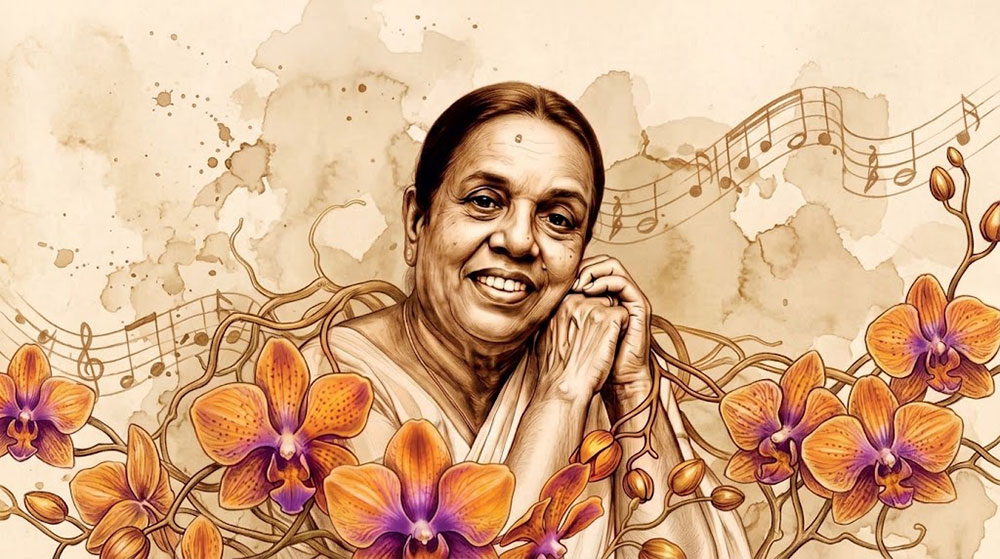
A flower named after one of Sri Lanka’s most celebrated voices has become a unique tribute to the country’s cultural heritage, with the Nanda Malini Ascocenda orchid carrying the name of veteran singer Dr. Nanda Malini.
The orchid was named in honour of Nanda Malini, recognising her outstanding contribution to Sri Lankan music and culture. She is among the country’s most acclaimed singers, with a career spanning several decades and a repertoire deeply rooted in Sri Lankan social and cultural experiences.
The striking illustration, released by the Ministry of Environment on August 21, features the veteran singer surrounded by colourful orchids and musical notes, bringing together two important elements of Sri Lankan identity — the country’s rich natural heritage and its musical tradition.
The Nanda Malini Ascocenda is particularly significant because it represents an unusual meeting point between art and nature. Orchids have long been associated with Sri Lanka’s botanical wealth, while the naming of individual hybrids after distinguished personalities provides a lasting link between the country’s natural and cultural heritage.
According to published accounts, the Nanda Malini Ascocenda was named in 2004 in recognition of the singer.
A recent profile described her as possibly the only Sri Lankan artiste to have an orchid named after her by the Orchid Circle of Sri Lanka.
Nanda Malini’s contribution to music has been recognised through numerous awards. She has also performed internationally and remains one of the most recognised figures in Sri Lankan music.
Her association with songs reflecting social realities, human emotions and national identity has given her a special place in the country’s cultural landscape.
The orchid, therefore, represents more than a botanical curiosity. It is a living tribute to an artiste whose voice has accompanied generations of Sri Lankans.
The Ministry of Environment’s presentation also serves as a reminder that conservation is not limited to forests, wildlife and ecosystems. Sri Lanka’s natural heritage is closely intertwined with its history, culture, art and the people who have enriched the nation’s identity.
As the colourful blooms of the Nanda Malini Ascocenda evoke the beauty of Sri Lanka’s orchid heritage, the name attached to them ensures that the contribution of one of the country’s most distinguished musical voices continues to live on in an entirely different form — through nature itself.
By Ifham Nizam
The launch of The Best of Malkoha: Half a Century of Ornithological Writings marked a significant milestone in Sri Lanka’s birdwatching and conservation history, as the Field Ornithology Group of Sri Lanka (FOGSL) celebrated its Golden Jubilee at the Faculty of Science, University of Colombo.
The book, drawn from five decades of writings published in Malkoha, the FOGSL newsletter, brings together a rich record of observations, discoveries and experiences that helped shape modern field ornithology in Sri Lanka.
The launch formed part of FOGSL’s first-ever Founders’ Day, held on August 22, a date chosen to coincide with the 76th birthday of Vidyajothi Emeritus Professor Sarath Kotagama, one of the Organisation’s founding figures and its enduring source of inspiration.
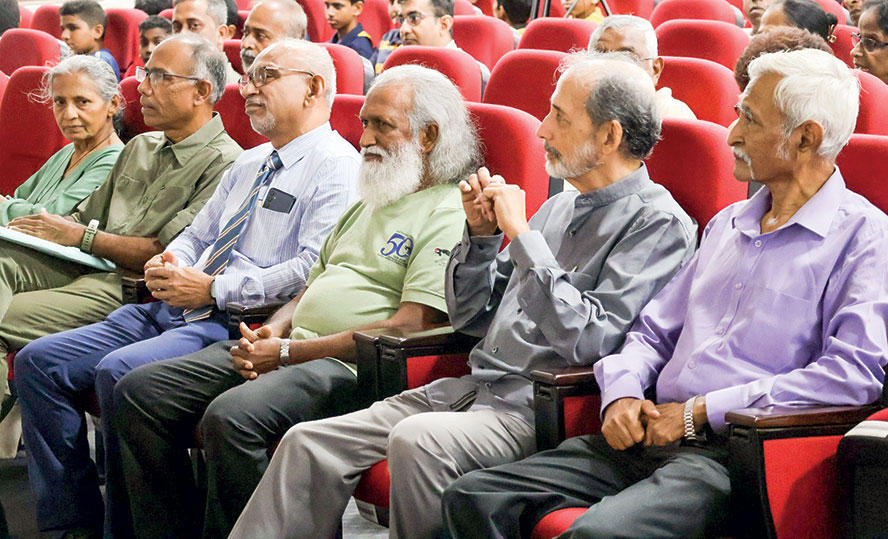
The occasion brought together academics, conservationists, naturalists, birdwatchers, students, young birders and members of FOGSL, reflecting the broad community that the organisation has cultivated since its establishment in 1976.
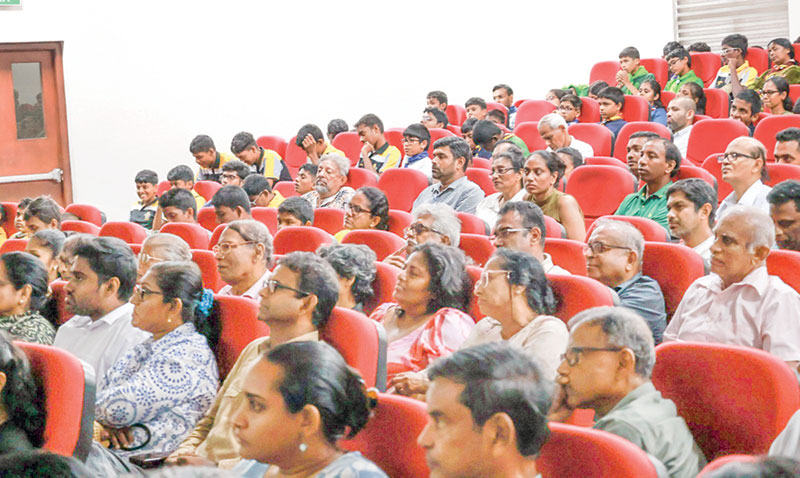
Section of the invitees
Biodiversity expert Dr. Rohan Pethiyagoda, delivering the Golden Jubilee Founders’ Day Oration, used the occasion to reflect on five decades of biodiversity research and conservation in Sri Lanka, while paying tribute to Professor Kotagama and the role played by FOGSL in taking birdwatching beyond a small circle of specialists.
Pethiyagoda said the organisation’s greatest achievement had been its ability to make knowledge of birds and nature accessible to ordinary people.
He recalled how, in the early 1990s, Professor Kotagama had proposed producing an affordable field guide so that birdwatching would no longer be restricted by the high cost of existing publications.
That resulted in the publication of A Field Guide to the Birds of Sri Lanka in 1994, which Pethiyagoda published and which subsequently became a bestseller.
The collaboration later produced Sri Lanka Kurulu in Sinhala, making serious bird identification and knowledge available to an even wider audience.
Pethiyagoda recalled a particularly emotional encounter that demonstrated the lasting impact of that work.
During a recent visit to Talangama to accompany Australian birdwatchers, he encountered two boys, aged around 12 and 14, carrying a battered copy of Sri Lanka Kurulu and using it to identify birds.
“I just started crying,” Pethiyagoda said, describing the moment as evidence of how knowledge had been passed from one generation to another.
-
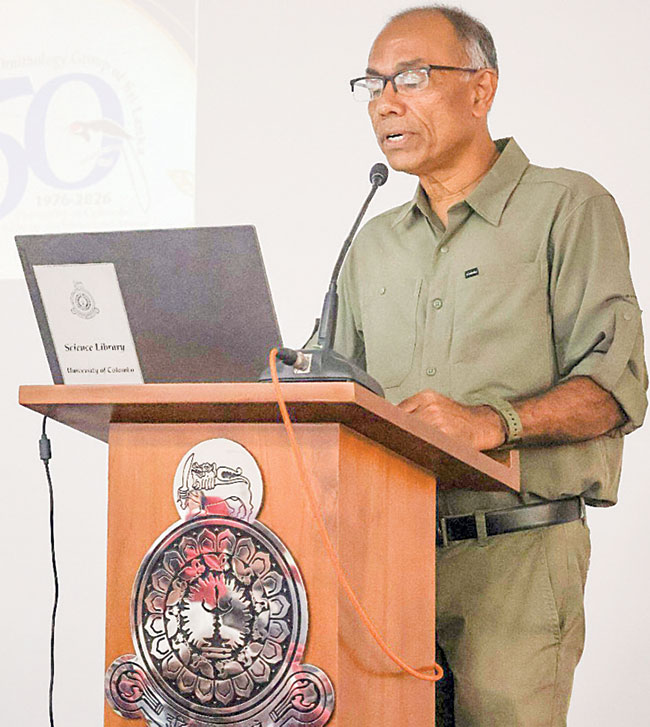
- Prof Nihal Dayawansa
-
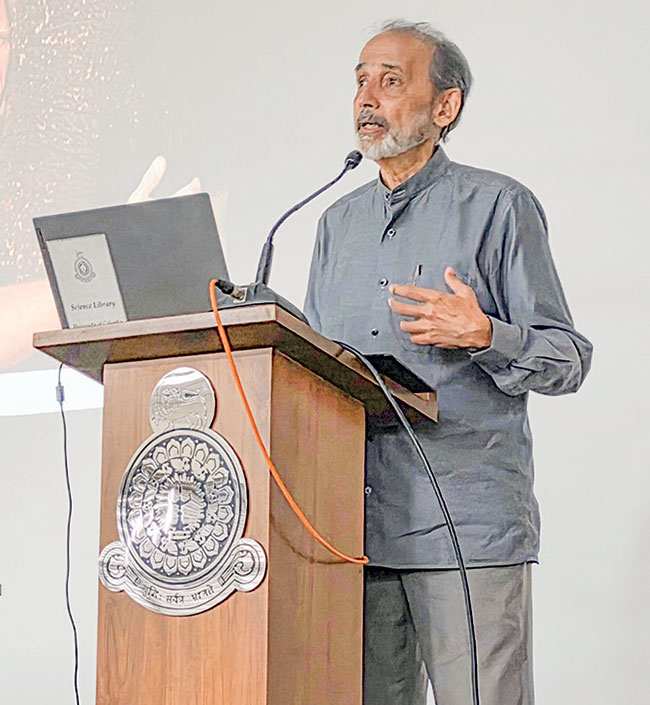
- Dr. Pethiyagoda
-
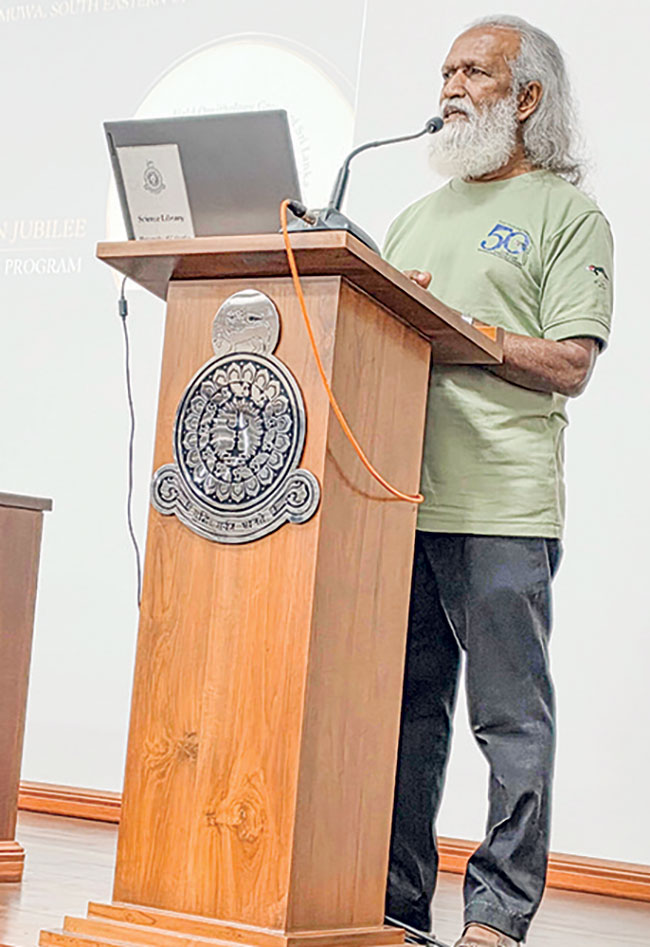
- Prof Kotagama
-
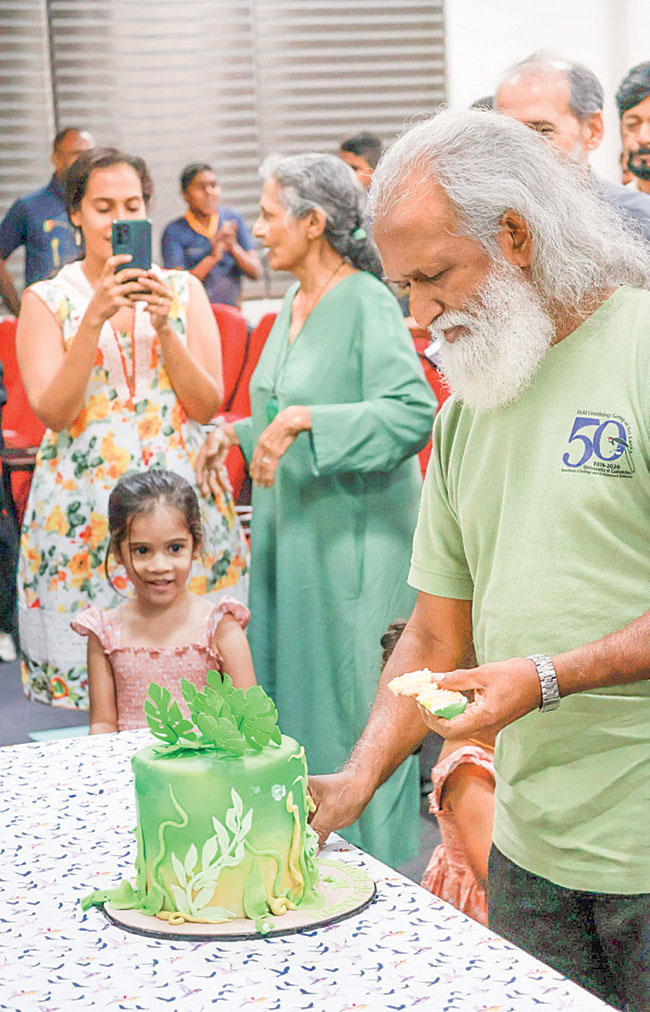
- Birthday celebration
He said the achievements of the past 50 years should not be underestimated. Sri Lanka has witnessed major advances in health, education, infrastructure and conservation, while the country’s protected-area network has expanded considerably.
At the same time, however, he warned that biodiversity research and conservation continue to face serious institutional challenges.
Pethiyagoda pointed to habitat fragmentation, climate change, inadequate scientific research and restrictions on field research as major challenges facing the next generation of conservationists.
He said climate change would increasingly force species to move towards cooler, higher elevations, but fragmented habitats could prevent them from making such movements.
“Our challenge now is to connect up those little fragments so that plants and animals can migrate across these landscapes,” he said, stressing the importance of restoring ecological connectivity.
He also called for greater investment in ex-situ conservation for species facing extinction and urged the establishment of conservation facilities across Sri Lanka’s different climatic zones.
Pethiyagoda placed particular emphasis on citizen science, arguing that Sri Lanka possessed an enormous reservoir of public enthusiasm for biodiversity.
He noted that more than 20,000 Sri Lankans were now involved in citizen science through platforms such as iNaturalist, with Sri Lankan users generating significant biodiversity data.
“The appetite for science, the appetite for conservation, for exploration, for discovery is there in the people,” he said.
Pethiyagoda also paid an emotional tribute to Professor Kotagama, describing him as the constant force behind much of Sri Lanka’s modern conservation movement.
“In future generations, we will talk of conservation in this country as before Kotagama and after Kotagama,” he said.
He also acknowledged Professor Kotagama’s wife, Namali, for being the “bedrock” of his household and for supporting his decades-long contribution to conservation.
The Golden Jubilee celebrations also looked back at the origins of FOGSL.
The Organisation was founded on October 10, 1976, when four passionate bird enthusiasts—the late P. B. Karunaratne, Professor S.U.K. Ekaratne, Professor Sarath Kotagama and Rex I De Silva —came together with a shared objective of making birdwatching accessible beyond the relatively exclusive group that had traditionally dominated the field.
FOGSL was subsequently formally recognised by the University of Colombo and developed as a platform bringing together birdwatchers, researchers, students, educators and nature enthusiasts.
Its philosophy was simple: one did not need an academic qualification to become a member. Enthusiasm, careful observation, recording and sharing knowledge were enough.
That principle continues to define the Organisation.
FOGSL has since become Sri Lanka’s BirdLife International partner and has played an important role in bird research, conservation, environmental education, field studies, school programmes and citizen science.
Its work has extended from research on endemic birds and migratory species to biodiversity monitoring, conservation education and programmes aimed at children and young people.
Speaking at the event, FOGSL President Professor Nihal Dayawansa said the organisation’s founding vision remained relevant even after half a century.
The Organisation, he noted, was created not simply as a birdwatching club but as a platform through which people could study and conserve Sri Lanka’s birds while inspiring the wider public to appreciate nature.
The Founders’ Day itself was described as an opportunity to honour those who established and shaped the Organisation while celebrating the contribution of generations of members.
Professor Mayuri Wijeyasinghe, Head of the Department of Zoology and Environmental Sciences, said FOGSL had given ornithology a new meaning in Sri Lanka by taking birdwatching beyond an elite community and making it accessible to ordinary people and schoolchildren.
She noted that Sri Lanka, as a tropical island with a remarkable diversity of birds and a high level of endemism, had a special responsibility to understand and conserve its avifauna.
The Dean of the Faculty of Science, Professor I.M.K. Fernando, meanwhile, said that although his own field was physics, he recognised the common foundation shared by all branches of science—curiosity.
He congratulated FOGSL on reaching 50 years and praised its contribution to research, education, student development, wetland conservation, public awareness and science-based advice on development projects.
“The work goes far beyond publishing,” he said, noting the Organisation’s lectures, school programmes, research projects and conservation initiatives.
He also paid tribute to Professor Kotagama, describing him as a legend whose influence had extended well beyond ornithology.
Professor Kotagama, speaking after receiving tributes from colleagues and friends, said the Organisation’s foundations had been laid with a belief that people could make a difference.
He stressed the importance of taking decisions based on scientific knowledge and criticised excessive bureaucratic barriers that, in his view, prevented scientists from carrying out important field research.
Reflecting on his own period as Director of Wildlife Conservation, he said he had sought to transform the Department into a scientific institution.
“For me and for us who were working in the Mahaweli environment programme at that time, we knew that if not for science, you cannot go forward in conservation,”
Professor Kotagama said, stressing that conservation required both natural and social sciences.
He recalled the challenges faced by the Department, including inadequate staffing structures and poor career progression for wildlife officers, and said efforts had been made to introduce a more professional and scientifically grounded system.
The 50-year journey of FOGSL is closely intertwined with the development of modern field ornithology in Sri Lanka.
From the early days when birdwatching was largely confined to a small group of specialists, the Organisation helped create a culture in which students, schoolchildren, amateur birdwatchers and citizen scientists could contribute to the understanding of the country’s biodiversity.
The launch of The Best of Malkoha, therefore, served as more than the unveiling of another publication. It was a record of that transformation.
The writings collected in the volume represent five decades of observations and experiences, documenting how Sri Lankan field ornithology evolved through the work of generations of birdwatchers, researchers and conservationists.
As theOorganisation enters its next half century, the message emerging from the Golden Jubilee celebrations was clear: the future of conservation will depend not only on institutions and scientists but also on an informed and empowered public.
FOGSL’s enduring motto—”Once a member, always a member”—perhaps best captures that legacy: a lifelong connection with birds, nature, scientific observation and the responsibility to protect Sri Lanka’s extraordinary natural heritage.

Dr. Rajitha de Silva
By Zanita Careem
Dr. Rajitha Y. de Silva, Consultant Cardiothoracic Surgeon and Consultant at Sri Jayewardenepura General Hospital, has built a distinguished career around one of medicine’s most demanding discipline – surgery of the heart. With his expertise, precision and pioneering spirit, he has become closely associated with the advancement of Minimally Invasive Cardiac surgery in Sri Lanka. He joined Sri Jayewardenpura General Hospital in 2013 and is today recognised as a pioneer of Minimally Invasive Cardiacs procedures in the country.
He is particulary recognised as a pioneer of mimimallyinvasive surgery in Sri lanka,with experience in procedures including minimally invasive coronary surgery and mitral valve repair. He is recognition as a leading figure in the advancement of modern cardiac surgery in the country. With years of specialised training and experience behind him, Dr de Silva has built a reputation in cardiothoracic surgery while remaining deeply conscious of the human story behind every patient who enters the operating theatre. For him, the beating heart is more than an organ to be repaired – it represents a life, a family, a future and a second chance.
His commitment to patients extends well beyond the operating theatre. Having witnessed the financial hardships faced by heart patients who desperately needed surgery but could not afford it. Dr de Silva, together with Senior Cardiologist Dr. Ruwan Ekanayake, co-founded the Heart to Heart Trust Fund.
The initiative was created with a powerful objective, that no patient should be denied life saving cardiac treatment simply because of financial difficulties.
Perhaps one of the most striking aspects of Dr de Silva’s personality is that his concern for patients does not end when the operation is over. His vision has included creating initiatives that make the difficult journey of cardiac patients more humane, giving them encouragement, dignity and hope during a period when they are often at their most vulnerable. Abayadhana was born from a simple but powerful conviction that every patient deserves a chance to live.
Through the Abayadhana programme, he represents his compassionate approach to caring for people who need not only medical attention, but also understanding, encouragement and support. What makes this initiative particularity meaningful is the personal commitment behind it. It reflects his belief that healing is not only about medicine, but about reaching out to people when they are most vulnerable.
Away from the intensity of the operating theatre, Dr. Rajitha de Silva finds another kind of joy – his passion for cricket over the years; he has taken the field in numerous matches, playing alongside and against many well known personalties.
Dr. Rajitha de Silva’s journey is guided by compassion and success anchored in humanity. From pioneering milestones in cardiac surgery to the Heart to Heart Trust Fund and the Abayadhana initiative, he has continued to give back to the people whose lives he touches. His love for cricket, his warmth and generosity reveal the heart behind the healing hands.
A surgeon by profession, a humanitarian by choice and a cricketer by heart, Dr. Rajitha’s greatest legacy may not be measured only by the operations he has performed, but by the lives he has changed, the hope he has restored and the hearts he has touched.
The trustees of the Heart to Heart Trust Fund stand united behind the mission of saving lives and giving hope. Their collective commitment helps turn the Trust’s vision into meaningful support for patients and families in need
The Executive Director, Heart to Heart Trust Fund, Shanti Fernando, plays a hands on role in turning the Trust’s vision into action, coordinating efforts, and bringing hope where it is needed.
Behind Dr. Rajitha de Silva’s demanding life is his wife, Dr. Arunie, and children, who has been his strength and support.

Malaysia declares emergency in Sarawak as haze from Indonesia worsens

UAE keep semi-final hopes alive after convincing win over Indonesia

Sun directly overhead Moratuwa, Kesbewa, Handapangoda, Idalgashinna, Yudhaganawa, Kotiyagala and Panama about 12.08 noon today (05)

Showers above 75 mm are likely at some places in the Uva, Central and Eastern provinces and in Polonnaruwa and Mullaittivu districts after 2.00 p.m

Namal remanded until Sept. 18 over Airbus deal investigation

Dengue cases surpass 96,000 this year

‘Dates have the highest sugar content to fight Coronavirus’

Sunday Island 27 December – Headlines

#SundayIsland 17th December – Headlines

Sunday Island – 28th March

Sunday Island Headlines – 21 March

Sunday Island – 21st February – Headlines
-

 Features6 days ago
“Wrap Me Up in My Blazer”— A Gentlemanly Bradby Reminiscence
-

 Features5 days ago
When Sri Lankan stories find their own voice
-
 Features6 days ago
JVP/NPP government as seen from outside by Lionel Bopage now domiciled in Australia
-

 News5 days ago
BASL takes exception to Justice Ganepola being denied a place in SC
-
 Features6 days ago
Prof. Savitri Goonesekere: What has she done?
-

 News2 days ago
Denied of promotion to SC despite vacancies, justice Gurusinghe retires
-

 Latest News3 days ago
Grade 5 scholarship exam results released
-

 News2 days ago
22A: SC urged to suspend hearing, appoint full bench