
Business
Dilum vows to break free from ‘prolonged illusion’ of one-stop-shop

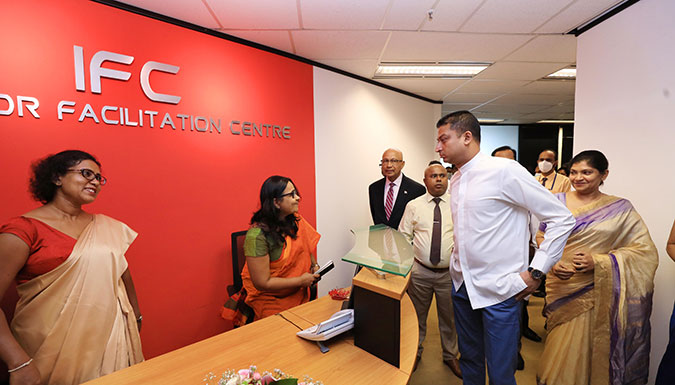
BOI unveils Investor Facilitation Centre
By Sanath Nanayakkare
The one-stop- shop or single window approval system for investors coming to Sri Lanka has been a pie in the sky over a long period of time and the Investor Facilitation Centre unveiled today will not be yet another one-stop shop that doesn’t serve its purpose, Dilum Amunugama, State Minister of Investment Promotions assured in Colombo last week.
“We had several rounds of discussions with the President who is also the Minister of Investment Promotions and he suggested that we name a competent official from the BOI and the President’s Secretary would appoint him/her as an official from the President’s Office so that this official will have the authority to go and discuss with any line ministry or agency and reconcile matters relating to FDI projects without creating undue delays. This is all about accelerating and streamlining the approval process. Any line agency can express their point of view in line with stipulated regulations and can say ‘yes’ or ‘no’ to a project proposal. But it has to be logical and swift. It shouldn’t take six months to respond to a proposal. And when there are issues relating to environment, land allocation, waste water management etc., let me know and then I will take it up at ministerial level and see if conflicting issues can be reconciled and give the project the green light or not. I request all officials from different departments and line agencies present here to support the BOI in accelerating the approval process and attract much needed FDI to the country. We might not be able to swiftly change the way of state correspondence, but the IFC will directly involve in taking the documents forward without letting them dust on someone’s desk,” he said.
The minister said that if currently stuck FDI proposals are given the green light, it will bring the country about USD 3 billion and that will be an amount of foreign exchange Sri Lanka can raise more than from the expected IMF loan.
BOI Chair Eng. Raja Ediruisuriya said that IFC alone wouldn’t be able to bring in foreign exchange. “The only thing IFC can do is coordinating with the relevant agencies for fast-tracked approval of BOI projects. We are competing with countries like Vietnam and Cambodia because they are also trying to attract FDIs. So we have to be very competitive in this sphere. Our goal is to increase the FDI share to GDP by 2.6% between 2022-2026. Our target is to realize FDIs till 2026 by about 3 billion USD per annum. We can’t meet this target unless investors are not encouraged to come in. BOI is not only a service-oriented organization. We have targets to achieve. I therefore appeal all line-agencies to help us achieve these targets and help boost the national economy. Minister Amunugama went through 77 projects and found that about 10 line agencies were holding up these projects for a couple of years or even more. We need to improve our communication and collaboration to fast-track these FDIs. The collaboration between the IFC and your line-agencies is critical at this hour to increase our foreign exchange reserves,” he pointed out.


The Securities and Exchange Commission of Sri Lanka (SEC) and the Colombo Stock Exchange (CSE) have taken their ‘A Share for Everyone, A Unit for Everyone’ (Samata Kotasak, Samata Ekakayak) initiative to Anuradhapura and Jaffna through investor forums last week, as part of an ongoing islandwide effort to broaden investor participation. The forums were held on 10th September at the Golden Mango in Anuradhapura, and on 12th September at the Tilko Jaffna City Hotel. The forums attracted over 600 participants across both locations.
The “A Share for Everyone, A Unit for Everyone” concept, developed by the Chairman of the SEC, Sen. Prof. D.B.P.H. Dissabandara and launched in July of this year, aims to promote a shared commitment to creating wealth and value within a fair, efficient, orderly, and transparent capital market by ensuring broad and accessible participation for all.
As part of this initiative, the SEC and CSE will continue to host investor forums across the country to strengthen investor education and awareness while promoting broader participation in the capital market beyond the Western Province. By leveraging the CSE’s nationwide reach and the growing interest in equity investments, the programme will provide investors with greater access to Sri Lanka’s capital market through stockbroking firms and unit trust management companies.
“Traditionally, Sri Lankan investors have favoured conventional investment avenues, but it has yielded comparatively fewer returns than the capital market,” remarked Executive Vice President – Marketing, CSE, Niroshan Wijesundera, speaking on the Unit Trust and Stockbrokering firm outreach objectives of the broad-basing initiative.
“Over the medium to long term, capital markets have given higher returns. By setting aside small allocations to invest regularly through professionally managed vehicles such as unit trusts, first-time investors can participate in the capital market, receive higher returns in the medium-to-long-term, and gain experience and confidence. On the other hand, those with experience and knowledge can directly engage with the capital market through a stockbrokering firm. Traditional investments are liable to be taxed, whereas investments in the capital market are capital-gains tax free.”
Speaking on the favourable investment climate, he noted that the Sri Lankan capital market is at a relatively low Price-to-Earnings (P/E) ratio of 11.03x in a global context. “As covered in the presentations at the forums, the Sri Lankan capital market has demonstrated comparative resilience in the face of global market corrections, such as the Middle Eastern crisis. Sri Lanka has withstood bigger shocks, such as past crises, the war, COVID-19, the economic downturn, and the fuel crisis.’’
Business
“Pulle Madu” to medical school: record intake signals turning point for plantation sector welfare

Many generations ago, an estate child’s first years began in a cloth hammock strung up near the rows of tea bushes, so a mother could keep working within earshot of her infant. Later a corner in a line room was converted to establish Pulle Madu, where infants and toddlers were sheltered to ensure that plucking by their mothers was not disrupted.
Today, fully equipped Child Development Centers (CDC’s) complete with qualified and trained CDC officers have replaced the old Pulle Madu, to offer children the same level of education and exposure that any child in a city avails. These children receive custodial care, and child development support through these CDC’s, while Early Childhood Centers (ECD) lay greater emphasis on structured early learning through a play-based curriculum, while also providing dedicated spaces for working mothers to breastfeed.
These Centers are the result of the collaborative efforts of the Regional Plantation Companies (RPCs), the Government of Sri Lanka, and key plantation-sector trade unions, including the Planters’ Association of Ceylon. Together, these stakeholders form the tripartite body that established the Planters’ Human Development Trust (PHDT) in 1992, and have since contributed to significant development across the 22 RPCs.
The RPCs collectively spend nearly Rs. 720 million annually to maintain these CDC’s, reflecting the sector’s continued investment in childhood development and the wellbeing of plantation communities. This foundation supports their continued education and health development and, in the long term, helps them progress towards successfully completing the GCE O/L and A/L examinations.
To date, primary school enrolment among children from plantation communities has reached 100%, while approximately 2–3% of students go on to pursue higher education at local universities. Over the past two years, nearly 250 children from plantation families have gained admission to university, marking the highest number recorded by the sector to date. Among them is a young man from Strathspey Estate, now training to be a doctor at Eastern University. “Everything I have achieved is a direct result of my parents’ tireless hard work,” he said, thanking his teachers and the scholarship grant that carried him through school, whose identity is withheld in line with the programme’s standard practice for student privacy.
It also manifests powerfully in Roots to Wings, the university start-up scholarship initiative launched by PHDT in collaboration with the Planters’ Association and other industry partners. “Every year we saw bright students earn a place at university and then risk losing it, not for lack of ability, but because they couldn’t afford a laptop, a set of books, or even proper clothing to arrive on campus with dignity,” explained PHDT Director General Lal Perera. “To correct this situation, after careful study, we facilitated a scheme that bridges the most urgent gap. We cover the immediate start-up costs, while the Regional Plantation Companies, through their CEOs, ensure that the student is carried through to graduation. If a family loses estate housing when a parent retires, we don’t let that end a degree either. Students are granted extensions, and where needed, RPCs provide new housing, supported in part by Indian High Commission grants. Once a child has earned a place at university, we consider it our duty to make sure that place is never lost to circumstance.”
This scheme has become more than financial assistance; it is a lifeline of dignity, continuity, and hope. By addressing the hidden barriers that often derail promising futures, Roots to Wings ensures that talent from the plantation sector is not wasted but nurtured into leadership for tomorrow. It is a model of shared responsibility, where industry stakeholders collectively safeguard the aspirations of youth, transforming vulnerability into opportunity and circumstance into achievement.
The scheme costs an estimated LKR 10 to 15 million a year, funded by various industry stakeholders. The 2024 to 2025 cohort spans 35 Arts students, 22 in Commerce and Management, 13 in Drama and Theatre, 10 in Bio-systems, 7 in Music, 6 in ICT, four each in Medicine and Engineering, three in Engineering Technology, two in Law and 24 across other faculties, a spread once unimaginable on estates where literacy in PHDT’s target areas has climbed from 40 to 84 percent. Specialised degree pathways and vocational opportunities such as Uva Wellassa University’s Bachelor of Science Honours in Plantation Management, vocational training through the National Institute of Business Management and digital learning through the Open University of Sri Lanka has further empowered students with promising academic and career prospects.
The health figures tracked alongside the Department of Census and Statistics and the Family Health Bureau since 1992, shows infant mortality falling from 18.3 per 1,000 live births to 4.65, and under five mortality from 42.6 to 6.26. Maternal mortality, once as high as 150 per 100,000 live births, has fallen close to zero in most recent figures, and stillbirths have dropped from 40 per 1,000 deliveries to under five today. Nearly all deliveries now happen in health institutions, almost every mother receives antenatal care, and every child completes first year immunization, which are gains attributed to better roads, housing, welfare services and preventive healthcare across the estates.
Nutrition support has similarly evolved, with centers moving from contractor-supplied meal packets towards parent-prepared midday meals. A centrally managed kitchen model has also been piloted at Dessford Estate, with a second facility planned at Holyrood Estate. However, officials do acknowledge that nutrition among younger children remains the area needing the most continued investment.
The progress made in improving health outcomes, particularly in reducing infant mortality, is significant. This reflects the RPCs’ continued commitment to community development, which extends to supporting education through scholarship programmes. These initiatives, together with established healthcare and educational support systems, contribute to improving opportunities and outcomes for children and families across plantation communities.

Ceylinco Life has reaffirmed its standing as a powerhouse of sales excellence in Sri Lanka’s life insurance industry, securing an outstanding 12 awards at the 2026 edition of the National Forum for Life Insurance Advisors (NAFLIA), including five National Awards that recognised its professionals as the best in the country.
The awards event saw Ceylinco Life’s sales professionals excel at both the Large Company and National levels, with the company claiming top honours across the Advisor, Supervisor and Branch Manager categories in both levels, while also producing two winners in the Large Company level in the Fast Starter Advisor category.
In the Advisor category, A. P. S. Wijayakumar secured first place at National and Large Company Level, while A. I. P. Manjula was placed second in both levels, giving Ceylinco Life four awards across the two tiers of recognition in this category.

Advisory for strong winds and rough seas for Multi-day boats in the Bay of Bengal

Showers in the Western, Sabaragamuwa and North-western provinces and in Galle, Matara, Kandy and Nuwara-Eliya Districts

Some NPP manifesto promises may be difficult to fulfil – CIABOC DG

Yoshitha and ex-Navy chief Karannagoda’s case fixed for PTC

Court orders probe into Wimal’s rally speech

Court to rule on Dilith’s writ petition on September 30

‘Dates have the highest sugar content to fight Coronavirus’

Sunday Island 27 December – Headlines

#SundayIsland 17th December – Headlines

Sunday Island – 28th March

Sunday Island Headlines – 21 March

Sunday Island – 21st February – Headlines
-

 News6 days ago
Gnanasara Thero absconding after SC ruling
-

 Opinion5 days ago
From Galkissa (Mount Lavinia) to Tambuttegama
-

 Business6 days ago
HNB Finance strengthens Board with four independent directors
-

 News2 days ago
US embassy won’t comment on IGP’s probe into joint drug raid
-

 Sports6 days ago
Culture within cricket team worrying authorities
-

 Features4 days ago
The emptying university: why are academics leaving?
-

 Features5 days ago
Sri Lanka’s university crisis: Brain drain and union action demand urgent reform
-

 News6 days ago
House to debate 22A, Judicature Bill next week