
Features
An Imaginary Museum or a Museum Without Walls:

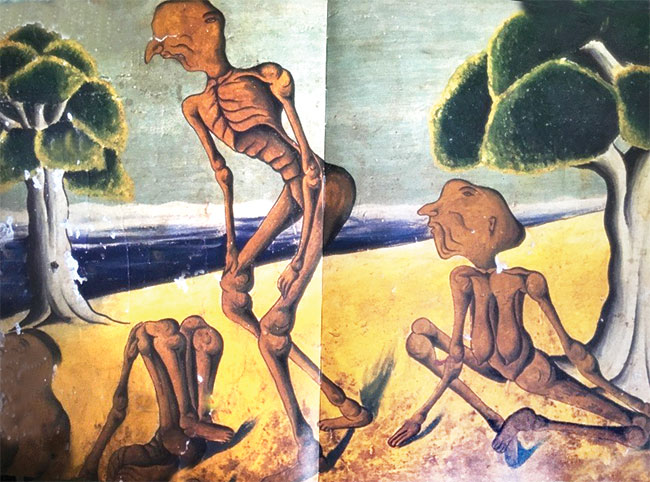
David Paynter and L.T.P. Manjusri
(Part one of this article appeared in Midweek Review yesterday.)
by Laleen Jayamanne
Eclecticism and Abstraction
It would appear that a book or two might be written about the lesser known history of 20th Century Lankan modern art and visual culture, which seems to be much wider than the art historical accounts of 43 Group Modernism. There must be many others as well. For example, one comes across the name of H.A. Karunaratne as an abstract painter influenced by Euro-American abstraction as having held a solo exhibition in 1956 at the USISC. What response did this exhibition receive in that momentous year of the triumph of Sinhala-Buddhist Nationalist exceptionalism after Sir John Kothalawala’s pro-American government was defeated. Then there is the Ian Goonatilake collection bequeathed to the University of Peradeniya and now languishing in the basement of the library, stored under poor conditions, awaiting a dedicated gallery. While it is well known that his collection consists of a large number of George Keyt drawings because of his wide taste and sympathies his collection might hold potential for considering a somewhat decentred (less linear), art historical narratives of the twentieth century. The blatantly self-interested, thin accounts that pass as recent art history can thereby be displaced by more careful art historical research with rigorous conceptual frameworks. The history of the use of colour in the move from the Buddhist temple paintings to the easel and then from easel to Christian church walls and back as in the case of Paynter would be fascinating to explore within a theoretical framework. Such a framework might explore the generative philosophico-aesthetic discourses on the links between colour, affect and thought, for example. There, colour is considered to be the most immaterial manifestation of matter, haunted by spirit. Colour within such an optic is a force of metamorphosis.
Christian Themes
Christian themed art also would have to be explicitly taken into account in the narrative of Lankan modern art when studying Paynter’s work. What links might there be, say, between Richard Gabriel and Paynter who composed Christian religious scenes in murals in chapels, too. It is certainly noteworthy that in the large murals he created in the Trinity College chapel in the ‘30s, Paynter’s Jesus and disciples are presented with brown skin tones. This fact alone is the decision of an original artist because it was decades prior to the radical Vatican 2 reforms of the ’60s, which lead to adopting vernacular forms and realities in Catholic Church ritual. The vegetation and light in the landscapes of some biblical scenes are those of Lanka of the East coast, I am told. Chandrajeewa, too, has done a large scale series of 46 bronze murals on the history of Christianity in Lanka around the Basilica on a hill top at Thewatta (surrounded by rubber trees, as I remember from my school visits there for church feasts) near Ragama though he himself does not subscribe to any religious faith. Barbara Sansoni’s Christian murals would be of interest in such a context. A national collection can create digital installations of site-specific religious work such as these to educate Lankans about the religious diversity of our art and culture as well. Inter-faith dialogue would certainly be enhanced by such educational ‘tools’ made available to school-children especially, but also to the more ethnocentric and parochial Lankans. It could then also be a point of entry to understanding something about our long colonial history and religious violence of the Portuguese who converted Lankans at gunpoint. Both my parents and grandparents came from the thin strip of coastal fishing villages (just a stones throw from the Colombo harbour), starting from Uswatakeiyawa, Kapungoda and Pamunugama, all mostly Roman Catholic, during my childhood. The largest buildings in each of these villagers were the local churches built on Italian models with large statues of white saints, mother Mary and Jesus. There were a few French parish priests who also spoke fluent Sinhala.
A Queer Aesthetic: Exploring the +
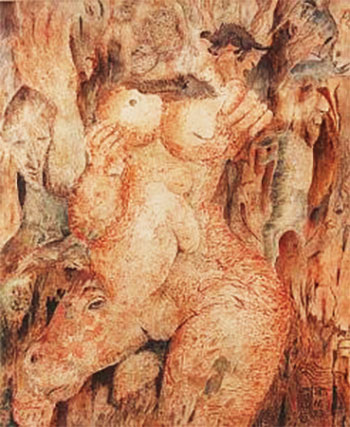
Evolution 1973 L.T.P. Manjusri (1902-1982)
Water colour on Paper 36.5 X 31 cm
Image Credits : http://www.artsrilanka.org/retrospective/manjushri/19731.html
Is there an embryonic queer sensibility, and a radical aesthetic, in Paynter’s ‘Offering’ (1926), of an ethereal youth, standing naked in a dreamy, somewhat Pre-Raphaelit landscape, with raised arms, delicate hand gesture, holding a white flower, for instance? Perhaps, there are ‘elective affinities’ to be drawn between Wendt’s homo erotic photography of young men and some of Paynter’s work. Or, are their differences more productive for exploring the diversity of queer aesthetics well before such a term was invented to address social reality of LGBTQI rights? Paynter’s ‘Apres Midi’ (‘Afternoon’, 1935) is an astonishing work full of surprises, even now. The inclusion of the title in French immediately evokes the 1911 ballet ‘Afternoon of a Faun’ choreographed and performed by Nijinsky in his lover Diaghilev’s company, Ballet Russes, in Paris, with Debussy’s music. Apart from that notable allusion to a highly sexualised performance that shocked the traditional ballet audience, the two Lankan figures, one facing us, and the other, appears to be his double, a mirror image, though all we do see is his back view. There is an essay to be written about this doubling and elegant most subtle ‘performance of narcissism,’ in the sense of an exploration of a queer subjectivity, the very formation of a sense of ‘self’ based on similarity rather than sexual difference. The facial expression of the slim tall figure (so unlike Nijinsky’s muscular compact short body), is thoughtful, as he looks at ‘the other’ and his features suggest that he might be a Lankan of Malay descent perhaps. As with ‘Offering’, here too the male figure holds a red flower, reminiscent of the distilled eroticism seen in Moghul miniatures. In Paynter’s tropical ‘Afternoon’ there is a more every-day feel as well because of the towels and informal postures – are ‘they’ about to swim in the river behind them? The blue green bamboo grove creates a lush tropical heaven for ‘the couple’. Might we think of it as a queer self-portrait perhaps? If so it’s quite different from his earlier, personal ‘Self-Portrait’ (1927), where the ‘self’ is decentred, seen in a mirror image, while a vase of overflowing pink lotus blossoms occupies the centre. As early as that, he is painting the iconic flower in Buddhist iconography, rather than the readily available English roses of Nuwara-Eliya which is where the Paynter Home was located.
Then there is the painting of a group of fishermen and male onlookers after a catch. While some onlookers are fully clothed, the two fishermen in the foreground are conspicuous not because they wear only loin cloths (which is realistic) but because of the way their anatomy is modelled.
The anatomy of the two prominent fishermen are modelled in such a way that their biceps, pectoral and abdominal muscles are beautifully articulated. Lankan men who do heavy manual work have wiry limbs, sinewy muscles, a function of diet and genetics, they are certainly not moulded and fashioned quite like those on these two fishermen. Though these conspicuous muscular details are not realistic, the scene nevertheless has a powerful ethnographic vitality. The choreography of each gaze has an intensity, a realism, as each figure looks intently in slightly different directions. Their features evoke a specific Lankan era. I remember the men who looked like that in my maternal grandfather’s fishing village, Uswatekeiyawa. My grandfather tied his hair in a little knot just like some of them in the picture.
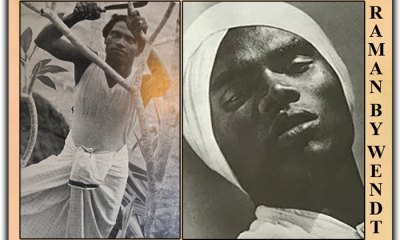
Wendt’s photographs of young men’s bodies are quite different. Their gaze is rather more diffused. It’s his play with and command of light and shade and chemical processing that sculpts their bodies, either caught straining in manual work or relaxed in posed still lives. In striking contrast, Paynter has given his standing fishermen a deep, anatomically grounded musculature that feels so contemporary in its fashioning, sculpting of desire. Thereby, he helps us (straight folk also) to understand how a Queer sensibility is crafted and invented as a fertile affective zone of aesthetic innervation, which also includes nature. These two paintings have a quiet theatrical and even cinematic sensibility (i. e. there is movement and drama), which reminds me of Pier Paolo Pasolini’s cinema, especially Gospel According to St Mathew. Pasolini however, was a flamboyantly public gay artist and poet. I feel that Paynter’s work offers young LGBTQI+ artists a vital tradition to draw from, not imitate. Some of them might have been at that Gay Pride March in Colombo sponsored by the Aragalaya recently, which I saw on You Tube. I hear Paynter the teacher say, ever so softly: ‘explore the +’. With just a slight turn, artists may change the + into an x.
These are thoughts that occur to me as I glance at Paynter’s work in the catalogue edited by Chandrajeewa, issued at the inaugural J.D.A. Perera Gallery, which houses 19 of Paynter’s work at the University of Visual and Performing Arts. But ‘The Afternoon’, sadly, is in a foreign gallery. This rare gift was given to the very institution whose Sinhala-Buddhist nationalist students and staff got rid of Paynter in 1963, through an ugly racist campaign against him, calling him a ‘Burgher suddha’!
I know that Professor Ashley Halpe, himself a painter, introduced Paynter’s art to students of Fine Arts at Peradeniya University and accompanied them to the Trinity College Chapel to look at the murals Paynter had designed in the 1930s. By the way, Prof Halpe was a Roman Catholic, who nurtured extracurricular student life on campus generously with an open house filled with painting and music every Friday, enthusiastically supported by his wife Bridgette.
What is to be Done?
I hope young Lankan art historians might take a cue from the marvellous idea of the ‘Memory Walks’ conducted by the ‘Collective for Historical Dialogue and Memory’ and go off the beaten track to find out what was made; what has been lost and the provenance of work that really should have been in a national collection but are now in private homes and overseas galleries and in damp basements, even locked away in a vault. Perhaps, only such dedicated hands-on work by scholars with intellectual and social capital and spiritual stamina might eventually convince the National Museum to open one of its majestic wings to house whatever is left of modern 20th Century art and Visual Culture of a multi-ethnic, multi-religious Lanka. On the other hand, as some folk in the Aragalaya suggested, perhaps the official residence of the President, which was formerly known as the Queens’s House but has become the President’s House, can be converted like the European palaces into a museum of modern and contemporary art and the art work of the Aragalaya too.
Perhaps, an archive of photographs of work that has been sold or stolen or unavailable in the public domain can be compiled digitally just so that future generations of artists might get to know the eclectic variety of work that had been created by their multi-ethnic, multi-faith, queer and straight ‘ancestors.’ Then, they might begin to understand deeply some of the ideas and passions which animated the skilled and dedicated modern Lankan artists of the 20th and 21st Centuries. Such a virtual collection might be called following the famous idea of French Minister of Culture Andre Malraux, ‘An Imaginary Museum’ or ‘Museum Without Walls.’ Such a museum would, I hope, assemble an eclectic (non-partisan), collection of art- work with the power to nurture life in a multi-ethnic, multi-cultural, multi-faith Lanka.
Here is a link to Paynter’s Apres Midi (Afternoon, 1935).
https://thuppahis.com/2022/03/27/david-paynters-open-homosexuality-on-display- then/



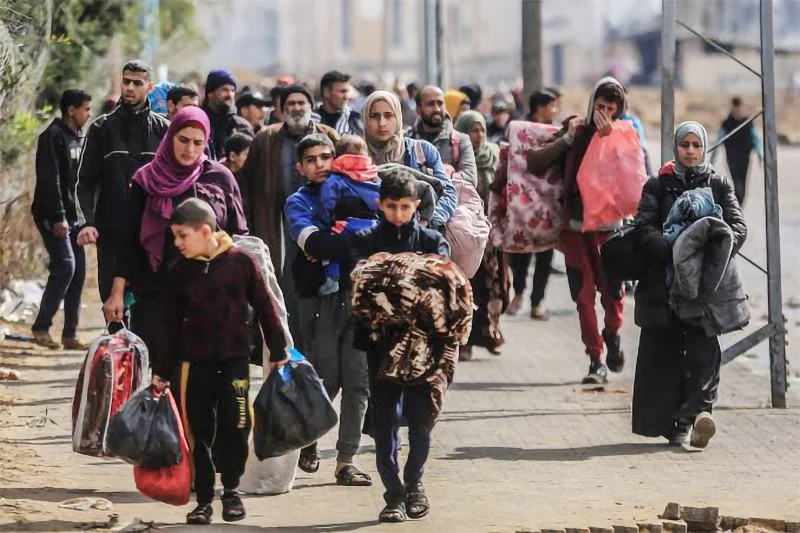
 Despite some sections of the Trump administration persisting with the view that the possibility could not be entirely ruled out of there being a diplomatic solution to the current US-Iran hostilities in West Asia, the skeptic could not be blamed for thinking otherwise. The intensity, scale and frequency of the tit-for-tat strikes by the antagonists over the past few days against selected military targets and civilian infrastructure in particular in West Asia make the adoption of this stance excusable.
The continuing hostilities render the mentioning of the MOU signed between the warring parties in mid-June a laughable matter. While it could very well be that the foes are wishing privately for a cessation of hostilities before long, what seems to be uppermost on their minds right now is to negotiate with each other from a position of strength. This strategy compels them to incapacitate each other militarily to the extent possible, lest they have to concede too much to each other during negotiations. Hence the stepped-up hostilities.
However, even on the question of there being a negotiated political settlement in the West Asian theatre in the longer term, the skeptic could come to be seen as scoring over the optimist. Developments on the ground account for this.
At the time of writing Israel’s Netanyahu government is going ahead in fairly care-free fashion with the establishment of more Jewish settlements in the Gaza and the West Bank, and it’s all happening under the apparently complacent gaze of the US. In fact, some quarters estimate that Israel is in control of some 65% of the Gaza Strip. Ethnic cleansing, that is, is being drastically stepped-up.
Accordingly, in terms of the power relations of West Asia, the world is almost back to the status quo of the late forties of the last century when the state of Israel was established and the Palestinians were reduced to a microscopic minority in the land they came to inhabit. Therefore, even the impartial observer would be compelled to ask: ‘Will a negotiated peace be ever possible in the Middle East?’
The humanist in the observer would prefer to answer this question in the affirmative and it is indeed the ideal stance to adopt considering the staggering human and material costs of the conflict. But the way ahead to peace could be expected to be highly hazardous and arduous. Among other odds, it would also prove an uphill endeavour to win minds and hearts.
The US’ Trump administration would need to be counted out in this pursuit. This is on account of the fact that it has been far too wayward in its management of West Asian affairs in particular over the past couple of years. Given its unpredictable character it is a matter for conjecture whether it could be counted on to live up to its commitments.
Moreover, Israel could be expected to ‘go it alone’ in the Middle East regardless of whether US help is coming or otherwise. It has indicated as much in recent times and Israel could be doubted on this score only at the doubter’s peril. Because time and again Israel has demonstrated that it could steadfastly defend its interests even single-handedly in the Middle East. History bears this out.
However, a durable alliance with the US would stand Israel in good stead. On the matter of military and intelligence assistance, for example, the US’s help proved invaluable for Israel in the past and going forward this is bound to be so as well. Moreover, it is unlikely that the Trump administration would give up on Israel, considering that a strong Israel is crucial for the furtherance of the US’ strategic and economic interests in West Asia.
But whether the above factors would have a considerable bearing on the question of working out a durable solution to the West Asian tangle is an entirely different matter. Israel, as in the case of the Palestinian enclaves, is acutely security conscious and would need to satisfy itself fully that it could live in a security environment that would guarantee its complete safety, going forward.
The Middle East is badly in need of another peace effort on the lines of the Oslo Accords of the mid-nineties that brought the key actors together and helped hammer out a solution that addressed some of their notable concerns. To be sure, that process did not prove to be the ideal answer to the tangle, but it yielded some respite to the region and drove home that one-time sworn foes could indeed negotiate with a degree of success. The West Bank authority, although falling short of fulfilling some key Palestinian aspirations, is testimony that a degree of success is possible if the intent is right.
Given the current realities of West Asia, peace-making is bound to be an uphill challenge. The violence faced in recent times by the Palestinian community, in particular, has been nothing less than mind-numbing. Merciless has been the violence visited on them by the Israeli side. In such circumstances, durable peace in the region could smack of an idealist’s dream.
Nevertheless, there needs to be urgently, a meeting of minds over the divides. The US would need to be counted out as an honest broker in bringing the sides together but the rest of the West would do well to step up to the challenge.
In this exercise the onus would be on the world’s democracies to take the initiative and doggedly stay the course. An acceptable combination would be the EU and the UN. Given their credentials, the main sides in West Asia ought to find them the least controversial.
Even if the relevant institutional and political arrangements could be shored up to take a reconciliation process forward, winning hearts and minds for the peace drive would prove a grueling challenge. Over the past few years in particular tens of thousands of hearts and minds on both sides of the divide have been bruised badly in the runaway murderous violence that has come to define the Middle East.
These badly scarred personalities would need to experience healing without much delay. It is therefore a multi-faceted challenge that is at hand. Since wide-ranging expertise would be needed in the healing process, people’s participation in peace-making, ranging over the divides, would need to be made a durable reality. It will be a time for enthroning humanity and ensuring the rejection of all forms of violence and coercion.
 For many Sri Lankans, Thailand is the go-to holiday — beaches, temples, food, and that famous warm hospitality.
In fact, I’ve been to Amazing Thailand 24 times myself, and was honoured with the Friends of Thailand International Media Award by the Tourism Authority of Thailand for promoting Thai tourism.
The good news I have for you today is that you don’t even need a passport to get a taste of Amazing Thailand.
The Royal Thai Embassy, in Colombo, is bringing a vibrant slice of Thailand, to the city of Colombo, with Thai Festival 2026 — a cultural experience like never before.
Whether you are an avid enthusiast of Thai culture, a total novice, or simply just interested in exploring foreign cultures, Thai Festival 2026 is going to be the perfect opportunity for you to get more than just a glimpse into one of the most celebrated cultural heritages in South East Asia. And ENTRANCE IS FREE.
The festival will be held on the 1st and 2nd of August, 2026, at Siam Nivasa, 43, C.W.W. Kannangara Mawatha, Colombo 7, and the East Parking Area, of the Colombo Municipal Council, from 11:00am to 5:00pm.
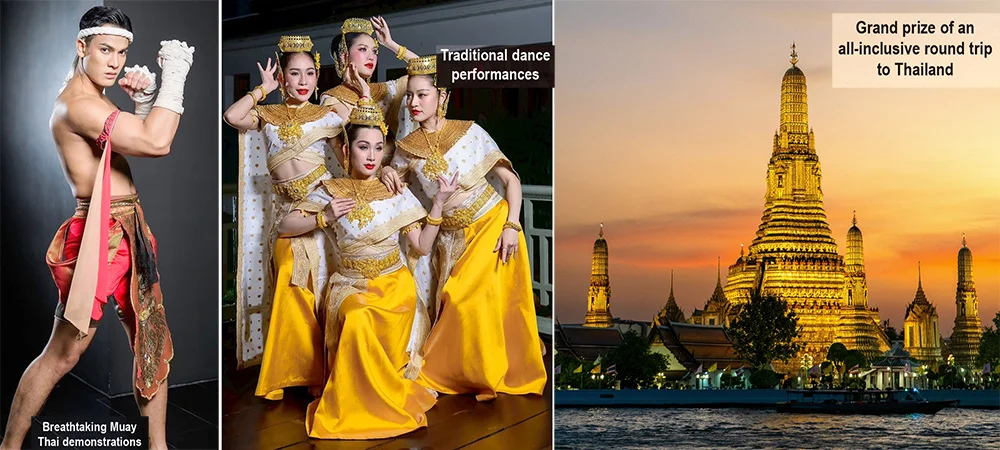
Both days will be full of live entertainment, and dispersed throughout with Thai cultural displays, including exhilarating traditional dance performances and breathtaking Muay Thai demonstrations.
Exploring art and craft specific to Thailand, tasting irresistible authentic Thai cuisine, and playing arcade games, are just a few more fun-filled events available for visitors at the festival premises.
An array of Thai products will also be available for purchase.
While at the festival, you will find Sri Lankan Alumni from Thai universities sharing their experiences with you and willing to answer any questions you might have, related to studying abroad in Thailand.
You can also register for the Muay Thai workshop that will be happening on the 7th and 8th of August, 2026, in Colombo.

Irresistible authentic Thai cuisine
Visitors can also stand a chance to win traditional Thai souvenirs, get exclusive photo opportunities, and, the big one — to enter the raffle draw, at the end of each day, for the grand prize of an all-inclusive round trip to Thailand.
Be sure to avail yourself of this exceptional opportunity and add a cultural spin to your weekend.
To keep up with the latest updates on Thai Festival 2026, head over to the Thai Festival official social media pages.
The Royal Thai Embassy in Colombo official webpage:
https://colombo.thaiembassy.org
Official social media:
Facebook: @RTEColombo
Instagram: @thaiembassysrilanka
Thai Festival official social media:
Facebook: Thai Festival in Colombo
Instagram: @thaifestival_colombo
TikTok: @thaifestival.incolombo
 Hair fall, in this heat, can be so frustrating, and noticing a thin patch is even more worrying. The good news is … yes, with a little care and kitchen ingredients, you can nourish your scalp and support healthy regrowth.
Try these four easy home remedies … even our grandmothers trusted:
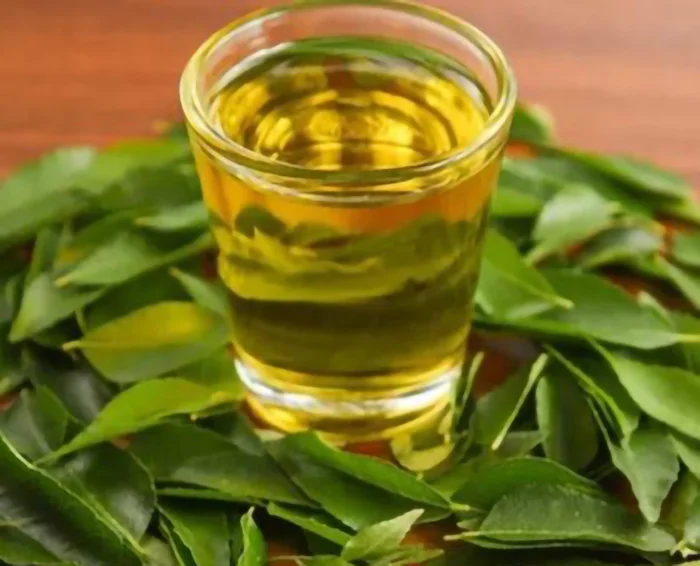
* Coconut Oil and Curry Leaves Tonic:
Warm 04 tablespoons of coconut oil, with a handful of curry leaves, till the leaves turn black. Cool, strain, and massage into scalp 02-03 times a week. Leave for 01 hour, or overnight.
Why:
Coconut oil deeply nourishes, while curry leaves help strengthen roots and add shine.
* Onion Juice for Spot Treatment:
With cotton, dab the juice of 01 small onion, directly on the thin/bald patches. Leave for 20-30 minutes, and then wash with a mild shampoo. Use twice a week.
Why:
Rich in sulfur, onion juice helps boost blood circulation to the scalp.
* Aloe Vera and Castor Oil Mask:
Mix 02 tablespoons of fresh aloe vera gel and 01 tablespoon castor oil and apply to the scalp, focusing on thinning areas. Leave for 45 minutes, and then rinse with cool water.
Why:
Aloe vera soothes the scalp, while castor oil coats hair to make it look thicker.
* Fenugreek and Curd Strengthening Pack:
You will need 02 tablespoons fenugreek seeds, soaked overnight, and 02 tablespoons plain curd.
Grind to a paste, apply to scalp for 30 minutes, and then wash.
Why:
Fenugreek strengthens strands and reduces breakage.
Extra Tips for Healthy Hair:
Avoid tight hairstyles that pull on the scalp.
Eat iron and protein rich foods: greens, dhal, eggs, fish.
Use lukewarm water, not hot.
Be gentle when brushing and drying.
Manage stress — it plays a big role in hair fall.
Important: If bald patches are growing, or there is itching/redness, please consult a dermatologist.
Home remedies support hair health, but a doctor can find the exact cause.
Remember, healthy hair starts with a healthy, happy you.

More than 4,200 Israelis storm Al-Aqsa Mosque in Jerusalem

Feroza, Amin, Sandhu shine as Pakistan go 1-0 up against Sri Lanka

Colombo District Waste Management subcommittee convenes at Parliament

Government to coordinate Kotte Rajamaha Viharaya Sri Dalada Maha Perahera

Taskin Ahmed withdraws from LPL to prepare for Australia tour

US and Saudi Arabia announce nuclear cooperation deal

‘Dates have the highest sugar content to fight Coronavirus’

Sunday Island 27 December – Headlines

#SundayIsland 17th December – Headlines

Sunday Island – 28th March

Sunday Island Headlines – 21 March

Sunday Island – 21st February – Headlines
-
 Features5 days ago
Two memorable excerpts from a former SLAF commander’s memoir
-
 Business5 days ago
‘Giving up was never an option’: The fisherman who fought back after losing millions in SL
-
 Latest News5 days ago
Davis cup Asia/Oceania Group IV 2026 to be held in Colombo from 20th to 25th July
-
 Features5 days ago
Erdoğan’s New Republic
-
 Life style5 days ago
Taste of the Swiss Alps comes to Colombo
-
 News6 days ago
Evidence recorded in money laundering case against Yoshitha Rajapaksa
-
 Midweek Review2 days ago
Three high-profile alleged suicides shaping key investigations
-

 News6 days ago
Dengue outbreak gallops ahead: Infections surpasses 73,455, leaving 50 dead