
News
Polls monitors, journalists’ outfit among recipients of Canadian funding


Sri Lanka Press Institute and two election monitoring groups are among nine Sri Lanka and Maldives based organizations provided with funds from Canada Fund for Local Initiatives (CFLI)
The Canadian HC in Colombo maintained that following a highly competitive process, the following recipients were chosen:
* Ministry of Gender, Family and Social Services, Maldives,
* People’s Action for Free & Fair Elections (PAFFREL),
* Environment Foundation Limited (EFL),
* Centre for Monitoring Election Violence (CMEV),
* Planeterra,
* Center for Investigative Reporting Sri Lanka (CIR),
* Sri Lanka Press Institute (SLPI),
* Northern Cooperative Development Bank (NCDB), and
* Zero Waste Maldives.
The CFLI supports small-scale, high-impact projects conceived and designed predominantly by local partners in Sri Lanka and Maldives. This enables Canada to respond to local needs by working at the community level. Equally important, the CFLI serves to strengthen Canada’s relationships with civil society and local communities.
This year, the CFLI’s call for proposal focused on key thematic areas: Inclusive governance, Environment and climate action and Growth that works for everyone, including women’s economic rights.
Given the current pandemic, the CFLI program was also able to respond to Covid-19 related proposals, including a contribution of $100,000CAD in support of the Maldives Government’s efforts in providing basic services to the homeless and the most vulnerable communities impacted by Covid-19 in Malé.
In Sri Lanka, the CFLI has already supported CMEV and PAFFREL’s contribution towards ensuring a creditable parliamentary election — free of violence and with the distribution of PPE to voters and observers at selected voting locations.
From pandemic response, to election monitoring, to women’s economic empowerment and climate action, we stand proud to work together with Sri Lankans and Maldivians to find solutions to issues that matter to them.

By Shamindra Ferdinando
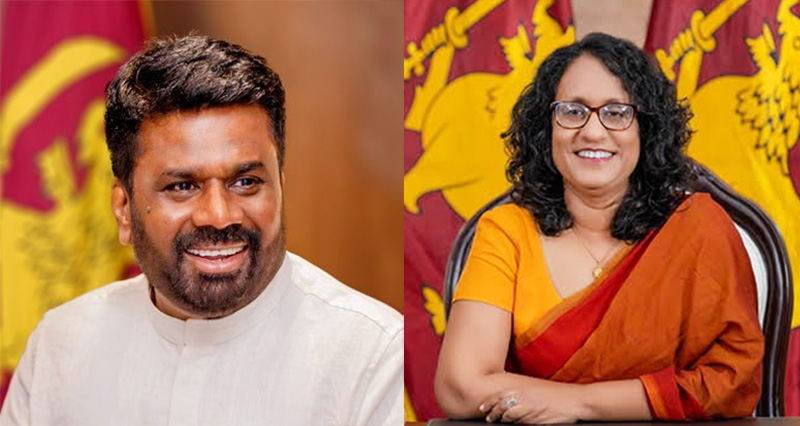
The ruling NPP yesterday (21) dismissed claims of a widening rift, within the government, over the proposed 22nd Amendment. Asked whether the NPP was concerned over a section of the Opposition alleging Prime Minister Dr. Harini Amarasuriya and two dozen MPs taking a view contrary to that of the party in this regard, authoritative party sources said some persons were propagating speculation for their own interest.
Declaring that there was absolutely no issue regarding the controversial Amendment, sources emphasised once it was tabled in Parliament, it would be passed with 2/3 majority.
Sources dismissed claims that out of its 159-member parliamentary group a section of NPPers was opposed to the government move. According to an influential Opposition activist, there are 57 JVPers and 66 NPPers in the government group and the rest contested the last parliamentary polls, having aligned with the JVP.
Ministerial sources told The Island that the government was confident of going ahead with the 22nd Amendment and Judicature (Amendment) Bills. Sources said that the NPP was not bothered about the Opposition protests in and outside Parliament.
Speaker Dr. Jagath Wickremaratne is expected to disclose the confidential ruling that he received from the Supreme Court in respect of more than 65 petitions for and against the 22nd Amendment and Judicial Amendment Bills. The enactment of the 22nd Amendment would pave the way for extending the retirement age of Supreme Court judges, from 65 to 67 years, and Court of Appeal judges, from 63 to 65 years.
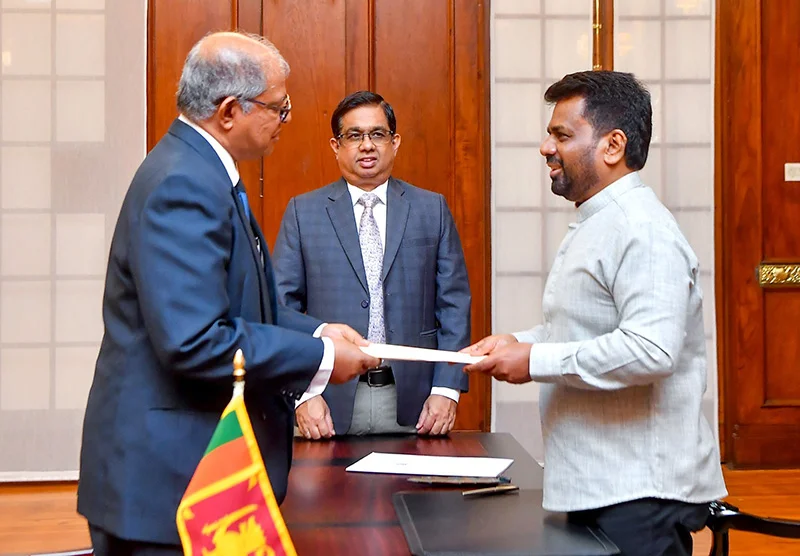
President Anura Kumara Dissanayake has appointed Court of Appeal Judge Mayadunna Sri Mevan Anthony Edirimannasuriya Corea as the Acting President of the Court of Appeal.
The appointment has been made as President’s Counsel Nalin Rohantha Abeysuriya, who currently serves as President of the Court of Appeal, will be overseas until the 24th.
Accordingly Justice Mayadunna Corea was sworn in as Acting President of the Court of Appeal before President Anura Kumara Dissanayake at the Presidential secretariat last morning (21).
Secretary to the President Dr Nandika Sanath Kumanayake was also present at the occasion.
… school alleges deception
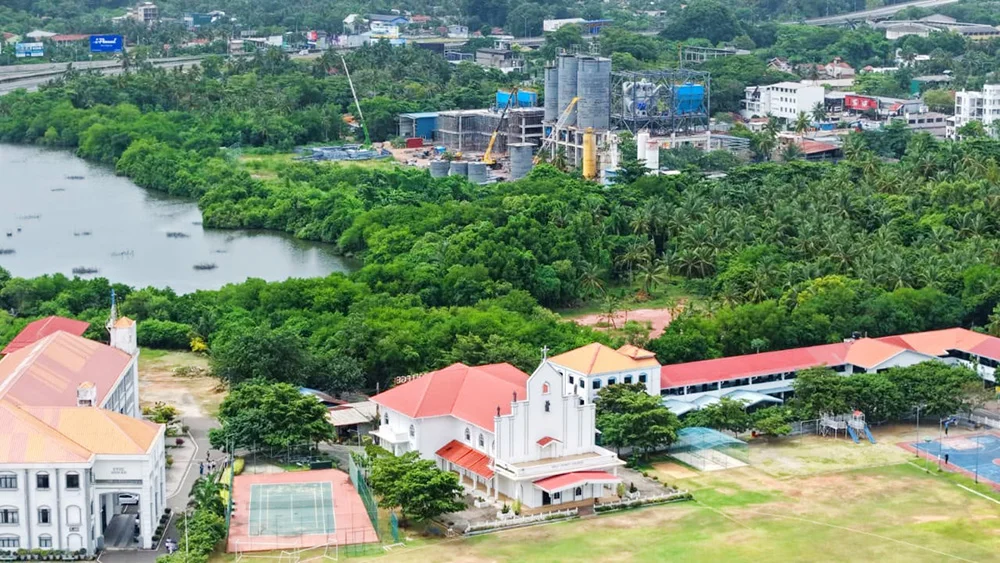
What began quietly as a single-storey tourist hotel, on the edge of Katunayake-Seeduwa has, five years later, morphed into a looming five-storey cement factory and with it, a storm of fear, anger and unanswered questions.
At a media briefing held on 19 September at St. Thomas International School, Seeduwa, the community finally found its voice. The gathering included priests, school principals, environmental defenders, and parents whose children study within a few hundred metres of the site.
The briefing was led by Rev. Fr. Jude Chrishantha Fernando, Director of National and Archdiocesan Catholic Social Communications, Rev. Fr. Nilantha Heshan, Director of the Archdiocesan Sethsarana Institute, Dinusha Nanayakkara, Convener of the Archdiocesan Committee for the Protection of Muthurajawela, and Attorney-at-Law Ms. Isuri Rodrigo.
Their message was clear: This is not a campaign against development.
“We Are Not Against Cement. We Are Against Deception.”
“Cement is an essential raw material for the country. We have no opposition to any such factory or production plant,” they told the media. “But what we cannot agree to is a project of this magnitude, in this location, without any proper environmental assessment.”
The speakers alleged a textbook case of deception, obtaining approvals for a low-impact tourist hotel, in one of the most densely populated educational zones in the Katunayake-Seeduwa Municipal Council area, and then transforming it into a heavy industrial plant.
“In an area where thousands of schoolchildren study, to show one thing on paper and build another is a highly fraudulent procedure. It is clear that the real environmental damage and the truth have been hidden from the people,” they said.
With the sea and lagoon winds that sweep across Seeduwa, experts fear these fine particles will not stay confined to the factory walls. They will drift across classrooms, homes, and the Katunayake Free Trade Zone, where thousands of workers, representing all 25 districts of Sri Lanka, work every day.
“The risk is not local. It is national. We are talking about a future generation of children with respiratory illnesses, and workers developing chronic breathing disorders,” one speaker warned.
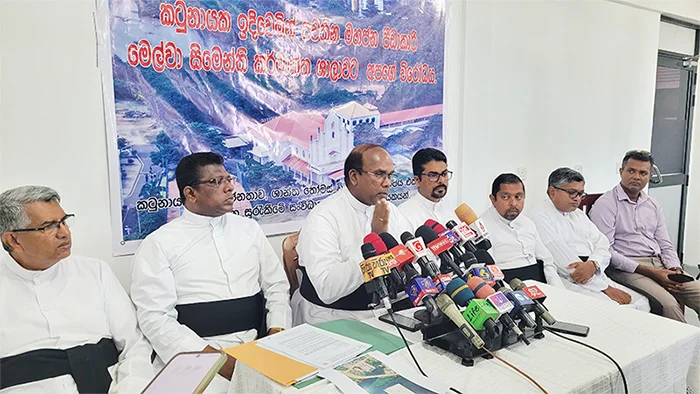
Rev. Fr. Jude Chrishantha Fernando, Director of National & Archdiocesan Catholic Social Communications, responding to journalists
Then there is the proximity that defies logic, just 500 metres from the Bandaranaike International Airport.
The panel presented a scientific concern that has aviation experts worried: a significant drop in air quality around the airport and its runway, and the severe risk to highly sensitive aircraft engines when they ingest air mixed with cement dust. What is at stake, they argued, is not just health but the economy itself.
“When you weigh it deeply, the economic contribution of an international airport is far higher than that of a cement factory. If international airlines start to avoid Katunayake due to safety and air quality concerns, it will be a fatal blow to our country’s economy,” they emphasised.
A few minutes away lies another victim the Negombo Lagoon and the Muthurajawela wetlands, Sri Lanka’s largest and most sensitive coastal ecosystem.
The panel warned that cement dust settling on the mangrove system could degrade water quality, disrupt the delicate salinity balance, and directly interfere with fish breeding grounds. For the fishing communities of Negombo, whose lives depend on the lagoon, this is an existential threat.
“The lagoon is a nursery. If its water quality drops, fish will not breed. If fish do not breed, an entire fishing community collapses,” they said.
The speakers alleged that while the developers claim to have approvals from various state institutions, many of the mandatory clearances, particularly comprehensive Environmental Impact Assessments and feasibility reports, have not been obtained.
They stressed they are not calling for an end to investment, but for it to be done right.
“We have no objection to this factory being started in another suitable location where it will not cause these environmental impacts, based on proper feasibility and assessment reports. Stop this construction here and move it,” was the unanimous demand.
The appeal has now been directed again to the President, the government, and all responsible state institutions and officials.
As the briefing ended, one image lingered — a school playground, a lagoon, and a towering cement structure rising between them. It is a scary picture for the people of Seeduwa; they asks a simple question: What price are we willing to pay for development that doesn’t breathe?

Fatima Sana and Umm-e-Hani secure bronze for Pakistan in Asian Games

India bat first in Asian games womens cricket final

Showers about 100mm will occur in the Western, Sabaragamuwa, Central and North-western provinces and in Galle and Matara Districts

Govt. confident of 2/3 majority despite NPP split speculation

Justice Corea appointed Acting President of the Court of Appeal

Protest against setting up of cement factory in highly populated area near BIA

‘Dates have the highest sugar content to fight Coronavirus’

Sunday Island 27 December – Headlines

#SundayIsland 17th December – Headlines

Sunday Island – 28th March

Sunday Island Headlines – 21 March

Sunday Island – 21st February – Headlines
-

 News6 days ago
US embassy won’t comment on IGP’s probe into joint drug raid
-

 News5 days ago
Bid for Basil’s extradition nears final stage: Police
-

 News4 days ago
Shanakiyan urges urgent action over reported death sentence for Lankan in Saudi Arabia
-

 Business6 days ago
All-new Bolero MaXX unveiled in Sri Lanka
-

 News3 days ago
Namal Rajapaksa Buddhist gambit fails, bail denied
-

 Opinion6 days ago
A journalist who wrote across the divide
-

 Editorial7 days ago
More fuel price shocks shrouded in secrecy
-

 Sports7 days ago
MAS Holdings, official clothing sponsor of Sri Lanka team at Aichi–Nagoya 2026 Asian Games