
News
AMS warns of chaos in health sector due to new retirement rule


The Association of Medical Specialists (AMS) has confirmed that nearly 300 of their members will have to retire from government service on or before 31 December 2022 and their retirement will have an adverse impact on the health sector.AMS President Dr. LakKumar Fernando has, in a letter to Health Minister Keheliya Rambukwella, said the National Hospital Sri Lanka will lose 43 consultants, the National Hospital Kandy 30, the Teaching Hospital Karapitiya 17, the Lady Ridgeway Hospital 15 and Apeksha Hospital 09.
“The medical specialists who are working in universities and Sri Jayewardenepura hospital have been exempted from this new rule on retirement age due to some unknown reasons,” he has said, adding that a large number of doctors are preparing for foreign licensing examinations (AMC for Australia, PLAB for the UK) instead of sitting for local postgraduate entry exams. This means that a significant number of these young doctors are very likely to move out of Sri Lanka.
“Significant numbers of Sri Lankan postgraduate medical trainees on overseas training are less likely to return due the current situation in the country. This will further reduce the number of qualified consultants in the future. A significant number of younger consultants who are in the state health sector have applied for foreign jobs. Some state sector hospitals have left / are leaving the country. E.g. more than 15 consultants in anesthesiology are leaving / have left in August / September 2022,” he said.
Given such a situation, it would be devastating if a large number of consultants are retired from the service en-bloc.Given below are excerpts of Dr. Fernando’s letter to the Minister.
“1. Dynamic and varying situation regarding age of retirement of consultants
“Consultants in the Ministry of Health play an important leadership role in clinical settings in hospitals and the community health sector. Making a medical specialist is a very resource intensive process as it takes approximately 12 years to produce a medical specialist from undergraduate days. Their importance and shortage were recognised and their retirement age was extended to 63 in 2018 (Government Gazette Extraordinary 2086/1 of 27th August 2018) by the government under Prime Minister Ranil Wickremesinghe. Medical specialists attached to universities who provide the same care in same government hospitals retiring at 65 years were also considered when this decision was taken.
“In the Budget proposals for 2022 (presented in 2021), the retirement of all government servants was extended to 65 years. In the Interim Budget Proposals presented this year, the retirement age of government servants was brought down to 60 years. Those who have completed 60 years or more are required to retire by 31st December 2022.
“Subsequently, the Secretary, Ministry of Public Administration issued a press release (PUB.ADM/SEC/07 of 1st September 2022) stating that the retirement age of more than 60 years of certain special categories of state employees, will remain unchanged as defined in the antecedent circulars. This meant that the Consultants’ retirement age will be 63 years going with the 2018 circular (described above).
“However, the Secretary, Ministry of Public Administration has issued another circular on 14 September 2022 specifying that the retirement age of all public servants will be 60 years, irrespective of the specifications defined in the previous circulars (except judicial officers) (Public Administration Circular: 19/2022 of 14th September 2022). This construes that the date of retirement of consultants will become 60 years, contrary to what was mentioned in the above press release (1st September 2022)
“2. What happens if this rule is applied?
“As the situation currently stands, if the 60-year-old rule is imposed, nearly 300 medical specialists will have to retire on 31st December 2022. This is the first time that such a large number of medical specialists will retire in one single day from state health service.
“This will no doubt create a major crisis in the state health sector (a) The replacement of these vacancies will require the movement / transfer of the remaining consultants from the provincial / base hospitals. It will not be possible to transfer them to vacant posts without replacement consultants. Replacement consultants are generally new consultants who come after foreign training. With the current situation in the country, a considerable number are not returning.
“(b) This will potentially cause collapse of the entire health service especially in the peripheral hospitals.
“To give a few examples to illustrate the grave situation – There were only 33 transfusion specialists in the country and eight will retire with the new rule while two have already retired and five have migrated and four are in the process of leaving the country bringing down the remaining number to only 14. Even before this, the waiting list for Bone marrow transplantation at Cancer hospital Maharagama was extending to 2025 and one can imagine the effect of further prolonging the waiting time. Many patients will die while waiting.
“Histopathologists are needed to report on biopsies. Though the country needs at least 80 of them, we only had 60. While 5 of them are already on overseas leave, 10 others are in the process of migrating for overseas jobs, and 5 will retire with the new rule. Having less than half to do the job, the waiting time for biopsy reports will go up impacting the outcome of patients in conditions like cancer.
“Lot more similar examples can be given and the impact is frightening and it will certainly affect the poor more than the rich. Further, it is pertinent to mention following data about the number of consultants retiring by major institutions under the new circular; NHSL – 43 consultants, NH Kandy – 30, TH Karapitiya – 17, LRH – 15 and Apeksha Hospital – 09.
“It’s interesting to note that the medical specialists who are working in universities and Sri Jayewardenepura hospital are exempted from this new rule on retirement age due to some unknown reasons.
“3. Exodus of doctors
“(a) A large number of newly passed out doctors are preparing for foreign licensing examinations (AMC for Australia, PLAB for the UK) instead of sitting for local postgraduate entry exams. Significant number of these young doctors are very likely to move out of Sri Lanka.
“(b) Significant numbers of Sri Lankan postgraduate medical trainees on overseas training are less likely to return due the current situation in the country. This will further reduce the number of qualified consultants in the future.
“(c) A significant number of younger consultants who are in the state health sector have applied for foreign jobs. Some state sector hospitals have left the country. E.g. more than 15 consultants in anesthesiology are leaving / have left in August / September 2022.
“The retirement of a large number of consultants at 60 years on a single day will further compound the crisis with the above detailed exodus. There is already a shortage of consultants in the state health sector.
“4. Shortage of Consultants / Spreading Transfers
“(a) Although there is a claim by few that there is a surplus of consultants, there is only a shortage. The annual transfer lists of Specialists bear testimony to this fact.
“(b) The annual transfer lists go on four-year cycles before it is implemented, therefore the filling of these vacancies cannot be immediate and will spread over a long time.
“5. Adverse impediment of postgraduate training
“The training of postgraduates who become future consultants is mainly done in the teaching hospitals by experienced consultants. With the retirement of senior experienced consultants suddenly in large numbers, training programmes and postgraduate examinations will be in severe jeopardy. The sudden retirement of senior consultants will create a vacuum of people with knowledge and experience in running postgraduate programmes and examinations. The number of qualified examiners and trainers will be suddenly reduced. The major hospitals will have new consultants who may not be eligible to train the trainees due to the PGIM requirements and this will adversely affect the quality of training programmes and examinations.
“Following are the current criteria to become trainer and examiner at the PGIM. A) Trainer – 3 years of post-board certification/ must have undergone a trainers training program. B) Examiner – Selection examination – 5-year post board certification, C) MD final examination – 7 year post board certification. They must have undergone trainers and examiners training programs.
“With all the facts mentioned above, it’s more than obvious that EN BLOC retirement of approximately 300 medical specialists in one single day will have a huge impact on maintaining health care services in our country. This situation is not seen in most parallel categories as the extension of retirement age to 63 years was in existence for a period more than 4 years only for medical specialists.
“We, as medical specialists, would like to highlight this to all the relevant authorities at this critical juncture as our country and our people have experienced enough wrong decisions in the past. No right-thinking government will allow the retirement of such a large number of medical specialists in one single day from state health service especially during a time where many technocrats are considering moving overseas.
The loss of lives, health crises will move people’s lives into peril. The cost of damage control measures will far exceed the saving of money by saving the salaries of those who retire. As a group of responsible professionals, the AMS has always come forward to explain correct facts to authorities whenever we foresee an event causing adverse consequences to the nation. We believe, in this instance too, it is our moral duty and social responsibility to represent the actual facts to the authorities as well as to the public, without remaining silent.”

News
Establishment of National Trade Negotiation Committee (NTFC) and Trade Policy Consultation Committee.

Approval has been granted at the cabinet meeting held on 24-08-2026 to implement the recommendations submitted by the committee appointed to review Sri Lanka’s current Free Trade Agreements and future course of Free Trade Agreements in Sri Lanka.
Taking into account these recommendations, it has been
recognized the necessity of establishing a National Trade Negotiation Committee and Trade Policy Consultation Committee enabling Sri Lanka to follow a more targeted, sequential, and evidence-based approach in conducting negotiations for Sri Lanka’s future Free Trade Agreements and to ensure a sustainable and meaningful stakeholder consultation process.
The Cabinet of Ministers has approved the resolution furnished by the Minister of Trade, Commercial, Food Security, and Cooperative Development to act as follows.
• Establishment of a National Trade Negotiation Committee to guide trade discussions conducted with potential bilateral or regional trade partners
• Appointment of the Secretary to the Ministry of Trade, Commerce, Food Security, and Cooperative Development as the Chairman of the National Trade Negotiation Committee and
the Chief National Trade Negotiator.
• Establishment of 12 subject specific sub- committees with the required technical working groups under the National Trade Negotiation Committee
• Appointment of Trade Policy Consultative Committee comprising of trade experts, researchers engaged in research relevant to trade field, business community, unions, civil societies and relevant public officers to instruct the National Trade Negotiation Committee on active and technical sectors, to submit the policy recommendations to the Cabinet of Ministers regarding the matters relevant to the trade agreements, to inquire sustainable ideas regarding the Free Trade Agreements, and to ensure the communication mechanism.
• The Minister in charge of the Subject international trade and the Minister in charge of the subject of Industry to serve as Co-Chairpersons of the Trade Policy Advisory Committee.

By Saman Indrajith
Justice Minister Harshana Nanayakkara yesterday told Parliament that the Commonwealth Lawyers’ Association (CLA) was not an organisation officially recognised or registered under the Commonwealth Secretariat, but a fee-levying private association.
Responding to a question by Opposition and SJB Leader Sajith Premadasa on why he had failed to meet CLA representatives, who recently visited Sri Lanka, Nanayakkara said he had offered them a date and time for a meeting, but they had been unable to attend.
The Commonwealth Lawyers Association (CLA) has questioned procedural fairness and other matters of concern in a report that deals with the Supreme Court hearing petitions against the 22nd Amendment to the Constitution. Among the issues raised by CLA President Steven Thiru, is the composition of the five-member bench.
The Minister said the CLA representatives subsequently requested another date, but he had already scheduled official engagements for the proposed day.
Nanayakkara said it was, therefore, incorrect to claim that he had refused to meet the CLA delegation.
“The CLA is not an official body accepted or admitted into the Commonwealth of countries. It is a private club whose members pay fees for membership,” he said.
However, the Minister said he was not suggesting that the organisation was “a bad organisation”, adding that the accuracy of several statements made by CLA members during their visit to Sri Lanka had yet to be established.
Nanayakkara identified lawyer Upul Jayasuriya as the CLA’s local representative and said Jayasuriya had sought a meeting with him.
“I gave him the opportunity, but he came up with the excuse that he could not make it as he was not in Colombo. Therefore, it is wrong to state that I did not give them time,” the Minister said.
By Shamindra Ferdinando
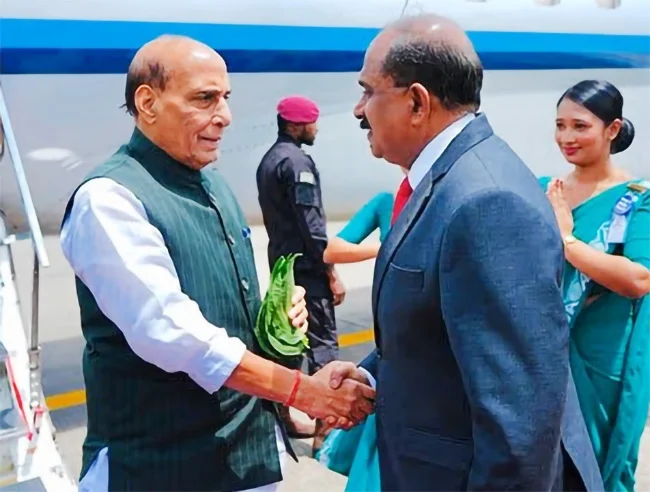
Indian Defence Minister Rajnath Singh is in Colombo on a three-day official visit, the first by an Indian Defence Minister since the 1988 visit by K.C. Pant, during Rajiv Gandhi’s tenure as the Prime Minister.
The Indian Defence Ministry declared that the visit would further strengthen the traditionally strong and friendly bilateral relations in mutually beneficial areas, including a strong maritime and defence partnership.
The visit takes place in the wake of Sri Lanka and India signing seven MoUs, including one on defence, in April 2025. Communist Party General Secretary Dr. G. Weerasinghe told The Island that the government should set the record straight regarding the rapidly developing military relations with the US and India. The acquisition of Colombo Dockyard Ltd., by Indian Defence Ministry-run Mazagon Dock Shipbuilders Limited, soon after the finalisation of MoUs, underscored New Delhi’s strategy, Dr. Weerasinghe said. Responding to another query, Dr. Weerasinghe said that the government should take this opportunity to discuss the Tamil Nadu fishing fleet poaching on Sri Lankan waters.
Pant visited during the Indian Army operations against the Liberation Tigers of Tamil Eelam (LTTE) in the Northern and Eastern Provinces here, while Pranab Mukherjee visited Colombo, in August 2005, to pay last respects to assassinated Foreign Minister Lakshman Kadirgamar.
Indian and Sri Lanka governments said that the visit was meant to strengthen cooperation between the two neighbouring countries in the fields of defence, economic engagement, maritime affairs and regional security.
An Indian warship arrived at the Colombo harbour ahead of the Defence Minister’s visit, reminiscent of old gunboat diplomacy. INS Udayagiri’s visit coincided with the Defence Minister’s visit. The Defence Minister’s delegation included senior officials from Ministry of External Affairs.
During the visit, the Indian Defence Minister is scheduled to hold high-level discussions with President Anura Kumara Dissanayake who also holds the Defence portfolio, Prime Minister Dr. Harini Amarasuriya and Defence Secretary Sampath Thuyacontha. He is also expected to meet members of the Indian community, residing in Colombo.
Dr. Weerasinghe said that the NPP government conveniently extended the moratorium on foreign research vessels imposed during Ranil Wickremesinghe’s tenure in 2024. The CP official said that the media alleged that that decision was taken at the behest of the US and India but nearly two years after the last presidential election the ban remains.

Avindu makes history with first World University gold for Sri Lanka

Establishment of National Trade Negotiation Committee (NTFC) and Trade Policy Consultation Committee.

Showers will occur in the Western and Sabaragamuwa provinces and in Galle and Matara districts

Justice Minister hits back at CLA

First visit by an Indian Defence Minister since IPKF deployment

“I’m not a war criminal, I fought for my country”: Shavendra Silva

‘Dates have the highest sugar content to fight Coronavirus’

Sunday Island 27 December – Headlines

#SundayIsland 17th December – Headlines

Sunday Island – 28th March

Sunday Island Headlines – 21 March

Sunday Island – 21st February – Headlines
-

 News6 days ago
Denied of promotion to SC despite vacancies, justice Gurusinghe retires
-

 Latest News7 days ago
Grade 5 scholarship exam results released
-

 News6 days ago
22A: SC urged to suspend hearing, appoint full bench
-

 News4 days ago
Namal remanded until Sept. 18 over Airbus deal investigation
-

 Latest News3 days ago
Tharanga creates history with Diamond League crown in Brussels
-

 News6 days ago
Govt. seeks NATO assistance
-

 News3 days ago
Dispute which triggered listed company director being detained at BIA resolved
-

 Editorial6 days ago
Strange arithmetic goes unchallenged