
Sports
ICC makes changes to Playing Conditions


A host of changes have been announced by the ICC to the Playing Conditions, which will come into effect on October 1 2022.
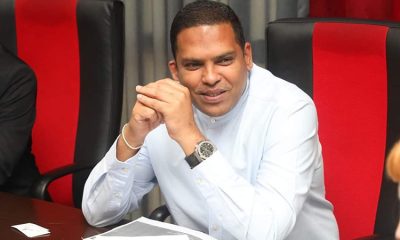
The Men’s Cricket Committee led by former India captain Sourav Ganguly recommended changes to the Playing Conditions in MCC’s updated 3rd Edition of the 2017 Code of the Laws of Cricket.
The conclusions were also shared with the Women’s Cricket Committee, who endorsed the recommendations.
The new Playing Conditions will come into effect on October 1, 2022, which means the ICC Men’s T20 World Cup in Australia next month will enforce the news rules.
The main changes are as follows:
Batters returning when caught:
When a batter is out Caught, the new batter will come in at the end the striker was, regardless of whether the batters crossed prior to the catch being taken.
Previously, in case the batters crossed before a catch was taken, the non-striker would take strike the next ball while the new batter would be at the non-striker’s end.
Use of saliva to polish the ball:
This prohibition has been in place for over two years in international cricket as a Covid-related temporary measure and it is considered appropriate for the ban to be made permanent.
The outbreak of COVID-19 had enforced the rule to avoid transmission of the virus on the field. The rule came into play when cricket resumed after a break in July 2020 and will now be made permanent. During the saliva ban, the players resorted to the use of sweat to shine the ball, which has proven to be effective.
Incoming batter ready to face the ball:
An incoming batter will now be required to be ready to take strike within two minutes in Tests and ODIs, while the current threshold of 90 seconds in T20Is remains unchanged.
Previously, the incoming batter had three minutes to take strike in ODIs and Tests but it has now been reduced. Failing to do so, the fielding captain can appeal for timed out.
Striker’s right to play the ball:
This is restricted so as to require some part of their bat or person to remain within the pitch. Should they venture beyond that, the umpire will call and signal Dead ball. Any ball which would force the batter to leave the pitch will also be called No ball.
Unfair movement by the fielding side:
Any unfair and deliberate movement while the bowler is running in to bowl could now result in the umpire awarding five penalty runs to the batting side, in addition to a call of Dead ball.
Running out of the non-striker:
The Playing Conditions follow the Laws in moving this method of effecting a Run out from the ‘Unfair Play’ section to the ‘Run out’ section.
Previously looked down as unfair play, running out a non-striker for backing up too much will now be considered as a regular run-out.
Bowler throwing towards striker’s end before delivery:
Previously, a bowler who saw the batter advancing down the wicket before entering their delivery stride, could throw the ball to attempt to Run out the striker. This practice will now be called a Dead ball.
Other major decisions:
The in-match penalty introduced in T20Is in January 2022, (whereby the failure of a fielding team to bowl their overs by the scheduled cessation time leads to an additional fielder having to be brought inside the fielding circle for the remaining overs of the innings), will now also be adopted in ODI matches after the completion of the ICC Men’s Cricket World Cup Super League in 2023.
The rule has already been implemented and has cost teams games due to them maintaining a slow over rate, one of the examples being the second match of the 2022 Asia Cup between India and Pakistan.
Ganguly praised all the ICC Cricket Committee members for their contributions to the recommendations.
“It was an honour chairing my first meeting of the ICC Cricket Committee,” he said.
“I was pleased with the productive contribution of the Committee members which resulted in key recommendations being made.
“I thank all members for their valuable input and suggestions.”
The ICC Cricket Committee:
Sourav Ganguly (Chair); Ramiz Raja (Observer); Mahela Jayawardena and Roger Harper (Past Players); Daniel Vettori and VVS Laxman (Representatives of Current Players); Gary Stead (Member Team Coach Representative); Jay Shah (Full Members’ Representative); Joel Wilson (Umpires’ Representative); Ranjan Madugalle (ICC Chief Referee); Jamie Cox (MCC Representative); Kyle Coetzer (Associate Representative); Shaun Pollock (Media Representative); Greg Barclay and Geoff Allardice (Ex Officio – ICC Chair and Chief Executive); Clive Hitchcock (Committee Secretary); David Kendix (Statistician).
(ICC)








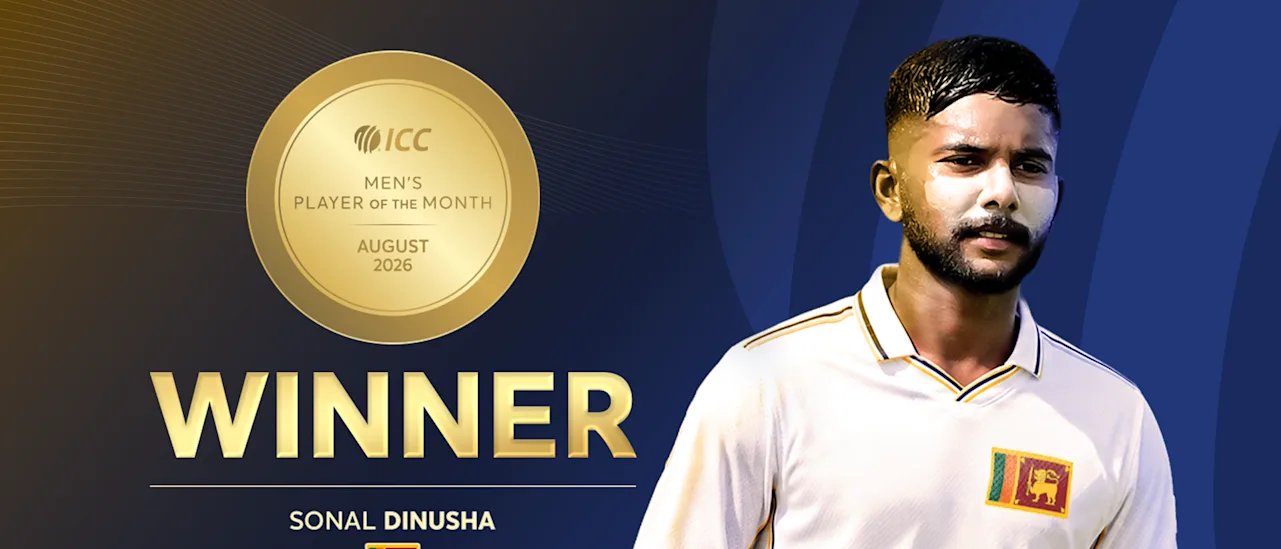
Sonal Dinusha has been named the ICC Men’s Player of the Month for August 2026.
This marks Dinusha being crowned with the accolade for the first time in his career.
Having played only three Tests for Sri Lanka coming into the ICC World Test Championship series against India, the left-handed batter was the leading run-getter in the two-match series.
Dinusha finished with 420 runs, averaging a spectacular 140, with three centuries and a half-century to his name.
“This recognition means so much to me, especially so early in my career, and I’m truly grateful to the ICC for this honour,” Dinusha said while reflecting on his latest achievement.
While Sri Lanka lost the first Test by 165 runs, Dinusha managed to score 100 in the first innings, followed by 84 runs in the second.
In the second Test, with the hosts battling to avoid a series sweep, Dinusha scored twin centuries in the two innings (103 and an unbeaten 133) to orchestrate a famous draw.
“The series against India will always hold a special place in my heart,” Dinusha added.
“Scoring three centuries was a dream come true, made even more meaningful by achieving them in Colombo and Galle in front of our home fans. “Although we didn’t get the overall result we hoped for, the way our team fought back in the second match showed the character, belief and determination we have as a side. I’m proud to have shared that fight with my teammates.
Dinusha made his Test debut for Sri Lanka last year, during the home series against Bangladesh.
In a short time, the all-rounder has made a big impact while representing his team in the longest format, an achievement he isn’t taking for granted.
“Representing Sri Lanka is a privilege I never take for granted, and this recognition gives me even more motivation to keep learning, improving and contributing to the team.
“I’ll continue to give my very best for Sri Lanka in the months and years ahead.”
The hosts managed to keep the series at 1-0, and Dinusha was named the Player of the Match in Colombo.
[ICC]
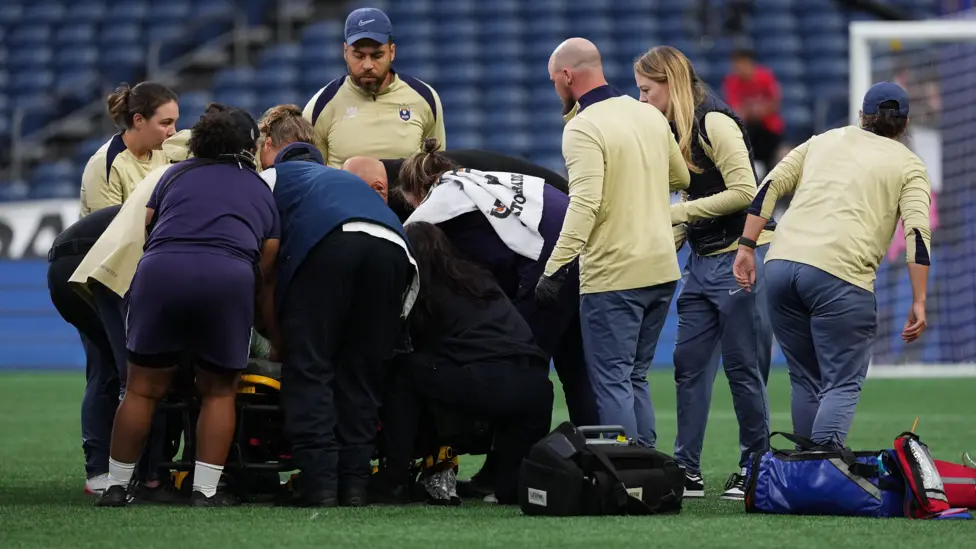
United States women’s national team player Savannah DeMelo is suing a hospital and two doctors after she suffered a cardiac arrest on the pitch last year.
Midfielder DeMelo, who has seven senior caps for the USA, has filed a lawsuit against University of Louisville Health (UofL Health) for negligence.
The 28-year-old, who plays for Racing Louisville, collapsed in the first half of a National Women’s Soccer League (NWSL) match on 14 September 2025.
According to documents seen by BBC Sport, the case was filed on Tuesday morning with Jefferson Circuit Court in Kentucky, where her club is based – a year and a day after her on-field collapse.
DeMelo’s filing claims UofL Health and two doctors, Dr Sarabjeet Suri and Dr Jennifer Daily, “failed to act as a reasonably prudent and competent medical practice, and such negligence was a substantial factor in causing DeMelo to suffer severe physical injuries, including, but not limited to, her cardiac arrest”.
Dr Daily, according to her online UofL biography, is Racing Louisville’s chief medical officer. The lawsuit states DeMelo was under the care of Dr Daily from January 2024 to July 2026.
It states that in March 2025, Dr Daily referred DeMelo to Dr Suri for “evaluation and treatment” after she had been complaining of chest pain, dizziness and shortness of air; Dr Suri obtained a history, performed a physical examination and ordered diagnostic tests.
Nearly six months later, DeMelo suffered the cardiac arrest.
“She was subsequently diagnosed and treated for ventricular tachycardia [an abnormal heart rhythm],” the suit states.
DeMelo, who has spent her entire professional career with Racing Louisville, has not played since her collapse.
In a post to her instagram page on Tuesday, De Melo – who was picked in the USA squad for the 2023 Women’s World Cup and started their first two games – marked the anniversary of the incident.
“A year ago today, while playing soccer, I collapsed due to an undiagnosed cardiac arrhythmia, that caused me to go into cardiac arrest,” she wrote.
“I respect and appreciate the privacy everyone has met me with while going through everything I have this year. I’ll never be able to fully put into words how emotionally hard this year has been. There has been a lot of uncertainty and emotions intertwined with it all.”
[BBC]
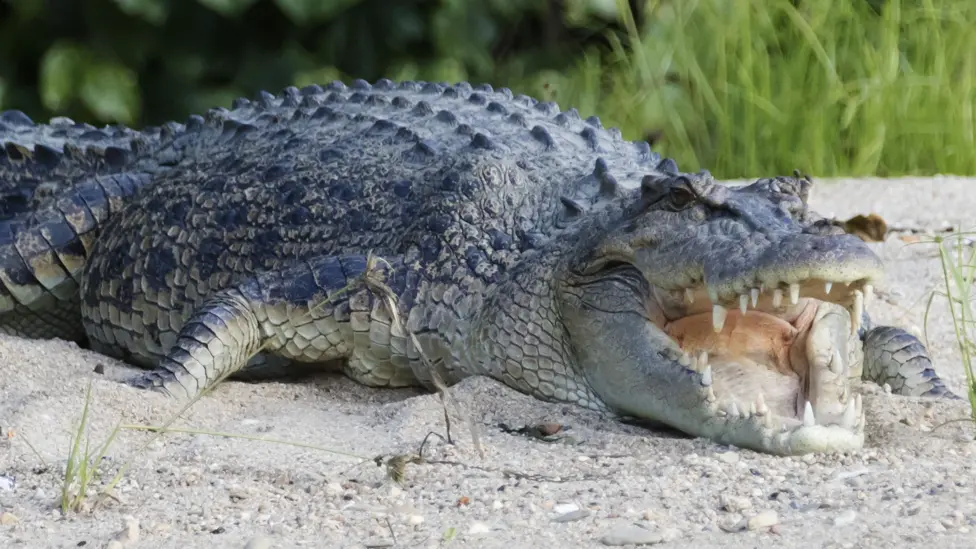
A river that is home to about 500 saltwater crocodiles has been given the OK to host Olympic and Paralympic rowing and canoeing events at the 2032 Brisbane Games.
The course on the Fitzroy River in Rockhampton, Queensland, has passed an independent technical assessment into its suitability.
The assessment did not consider the crocodiles but instead looked at “how the course would perform under a range of conditions, weather patterns, water levels and flood risk at both Games time and throughout the period leading into the Games”.
The report was commissioned by the Games Independent Infrastructure and Coordination Authority (GIICA), which noted that the Fitzroy River Flatwater Facility “is already a training and competition venue for flatwater sports, supporting school state championships, local regattas, and national team training camps”.
As a recognised rowing facility, contingency plans are in place at events for when crocodiles are spotted and Olympic officials have previously been assured of rower safety.
World Rowing and Paddle Worldwide, formerly International Canoe Federation, both endorsed the course.
“Based on the extensive analysis undertaken, we now know that the Fitzroy River is capable of providing fair competition conditions during the period of the Games, consistent with the requirements of Olympic and Paralympic Rowing,” World Rowing President Jean-Christophe Rolland said .
Paddle Worldwide President Thomas Konietzko said: “The quality and depth of the technical work undertaken has significantly improved our understanding of the field of play and provides confidence to us and our athletes that the course can deliver fair competition for Canoe Sprint athletes.”
Brisbane 2032 President Andrew Liveris played down the issue of crocodiles last year.
“There are sharks in the ocean and we’re still surfing… it’s a can do, not a can’t do – please change the mindset here,” he said at the time.
Speaking on Thursday about the venue having now been given the go-ahead, he said: “The endorsement provides additional certainty as we move into the next phase of venue planning and Games delivery, ensuring all future design and operational work continues to focus solely on Rockhampton.”
Saltwater crocodiles – known locally as Salties – live in both freshwater and saltwater and can grow to be in excess of six metres long.
‘I’m sure all the athletes would row faster’
Drew Ginn, who won three Olympic gold medals for Australia in rowing, told BBC Radio he has concerns over potential flooding and “fairness and integrity” at the venue, along with the Olympic experience for athletes and spectators at a location “six or seven hours” from Brisbane.
“Personally, I’m not fearful of the Australian animals but I’ve never had a crocodile near me,” he said.
“I’m sure I’d row faster, I’m sure all the athletes would row faster. That’s on the list of concerns, I don’t think it’s the highest priority in concerns but it was certainly cited very early on.
“Things like relocating crocodiles out of the river, you sort of go, ‘does international rowing want to have the athletes in jeopardy of that sort of stuff?’.
“Even just the idea of being at a venue where you could have your race decided by half a second and it could show it’s different in lanes by two or three seconds.
“And, while I’m thinking Rockhampton is a great town, I just don’t think it’s right for the Olympic Games to spread the venues out in such a way that jeopardises the experience for the athletes and spectators.”
[BBC Sports]

Sonal Dinusha named the ICC Men’s Player of the Month for August 2026.

USA midfielder sues doctors after on-pitch cardiac arrest

River home to 500 crocodiles chosen as Olympic rowing venue

Steps will be taken to implement a new National Youth Policy in Sri Lanka in the first quarter of 2027 – PM

Pakistan survive Thailand scare to make Asian Games semi-finals

Bangladesh through to semi-final after washout against China

‘Dates have the highest sugar content to fight Coronavirus’

Sunday Island 27 December – Headlines

#SundayIsland 17th December – Headlines

Sunday Island – 28th March

Sunday Island Headlines – 21 March

Sunday Island – 21st February – Headlines
-

 Sports7 days ago
DDS set to lose Test captaincy
-

 News7 days ago
Sri Lanka faces new grid challenge as rooftop solar surges: former CEB GM
-

 Latest News6 days ago
Shafali, Deepti power India into sixth T20 Asia Cup final
-

 Latest News6 days ago
Sri Lanka thwart Fatima Sana challenge to secure Asia Cup final spot
-

 News5 days ago
Gnanasara Thero absconding after SC ruling
-

 News6 days ago
Ammunition cache found in old Kandy bungalow
-

 Editorial7 days ago
A flight of fancy
-

 News5 days ago
Green Climate Fund (GCF) Regional Dialogue for East and South Asia will be held from 14 to 17 September 2026 at Cinnamon Life at City of Dreams Hotel, Colombo