
Features
The death of Queen Elizabeth and Tory makeovers in government


by Rajan Philips
Queen Elizabeth passed away late afternoon on Thursday, two days after giving her traditional audience to Britain’s new Prime Minister Liz Truss. Church bells tolled throughout the country for Britain’s longest serving monarch. Starting with Sir Winston Churchill in 1952 to Liz Truss last week, the Queen has gone through 15 British Prime Ministers, 11 Tories and four Labour PMs in her 70 years as Monarch. Five of them were born after she became Queen. The Queen was witness to the episcopates of seven Archbishops of Canterbury, and there were as many Popes in the Vatican during her reign. For good measure, she has also seen a dozen US Presidents and half a dozen Soviet chiefs come and go. Stalin was alive when she became Queen and Mao was already at the helm in China, but it would be two years before he would also become the country’s formal Head of State.
A Perfect Monarch
In her long reign as British monarch, Queen Elizabeth did not quite preside over the liquidation of the British Empire, but she did play a guiding role in its transition from Empire to Commonwealth. In Britain’s former colonies, her presence helped soften the legacies of colonial rule and facilitated reasonably cordial relations between the old centre and new polities. In his finest hour, Jawaharlal Nehru, as recorded by Canada’s Lester Pearson, found a way to reconcile India becoming a republic and being the largest member of the Commonwealth under the patronage of the Queen.
Within Britain the Queen fulfilled to perfection the monarch’s role in the British parliamentary system operating without a written constitution. In his 19th century classic, The English Constitution, Walter Bagehot described it as the sovereign’s three rights – “the right to be consulted, the right to encourage, the right to warn.” What Bagehot said of Queen Victoria could be said of Queen Elizabeth as well: “The use of the Queen, in a dignified capacity, is incalculable. Without her in England, the present English government would fail and pass away.” In the context of 20th century postwar politics, Sir Ivor Jennings said it from the people’s standpoint – that the monarchy gives people the room to “damn the government and cheer the Queen.”
The way in which she applied her dignified capacity to the new British reality of Irish, Scottish, Welsh and English nationalisms was truly remarkable. She was a committed catalyst for the Good Friday agreement, and won over Irish hearts by publicly appreciating their aspirations. With no sign of any rancour over the IRA’s killing of Lord Mountbatten, her kinsman and early mentor, Queen Elizabeth shook hands with Sinn Féin’s Martin McGuinness, a former IRA leader at an event in Belfast. Both the Scottish and Welsh leaders have spoken to the love, respect and admiration the Queen enjoyed among their respective peoples.
The Queen’s death comes at a time when the British people are all set to damn the central government and will miss their Queen to give them some cheer. The new King, Charles III, will be tested to his limits. The old debate over the need for the monarchy might get rekindled sooner or later. The late Queen saw 15 Prime Ministers over 70 years, four of them over the last six years, and all Tories. The ghost of Brexit is haunting Britain and Boris Johnson’s boast that Britain will have its Brexit cake and eat it too has left Britain baked and burnt. Another Scottish referendum is unavoidable.
The people are facing a crushing cost-of-living crisis, an economy on recessionary tracks, and collapsing public services especially in the health sector. And they have a new Prime Minister with a new cabinet who will have to navigate through a divided Conservative Party and govern a country that is fast turning against the Tories. The Conservates won a landslide victory in December 2019, but in less than three years they have managed to turn the country against them. The Tories just went through the divisive process of electing a new Party leader and PM after Boris Johnson was forced to resign over the ‘Partygate’ scandal involving staff drinking parties at 10 Downing Street in breach of national Covid-19 regulations.
The Runoff Election
The runoff election pitted two unconventional candidates, Rishi Sunak and Liz Truss. Sunak is an upper class British Conservative born in England to immigrant parents of Indian origin from East Africa and married to the daughter of a billionaire Indian businessman. Sunak was Chancellor of the Exchequer Under Boris Johnson, but led the cabinet revolt against the PM over Partygate triggering Johnson’s expulsion. Liz Truss is the daughter of English middle-class parents who were strong Labour supporters, a Lib-Dem as a student at Oxford, and ultimately a Tory politician. She was Johnson’s Foreign Minister and remained loyal to him in the Partygate controversy.
Even though Sunak was the number one pick among Tory MPs in parliament, he was not expected to win in the final runoff vote by all the Conservative Party members in the country. But Sunak performed better than predictions, winning 60,399 votes (43%) to Truss’s 81,326 votes (57%). Truss’s winning vote share is nowhere near Boris Johnson’s 66% in 2019, or David Cameron’s 68% in 2005. The main reason for Sunak’s defeat was the internal campaign against him by Boris Johnson’s loyalists who were furious with Sunak for resigning from cabinet and triggering Johnson’s expulsion.
Two weeks before the Tory vote and Sunak’s defeat, Shashi Tharoor, one of India’s more prominent intellectual politicians, wrote an article titled, “Britain not ready for brown PM.” May be, not till India is ready for an Indian Muslim PM. Strangely, Tharoor missed the obvious rejoinder. In fairness, despite the title Tharoor acknowledges in his article that Britain is now a far more open and plural society than it ever was, and picked on “the xenophobia with which some Indians reacted to the prospect of Italian-born Sonia Gandhi becoming our prime minister in 2004.” But no mention of the official aversion towards Muslims in Modi’s India. After 75 years, the official secularism that was launched in India at independence has many discontents and little contentment.
In Britain, even though the first brown male contender to be PM lost, the country’s third white female Prime Minister is creating a rainbow cabinet of her own. For the first time since cabinet government began in Britain, a white man will not be holding any of the three most powerful cabinet posts – chancellor of the exchequer, home secretary and foreign secretary. Kwasi Kwarteng, another upper-class Conservative, born to immigrant parents from Ghana, becomes Britain’s first Black Chancellor of the Exchequer after two brown men had come and gone under Johnson. Suella Braverman, whose parents came from Kenya and Mauritius, is the new Home Secretary, and James Cleverly, whose mother migrated from Sierra Leone, is Britain’s first non-white Foreign Secretary.
There are also other women and men of colour who have been appointed as Ministers. South Asian MPs may not seem to have fared as well as they did under Boris Johnson, although Ranil Jayawardane, son of an immigrant Sinhalese father and Indian mother, has been appointed as Secretary of State for Environment, Food and Rural Affairs. Prominent Tories of South Asian origin in the Johnson cabinet, besides Rishi Sunak, and including Priti Patel (Home Secretary) who resigned and Sajid Javid (of Pakistani origin and Sunak’s predecessor at Finance) are not the new Liz Truss cabinet. Unlike after a general election, cabinet appointments following an internal leadership change are invariably given to those who stood by the winner and not to those who opposed her.
It might seem strange, but it is true that it is the Conservative Party and not the Labour that is rapidly changing the gender and colour profiles of the British cabinet. Labour is yet to have a woman as its leader and there are not many people of colour among its frontline MPs as there are among the Conservatives. The latter also speaks to the entrenched conservatism of established and ‘model’ immigrants. In contrast, the majority of immigrants are socially and economically underprivileged; they vote labour but have fewer representatives from their ranks.
The truth of the matter is that even as post-Brexit Tory cabinets are becoming increasingly polychromatic, they are also becoming historically more right-wing conservative. The ministers of colour in Tory cabinets are also on the right wing of the Conservative Party. There is no difference in ideology or policy between the outgoing Home Minister Priti Patel and her replacement Suella Braverman. Both strong Brexiteers, the two women of colour also support UK’s withdrawal from the European Convention on Human Rights and sending cross-Channel migrants to Rwanda for refugee processing. Braverman considers Twitter “a sewer of left-wing bile,” has “admiration and gratitude for what Britain did for Mauritius and Kenya, and India,” and credits the British Empire for being “a force for good.”


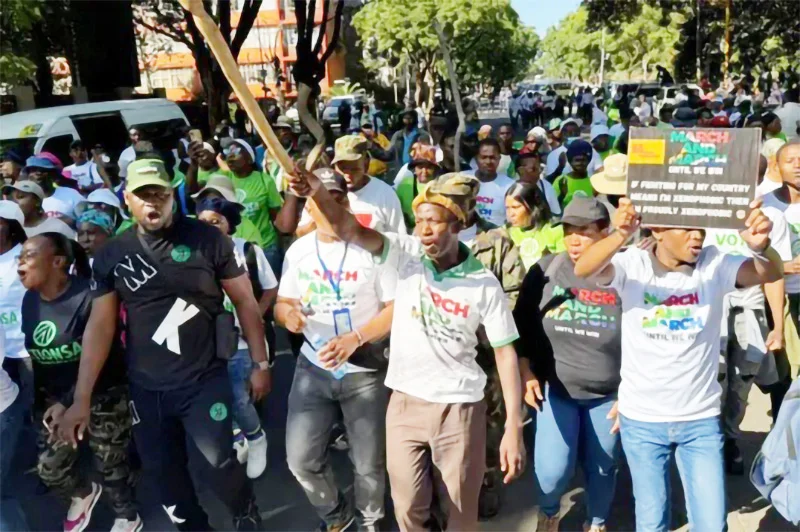
 The current outbreak of anti-immigrant protests in Durban, South Africa is bound to have taken many a subscriber to value-based politics or political idealism quite by surprise. After all, this is evidence that despite the historic accomplishments of nation-builders of the stature of the late President Nelson Mandela it cannot be taken for granted that identity politics, including racism in its worst forms, is no more in South Africa.
At the time of this writing details are scarce on the substantive root causes of the protests but it could very well be that economic grievances, particularly on the part of the majority community in South Africa, are contributing considerably to the disaffection. Shrinking employment and material prospects are likely to figure majorly among the factors igniting the unrest.
Fortunately, the local authorities in Durban are losing no time in calling for peaceful co-existence among the relevant communities and are pointing to the vital importance of stepping-up national integration processes. Apparently, immigrants in sizable numbers from neighbouring countries are present in Durban. However, international TV footage of the protests quoted some local authorities as saying that the majority of the immigrants in some centres that housed them were not illegal migrants and had the documents that entitle them to be in Durban.
In the Durban protests the world has fresh proof of the socially divisive consequences of the gathering globe-wide economic disaffection, touched off particularly by the continuing crisis in West Asia. Going ahead, the world would need to brace for increasing identity-based unrest of the kind it is just witnessing in South Africa.
Considering that the material lot of ordinary people everywhere could only aggravate progressively, with the US and Iran showing no signs of negotiating an end to their confrontation any time soon, it will be left to the more democratic and progressive sections of the world community to initiate positive measures collectively to bring a measure of relief to the discontented.
The swiftness with which such relief will be provided would depend crucially on the importance those sections taking up these undertakings attach to value-based politics as opposed to Realpolitik of power politics.
Going by these yardsticks, Italy could be considered to be moving in the right direction. Recently Italy came to the fore in initiating the collective named, ‘Rome Coalition for Food Security and Access to Fertilizer’, which has as one of its aims the swift provision of fertilizer to economically weak African countries.
In a recent statement Italian Minister of Foreign Affairs and International Cooperation, Antonio Tajani, said that a principal aim of the project was to ensure that the farmers of Africa gained easy access to fertilizer, considering that food security is a growing concern among some of Africa’s economically vulnerable countries.
The statement went on to mention that some 30 countries hailing from the Mediterranean region, the Middle East, the Balkans as well as the FAO had been invited to join the coalition. The venture is far-seeing in that food security is main among the reasons for social discontent which in turn could degenerate into endemic political turmoil and bloodshed. Separatist violence and geographical fragmentation of countries wouldn’t be too far behind these developments, as Africa itself has often proved.
It is hoped that more G7 countries would take the cue from Italy and do what they could to ease the hardships of economically distressed countries, particularly of the global South. In these efforts they would need to break rank with the US, which is today brutally indifferent to the consequences of its policy of making ‘America First’, come what may.
Going by current developments, the Trump administration seems to be blithely oblivious to the wider, deleterious effects of its policy course in West Asia. Besides rendering Iran militarily and otherwise impotent nothing else seems to matter to Washington, as regards West Asia. This is policy short-sightedness of an extreme kind. After all, right now West Asia could be said to be sitting on the proverbial powder keg.
On the other hand, Iran is not giving the world the impression that it is doing anything constructive to get out of the policy straitjacket that it wove for itself decades ago. Rather than enter into a policy of ‘live and let live’ in relation to Israel in particular and initiate a process of reconciliation with the latter, it has chosen to operate within policy parameters that continue to damn Israel. This has put Israel always on the ‘defensive’ so to speak and prevented the opening up of space for meaningful dialogue.
That said, Israel is obliged to explore the possibilities of entering into a negotiatory process with the Arab-Islamic world that could lead to a de-escalation of tensions and bloodshed. It cannot continue to look at its neighbours through lenses that distort them as archetypal enemies who should be ‘wiped off completely from the face of the earth.’
In other words, the need is urgent for Realpolitik to give way to value-based politicks. Italy is beginning to prove that the latter approach could be pursued with some success. May be the EU and the UK could throw their weight behind these initiatives as well and establish that international politics could be refashioned on the basis of humane, civilized norms. The UN would need to be fully supportive of these moves and prove an organizational nucleus of the operations that follow.
In fact the time is ripe for people of conscience to collectively stand up on the side of peace and say ‘No’ to war and violence. Organizations such as the ICRC, the WHO and Medicines Sans Frontiers have already taken up this call. Referring to the widespread destruction of health facilities and their dehumanizing results these organizations have said, among other things, that ‘This is not a failure of the law. It is a failure of political will.’
True, ‘failure of political will’ among those powers that matter accounts for the runaway, uncontrollable nature of war and destruction in contemporary times, but more fundamentally it is a failure of the human conscience. It could very well be that the phenomenal levels to which violence and war have been unleashed today have had the effect of deadening consciences. This is a matter for urgent study and wide discussion.

 I would describe Indunil Kaushalya Dissanayaka as innovative and creative, and she operates under the name of Cuteefly.
Indunil always comes up with something novel to celebrate special occasions, and she does it with candles … and that’s her profession.
She was in the spotlight when she created a happening scene, with candles, for Christmas, Sinhala and Tamil New Year, and Valentine’s Day.
As lanterns light up Sri Lanka for Vesak, the Colombo-based candle maker is quietly turning wax and wick into little pieces of the festival.

Candles reflecting Vesak themes
Her candles reflect Vesak themes – light, peace, remembrance, giving, etc., to enable you to fill your Vesak celebration with devotion and beauty.
Among her Vesak creations is a lotus-shaped soy candle, scented with sandalwood, lavender, etc., meant to burn during this Vesak Poya Day.

Indunil Kaushalya Dissanayaka: Customers
praise her for her creativity
These handcrafted Vesak candles are perfect for offering at the temple, she says.
What makes her creations so novel is that they come in different shapes, scents, themes, and all are handmade.
What’s more, her customers have heaped praise on her for her creativity.
According to Indunil, her creations are perfect as a thoughtful gift … to bring beauty, unity, and light into every moment.
Says Indunil: “Our beautifully handcrafted Unity candles are designed with premium detail and love, making them perfect for celebrations, gifts, and meaningful occasions.”
Cuteefly, says Indunil, is available online.
Readers could contact Indunil on 0778506066 for more details.
He Facebook Page is: Cuteefly.

Handmade with love

 Yes, dark spots do crop up on the skin, especially with sun exposure and, of course, as the skin ages.
However, these tips should be of immense benefit to those who are faced with dark spots.
* Lemon and Honey Glow Mask:
You will need 01 teaspoon lemon juice and 01 teaspoon honey.
Mix the lemon juice and honey well and then apply this mixture, only on the dark spots.
Leave for 10–15 minutes and then rinse with cool water.
Benefits:
Lemon helps brighten pigmentation.
Honey moisturises and heals skin.
Gives a natural glow.
* Aloe Vera Gel Treatment:
All you need is fresh aloe vera gel.
Apply the gel apply on dark spots, before going to bed.
Leave overnight and wash in the morning.
Benefits:
Reduces acne marks and pigmentation.
Soothes irritated skin.
Helps skin repair naturally.
* Turmeric and Yoghurt Paste:
You will need 01 teaspoon yoghurt and a pinch of turmeric
Mix the yoghurt and turmeric into a smooth paste and apply on affected areas.
Leave for 15 minutes and then wash gently with lukewarm water.
Benefits:
Turmeric brightens skin naturally.
Yoghurt removes dead skin cells.
Helps fade dark spots gradually.
Use these packs 02-03 times a week as results are generally seen over time.
You can also try this out: Mix a ripe papaya into a smooth paste and apply to the face, or directly on to the dark spots. Leave for 15-20 minutes and then wash with lukewarm water.

Advisory for strong winds and rough seas for the sea areas extending from Kankasanthurai to Chilaw via Mannar and from Galle to Pottuvil via Hambantota

West Indies to host Sri Lanka, New Zealand and Pakistan in 2026 home season

Hacking claims, mismatched answer-sheets: Controversies rock school exam in India

Iran says it targeted American base after fresh US strikes

Farmers Affected by the Nilwala Salinity Barrier paid Rs. 1.2 Billion in Compensation

State Vesak Festival held with the participation of the President

‘Dates have the highest sugar content to fight Coronavirus’

Sunday Island 27 December – Headlines

#SundayIsland 17th December – Headlines

Sunday Island – 28th March

Sunday Island Headlines – 21 March

Sunday Island – 21st February – Headlines
-

 Business7 days ago
Historic launch of CCWE Fashion Week & International Summit 2026
-

 News5 days ago
All-New GRAVITE launches at LKR 6.99 Mn
-
 Features5 days ago
The NPP’s pivot to the past
-
 News4 days ago
Police probe underway to ascertain links between criminals deported from UAE and local politicians
-

 News3 days ago
Easter Sunday carnage: Court told Maulana’s statement cannot be accepted without cross-examination
-

 Opinion7 days ago
The need to reform Buddhist ecclesiastical order
-
 Features5 days ago
End of Peacekeeping
-

 Opinion3 days ago
Undermining the democratic political framework