
News
Chinese Ambassador: ‘Promises must be kept’

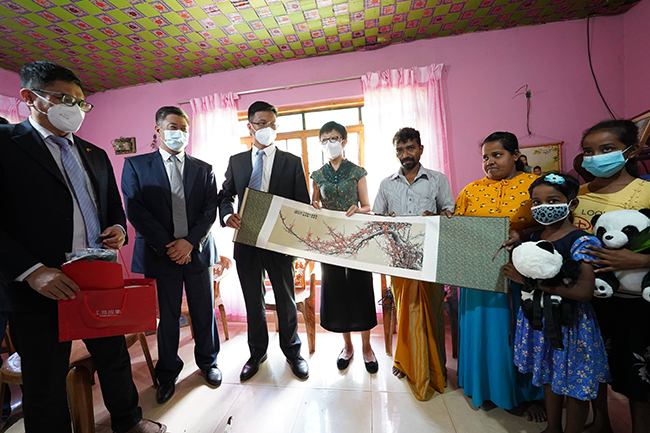
Chinese Ambassador Qi Zhenhong has declared that in spite of major changes in the political scene here and elsewhere, the overall China-Sri Lanka foreing releations remain the same.Ambassador Zhenhong said so in the East during a two-day visit (Sept 5 and 6), his second to the region within 3 months. The top Chinese envoy was accompanied by his wife Jin Qian.
The Chinese Embassy quoted Ambassador Zhenhong as having said: “Over the past three months, there have been many major changes in Sri Lanka and the world. But we are pleased to see that the overall situation of China-Sri Lanka traditional friendship and the momentum of common development have not changed. The mutual understanding, mutual respect and mutual support between our two countries and the two peoples have not changed either. The main reason is because our bilateral friendship is deeply rooted in the hearts of the two peoples.”
Ambassador Qi Zhenhong met with Governor of Eastern Province Anuradha Yahampath at the latter’s secretariat in Trincomalee on the afternoon of 5th Sept. The embassy quoted the envoy as having told Yahampath: “Promises must be kept, and action must be resolute”.
The Ambassador has updated the officials on the progress of China’s assistance following his previous visit 3 months ago. The Ambassador also highlighted that encouraged by the embassy and invited by the EP government together with the Sri Lanka Ports Authority, some Chinese enterprises had visited Trincomalee Port recently to explore future cooperation.
Following the meeting, Ambassador Qi handed over 22 Smart Boards (75-inch & 65-in, worth LKR 21 million) for distance education to the principals of 20 schools across the Eastern Province. The program was funded by China’s Yunnan Provincial Government as a follow-up of its food packages donation (worth LKR 55 million) to 10,000 needy families from EP in May. Witnessed by the Ambassador and Governor Yahampath, Chief Secretary of Eastern Province Mr. Thusitha Wanigasinghe and Director of Yunnan Commercial Office in Sri Lanka Mr. Hu Kai signed a MOU to provide 70 sets of solar streetlight systems (worth LKR 13 million) to schools in the Eastern Province by Yunnan.
On the morning of 6th, Ambassador Qi Zhenhong and Madam Jin Qian visited the Faculty of Health Care Sciences, Eastern University in Batticaloa and handed over Chinese Ambassador’s Scholarship (a total of LKR 4.3 million) to 150 students (mainly girls) from underprivileged families of all ethnicities in the University to help their study and daily life for up to 7 months. Professor Vallipuram Kanagasingam, Vice Chancellor of Eastern University and Dr. K.E. Karunakaran, Deputy Vice Chancellor together with deans, teachers, students and their parents attended the event.
In his keynote speech, the Chinese Envoy talked to the Sri Lankan youth.
As a conclusion, Ambassador Qi pointed out that “Youth is the future of a country and the future of the friendship between two countries. This year marks the 65th anniversary of the diplomatic ties between China and Sri Lanka, and the 70th anniversary of the Rubber-Rice Pact. I sincerely wish all the students to study hard, grow strong, and become new backbone of Sri Lanka and China-Sri Lanka friendship as soon as possible.”
On the afternoon of 6th, Ambassador Qi and the delegates from the Chinese embassy were invited by the Batticaloa District Civil Society to visit Kaluwankerni, an underdeveloped Tamil fishing village in Batticaloa which has been suffering from domestic conflicts, natural disasters, Covid-19 pandemic and the ongoing economic crisis. After laying a foundation stone for a housing scheme funded by the embassy for 10 most needy families in Kaluwankerni, the Chinese Ambassador talked to about 50 villagers representatives gathering at the ceremony and stressed it is his duty as Chinese ambassador to Sri Lanka to strengthen friendly cooperation with all ethnic groups in the Eastern Province. “China will, as always, provide all-out help for Sri Lanka to get out of current difficulties.” said Qi.







News
Establishment of an Institutional Framework to Inagurate Upper Hydro Catchment Areas Management Authority

Policy approval of the Cabinet of Ministers was granted at their meeting held on 08.06.2026 to establish the Upper Hydro Catchment Areas Management Authority for identification and
execution of a formal and long – lasting remedy to secure the central hills including the upper hydro catchment areas enabling them to sustain amidst extreme weather conditions
due to natural calamities and human activities as well as to be used for the sustainable development of the country.
Accordingly, a concept paper has been prepared including
institutional structure, activities, powers, active subject area as well as administrative and coordination mechanism for the proposed authority by an expert technical committee appointed by the Secretary to the President.
Based on the said concept paper, the Cabinet of Ministers granted approval to the resolution furnished by the President to instruct the Legal Draftsman to prepare a draft bill including legal provisions required for the establishment of Upper Hydro Catchment Areas Management Authority.
News
Introduction of Flora and Fauna (Regulation of actions of the Indigenous Community within the nominated areas) Regulations
With the objective of securing the traditional livelihood and the eco system of the indigenous community, it has been recognized the necessity of introducing a formal regulation methodology to secure their engagement in livelihood activities by being more sensitive to the existing laws.
Thereby, the Fauna and Flora (regularizing) regulations under the Fauna and Flora Protection Ordinance (Authority 469) have been prepared so that nominated activities within the prescribed area to a member of the indigenous community
who has been registered for securing the rights acquired from law or custom or usage or traditional stance to execute an act within a certain state land that is fundamental to the survival of the indigenous community permission can be granted
Accordingly, the Cabinet of Ministers granted approval to the resolution furnished by the Minister of Environment to publish the said regulations in the government gazette notification and thereby submit to the Parliament for its concurrence.
Latest News
M. M. D. J. Senarathne, appointed Director General of the Department of National Botanical Gardens
The Cabinet of Ministers approved the resolution furnished by the Minister of Environment to appoint M. M. D. J. Senarathne, who is the senior most officer in Grade I of Sri Lanka Scientific Service se

Establishment of an Institutional Framework to Inagurate Upper Hydro Catchment Areas Management Authority
Introduction of Flora and Fauna (Regulation of actions of the Indigenous Community within the nominated areas) Regulations
M. M. D. J. Senarathne, appointed Director General of the Department of National Botanical Gardens

Harmanpreet Kaur steps down as India captain

Turkiye, Pakistan agree Saudi Arabia military deployment under Mecca pact

Rumesh Tharanga among nominees announced for World Athlete of the Year 2026

‘Dates have the highest sugar content to fight Coronavirus’

Sunday Island 27 December – Headlines

#SundayIsland 17th December – Headlines

Sunday Island – 28th March

Sunday Island Headlines – 21 March

Sunday Island – 21st February – Headlines
-

 Latest News7 days ago
Gold winner Tharanga gets brand-new Honda Vezel from SLAAJ
-

 News6 days ago
US-assisted ‘Ice’ detection: NPC to examine IGP’s move to transfer drug-busting team
-

 Features7 days ago
Why Sri Lanka needs an Inclusive Civic Nationalism – urgently
-

 Editorial5 days ago
Colombo Port drug bust: The plot thickens
-

 News7 days ago
Civil society activist accuses govt. of favouring Ven. Gnanasara
-
 Midweek Review7 days ago
Dappula’s Easter Sunday ‘grand conspiracy’ claim demolished
-

 Editorial7 days ago
When crime bosses rise above law and shrines
-
Editorial6 days ago
Drug busting, transfers and trust deficit