
Midweek Review
Playing politics with national security

By Shamindra Ferdinando
Security of a country did not depend on its Defence Secretary. There were various structures and it was a matter of collective action, one-time Defence Secretary, Austin Fernando, told the Presidential Commission of Inquiry (P CoI) on Saturday (26).
The P CoI, appointed by former President Maithripala Sirisena, is inquiring into the Easter Sunday attacks. Sirisena named the Commission several weeks before the end of his five-year term.
Fernando further said: “It is not mandatory for the Defence Secretary to have an intimate knowledge of the role played by the Ministry. If that is the case, a fisherman should be the Secretary to the Ministry of Fisheries, and the Secretary to the Ministry of Agriculture should be a farmer.”
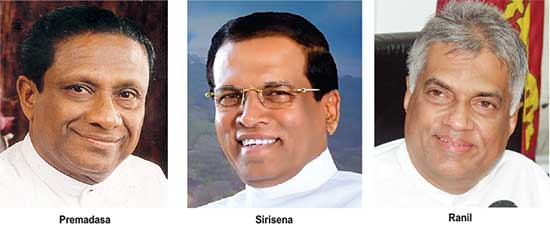
Let me examine Austin Fernando’s statement, taking into consideration the direct talks between President Ranasinghe Premadasa and the LTTE, during the period 1989-1990 (the late General D.S. Attygalle served as the Defence Secretary from 15.08.1983 to 16.02.1990), outbreak of Eelam War II (General S.C Ranatunga served as the Secretary Defence from 16.02.1990 to 01.05.1993) and the Ceasefire Agreement (CFA) with the LTTE entered into by Premier Ranil Wickremesinghe (Austin Fernando functioned as the Secretary Defence from 21.12.2001 to 03.11.2003).
Hemasiri Fernando, who served as Secretary Defence in the run-up to the April 21, 2019, Easter Sunday attacks, is under investigation for criminal negligence. In all four above-mentioned instances, the government apparatus collectively failed, though the circumstances were different.
The only difference is in the case of the disastrous 2002 CFA. The then President Chandrika Bandaranaike Kumaratunga cannot be faulted as Premier Ranil Wickremesinghe blindly signed the catastrophic Oslo-drafted 2002 peace initiative, keeping even his cabinet in the dark.
Austin Fernando is absolutely right. Security of a country does not depend on its Defence Secretary. In fact, a single person cannot guarantee national security, regardless of political clout he or she wielded. However, one person can cause irreparable damage, through irrational and unilateral actions/decisions, as in the case of the CFA. The appointment of retired military officers certainly cannot guarantee national security. The late Gen. Attygalle and Gen. Ranatunga facilitated President Premadasa’s ill-fated strategies that weakened the military. Taking Fernando’s assertion into consideration, it would be pertinent to examine how President Premadasa (1989-1990), Premier Wickremesinghe (2002-2003) and President Sirisena and Premier Wickremesinghe (2015-2019) jeopardized the national security. Those who served under them, too, equally contributed to the rapid deterioration of security by simply giving into political dictates, thereby providing tacit support to despicable political agendas.
Sri Lanka paid a huge price for political and military miscalculations. The political environment, created by Sirisena-Wickremesinghe, cannot be scrutinized without taking into consideration previous situations. In the absence of detailed study, the public tend to consider the Easter Sunday security failure as an isolated case. But, the extraordinary Easter Sunday terror project, perhaps, is part of an insidious political strategy to keep Sri Lanka in perpetual anarchy. Those who had perpetrated nearly simultaneous suicide attacks, in three administrative districts, certainly deliberated the political environment before going ahead with the operation. Who exploited the National Thowheed Jamaat (NTJ) to deliver such a devastating message? Did NTJ succumb to external elements? When did India actually infiltrate the NTJ and what is the status of the Indian intelligence gathering operation in Sri Lanka? Why didn’t Indian intelligence share information on NTJ (Zahran Hashim’s gang) much earlier? And, most importantly, why were both Sinhala and Tamil communities targeted?
Defence Chiefs play ball with Ranasinghe Premadasa
Having secured the presidency, in January 1989, President Premadasa sought an agreement with the JVP. The UNP leader also made an attempt to reach a consensus with Tamil groups, including the LTTE. The President succeeded in reaching an understanding with all armed Tamil groups, except the LTTE. The presence of one-time militant Douglas Devananda, leader of the EPDP (Eelam People’s Democratic Party), in President Gotabaya Rajapaksa’s cabinet of ministers, is evidence of Premadasa’s successful political strategy. In addition to the EPDP, Premadasa brought the EPRLF (Eelam People’s Revolutionary Liberation Front), TELO (Tamil Eelam Liberation Organization) and PLOTE (People’s Liberation Organization of Tamil Eelam) into the political mainstream. However, Premadasa’s bid to reach an understanding with the LTTE ended disastrously, in the second week of June 1990.
At the time, Premadasa initiated direct negotiations with the LTTE, the late Gen. Attygalle had been the Secretary, Ministry of Defence while Lt. Gen. Hamilton Wanasinghe served as the Commander of the Army (16.09.1988- 15.11.91). Did the President consult the Defence Secretary and the Commander of the Army before initiating negotiations with the JVP and the LTTE? Did they approve of releasing from custody of over thousands of JVP suspects in early 1989? Their release resulted in an immediate stepping up of violence though the police, the military and the government-sponsored civilian death squads crushed the JVP, by the end of 1989.
Having captured JVP leader, Rohana Wijeweera, at Ulapane, in the second week of Nov. 1989, he was brought to Colombo, interrogated and executed. Premadasa knew what befell Wijeweera, who led two insurrections, in 1971 and 1987-89.
However, Premadasa’s apparent unilateral decisions, in respect of the LTTE, caused immense harm. Believing in the possibility of successful conclusion of negotiations with the LTTE, Premadasa, hastily announced the hotly disputed decision to request New Delhi to terminate its military mission in the North-East Sri Lanka. Did Premadasa genuinely consult the Defence Secretary, Commander of the Army or at least his Prime Minister, the late D.B. Wijetunga, before demanding the pull-out of the Indian Peace Keeping Force? Premadasa, obviously didn’t believe in consultations. In his capacity as the leader of the UNP and the President, Premadasa largely believed in unilateral decisions. The catastrophic handling of direct negotiations with the LTTE paved the way for terrorists to launch devastating attacks on the Army after obtaining from the then naïve government military supplies, money, as well as building materials. Clearly, the Secretary Defence and the Commander of the Army played ball with Premadasa. In fact, all cooperated with Premadasa. Officials bent backwards to appease the all-powerful President. The then Election Commissioner, the late Chandrananda de Silva, overnight recognized the PFLT (People’s Front of Liberation Tigers) as a registered political party. The writer was among several local and foreign journalists, invited by the late LTTE theoretician Anton Balasingham, to the Colombo Hilton where he made the announcement. Chain-smoking British passport holder Balasingham declared proudly that their emblem would be a Tiger in a red flag of rectangular shape. Premadasa, or late Chandrananda de Silva, had no qualms in the PFLT receiving political recognition in spite of it being armed. The LTTE received political recognition a couple of months before Velupillai Prabhakaran resumed Eelam War II.
Prez playing with fire
Did Premadasa consult the Defence Secretary and Commander of the Army before lifting restrictions imposed on the Northern Province, abandoned Point Pedro and Valvettiturai army detachments, pardoned convicted Maradana bomber Manouri Daniels, along with over a dozen other LTTE cadres, held under the PTA (Prevention of Terrorism Act), and provided weapons and funds to the LTTE. Premadasa did what he wanted to do. The UNP leader was not bothered about security implications. Obviously, his security chiefs remained mum. President felt confident in his political strategy. He was so confident, he ordered law enforcement personnel to surrender after the LTTE surrounded police stations in the East. Premadasa’s decision resulted in the deaths of over 400 officers and men. Did the President consult Gen. Attygalle’s successor Gen. Cyril Ranatunga and the Commander of the Army before the government reached an agreement with the LTTE?
The Army in the East averted a calamity by refusing to surrender, in spite of the senior leadership directing them to do so. General Gerry H. de Silva, who served as the Commander of the Army (1994-1996) in his memoirs titled ‘A most noble profession’ commented on Premadasa’s strategy/the government’s failure to recognize the threat posed by the LTTE. First published in 2011, two years after the successful conclusion of the war against the LTTE, De Silva acknowledged: “We failed to see through the emerging trends and LTTE machinations. Despite constant threats and humiliation meted out to security forces and the police by the militants, the politico-military hierarchy preferred to put up with the ignominy in order not to ‘rock the boat.’
The LTTE capitalized on the situation. A rejuvenated LTTE ‘called the shots,’ and quickly moved into a position of strength, politically and militarily. They were riding the crest of a wave and must have felt that the time was opportune to achieve their goal of Eelam.”
The Gemunu Watch officer is the only Commander of the Army to author a book on his career.
Within a week after the resumption of hostilities, in the second week of June 1990, the ill-prepared Army lost the Overland Main Supply Route (MSR) to the Jaffna peninsula. Premadasa’s ‘honeymoon’ with Prabhakaran lasted 14 months. The Tiger Supremo resumed the war, at lightning speed, just two months after India terminated its military mission here. Sri Lanka was left high and dry after the series of follies by Premadasa, at peace making, and the military couldn’t regain the MSR, till January 2009. Premadasa’s Generals turned a blind eye to what was happening on the ground. When fighting erupted, the Army had just one battalion, plus troops in the Jaffna peninsula. In spite of continuing to build up, the top brass ignored the growing threat until it was too late. So, the mere appointing of a retired General as Secretary Defence cannot guarantee rationale thinking. Premadasa’s strategy was nothing but a massive and unprecedented collective failure that almost resulted in capitulation of the Northern forces. Premadasa turned a Nelsonian eye to the LTTE evicting the entire Muslim population from the Northern Province, in Oct 1990. At the behest of Premadasa, the then Army Commander facilitated coordinated LTTE attacks on rival Tamil groups. The LTTE massacred hundreds of people. The response of Premadasa and his chief negotiator, the late A.C.S. Hameed, to the LTTE threat, caused quite an embarrassment to the government, undermined the State and, basically, allowed the LTTE to transform itself to a conventional fighting force. The then Higher Education Minister Hameed never realized ground realities.
Retired General de Silva’s assessment can be applied to all Presidents. except war-winning Mahinda Rajapaksa, who had faith in his younger brother Gotabaya’s capacity to coordinate the war effort against the LTTE.
Generals Attygalle and Ranatunga certainly owed an explanation as regards their failure to prevent the catastrophe in the North. Obviously, no one dared to challenge Premadasa’s dangerous strategies. Having served as the Commander of the Army, for a decade, and Defence Secretary, General Attygalle received appointment as Sri Lanka’s High Commissioner in London where he facilitated Kittu’s (Sathasivam Krishnakumar) arrival there. On the orders of Premadasa, the SLAF brought Kittu to Colombo where the British High Commission made arrangements to send the former LTTE Jaffna Commander to receive treatment for his amputated leg. The Generals had no say and Premadasa had his way.
Can you imagine a government facilitating a terrorist’s travel to London where he took over the LTTE’s International Secretariat responsible for running a massive extortion racket? The funds ultimately ended up with arms suppliers who provided the LTTE a range of weapons, T 56 assault rifles to shoulder fired missiles. General Ranatunga, too, received appointment as Sri Lanka’s High Commissioner in Canberra and then London. Presidential nominees to top diplomatic posts always received parliamentary approval.
Security fiasco in 2002
Not having learnt from Premadasa’s stupidities, Ranil Wickremesinghe too plunged headlong into a similar folly with Austin Fernando et al in tow.
Ranil Wickremesinghe picked experienced administrative service officer Austin Fernando as Secretary Defence within days after winning the Dec 2001 parliamentary election. Wickremesinghe also brought in one-time Attorney General Tilak Marapana on the National List as the Secretary to the Ministry of Defence. Wickremesinghe adopted a simple strategy. The UNP leader advocated a policy of appeasement, thereby jeopardizing the entire security apparatus. The LTTE brazenly exploited the situation to its advantage. Prabhakaran stepped up training, recruitment of fresh cadres, as well as forcible conscription of children. The government did nothing. The LTTE intensified protests opposite security forces bases, restricted/interfered with police and military movements whereas the government repeatedly reiterated its commitment to the Oslo-led peace process like a mantra. Wickremesinghe dismissed intelligence assessment as regards the rapid LTTE built up. Wickremesinghe told a hastily arranged Temple Trees meeting, attended by senior officers responsible for intelligence services et al their assessment of the LTTE training 6,000 cadres at the onset of the CFA was wrong. The Premier contradicted his own intelligence apparatus on the basis of what the Indians told him. The then Defence Advisor Senior DIG Merril Gunaratne, who had been among those invited by the Premier, had the strength to stand by his report, based on information/analysis provided by all services. Obviously, Wickremesinghe hadn’t been in a mood to listen to anyone who questioned Prabhakaran’s motives though the continuing LTTE build up was evident.
Wickremesinghe followed his policy of appeasement. In his capacity as Secretary Defence Austin Fernando had no option but to go along with the Premier who authorized the finalization of CFA without proper consultations with the military top brass or the intelligence services.
The then Defence Secretary also provided some hilarious side shows like carrying a basket of fruits to a terrorist receiving treatment at a Colombo hospital.
Fernando himself claimed at the Lessons Learnt and Reconciliation Commission (LLRC) in August 2010 that he hadn’t been involved in the process leading to the finalization of the document. However, top SCOPP (Secretariat for Coordinating Peace Process) Dr. John Gooneratne subsequently revealed before the LLRC how Norway rejected four proposals made by Sri Lanka. Had those proposals been accommodated in the CFA perhaps Eelam War IV could have been avoided, Gooneratne told the late C.R. de Silva’s Commission. The writer covered the entire LLRC proceedings. Gooneratne revealed the hitherto unknown proposals namely (a) CFA to pave the way for a negotiated settlement (b) prohibition of smuggling of arms, ammunition and equipment (c) freedom of movement for other political parties in areas under the LTTE control and finally (d) halt to forcible recruitment. Sri Lanka never received the backing of Peace Co-Chairs, the US, Norway, EU and Japan to get those just proposals included in the CFA.
The UNP never revealed rejection of its proposals until Gooneratne took advantage of the LLRC to set the record straight. Austin Fernando and SCOPP Chief Bernard Goonetilleke, who appeared before the LLRC could have revealed the truth. The UNP remained mum. Throughout the CFA period, Premier Wickremesinghe tried to suppress information that may have caused embarrassment to his government, the Norwegians and the LTTE. Obviously there hadn’t been any proper consultations among members of the cabinet, parliamentary group or the military top brass regarding the Oslo-led process.
Austin Fernando cannot absolve himself of the responsibility for the UNP government’s actions during the CFA. The person who served as Secretary Defence cannot claim lack of knowledge of a particular situation. The same applies to the Defence Minister. During Marapana’s tenure as the Defence Minister Directorate of Military Intelligence (DMI)-run operation was exposed to the whole world with media scenes. In spite of strong protests by the Army, the UNP went ahead with its political project. The exposure of the operation led to the deaths of several operatives. The LTTE also hunted police officers engaged in anti-terrorist operations. When Defence Advisor Merril Gunaratne blamed the LTTE for the killing of Inspector Thabrew at the Dehiwela police station, Premier Wickremesinghe himself questioned the veteran law enforcement officer’s assessment.
The UNP allowed the LTTE to bring in undeclared cargo via the Bandaranaike International Airport (BIA). LTTE delegations returning from negotiations with Wickremesinghe’s delegations from various foreign venues and others brought large packages. The foolish government provided air transport. The LTTE brazenly used the opportunity to its advantage. The CFA provided the organization required protection. The LTTE exploited the Oslo arranged CFA, the same way it used direct talks with Premadasa to achieve its targets. High profile assassination of TULF leader Appapillai Amirthalingham is a case in point. Prabhakaran moved a hit team in an SLAF chopper that brought LTTE delegates from the Vanni to Colombo in 1989.
Both political and military leaderships should accept responsibilities for lapses. During Austin Fernando’s tenure as the Defence Secretary, the military was ordered to stop issuing situation reports, suspended ‘Wanni Sevaya’ (special radio that catered to the military and the police), subjected military reports to civilian approval and basically succumbed to LTTE tactics. While closing down ‘Wanni Sevaya’, the government permitted the LTTE to import state-of-the-art radio equipment to upgrade its own propaganda and communication facilities.
If not for the then President Chandrika Bandaranaike Kumaratunga’s intervention in late 2003, the UNP could have allowed the LTTE build up to continue until it was too late to take counter action. The UNP permitted the deterioration of the situation to such an extent, the LTTE by early 2003 felt confident enough to brazenly quit the negotiating table. The LTTE quit talks in late April 2003 to set the stage for an all-out war. By late 2005, the LTTE was confident it could overwhelm the Army in a large-scale conventional confrontation. The assassination of much-loved Foreign Minister Lakshman Kadirgamar, in early August 2005, indicated their readiness to take on the government. Had the LTTE succeeded in assassinating Army Chief Lt. Gen. Sarath Fonseka and Defence Secretary Gotabaya Rajapaksa, in late April and early Oct, 2006, the LTTE, perhaps could have achieved Eelam. There cannot be any dispute as regards the role played by the Army Commander and the Defence Secretary to bring the war to a successful conclusion. There had never been previous attempts on the lives of the Army Commander and Secretary Defence. The LTTE knew the government strategy could be aborted by assassinating the two most important men. Their failure brought the war to an end three years later with the LTTE militarily annihilated. If the LTTE succeeded, Sri Lanka’s unitary status could have been jeopardized by now. The Sirisena-Wickremesinghe coalition proved the danger in pulling in different directions, lack of vision and strategy as well as pursuing of political agendas inimical Sri Lanka State.


Midweek Review
Legacy of enforced disappearances: Vital facts conveniently forgotten to whitewash LTTE and India
Those demanding accountability from Sri Lanka for war crimes allegations are strangely silent on atrocities committed by the LTTE. On the orders of its leader Velupillai Prabhakaran, the LTTE killed hundreds of members belonging to rival terrorist groups. It assassinated President Ranasinghe Premadsasa, almost succeeded in assassinating President Chandrika Bandaranaike Kumaratunga and made attempts on President Mahinda Rajapaksa. But, the indiscriminate use of children as cannon fodder went unnoticed. How many children, forcibly recruited into their ranks, perished in fighting? And, lastly, shouldn’t the Tamil community hold the Illankai Thamil Arasu Kadchi (ITAK)-led now defunct Tamil National Alliance, that recognised the LTTE in 2001 as the sole representative of the Tamil speaking people, responsible for death and destruction caused since 2001?
By Shamindra Ferdinando
Working Group on Enforced or Involuntary Disappearances (WGEID) representative Ana Lorena Delgadillo Pérez, and head of the Association of Relatives of Enforced Disappearances (ARED) Yogarasa Kanagaranjini, on 30 August, opened an exhibition at the Thanthai Selva Auditorium in Jaffna. The exhibition, appropriately named ‘Long Road for Justice,’ coincided with the International Day for Victims of Enforced Disappearances.
Pérez later addressed a conference held therein where the responsibility on the part of Sri Lanka was stressed.
Civil society activist Sunanda Deshapriya, in an article titled ‘Sri Lanka’s Disappeared: Where Do We Go from Here?’ carried in Jaffna Monitor, dealt with missing persons issue. Deshapriya focused on the North-East war (https://www.jaffnamonitor.com/sri-lankas-disappeared-where-do-we-go-from-here/)
The ICRC, Colombo, issued a statement regarding the International Day of the Disappeared. When the writer sought the number of missing persons in the country, Ruwanthi Jayasundare, Head of Communications, said that they had a caseload of 15,000 registered tracing requests (1983-2009) but she asserted that the actual number of missing was far bigger (https://island.lk/icrs-sustained-and-collective-efforts-critical-to-address-issue-of-missing-persons/)
Perhaps, many people wouldn’t know that the ICRC arrived here in 1989 during the second Janatha Vimukthi Peramuna (JVP) terror campaign in the wake of Indian military intervention here. The much discussed issue of disappearances must be appropriately dealt with, taking into consideration the relevant factors. At the time of their deployment here, President Ranasinghe Premadasa had been engaged in direct talks with the Liberation Tigers of Tamil Eelam (LTTE) and the Geneva-headquartered body never expected a gruesome outbreak of violence. It would be pertinent to mention that within weeks after the ICRC’s arrival here, the JVP was crushed with brute force as it, too, resorted to senseless violence. The counter violence unleashed by the state apparatus was such that the then Marxist group’s top leadership was killed, except for Somawansa Amarasinghe, who escaped, with Indian help, in February 1990, and remained in exile till late 2001.
The ICRC deployment took place in mid October, 1989, and JVP leader Rohana Wijeweera was captured in the second week of November, at Ulapone, and shot in custody, and was allegedly cremated alive at the Borella cemetery.
In fact, at the time the ICRC arrived here, the JVP was on its last legs. The UNP government never bothered to hand over the bodies of slain JVP cadres to their families. Those who had been listed missing at that time were no longer in the land of the living, by the time the ICRC brought its operation in the South to an end.
What the country never expected was a fresh flare-up in the northern and eastern regions. The LTTE resumed large-scale hostilities, in June, after the Indian Army pulled out from Sri Lanka in late March 1990. Interestingly, some of those demanding justice for the missing/disappeared are conveniently silent about the disappearances during the Indian Army deployment here (July 1987 to March 1990).
Soon after hostilities erupted in the northern and eastern regions, following a 14-month truce between President Ranasinghe Premadasa and LTTE leader Velupillai Prabhakaran (May 1989 to June 1990), the ICRC was invited to open offices in that region. There had been excesses on the part of the military and law enforcement authorities as the government battled the LTTE, the world’s most ruthless terrorist organisation as assessed by none other than the US Federal Bureau of Investigation.
Yet Sri Lanka must earnestly address accountability issues and take meaningful measures to compensate the families of the innocents.
However, the Tamil community must come to terms with the reality that the vast majority of dead were members of the LTTE. The LTTE enjoyed considerable firepower as it literally wielded a conventional fighting capability, which even included a fledgling air force and directly challenged the government, and the armed forces had no option but to fight back. Obviously, the LTTE, that achieved significant battlefield successes over the years, never expected the almost non-stop three-year-long offensive that brought the war to an end in May 2009. Disappearances became exceptionally an important issue in the overall agenda pursued by the Tamil Diaspora and Tamil speaking political parties here only after the LTTE’s eradication.
Multiple reasons
In September 1990, several months after the Indian Army was literally forced to pull out from Sri Lanka as Tigers fought back the mighty IPKF to a standstill, while President Premadasa, too, made it clear that they were no longer welcome here, Amnesty International (AI) documented 43 cases of disappearances. According to the London headquartered AI, the majority of these disappearances happened in the Jaffna peninsula, following the outbreak of fighting in October 1989. The Indian Army launched ‘Operation Pawan’ meant to disarm the LTTE in line with the Indo-Lanka Accord, signed on 29 July, 1987.
During the Indian Army deployment here (1987 July to 1990 March), the Sri Lankan armed forces were confined to their barracks in the North and East. The AI accused the Indian Army of torture, extrajudicial executions and disappearances. The deaths of nearly 1,500 Indian officers and men, and injuries to approximately 3,000 others during the Indian deployment here, underscored the ferocity of the situation.
The Indian Army carried out reprisals, following LTTE attacks in both provinces. The Indian Army was also accused of sexual violence. Perhaps, the August 1989 Valvettithurai orgy of violence, during which Indian soldiers killed civilians, tortured detainees, committed sexual violence, and systematically destroyed homes and businesses, while the town was under curfew, was the worst case.
In October, 2025, the International Truth and Justice Project (ITJP) presented a detailed reparations claim, in association with the Valvettithurai Citizens’ Committee, to the Sri Lankan Office for Reparations, requesting USD $15 million (LKR 4.5 billion) for victims of a 1989 orgy of violence committed by the IPKF where at least 66 civilians were killed and 34 injured.
There hadn’t been a previous instance of a comprehensive compensation claim for such a wartime crime. Thousands of LTTE cadres, some of them trained in India, and civilians, perished in Indian Army action. The Indian Peace Keeping Force (IPKF) earned such a bad reputation it came to be dubbed the Indian People Killing Force.
The war in Sri Lanka, or whatever one chooses to call it, should be examined in the context of a high profile Indian destabilisation project ordered by Premier Indira Gandhi. Over a year after the Indian Army pullout, the LTTE assassinated Rajiv Gandhi, by then out of power, but he was the person Velupillai Prabhakaran held responsible for the Indian Army deployment in Sri Lanka. Following Gandhi’s assassination, India hunted down the LTTE team, involved in the operation, carried out by a female suicide cadre.
The LTTE forgot the Indian role in the transformation of the Tamil separatist terrorist movement to a deadly conventional threat. If not for the despicable Indian action, Sri Lanka wouldn’t have been hauled up before the Geneva-based United Nations Human Rights Council (UNHRC). That is the unpalatable truth.
How many Sri Lankan Tamils disappeared during weapons training in India? Did India investigate such disappearances as well as deaths caused by fighting among rival Tamil terrorist groups operating in India at that time? Among the groups that had been armed by India were PLOTE (People’s Liberation Organisation of Tamil Eelam), EPRLF (Eelam People’s Revolutionary Liberation Front) and TELO (Tamil Eelam Liberation Organisation) responsible for quite a significant number of killings and human rights violations.
India never accepted responsibility for the PLOTE raid on the Maldives on a contract to topple the then Maldivian PM Gayoom’s government given by a domestic rival in early November, 1988. Shouldn’t New Delhi at least apologise for the sea borne raid on the Maldives that resulted in deaths of Maldivians, as well as raiders? The Indian Navy sank a ship commandeered by the attackers fleeing the Maldives after air borne Indian troops brought the situation under control.
The Indian and global media praised swift Indian intervention but ignored two key factors, namely (i) the operation targeting Maldivian President Maumoon Abdul Gayoom was mounted by one of the groups trained, armed and deployed by India and (ii) two trawlers carrying the raiding party left the northern part of Sri Lanka, at that time held by the Indian Army.
The writer had the opportunity, in November, 2011, to interview the Maldivian businessman, Abdullah Luthufee, who convinced the PLOTE leader Uma Maheswaran to carry out the operation. (Male plot leader speaks out 3 November, 2011, Rajiv saved us from Gayoom-Male coup leader 4 November 2011 and How Luthufee moved SAARC venue from Male to Addu 11 Nov 2011) dealt with the operation that should have drawn international attention to the Indian destabilisation project. Let me stress that some PLOTE cadres perished when the Indian Navy sank the vessel commandeered by the fleeing PLOTE cadres. They were among those who had been listed missing during the conflict.
Australian and US interventions
One-time top JVPer Kumar Gunaratnam secret arrival in Sri Lanka as an Australian Citizen Noel Mudalige, in early September, 2011, emphasised the issuance of foreign passports in assumed names to Sri Lankans under controversial circumstances. The writer exclusively reported how the head of the breakaway JVP faction, known as the Frontline Socialist Party (FSP), arrived here. The Australian High Commission in Sri Lanka acted swiftly and decisively when Gunaratnam disappeared after entering the country, using Australian passport bearing number N 1016123 on September 4, 2011 (https://dbsjeyaraj.com/dbsj/?p=43914). The writer dealt with the same issue again in August 2016 (https://dbsjeyaraj.com/dbsj/?p=47936).
Among thousands of Sri Lankans, now having foreign citizenship, there can be many people listed here as “missing/forcibly” disappeared. Western governments never helped Sri Lanka to establish the real identities of Sri Lankans living abroad, under assumed names. If Gunaratnam never acted in a manner inimical to the JVP, he could have easily lived a comfortable life in Australia as Sinhala Buddhist Noel Mudalige.
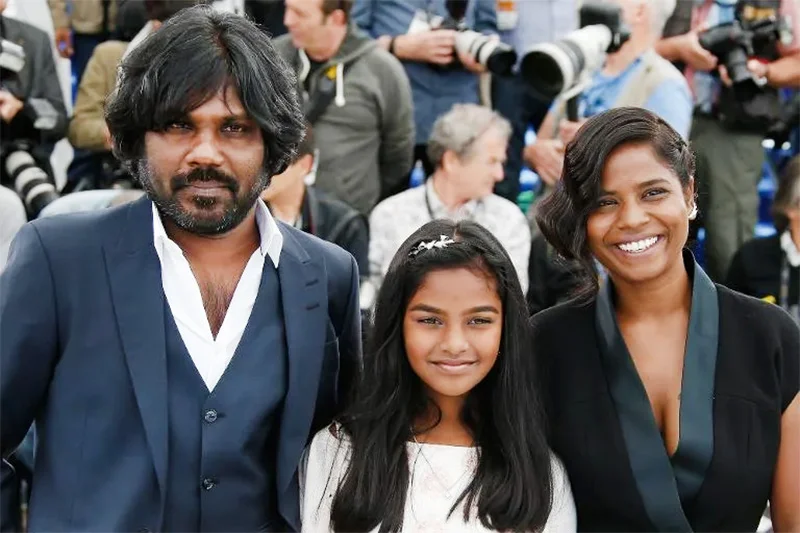
There had been many interesting stories of those categorised as missing/dead turning up in the West, under new identities. One of the most intriguing ones, is about an ex-LTTE terrorist turned Frenchman Antonythasan Jesuthasan, the lead actor in Dheepen that won the prestigious Palme d’Or at the 2015 Cannes Film Festival.
Internationally acclaimed Jacques Audiard directed the movie about three Sri Lankans who formed a fake family to escape the war and to secure asylum in France. Antonythasan Jesuthasan’s performance in Dheepan earned him a Best Actor nomination at the 2016 César Awards (the French equivalent of the Oscars). Jesuthasan is the only ex-LTTE terrorist to receive international acclaim as an actor.
In an interview with Tom Seymour (Dheepan’s Antonythasan Jesuthasan: from Tamil Tiger to star of a Palme d’Or winner in The Guardian) posted online on March 31, 2016, transformed Frenchman Jesuthasan, unwittingly revealed how he deceived the United Nations High Commissioner for Refugees (UNHCR) to secure political asylum. Seymour reported that Jesuthasan, after having shown him a dense lattice of scars on his forearm, declared: “I did those to myself. I was 22, and I had spent years trying to come to the west. I wanted to get a fake French passport, but I had to be accepted as a refugee. I went to the UNHCR [the UN High Commissioner for Refugees], but they wouldn’t believe my story. So I cut myself, and held up my arm, and said to them: ‘Look at my blood. This is my word.”
Jesuthasan is just one among thousands who obtained political asylum on false claims. Jesuthasan ended up as the star of Dheepan, directed by Jacques Audiard, possibly France’s most celebrated modern director. There cannot be a better example than Jesuthasan to highlight the web of deceit pertaining to the vast majority of those who successfully secured political asylum. But, the Sri Lanka Foreign Ministry never bothered to set the record straight. Born in Allaipiddy, on the Velanaitivu islet, Jesuthasan claimed he fought the Sri Lanka Army in August 1990 and subsequently fled the country and managed to reach France.
But, the case of Kathiravel Thayapararajah is one of the most controversial cases. Thayapararajah had been involved in a Tamil Diaspora funded project in Kilinochchi during Eelam war IV. He couldn’t have secured the Diaspora assignment without the approval of the LTTE and remained in the Vanni during the war. He disappeared in September 2009.
His disappearance prompted a section of the media, as well as some international NGOs, to accuse the Directorate of Military Intelligence (DMI) of executing him. No less a person than the then US Assistant Secretary of State for South Asian Affairs and one-time US Ambassador in Colombo, Robert O. Blake, inquired about the missing person.
The University Teachers for Human Rights (Jaffna), the Australian Government Refugee Review Tribunal, Tamilnet and the European Centre for Constitutional and Human Rights among others blamed the Sri Lankan intelligence for the disappearance. However, the Indian media, in May, 2014, revealed Thayapararajah’s arrest though they didn’t know at the time that he was the person who was supposed to have been killed by the Sri Lankan Intelligence. At the time Indian police apprehended Thayapararajah, at Arichamunai off Dhanuskodi, after arriving there in a boat from Sri Lanka, he had been with notorious female human smuggler Uthayakala. She claimed Thayapararajah was her second husband.
That chance detection exposed a blatant lie propagated over the years. The then Head of Missing Persons Commission, retired High Court Judge Maxwell Paranagama, is also on record as having called for international cooperation to trace persons living overseas under new identities. Paranagama told the writer that at that time both the international community, including the ICRC, had declined to help Sri Lanka identify those taking cover behind new identities.
Chemmani mass graves
Sri Lanka needs to investigate war crimes allegations, particularly the high profile Chemmani mass grave. The country cannot ignore the continuing accusations with the international media taking advantage of the situation to tarnish the country, especially the Rajapaksa rule. It must be a way of the West taking revenge from the Rajapaksas for going against their wish to save the bold thirsty Tigers. It is like their logic that Israel can do no wrong!
The CNN dealt with the Chemmani issue while the International Commission of Jurists (ICJ), in July last year, called for what it claimed as victim-centred investigation into the alleged mass graves in compliance with international law and standards.
Tamil political parties, too, repeatedly demanded tangible action against the perpetrators. The Chemmani mass grave site drew national and international attention in 1998 following the confession of a soldier implicated in the rape and murder of schoolgirl Krishanthy Kumaraswamy. Chemmani has become a powerful and painful symbol of the country’s war-torn past.
Krishanthy Kumaraswamy was raped and killed by soldiers on the 7th of September, 1996. The same group of soldiers later killed her mother, her younger brother and a family friend who went out searching for the teenager.
An excavation, in 1999, led to the recovery of 15 sets of remains, and then the matter was allowed to rest for about a quarter of a century. On the orders of the Jaffna Magistrate’s court, a fresh excavation was ordered last year, following the chance recovery of some skeletal remains and so far nearly 600 sets of human remains have been found, among them children and infants. Tamil media have declared Chemmani as the largest mass grave found in Sri Lanka.
It would be pertinent to mention that some time back the Army was accused of the Mannar mass graves but investigations undertaken by the Office of Missing Persons (OMP), with international expertise, proved the claims false. Bone fragment samples were submitted to Beta Analytic, a specialised US radiocarbon-dating laboratory. This happened during the Yahapalana administration (2015-2019) Later, the lab indicated that the tested bone samples dated back to the period between 1499 and 1719 AD (the 15th to 18th century). That brought an end to the Mannar mass graves hoax.
Whatever the circumstances, the government cannot remain silent regarding the Chemmani mass graves. The area that had been under Security Forces Headquarters, Jaffna continues to receive public attention, both here and abroad. The Army will have to address the issue without further delay. Let me stress the importance of investigating the atrocities perpetrated by others, namely the Indian Army for which the responsibility lies with the government of India as well as the LTTE, and over half a dozen other terrorist groups that subsequently entered the political mainstream.
The formation of Tamil National Army (TNA) by India before the Indian Army pullout by March 1990, too, must receive the attention of Sri Lanka as well the concerned international community. Having totally destabilised the smaller neighbouring county by arming scores of terrorist groups, New Delhi went a step further by the formation of the TNA meant to protect Varatharaja Perumal’s North-East provincial administration.
In spite of President Ranasinghe Premadasa drawing strong criticism for arming the LTTE against the Indian Army, in hindsight, if not for his controversial decision, India’s proxy, TNA may have taken root. Whatever various parties say today, the TNA had been formed to ensure the continuation of the deeply unpopular Perumal’s administration that went to the extent of forcible conscription. India can never absolve itself of responsibility for what it did in Sri Lanka. The destabilisation project, largely influenced by the then Premier Indira Gandhi’s concerns over the developing situation in Tamil Nadu, caused massive death and destruction. No less a person than J.N. Dixit, who served as their High Commissioner in Colombo (1985 to 1989), and later appointed National Security Advisor (2004 to 2005) disclosed in his memoirs ‘Makers of India’s Foreign Policy: Raja Ram Mohun to Yashwant Sinha’, Indira’s Gandhi’s intervention. The late Dixit in no uncertain terms blamed her for Indian intervention in Sri Lanka.
By Ifham Nizam
Pictures by Nishan S Priyantha and Kamal Bogoda
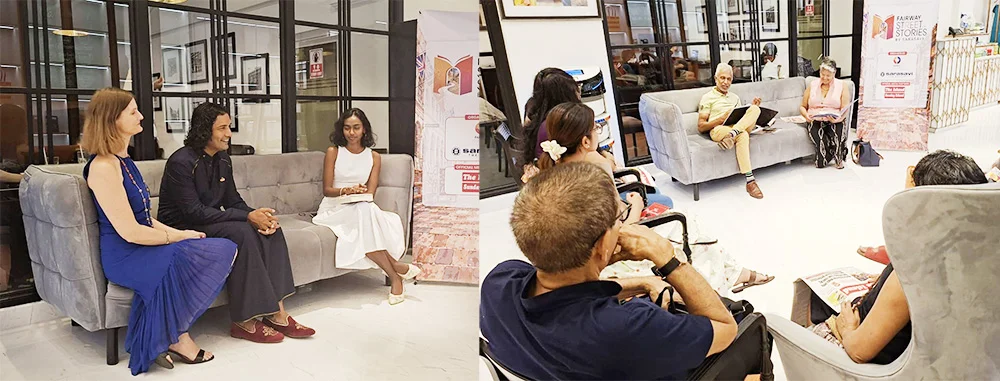
Ashok Ferrey took readers into an older Colombo through Colpetty People. Vivimarie Vanderpoorten opened the door to the personal stories behind her poetry. Andrew Fidel Fernando brought cricket, culture and the distinctive world of Sri Lankan school cricket into the conversation, while Ramya Jirasinghe spoke candidly about the long and often difficult road from writing a manuscript to seeing it published.
Then came Margaret Richardson and Asanka de Mel, whose conversation moved from literature to the question of where Sri Lanka should be by 2048.
These were among the voices that gave life to Fairway Street of Stories, a new initiative that sought to bring Sri Lankan English-language writers closer to their readers.
But behind the gathering of authors, readers, books, children, book clubs and aspiring writers was a bigger idea—the brainchild of Amendra Haputhanthri, Director of Sarasavi Bookshop (Pvt) Ltd.
For Haputhanthri, Fairway Street of Stories is not merely another literary event. It is part of a much larger attempt to create a marketplace for Sri Lankan talent and to persuade readers to discover stories that are unmistakably their own.
“Usually, when we have exhibitions, such as the Colombo Book Fair, we always think about what sells the most. Here, we wanted to create a niche market for people who want to read Sri Lankan writing,” she said.
And the first event demonstrated just how wide that literary world can be.
Stories from a Sri Lanka we know
Haputhanthri believes one of the greatest strengths of Sri Lankan English writing is its sense of place.
A thriller set in an unfamiliar foreign city may be entertaining. But a thriller unfolding at the Galle Face Hotel or Mount Lavinia Hotel carries another kind of intimacy for a Sri Lankan reader.
“You have familiar words and actual real-world places that we have been to. There will be a connection with the book,” she said.
That connection can be even more powerful when the story takes readers into places and experiences that are disappearing.
This is one reason she admires Ferrey’s work.
During his Fairway session, Ferrey, together with Tanya de Mel, offered readers an engaging glimpse into the world behind Colpetty People and the Colombo it captures.
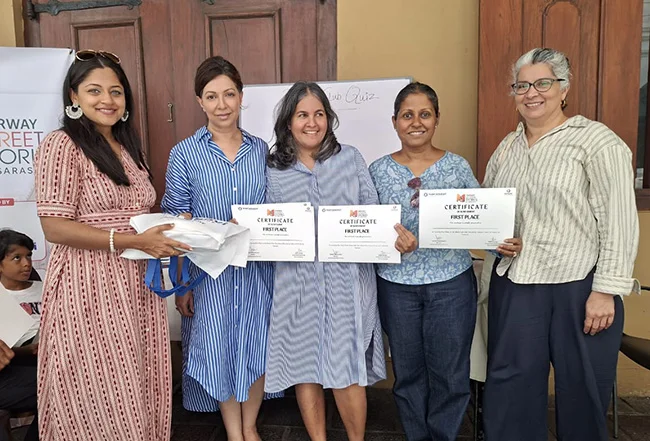
Amendra Haputhanthri (extreme left) with winners
For Haputhanthri, Ferrey’s writing is also a record of a rapidly changing city.
“Even Sri Lanka is changing very rapidly. Within Colombo also, the environment is rapidly changing, and that is being addressed nicely in the books of Ashok Ferrey,” she said.
Literature, in that sense, becomes more than entertainment.
It becomes memory.
The stories behind the poems
Vivimarie Vanderpoorten offered a very different literary experience.
Haputhanthri describes her as one of the country’s outstanding contemporary talents, particularly because of the personal histories embedded in her poetry.
A poem on a page may be only a few lines long. But behind those lines can lie an entire life.
Vanderpoorten spoke about those experiences at Fairway, including deeply disturbing events she had witnessed during her university years.
For Haputhanthri, hearing those stories transformed the poems.
“All her stories, there is a back story. All her poems, there is a back story,” she said.
She believes such conversations are precisely what literary events should create—a space where readers can move beyond the printed page and understand the human experience that produced it.
She also encouraged people to read poetry, even if only one poetry collection a year.
Poetry, she believes, forces readers to think beyond what is immediately presented.
“It gives you the ability to think out of the box,” she said.
Cricket is more than a score
Andrew Fidel Fernando brought yet another dimension to the event.
For someone who writes and comments on international cricket, his work naturally takes readers into the world of the game. But Haputhanthri noted that Fernando’s writing also captures the culture surrounding cricket in different countries.
And Sri Lanka has a particularly richstory to tell.
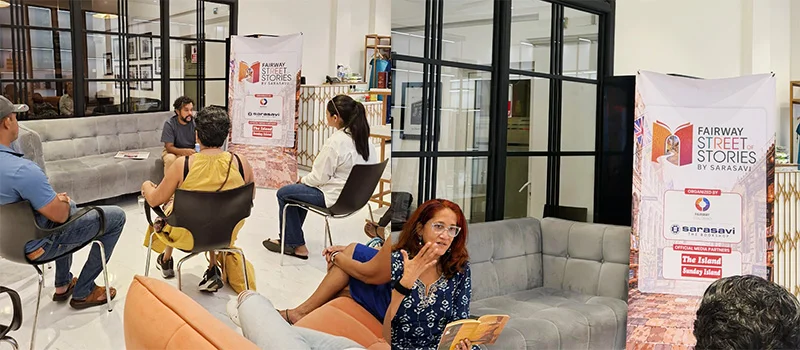
Andrew Fidel Fernando / Dr. Vivimarie Vanderpoorten
For Haputhanthri, the island’s school-cricket culture is something the world should know more about.
“We are the best in the world when it comes to having a culture for school cricket. It is something very unique to our country,” she said.
She even suggested that writers interested in Sri Lankan cricket should explore this largely distinctive phenomenon in greater depth.
Because literature can sometimes reveal what statistics cannot.
A schoolboy walking onto a cricket ground carries with him a school, a city, friendships, rivalries, family expectations and an entire culture.
From manuscript to book
Ramya Jirasinghe’s contribution was particularly relevant to aspiring writers.
She spoke about her own journey and the realities of getting a book published.
Her experience demonstrated that literary success rarely happens overnight.
Winning recognition is one thing. Turning a manuscript into an internationally published book is another.
For emerging writers listening to her, the message was clear: writing requires patience, revision and persistence.
Haputhanthri knows that process well.
Writers, she said, can be rejected repeatedly—even at international level.
And translations create another layer of difficulty.
Sometimes an author reads a translation of his or her work and says: “This doesn’t have my voice.”
That, Haputhanthri acknowledged, illustrates how complex the journey from an original manuscript to another language can be.
A speech from the future
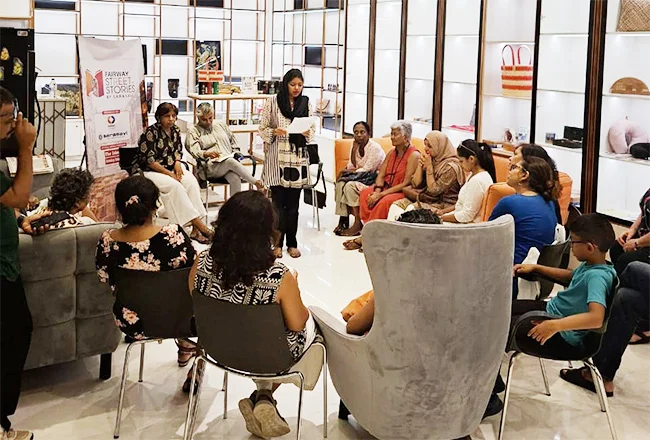
Carmel Miranda
Asanka de Mel and Margaret Richardson brought another perspective to Fairway.
De Mel’s 2048: A Speech from 2048 looks towards the centenary of Sri Lanka’s independence and asks why the country has not yet become a developed nation.
But his message, as Haputhanthri interpreted it, was not one of resignation.
Sri Lanka should not allow its small geographical size to become a psychological limitation.
De Mel’s own journey—from two decades in Silicon Valley to returning to Sri Lanka and embarking on entrepreneurial ventures—was offered as an example of what persistence and confidence can achieve.
For Haputhanthri, it reinforced one of the central lessons of both writing and life.
“There is no shortcut in life,” she said.
Stories that preserve a country
Fairway Street of Stories also reflected Haputhanthri’s belief that literature can preserve aspects of Sri Lankan identity that are increasingly vulnerable.
She spoke about Angampora, Beeralu weaving, traditional culture and historical stories.
Even the country’s royal heritage can become a gateway for a new generation to understand the island’s past.
She recalled seeing foreign visitors browsing books about Sri Lankan kings.
Those books were doing more than recounting history. They were presenting the story of a country with a long and complicated heritage.
Haputhanthri believes Sri Lankan literature can perform a similar role internationally.
“Our stories should also reach people in the same way our food and cultural experiences have reached the world,” she said.
She recalled meeting two foreigners who had visited Sri Lanka around 156 times.
Their extraordinary attachment to the country reminded her that Sri Lanka’s culture has an ability to attract people repeatedly.
The stories of the country, she believes, deserve the same reach.
The problem is not the e-book
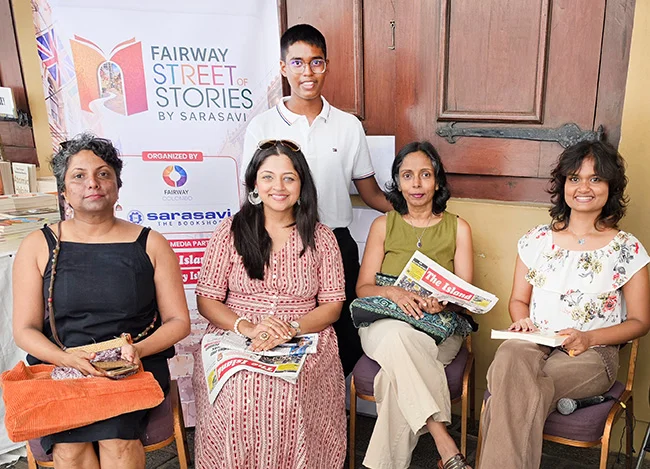
Ramya Jirasinghe (third from left)
Yet while Haputhanthri is passionate about books, she is equally concerned about the future of reading.
She does not believe e-books are necessarily the enemy.
“If people are reading an e-version, as long as they are reading something valuable, that will add something to you,” she said.
The bigger threat, in her view, is the endless scrolling culture of the smartphone.
“Scrolling on the phone reduces your attention span and you can’t do any sort of deep work,” she said.
She has observed this challenge among young people entering the workplace and believes sustained concentration is increasingly difficult.
But her answer is not to blame young people.
It is to begin much earlier—with parents and teachers.
“Whatever the parents read, the children also will read,” she said.
‘Readers Are Not Born, They Are Created’
That belief is now developing into another initiative.
Haputhanthri is working on a programme titled ‘Readers Are Not Born, They Are Created’, which she hopes to take from school to school and community to community.
The target will be parents as much as children.
The message is that reading habits are cultivated. They are demonstrated, encouraged and nurtured.
She also hopes to involve children who have themselves developed through reading, allowing them to share their experiences with others.
For Haputhanthri, the issue is deeply personal.
“I would credit everything that I have today, and everything I am today, because of reading,” she said.
She believes avid readers develop empathy, creativity and critical thinking—qualities that are increasingly valuable in a world dominated by information but often short on attention.
Beyond one literary weekend
Fairway Street of Stories, therefore, is not intended to remain a once-a-year literary celebration.
Haputhanthri wants to see activities connected with reading and books continue throughout the year.
A bargain book sale is among the ideas being considered, making use of books from Sarasavi’s extensive network of branches that may have suffered minor damage or discolouration while remaining on shelves.
The next major event will be the book fair, followed by further initiatives.
But the larger ambition goes beyond sales.
It is about discovery.
A reader discovering a Sri Lankan writer.
A child discovering poetry.
An aspiring author discovering that rejection is not the end.
A foreign visitor discovering that Sri Lanka’s stories are as rich as its food, landscapes and traditions.
And a country discovering itself in its own books.
That is perhaps the most significant contribution of Fairway Street of Stories.
Because the authors who gathered there did more than talk about their books.
They demonstrated the many ways in which Sri Lanka can be written, remembered and imagined.
And behind that gathering was Amendra Haputhanthri’s conviction that these stories deserve not only a place on a bookshelf, but a place in the minds of readers—and eventually, a place in the wider world.
By Lynn Ockersz
Just for a fleeting moment is this sense of relief,
As he eases himself heavily into his airline seat,
Hoping to leave no trace behind of his criminal self,
But he’s dragged down by a guilty conscience,
Which will dog him at heel from now onward,
And this is verily a cast-in-stone life sentence.

Showers will occur in the Western and Sabaragamuwa provinces and in Kandy, Nuwara-Eliya, Galle and Matara districts.


Sri Lanka reiterates its territory won’t be used against India

UK-led Core Group calls Jaffna mass graves a ‘stark reminder’ but stops short of calling for international accountability

India underscores security and defence in overall partnership with SL

If Sri Lanka wants ‘real’ stability, only one way to achieve it, in a short time

‘Dates have the highest sugar content to fight Coronavirus’

Sunday Island 27 December – Headlines

#SundayIsland 17th December – Headlines

Sunday Island – 28th March

Sunday Island Headlines – 21 March

Sunday Island – 21st February – Headlines
-

 News5 days ago
Namal remanded until Sept. 18 over Airbus deal investigation
-

 Latest News4 days ago
Tharanga creates history with Diamond League crown in Brussels
-

 News4 days ago
Dispute which triggered listed company director being detained at BIA resolved
-

 Features3 days ago
After the parade: What a traffic OIC’s walk-out tells us
-
 Opinion6 days ago
In Memory of Dr Upatissa Pethiyagoda
-

 Editorial5 days ago
Power vs Equality
-
 Latest News6 days ago
SLPP MP Namal Rajapaksa arrested by CIABOC
-
Editorial3 days ago
Arrests as theatre