
Sports
Sri Lanka record second win in Masters Hockey World Cup History

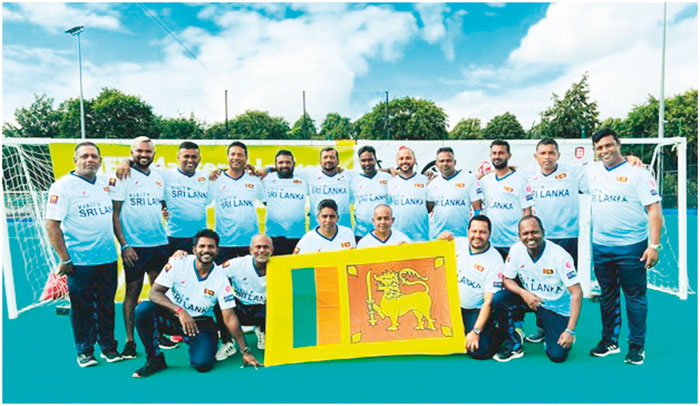
Sri Lanka Masters over 40 hockey team recorded its second win in the Masters World Cup history when they beat Italy 4-3 in the ranking games at the sport’s prestigious veteran tournament held in Nottingham, England.
Sri Lanka’s over 40 team, which lost all six round-robin matches against the World’s top European veteran hockey teams by big margins in Group A, put its house in order to win the crucial match in the 14-nation tournament.
Italy also lost all six group matches by margins less than that of Sri Lanka’s in Group B.
The match was crucial for the both teams to avoid being ranked at the last position in this year’s Masters World Cup.
The game was evenly poised, but Sri Lanka took the lead at the 11th minute when Sampath Subasinghe scored the first goal to a rebound for a penalty corner hit by vice-captain and Sri Lanka’s center forward Nadith Kudagama.
Duncan Devendra scored the second goal via a penalty stroke at the 17th minute and made it 2-0.
However, Italy fought back with Andrea Graziano scoring a field goal. Later, Sri Lanka defender Sanjay Edgar scored the third goal just before the half time to end the first half 3-1.
Italy fought back hard in the second half producing nail-biting moments. The European team, which beat Sri Lanka in the last 2018 Masters’ World Cup 2-1, scored at the 51st minute, snatching Sri Lanka’s weakly defended moment with Malluzzo Michele scoring a field goal.
However, an excellent forward combination of Nadith Kudagama, Mahesh Matiwala, and Duncan Devendra breached through the Italian defence and scored Sri Lanka’s fourth goal at the 60th minute of the game. Devendra netted the ball to score his fourth goal in the 2022 World Cup.
Italy skipper Alessandro Onano scored their third goal at the 67th minute of the game via a field goal and reduced the margin to 4-3. Sri Lanka saw some nervous moments in the last three minutes as Italy forwards breached Sri Lankan’s defence many times, but they held steady to finish the game in their favour to be ranked 13th in the 14-nation World Cup.
Sri Lanka was ranked 14th in the last World Cup held in Barcelona, Spain in 2018, which saw the participation of 15 nations.
It was Sri Lanka over 40 team’s second win at the Masters’ World Cup history. They recorded the first win against Denmark 2-1 in Spain, when they played the debut World Cup.
The men team’s main sponsor was Sri Lanka Tourism Promotion Bureau and co-sponsor was Nippon Paint Lanka (Pvt) Ltd, while Sri Lankan Airlines was the official airline partner for the team.
The team, which was in the toughest group, lost to Germany by 11-0 in the first game, but fought back well against the mighty France to minimize the margin of loss by 5-1 goals. However, it saw four disastrous defeats from then onwards, losing to the hosts England by 12-0, Wales by 12-1, Ireland by 16-0, and South Africa by 15-0.
All the teams in the A group in which Sri Lanka’s over 40 team was included, won the game against equal ranked team in the B group. It partly explains Sri Lanka’s defeat in the round robin matches amid injuries for four players while both the coach and team manager were also forced to play due to visa rejections for at least three players. The team had only 16 14 players excluding the coach and manager instead of 18.
Over 35 Men’s and over 40 Women’s Sri Lanka teams failed to impress in this year’s World Cup.
The over 35 Men’s team was ranked last among the 10 nations participated in the World Cup after it lost the ranking game against Wales by 0-11. In the group games, they lost the games against Spain 9-0, England 15-0, Ghana 11-1, and South Africa 18-0. The only goal for the team against Ghana was scored by Rasiah Sathya.
The over 35 men’s team also comprised only 15 players instead of full 18 players.
Sri Lanka’s women’s team, led by Manoji Pradeepika Koralage, competed in over 40-category and had a similar experience suffering a massive 22-0 defeat at the hands of England.
The women’ team also lacked key players due to visa rejections. They lost the first game against Ghana 5-0 followed by losses to USA 9-0, Germany by 15-0, Scotland 11-0 and England 22-0. They also lost their ranking game against Spain 13-0.
The hosts England won all age category finals, while Ireland (0ver 35 women), South Africa (Over 35 men), Argentina (Over 45 women), and Australia (Over 45 men) became the runners up in the 10-day tournament which saw the participation of a total of 19 countries in different age categories.



Hurdler Ayomal Akalanka provided a glimmer of hope for Sri Lanka on a largely disappointing day for track and field at the Asian Games in Nagoya, Japan, securing his place in the men’s 400 metres hurdles final on Sunday.
Akalanka produced an impressive 49.78 seconds to book his berth in the final, keeping Sri Lanka’s hopes of a medal in the event alive.
The day, however, was marked by disappointing performances in the field events.
Gayan Sampath failed to register a single legal jump in the men’s long jump, bringing his campaign to an early end.
Madushani Herath also endured a difficult outing in the women’s long jump, finishing 12th with a below-par 5.91 metres.
In the men’s 800 metres heats, Harsha Karunaratne produced a sub-1:50 performance, clocking 1:49.90 seconds. He finished fourth in his heat, but the time was not sufficient to earn a place in the final.
With Akalanka advancing to the 400m hurdles final, Sri Lanka will look to the young hurdler to provide a stronger finish in the final.
The women’s javelin final was in progress when this edition went to press.
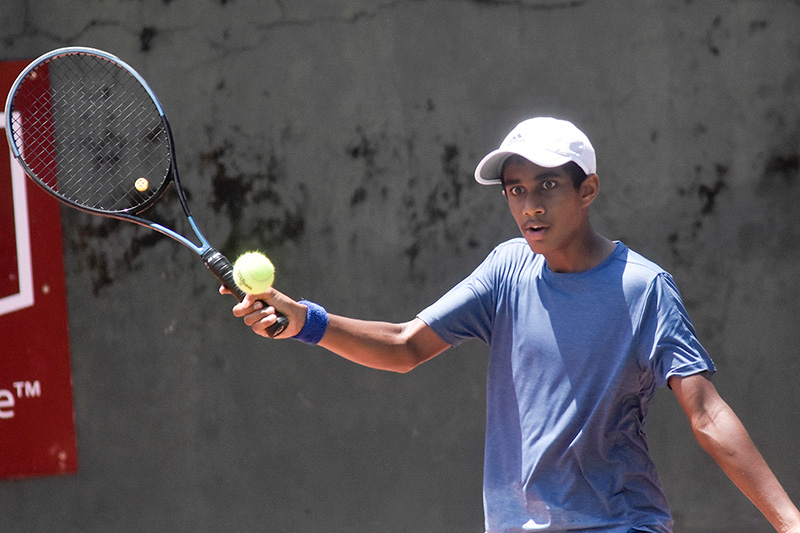
Colombo International School’s Samaira Fernando and S. Thomas’ College, Mount Lavinia player Revaan Amarasinghe emerged singles champions in the girls’ and boys’ categories respectively at the ATF Under-14 Colombo Week 1 tournament, which concluded at the Sri Lanka Tennis Association courts on Sunday.
Samaira produced an outstanding performance in the girls’ final, defeating India’s Saumya Choudhary 4-1, 4-1 to secure the title.
The Colombo International School player had earlier booked her place in the final with a semi-final victory over Sethuli Mathugama. She had also displayed her strength in the quarter-finals, defeating India’s Anandita Sarker 4-2, 4-0.
In the boys’ singles final, Amarasinghe defeated Hong Kong’s Ho Fung Choi 4-1, 4-0 to complete an impressive run to the title.
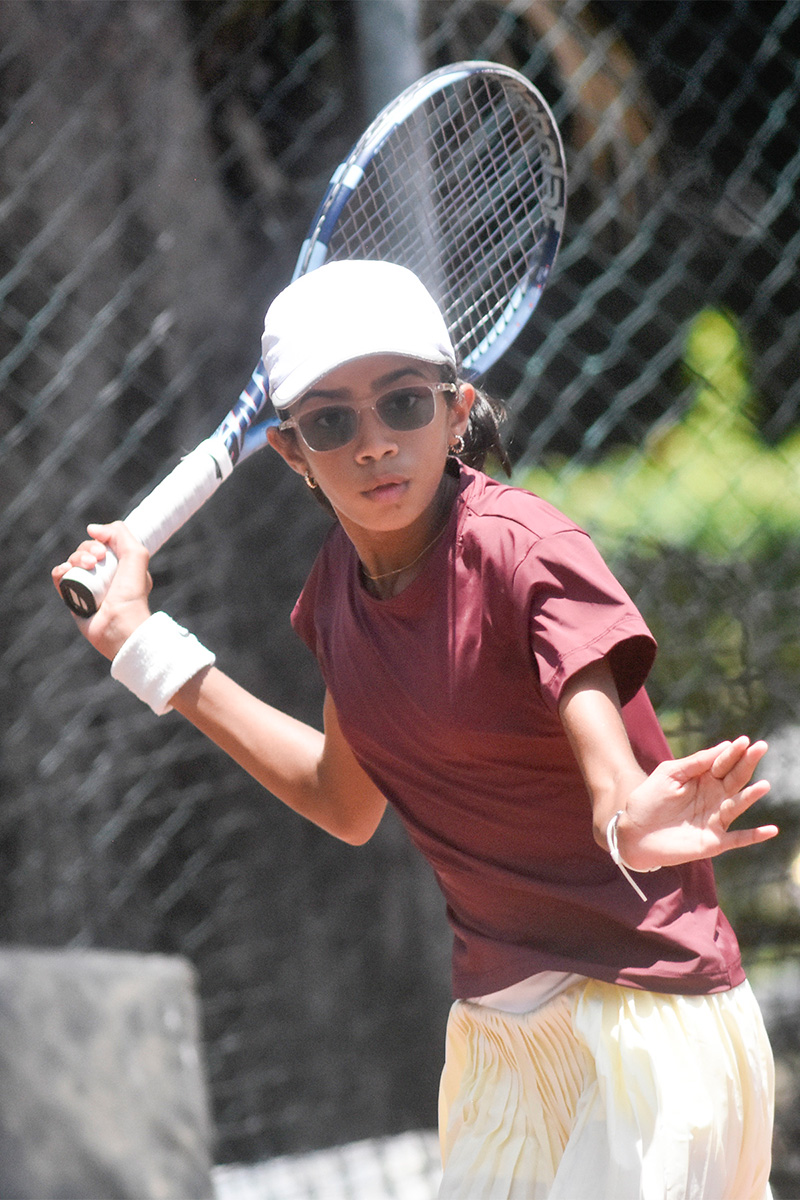
Samaira Fernando
The S. Thomas’ College player had been equally dominant in the earlier rounds. He defeated Hong Kong’s Oliver Lau 4-0, 4-2 in the semi-finals after recording a convincing 4-0, 4-0 victory over another Hong Kong player, Owen Cheung, in the quarter-finals.
by Rex Clementine
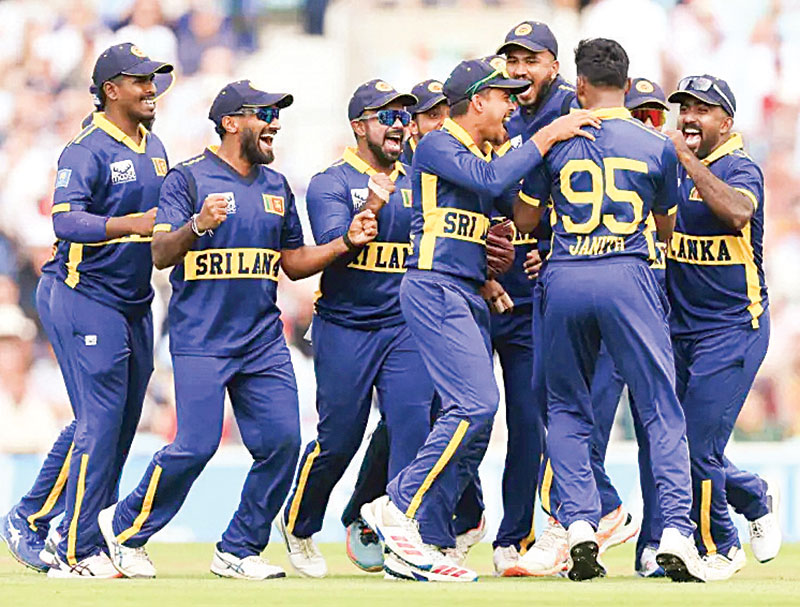
Sri Lanka were left with a mountain to climb after England set them a daunting target of 356 in the third and deciding ODI at The Oval on Sunday.
A sell out crowd packed the famous London venue for the series decider after Sri Lanka’s stunning comeback at Headingley had squared the three match contest and breathed fresh life into the tourists’ campaign.
On a dry surface, England opted to bat first, perhaps mindful that spin could become increasingly influential as the game wore on. They made full use of first strike, piling up 355, their second-highest ODI total against Sri Lanka.
Opener Tom Banton led the charge with his maiden ODI hundred after England suffered an early setback when Ben Duckett departed without scoring in the second over.
Sri Lanka, so sharp in the field at Headingley, were unusually sloppy. Joe Root was spilled in the slips while wicketkeeper Kusal Mendis put down Harry Brook early in his innings.
Part timer Janith Liyanage ensured Root did not make Sri Lanka pay dearly for the reprieve, trapping him leg-before for 17. Brook, however, cashed in on his second life and went on to post a brisk half-century.
Banton and Brook then seized control with a 140 run stand for the third wicket, targeting the shorter boundaries and forcing Sri Lanka onto the back foot.
There was a spell when Brook found Dunith Wellalage difficult to get away, but once Mendis took the left-arm spinner out of the attack, the England captain broke free and helped himself to some useful runs.
Brook eventually made 77 off 66 deliveries, striking nine fours and two sixes, while Banton produced the centrepiece of England’s innings with 126 off 105 balls, studded with 16 fours and five sixes.
Jordan Cox, drafted into the side in place of the injured Jos Buttler, ensured England hardly missed their talismanic wicketkeeper batter. He hammered 76 off 57 balls, his maiden ODI half-century, to keep the foot firmly on the accelerator.
Cox and Jamie Overton added 68 from just 30 deliveries for the sixth wicket as England launched their final assault.
Leg-spinner Sachindu Colombage continued to enhance his reputation, finishing with two for 71. A late replacement for the injured Wanindu Hasaranga, Colombage has proved a useful find, bowling with control and troubling England’s batsmen throughout the series.
Sri Lanka, however, will rue their lapses in the field. A cleaner effort, particularly during the closing stages, could well have kept England below 320. Instead, they were left needing 356 to win the match and with it the series.
Brief Scores:
England
355 in 50 overs (Tom Banton 126, Harry Brook 77, Jordan Cox 76; Sachindu Colombage 2-71).

Sajith rejects Jt. Opp. protest sabotage claim; SJB TU chief demands remedial action

Police remove Thileepan statue in Jaffna

NPP, Lal agree to disagree

Mudalige alleges irregularities in police body-camera tender

Navy seizes Rs. 1.5 bn drug haul off northern coast

Two killed in Baddegama shooting

‘Dates have the highest sugar content to fight Coronavirus’

Sunday Island 27 December – Headlines

#SundayIsland 17th December – Headlines

Sunday Island – 28th March

Sunday Island Headlines – 21 March

Sunday Island – 21st February – Headlines
-

 News5 days ago
Mastermind Naufer Moulavi among 15 found guilty
-
 News6 days ago
Protest against setting up of cement factory in highly populated area near BIA
-
 Midweek Review5 days ago
Thileepan’s fast unto death: An authentic narrative that many missed
-

 Latest News4 days ago
Showers above 100 mm are likely at some places in the Western, Sabaragamuwa, Central and North-western provinces and in Galle and Matara Districts
-

 Editorial6 days ago
Trouble beginning in earnest
-
Editorial5 days ago
Big Bad Bills
-

 Weather7 days ago
Showers about 100 mm are likely at times in the Western, Sabaragamuwa and North-western provinces and in Galle, Matara, Kandy and Nuwara-Eliya Districts
-
 News6 days ago
Govt. confident of 2/3 majority despite NPP split speculation