
News
Zuhair raps govt. for listing of Muslim organisations and individuals


Former lawmaker M M Zuhair, PC, has questioned the rationale behind the government alleging that 156 Sri Lankan Muslims and six Muslim organisations funded, or were associates of al-Qaeda or ISIL. One-time Sri Lanka’s Ambassador in Teheran said that Sri Lanka’s list of designated persons, and organisations, violated UN Security Council resolution 2253 of 2015.
Zuhair has said in a media statement: “While welcoming President Ranil Wickremesinghe’s statement at the recent annual conference of the Orgnisation of Professional Associations (OPA) on the need to “sort out the problems among the ethnic groups, as this has gone on for too long, as the war was over in 2009, and there is no need to fight again”, it is time that the President and his government do not permit unacceptable and unauthorised procedures being adopted to marginalize and ostracise minority community institutions, and individuals, under cover of national security, as we fear certain measures being unlawfully pursued will enhance radicalisation and counter radicalisation, in the country, leading to conflicts.
At this time of dire economic crisis, confronting the country, attributed by some to the ‘curse of all religious groups’, the urgent need is the unity of all the communities, as well as the economic support of all countries!
But why is the Foreign Ministry, through its competent authority, misusing, in its 1st August 2022 listing, the UN Security Council (SC) resolutions 1267 of 1999 and eight related subsequent SC resolutions, including resolution 2253 of 2015, the last in the series as quoted by the Sri Lankan authorities? The clear purpose of the Security Council resolutions was to control funding the terrorist entities, originally the then Taliban and later the Al-Qaeda and the Islamic State of Iraq and Levant (ISIL). How can the six Sri Lankan Muslim Organisations, and 156 Sri Lankan Muslims, be accused of funding any foreign terrorist entities or being associates of Al-Qaeda or ISIL?
Surely the Foreign Ministry has no proof that any one of these Sri Lankan entities, or persons, had funded the Taliban, the Al-Qaeda, or the ISIL, at any time, even though these entities, as originally resolved by the Security Council, had ceased to exist!
UN Security Council resolution 2253 of 2015 has unequivocally identified the target group of the resolution, in Section 2 as the ‘ISIL’, ‘Ai-Qaeda’ and associated individuals, groups, undertakings and entities’. The listing criteria are set out in Section 3 and are far beyond any fisherman’s hook! Is it the position of the Sri Lankan Foreign Ministry that the six, plus 156 Sri Lankan Muslim organisations and persons, are associates of terror outfits, ISIL or Al-Qaeda, thereby exposing Sri Lanka wrongfully for actions, including sanctions and damage claims by individuals, countries or the international community?
Then DIG of the CID, Ravi Seneviratne, gave evidence before the Parliamentary Select Committee that probed the Easter Sunday attacks of 21/04/2019 that there was no evidence of any links between Sri Lanka’s Easter Sunday suicide bombers and the ISIL or the Ai-Qaeda. The Defence Ministry has, on a number of instances, refuted foreign media allegations and assumptions attempting such links with foreign terror outfits. The Catholic Church has time and again pointed to elements seeking to net in the ISIS to take responsibility for the Easter attacks, for days after 21/04. The attempt was to show a non-existing link.
The 1st August 2022 listing of designated persons, purportedly under Article 41 of the UN Charter, is invalid and of no force or avail in law for several other reasons as well, including that Article 41 is entirely for the extraordinary UN objective of preventing wars and conflicts between nations and not to harass, humiliate or terrorise persons and organisations totally unconnected to ISIL or Al-Qaeda as defined in paragraph numbered 2 and the listing criteria in paragraph 3 of the Security Council resolution 2253 of 2015, not renewed thereafter because the two anti-Islamic entities have been killed and cremated.
In addition, several provisions in the gazetted regulations are violative of international laws, the provisions of the Constitution of Sri Lanka and Security Council resolution 2253 of 2015. The violations may become issues in the International Court of Justice in Hague, the UN Human Rights Council in Geneva and the Human Rights Commission of Sri Lanka in Colombo, unless the listing of Muslim organisations and individuals are promptly reviewed and cancelled. “


Bus fares have been increased by 12.19% with effect from midnight today [23rd March 2026].
The minimum fare will be increased from Rs 27 to Rs 30 while the maximum fare of Rs2159/- will be increased to 2422/-
Latest News
Public will not be served as Computer system failure at Department of Registration of Persons

The Acting Commissioner General of Registration of Persons has announced that due to an unexpected failure of the computer system of the Department of Registration of Persons, all services, including the one day service will not be held on Tuesday (24th March) at the Head Office and all Provincial offices.

Latest News
Heat Index at Caution Level in the Western, Sabaragamuwa, Southern and North-western provinces and in Anuradhapura, Mannar and Vavuniya districts
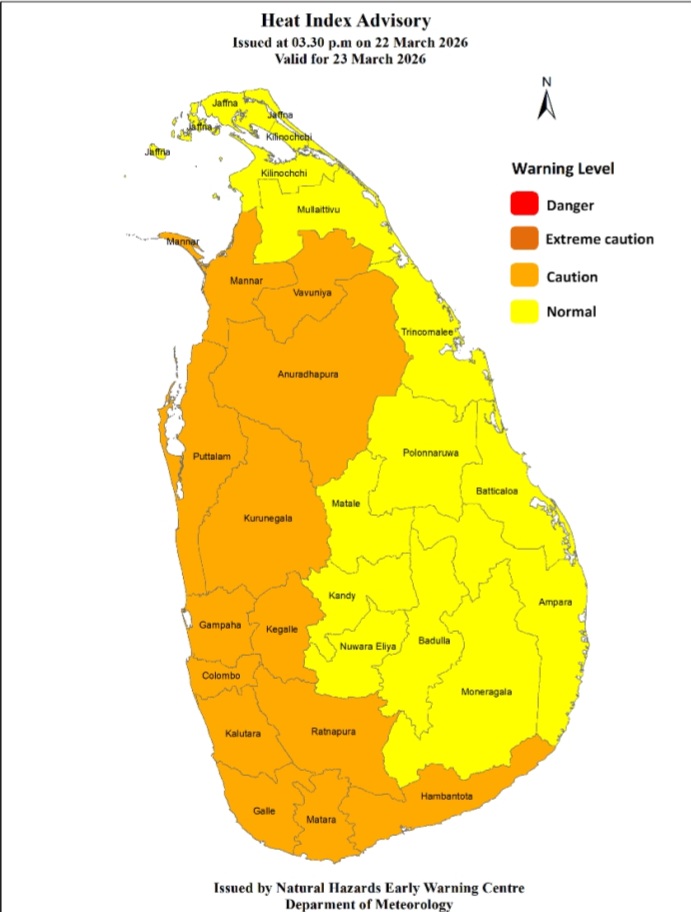
Warm Weather Advisory
Issued by the Natural Hazards Early Warning Centre of the Department of Meteorology
at 3.30 p.m. on 22 March 2026, valid for 23 March 2026.
The Heat index, the temperature felt on human body is likely to increase up to ‘Caution level’ at some places in the Western, Sabaragamuwa, Southern and North-western provinces and in
Anuradhapura, Mannar and Vavuniya districts.
The Heat Index Forecast is calculated by using relative humidity and maximum temperature and this is the condition that is felt on your body. This is not the forecast of maximum temperature. It is generated by the Department of Meteorology for the next day period and prepared by using global numerical weather prediction model data.

Effect of the heat index on human body is mentioned in the above table and it is prepared on the advice of the Ministry of Health and Indigenous Medical Services.
ACTION REQUIRED
Job sites: Stay hydrated and takes breaks in the shade as often as possible.
Indoors: Check up on the elderly and the sick.
Vehicles: Never leave children unattended.
Outdoors: Limit strenuous outdoor activities, find shade and stay hydrated.
Dress: Wear lightweight and white or light-colored clothing.
Note:
In addition, please refer to advisories issued by the Disaster Preparedness & Response Division, Ministry of Health in this regard as well. For further clarifications please contact 011-7446491.

Two killed when Air Canada jet hits fire truck at NYC’s LaGuardia Airport

Bus fares increased by 12.19% from midnight today [23]
Public will not be served as Computer system failure at Department of Registration of Persons

Trump says he is postponing strikes on Iran power plants after ‘productive’ talks on ending war

Asia stocks slide as US and Iran threaten to escalate war

Heat Index at Caution Level in the Western, Sabaragamuwa, Southern and North-western provinces and in Anuradhapura, Mannar and Vavuniya districts

‘Dates have the highest sugar content to fight Coronavirus’

Sunday Island 27 December – Headlines

#SundayIsland 17th December – Headlines

Sunday Island – 28th March

Sunday Island Headlines – 21 March

Sunday Island – 21st February – Headlines
-

 News6 days ago
CIABOC questions Ex-President GR on house for CJ’s maid
-

 News7 days ago
Sri Lankan marine scientist Asha de Vos honoured at UNGA opening
-

 News7 days ago
Australian HC debunks misleading travel risk claims for Sri Lanka
-

 News5 days ago
Bailey Bridge inaugurated at Chilaw
-

 News5 days ago
Pay hike demand: CEB workers climb down from 40 % to 15–20%
-

 News4 days ago
CIABOC tells court Kapila gave Rs 60 mn to MR and Rs. 20 mn to Priyankara
-

 Editorial6 days ago
Couple QR-based quota with odd-even rationing
-

 Features23 hours ago
Trincomalee oil tank farm: An engineering marvel