
Features
The President’s new clothes: A tragedy

By SANJA DE SILVA JAYATILLEKA
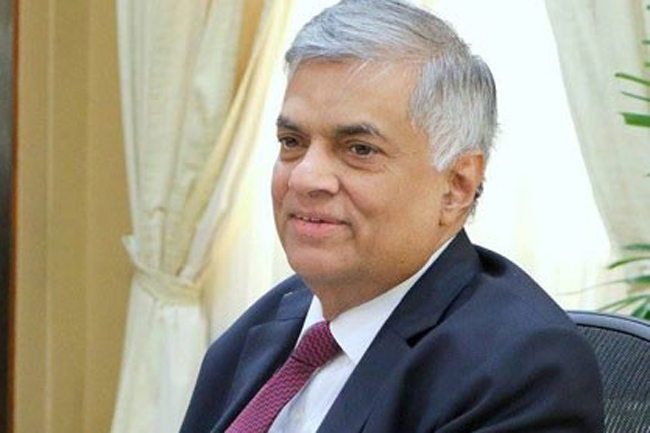
The new President, Ranil Wickremesinghe, recently selected and appointed by 134 Members of Parliament, is the main protagonist in an unfolding morality tale, political in category, a tragedy in the making.
Quite unlike in Hans Christian Andersen’s morality tale of the Emperor’s New Clothes, where no one dared to tell the emperor that he was naked, many have warned President Ranil Wickremasinghe that his style of governance, added to the method of his ascent, is a difficult combination to swallow, and is being rejected by the Aragalaya, condemned by civil society, and denounced by the religious community, including the Catholic clergy and Buddhist monks ,supportive of the people’s protests. And this, after only a few weeks in those new clothes.
But then, he didn’t take long to soil them, not even 24 hours.
OLD BAG OF TRICKS
Having forced President GR to vacate the premises, the People turned around to find that a far worse prospect had taken up residence without their consent. The new occupant had brought along with him an old bag of tricks which he promptly unpacked and unloaded on the people. Alarm bells rang when in the early hours of the morning, after the swearing-in, troops swarmed on the Galle Face protesters and began beating them with sticks and wires. Hitherto treated mostly with politeness by the authorities who had been in negotiations with them, the protesters were taken by surprise as were the people. And predictably, things have been heading south from there.
A prominent Aragalaya activist popularly known as Ratta, never seen to be violent, and a sane, moderate voice on behalf of the protesters, was just arrested as he voluntarily gave evidence at the CID. A worrying testament to the growing irrationality that guides the new President. Who exactly has taken the reins of our government?
Having arrested several protesters in unorthodox fashion, the President is now in pursuit of a priest. Why is he after Father Jeevantha, the Catholic clergyman? The priest was a prominent protestor at the Aragalaya, representing the people of his parish who are the poor, the marginalized, the forgotten; those at the lowest end and therefore the most vulnerable to the ill-conceived policies of governments. The Wickremesinghe administration, as if it had nothing better to do in a country that is bankrupt and on the edge of a precipice, has seen fit to prioritize sending the Police from church to church looking for Father Jeevantha!
The Cardinal wasn’t amused. Nor were 1640 priests and nuns who issued a statement questioning the President’s sense of civil and political rights, urging him to cease and desist and to get on with the job of saving the country from economic disaster. He has one job, at this time of economic crisis. Is he doing it? Or is he determined to empty all of that bag of tricks before he gets down to serious business, so to speak?
SO FAR, NO GOOD
Since he ascended the throne, protesters have been pulled off planes and buses by law enforcement, and even abducted in (trademark) white vans. While the government’s focus has been on subverting the Aragalaya, an unusually high number of people have been shot dead in broad-day-light, mafia-style, and three dead bodies have floated in from the sea, near the Galle Face. A student from Kelaniya claims that he was forcibly taken in a white van and questioned, threatened with planting drugs on him, and abandoned on a road after three hours of interrogation. This is going way worse than anyone expected. And not a dollar in sight for the economy, yet.
The President has been told that his conduct was utterly unbecoming and unacceptable. People have questioned his boldness (or rashness) in unleashing repression as an unelected President, only due to a constitutional provision and the show of 134 discredited hands. They could raise those hands again for fresh elections but that would go seriously counter to their self-serving logic.
So, the President has been warned. The naked truth is that the new clothes don’t fit him that well, and he is acting strange in them. Sri Lankans, quiet until provoked beyond reason, have told him that this will not end well. There is no evidence that he is listening. Listening wasn’t his strong suit anyway. Over the 25 long years he has been in the business of politics, that endearing quality of just not listening ensured that most of his party left him and formed themselves into another one, doing much better at their first showing without him. At the same election, he lost his seat. And yet, here we are, all in misery, except perhaps the President.
THE NEXT DELUGE
The President, having prorogued Parliament, is preparing to give the ‘Throne speech’ today, August 3rd. As the Americans say, “never mind what he says, watch his hands”. We have already watched his hands. A champion of human rights when out of power, is violating them like there is no tomorrow in a masterful display of hypocrisy, at the worst time for the country. Reputed to be the one hope for dollars due to his unsurpassed ‘external connections’, there isn’t any evidence of them. What is in sight, however, is a Chinese ship and an Indian protest, and the makings of a geopolitical disaster in our waters. The chance of economic support each of them may have meant to give us may sink in the Indian Ocean. A right Royal mismanagement of our international relations.
There will be a moral to this story, and it won’t be because the people didn’t dare articulate their discontent. It is becoming clear by the day that there will be ‘the deluge’. Another deluge, like the earlier deluge, is bound to hit the fortress of power, sooner rather than later.
Actually, the next deluge may be the solution. That it is coming, is beyond question given the conditions that are being created. And when they are ripe, we may see the story begin to end and the moral lesson emerge, hopefully to be learnt fast. The tragedy however, is already written by the 134 hands, and will be played out to the bitter end.

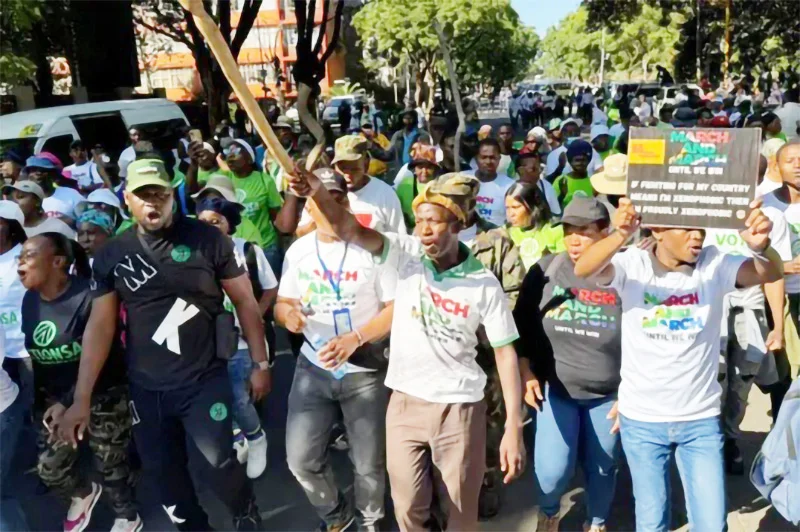
 The current outbreak of anti-immigrant protests in Durban, South Africa is bound to have taken many a subscriber to value-based politics or political idealism quite by surprise. After all, this is evidence that despite the historic accomplishments of nation-builders of the stature of the late President Nelson Mandela it cannot be taken for granted that identity politics, including racism in its worst forms, is no more in South Africa.
At the time of this writing details are scarce on the substantive root causes of the protests but it could very well be that economic grievances, particularly on the part of the majority community in South Africa, are contributing considerably to the disaffection. Shrinking employment and material prospects are likely to figure majorly among the factors igniting the unrest.
Fortunately, the local authorities in Durban are losing no time in calling for peaceful co-existence among the relevant communities and are pointing to the vital importance of stepping-up national integration processes. Apparently, immigrants in sizable numbers from neighbouring countries are present in Durban. However, international TV footage of the protests quoted some local authorities as saying that the majority of the immigrants in some centres that housed them were not illegal migrants and had the documents that entitle them to be in Durban.
In the Durban protests the world has fresh proof of the socially divisive consequences of the gathering globe-wide economic disaffection, touched off particularly by the continuing crisis in West Asia. Going ahead, the world would need to brace for increasing identity-based unrest of the kind it is just witnessing in South Africa.
Considering that the material lot of ordinary people everywhere could only aggravate progressively, with the US and Iran showing no signs of negotiating an end to their confrontation any time soon, it will be left to the more democratic and progressive sections of the world community to initiate positive measures collectively to bring a measure of relief to the discontented.
The swiftness with which such relief will be provided would depend crucially on the importance those sections taking up these undertakings attach to value-based politics as opposed to Realpolitik of power politics.
Going by these yardsticks, Italy could be considered to be moving in the right direction. Recently Italy came to the fore in initiating the collective named, ‘Rome Coalition for Food Security and Access to Fertilizer’, which has as one of its aims the swift provision of fertilizer to economically weak African countries.
In a recent statement Italian Minister of Foreign Affairs and International Cooperation, Antonio Tajani, said that a principal aim of the project was to ensure that the farmers of Africa gained easy access to fertilizer, considering that food security is a growing concern among some of Africa’s economically vulnerable countries.
The statement went on to mention that some 30 countries hailing from the Mediterranean region, the Middle East, the Balkans as well as the FAO had been invited to join the coalition. The venture is far-seeing in that food security is main among the reasons for social discontent which in turn could degenerate into endemic political turmoil and bloodshed. Separatist violence and geographical fragmentation of countries wouldn’t be too far behind these developments, as Africa itself has often proved.
It is hoped that more G7 countries would take the cue from Italy and do what they could to ease the hardships of economically distressed countries, particularly of the global South. In these efforts they would need to break rank with the US, which is today brutally indifferent to the consequences of its policy of making ‘America First’, come what may.
Going by current developments, the Trump administration seems to be blithely oblivious to the wider, deleterious effects of its policy course in West Asia. Besides rendering Iran militarily and otherwise impotent nothing else seems to matter to Washington, as regards West Asia. This is policy short-sightedness of an extreme kind. After all, right now West Asia could be said to be sitting on the proverbial powder keg.
On the other hand, Iran is not giving the world the impression that it is doing anything constructive to get out of the policy straitjacket that it wove for itself decades ago. Rather than enter into a policy of ‘live and let live’ in relation to Israel in particular and initiate a process of reconciliation with the latter, it has chosen to operate within policy parameters that continue to damn Israel. This has put Israel always on the ‘defensive’ so to speak and prevented the opening up of space for meaningful dialogue.
That said, Israel is obliged to explore the possibilities of entering into a negotiatory process with the Arab-Islamic world that could lead to a de-escalation of tensions and bloodshed. It cannot continue to look at its neighbours through lenses that distort them as archetypal enemies who should be ‘wiped off completely from the face of the earth.’
In other words, the need is urgent for Realpolitik to give way to value-based politicks. Italy is beginning to prove that the latter approach could be pursued with some success. May be the EU and the UK could throw their weight behind these initiatives as well and establish that international politics could be refashioned on the basis of humane, civilized norms. The UN would need to be fully supportive of these moves and prove an organizational nucleus of the operations that follow.
In fact the time is ripe for people of conscience to collectively stand up on the side of peace and say ‘No’ to war and violence. Organizations such as the ICRC, the WHO and Medicines Sans Frontiers have already taken up this call. Referring to the widespread destruction of health facilities and their dehumanizing results these organizations have said, among other things, that ‘This is not a failure of the law. It is a failure of political will.’
True, ‘failure of political will’ among those powers that matter accounts for the runaway, uncontrollable nature of war and destruction in contemporary times, but more fundamentally it is a failure of the human conscience. It could very well be that the phenomenal levels to which violence and war have been unleashed today have had the effect of deadening consciences. This is a matter for urgent study and wide discussion.

 I would describe Indunil Kaushalya Dissanayaka as innovative and creative, and she operates under the name of Cuteefly.
Indunil always comes up with something novel to celebrate special occasions, and she does it with candles … and that’s her profession.
She was in the spotlight when she created a happening scene, with candles, for Christmas, Sinhala and Tamil New Year, and Valentine’s Day.
As lanterns light up Sri Lanka for Vesak, the Colombo-based candle maker is quietly turning wax and wick into little pieces of the festival.
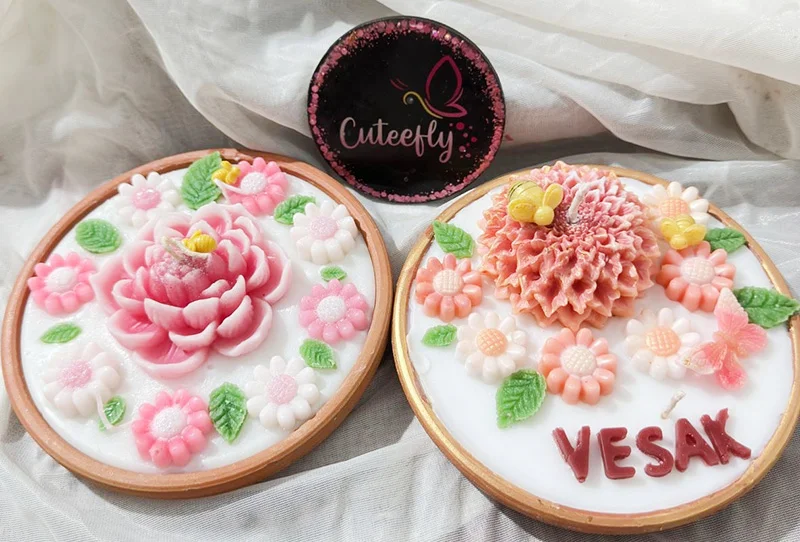
Candles reflecting Vesak themes
Her candles reflect Vesak themes – light, peace, remembrance, giving, etc., to enable you to fill your Vesak celebration with devotion and beauty.
Among her Vesak creations is a lotus-shaped soy candle, scented with sandalwood, lavender, etc., meant to burn during this Vesak Poya Day.

Indunil Kaushalya Dissanayaka: Customers
praise her for her creativity
These handcrafted Vesak candles are perfect for offering at the temple, she says.
What makes her creations so novel is that they come in different shapes, scents, themes, and all are handmade.
What’s more, her customers have heaped praise on her for her creativity.
According to Indunil, her creations are perfect as a thoughtful gift … to bring beauty, unity, and light into every moment.
Says Indunil: “Our beautifully handcrafted Unity candles are designed with premium detail and love, making them perfect for celebrations, gifts, and meaningful occasions.”
Cuteefly, says Indunil, is available online.
Readers could contact Indunil on 0778506066 for more details.
He Facebook Page is: Cuteefly.

Handmade with love

 Yes, dark spots do crop up on the skin, especially with sun exposure and, of course, as the skin ages.
However, these tips should be of immense benefit to those who are faced with dark spots.
* Lemon and Honey Glow Mask:
You will need 01 teaspoon lemon juice and 01 teaspoon honey.
Mix the lemon juice and honey well and then apply this mixture, only on the dark spots.
Leave for 10–15 minutes and then rinse with cool water.
Benefits:
Lemon helps brighten pigmentation.
Honey moisturises and heals skin.
Gives a natural glow.
* Aloe Vera Gel Treatment:
All you need is fresh aloe vera gel.
Apply the gel apply on dark spots, before going to bed.
Leave overnight and wash in the morning.
Benefits:
Reduces acne marks and pigmentation.
Soothes irritated skin.
Helps skin repair naturally.
* Turmeric and Yoghurt Paste:
You will need 01 teaspoon yoghurt and a pinch of turmeric
Mix the yoghurt and turmeric into a smooth paste and apply on affected areas.
Leave for 15 minutes and then wash gently with lukewarm water.
Benefits:
Turmeric brightens skin naturally.
Yoghurt removes dead skin cells.
Helps fade dark spots gradually.
Use these packs 02-03 times a week as results are generally seen over time.
You can also try this out: Mix a ripe papaya into a smooth paste and apply to the face, or directly on to the dark spots. Leave for 15-20 minutes and then wash with lukewarm water.

Advisory for strong winds and rough seas for the sea areas extending from Kankasanthurai to Chilaw via Mannar and from Galle to Pottuvil via Hambantota

West Indies to host Sri Lanka, New Zealand and Pakistan in 2026 home season

Hacking claims, mismatched answer-sheets: Controversies rock school exam in India

Iran says it targeted American base after fresh US strikes

Farmers Affected by the Nilwala Salinity Barrier paid Rs. 1.2 Billion in Compensation

State Vesak Festival held with the participation of the President

‘Dates have the highest sugar content to fight Coronavirus’

Sunday Island 27 December – Headlines

#SundayIsland 17th December – Headlines

Sunday Island – 28th March

Sunday Island Headlines – 21 March

Sunday Island – 21st February – Headlines
-

 Business7 days ago
Historic launch of CCWE Fashion Week & International Summit 2026
-

 News5 days ago
All-New GRAVITE launches at LKR 6.99 Mn
-
 Features5 days ago
The NPP’s pivot to the past
-
 News4 days ago
Police probe underway to ascertain links between criminals deported from UAE and local politicians
-
 News3 days ago
Easter Sunday carnage: Court told Maulana’s statement cannot be accepted without cross-examination
-

 Opinion7 days ago
The need to reform Buddhist ecclesiastical order
-
 Features5 days ago
End of Peacekeeping
-
 Opinion3 days ago
Undermining the democratic political framework