
News
G-20 finance chiefs pledge to tackle rising food crisis, but remain split over Russia’s role in it


During the talks, financial leaders from Western countries accused Russian economic technocrats of complicity in Moscow’s invasion of Ukraine, while also pointing to the war as the cause of the current global economic headwinds.
By Linda Yulisman/The Straits Times/ ANN | Jakarta | July 17
Finance chiefs from the Group of 20 largest economies (G-20) committed to tackling the worsening food insecurity, but remained deadlocked over Russia’s role in the crisis during the two-day meeting in Bali that ended on Saturday (July 16).
The finance ministers and central bankers did not issue a joint statement after the meeting, but agreed with most points in the chair’s summary – which covered various issues from macroeconomic stability to sustainable finance – produced by host Indonesia.
Russia’s war in Ukraine is “an issue members cannot reconcile”, said Indonesia’s Finance Minister Sri Mulyani Indrawati at a media briefing.
During the talks, financial leaders from Western countries accused Russian economic technocrats of complicity in Moscow’s invasion of Ukraine, while also pointing to the war as the cause of the current global economic headwinds.
Russia, on the other hand, blamed Western sanctions for blocked food shipments and surging energy costs.All members agreed that “a lot of attention, and intervention, and policy” is needed to improve and correct the supply disruption in order to address the current food security issues, Dr Sri Mulyani said.
This, she added, will be carried out by removing trade restrictions and protectionism to ensure the smooth flow of food from producing countries to those in need. “That’s certainly a very strong signal from all of us,” she noted.
Dr Sri Mulyani also said that in order to yield “a very concrete action”, members will consider establishing a joint cooperation between finance and agriculture ministers.This would be similar to the collaboration between finance and health ministers that generated the financial intermediary fund (FIF) for pandemic prevention and preparedness, which received additional pledges of up to US$1.28 billion (S$1.8 billion) at the meeting.
Indonesia, which has upheld an “independent and active” foreign policy, has sought a balance within the group, where relations have been frayed by the Ukraine war amid mounting economic pressures from rising inflation.While Western countries have imposed sanctions on Russia, other G-20 members, such as China, India, and South Africa, have refrained from condemning Russia.
Moscow’s invasion of Ukraine overshadowed previous meetings of the grouping, including last week’s gathering of foreign ministers, which did not produce a joint statement at its conclusion.Russian Deputy Finance Minister Timur Maksimov was in Bali for the meetings, and there was no reported walkout by officials as he addressed the meeting on Friday.
At the July 8 meeting of G-20 foreign ministers, Russian Foreign Minister Sergei Lavrov left the meeting during what he called “frenzied criticism” from the West against Russia.Ukraine’s Finance Minister Serhiy Marchenko, who addressed the meeting on Friday virtually at the invitation of host Indonesia, underlined that Russia’s invasion of his country “clearly marks the end of the existing world order”, and demanded “more severe targeted sanctions” against Moscow.
Canadian Finance Minister Chrystia Freeland told Russian representatives at the gathering that they are responsible for “war crimes in Ukraine”.
“It is not only generals who commit war crimes; it is the economic technocrats who allow the war to happen and to continue,” she said Friday.
In the opening session on Friday, US Treasury Secretary Janet Yellen, who attended the two-day meeting in person, condemned Russia’s “brutal and unjust war”, saying Russian officials shared responsibility for the “horrific consequences” of the war.
In another session on food security, she also blamed Russia for a global crisis of food insecurity marked by soaring prices of food, fertiliser and fuel.She said Moscow’s actions – including the destruction of agricultural facilities, the theft of grain and farming equipment, and blockage of Black Sea ports – were tantamount to using food as a “weapon of war”.
Dr Yellen, during her bilateral meetings with senior officials from Saudi Arabia, Australia, South Africa and Singapore on Saturday, called for countries to support a price cap on Russian oil to limit the flow of cash to its military, the Treasury said.Singapore was among a few non-G-20 member countries invited, represented by Deputy Prime Minister and Minister for Finance Lawrence Wong in Bali.The G-20 on Saturday discussed digital finance, green economy, cryptocurrencies, international taxation, and post-pandemic financial stability, among other issues.


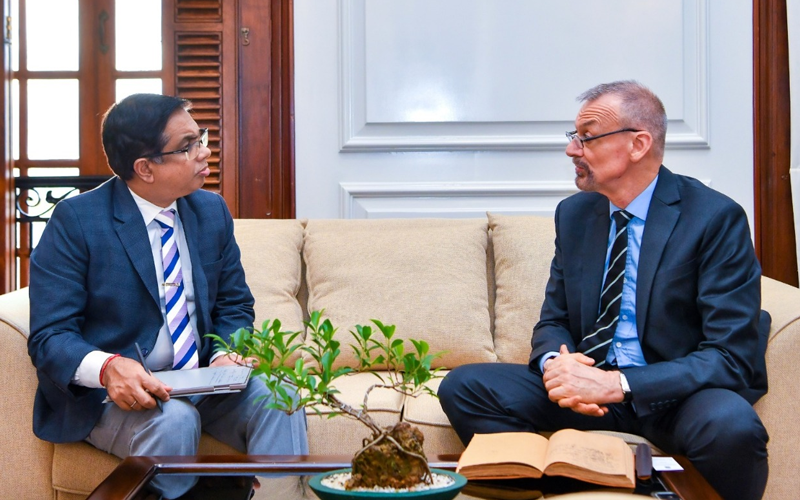
A meeting between the Secretary to the President, Dr. Nandika Sanath Kumanayake and the French Ambassador to Sri Lanka, Rémi Lambert, was held on Tuesday (09) afternoon at the Presidential Secretariat.
During the discussion, the French Ambassador assured the Secretary to the President that the French Development Agency would extend its support to the Government’s programme for providing relief to those affected by Cyclone Ditwah and for rebuilding Sri Lanka. He further stated that steps are being taken to dispatch a team of experts to the country in the near future.
The Deputy Head of Mission at the French Embassy, was also present on this occasion.
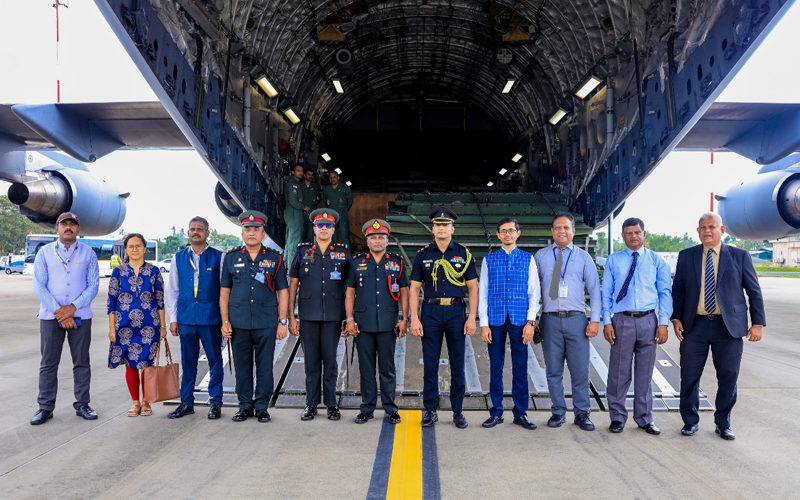
India has strengthened its humanitarian support to Sri Lanka in the aftermath of Cyclone Ditwah, providing critical air assets, emergency supplies, engineering equipment and medical aid to bolster national rescue and recovery operations.
India dispatched an additional MI-17 helicopter to assist the Sri Lanka Air Force (SLAF) in ongoing air rescue missions on Tuesday (09). Two MI-17 V5 helicopters of the Indian Air Force had been operating in Sri Lanka from 29 November, conducting around 90 sorties, rescuing approximately 270 survivors, airlifting about 50 tonnes of relief material to inaccessible areas and relief camps and deploying 57 Sri Lankan troops to cut-off locations.
Having completed their flying hours, the two helicopters returned to India on Sunday (08) for mandatory maintenance and a fresh MI-17 aircraft arrived at Katunayake Airport to continue operations alongside the SLAF.
The aviation support comes alongside major maritime assistance. The Indian naval vessel INS Gharial arrived at the Port of Trincomalee on Sunday (08) carrying a 700-tonne humanitarian shipment, marking India’s fifth naval relief consignment to Sri Lanka, apart from 10 aircrafts and 5 helicopters, which have contributed towards rescues and relief operations, since the cyclone.
The shipment included essential food supplies such as pulses, sugar and milk powder, as well as bed sheets, towels, sarees, dhotis and tarpaulins for families displaced by flooding and landslides. The emergency aid is being directed to the hardest-hit districts through local relief agencies.
In a further show of engineering support, India has also handed over a 63-ton Bailey bridge and a consignment of essential medicines to Sri Lankan authorities to restore connectivity and meet urgent medical needs in affected communities.
The cargo was received by General Chaminda Wijerathne of the Sri Lanka Army Headquarters, Sunil Jayaweera, former Director Preparedness of the Disaster Management Centre (DMC), now volunteering in the response and Shan Pathirana, Deputy Director of the DMC Awareness Division.
The handover was facilitated by the Indian High Commission in Colombo.
These coordinated air, sea and engineering initiatives underscore India’s continued commitment to supporting Sri Lanka during its national emergency response and long-term recovery. The assistance forms part of India’s broader partnership to restore essential services, reconnect isolated communities and provide relief to thousands affected by Cyclone Ditwah.
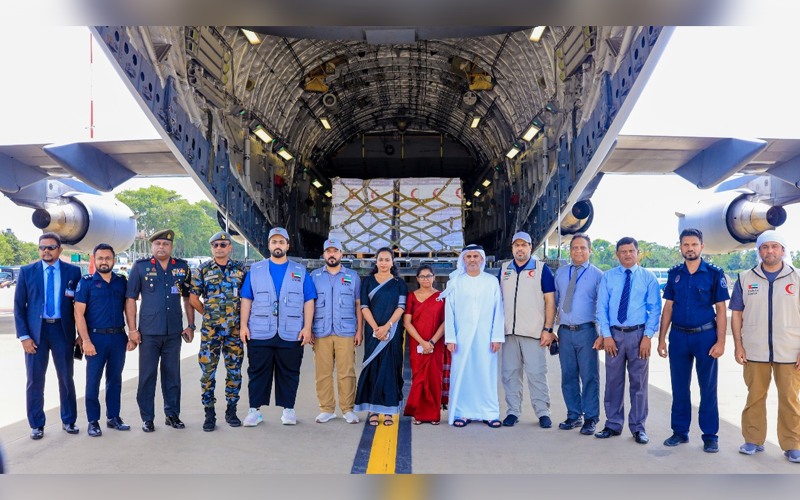
In a significant gesture of solidarity and support, a relief cargo from the United Arab Emirates has been officially received in Sri Lanka.
The cargo was accepted by key representatives from the Middle East Division of the Ministry of Foreign Affairs, including Ms. Ishara De Silva and Ms. Sajeeda Rasheed, both serving as Assistant Directors.
Joining them were Sunil Jayaweera, a former Director of Preparedness at the Disaster Management Center (DMC), who has returned to volunteer after retirement and . Shan Pathirana, Deputy Director of the Awareness Division at DMC.
The cargo was presented by the Deputy Head of Mission, representing the UAE, highlighting the strong ties and commitment to humanitarian aid between the two nations.

French Ambassador pledges support for relief efforts

India extends multi-front support to Sri Lanka’s cyclone relief efforts

Relief Cargo from the UAE arrives in Sri Lanka

639 deaths reported as at 0600AM today [10th]

Showers above 100 mm are likely at some places in the Northern, North-Central and Eastern provinces

UN pledges US$4.5 mn for post-Ditwah relief

‘Dates have the highest sugar content to fight Coronavirus’

Sunday Island 27 December – Headlines

#SundayIsland 17th December – Headlines

Sunday Island – 28th March

Sunday Island Headlines – 21 March

Sunday Island – 21st February – Headlines
-

 News2 days ago
Over 35,000 drug offenders nabbed in 36 days
-
 News6 days ago
Level III landslide early warning continue to be in force in the districts of Kandy, Kegalle, Kurunegala and Matale
-
 Business4 days ago
LOLC Finance Factoring powers business growth
-

 News4 days ago
CPC delegation meets JVP for talks on disaster response
-
 News4 days ago
A 6th Year Accolade: The Eternal Opulence of My Fair Lady
-

 News2 days ago
Rising water level in Malwathu Oya triggers alert in Thanthirimale
-
 News1 day ago
Cyclone Ditwah leaves Sri Lanka’s biodiversity in ruins: Top scientist warns of unseen ecological disaster
-
 Latest News4 days ago
Landslide RED warnings continue to be in force for the Districts of Kandy, Kegalle, Kurunegala, Matale and Nuwara Eliya