
Sports
Kerley leads American sweep of men’s 100m in Oregon


Chants of “USA! USA! USA!” rang out across Hayward Field on Saturday night (16) after Fred Kerley led a US sweep of the men’s 100m at the World Athletics Championships Oregon22.Kerley’s decision last year to drop down from the 400m to the 100m paid off in spectacular fashion as he powered past Marvin Bracy-Williams and Trayvon Bromell in the final strides to win the gold in 9.86 and claim the title of the world’s fastest man.Bracy-Williams and Bromell, who were both timed in 9.88, took silver and bronze respectively.
It marked the third US sweep of the 100m medals and the first since 1991, when Carl Lewis, Leroy Burrell and Dennis Mitchell went 1-2-3 at the World Championships in Tokyo.This time, the sweep came on home soil in front of a full crowd at the first World Championships held in the United States.
“We said we were going to do it and we did it,” the 27-year-old Kerley said after winning his first individual global title. “USA baby!”
“All three of us wanted the gold,” Bromell said. “I’m just happy we could get the sweep at home.”
The build-up to the final featured a flypast by two military jets, which proved to be a symbolic precursor to a super-fast race in which four of the eight athletes finished inside 10 seconds.Half of the finalists were from the host nation; the fourth US athlete was the defending world champion Christian Coleman, who finished sixth in 10.01.Kerley was in lane four, with Bracy-Williams next to him in lane three, and Coleman and Bromell on the outside in lanes seven and eight.
Coleman got off to the quickest start, but it was Bracy-Williams who quickly moved to the front and paced the field through 70m and 80m, with Bromell charging hard from the outside.But the tall, powerful Kerley built up momentum at the halfway mark, accelerated towards the line and edged in front in the final five metres, out-leaning the others at the line.Kerley waited for the result to be posted on the scoreboard, and when his name finally went up as the winner, he threw up his arms in triumph, pounded his chest and took off on a victory lap.
“The gold medal means more than anything,” he said. “It’s amazing to do it on home soil with the home crowd behind us. It’s a wonderful blessing to get a clean sweep.”
Fourth place went to 21-year-old Jamaican Oblique Seville, who ran 9.97 after clocking the fastest time in the semifinals (9.90). South Africa’s Akani Simbini was fifth in 10.01 – his fifth consecutive top-five finish at a global championships. Rounding out the field were Coleman, Japan’s Hakim Sani Brown (10.06) and Canada’s Aaron Brown (10.07).
After Kerley switched to the short sprints at the start of 2021, many experts scoffed at the decision. But he justified the move by earning the silver medal in the 100m at the Tokyo Olympics. And he has been dominant this year, clocking a world-leading 9.76 in the semifinals and 9.77 in the final of the US Championships in Eugene last month.
Kerley ran 9.79 in Friday’s heats but ran only 10.02 in winning his semifinal on Saturday – the first time in nine 100m races this year that he did not break 10 seconds.But, in the final, Kerley showed the power and determination needed to finally get an individual gold on the world stage. He earned bronze in the 400m at the 2019 World Championships in Doha and holds gold and silver from the 4x400m relay.Kerley will now focus on adding to his tally. He will be getting ready for the heats of the 200m on Monday and for the relay.
“This win means I can do 100m, 200m and 400m,” he said. “I’ve got a medal in 400m and 100m. There’s only one next.”
Winning a medal represented redemption for Bromell, who has battled injuries throughout his career and failed to make the final at the Tokyo Olympics last year after being considered the title favourite.Bromell broke down in tears on Saturday while being interviewed on the track after the US sweep.
“It’s been seven years since I got a medal through my injuries and everything I dealt with,” he said. I know so many people counted me out.”
And for Bracy-Williams, he was celebrating his first world outdoor medal on the global stage.
“It feels great to get my first medal at home and with an American sweep,” he said. “What else could I ask for? All the hard work has paid off with the injuries, the critics. This shows me I’ve got what it takes to get it done.”
Some big names failed to make the final.
Italy’s Olympic champion Marcell Jacobs pulled out before the semifinals after failing to fully recover from the hamstring injury that had sidelined him for most of the outdoor season.
“A painful choice, I am forced to stop,” Jacobs tweeted. “I am a fighter and this is why I decided to be in Eugene. Now, in order not to compromise the rest of the season by risking a more serious injury, I have to postpone the challenge. I promise I will do my best to make you dream!”
Jamaica’s Yohan Blake, the 2011 world champion and five-time national champion, missed out after finishing fourth in his semifinal in 10.12. Canada’s Andre De Grasse, the Olympic 200m champion who has struggled with injury and illness this season, was fifth in his semi in 10.21. And African champion Ferdinand Omayala of Kenya, who had made it just in time for Friday’s heats after delays in getting his US visa, was fifth in his semifinal in 10.14.But this day was about those who came through when it counted, and it was Kerley, Bracy-Williams and Bromell who showed the world that US athletes are the king of the sprints once again.
(worldathletics.org)



Rumesh Tharanga outsmarted a strong field including his closest rivals this season, Anderson Peters and Julian Webber to clinch the men’s javelin title of the inaugural Ultimate Championship in Budapest.
The Diamond League champion overtook Webber and Peters with his third round throw which was measured at 87.11 metres before further improving the distance to a colossal 91.01metres, the third time the 23 year old has exceeded the 90 meters mark this season.
The two-time world champion Peters finished second with 86.18m.
European champion Weber, who led in the first round, finished third with 85.89m. (RF)
Sports
Maris Stella Thimbirigaskatuwa, Lyceum Wattala clinch Western Province Schools Games athletics titles

Maris Stella College, Thimbirigaskatuwa and Lyceum International School, Wattala emerged as the boys’ and girls’ overall champions respectively at the Western Province Schools Games athletics championship, which concluded at Diyagama on Friday.
Maris Stella produced a strong all-round performance to secure the boys’ title, with St. Benedict’s College, Kotahena finishing runners-up and Maris Stella College, Negombo taking third place.
The Thimbirigaskatuwa school’s success was highlighted by an outstanding performance from Deesara Herath, who was adjudged the boys’ Best Athlete after producing a 7.49m effort in the Under-20 long jump.
Maris Stella also produced another Best Athlete through Akash Peiris, who claimed the Under-14 boys’ award with a 12.91m performance in the shot put.
The school further underlined its strength in sprinting by establishing a new meet record in the Under-18 boys’ 4x100m relay. The Maris Stella quartet clocked 42.4 seconds to take the gold.
Their depth was also evident in the relay events, where Maris Stella finished as the overall runners-up.
In the girls’ competition, Lyceum International School, Wattala secured the overall championship, with the school’s success spearheaded by Risansa Nirupama. She was named the girls’ Best Athlete following her impressive 24.49-second performance in the Under-20 200m.
The performances of Herath and Nirupama were among the standout individual displays of the championship, while Maris Stella’s meet record in the Under-18 4x100m added further gloss to their successful campaign.
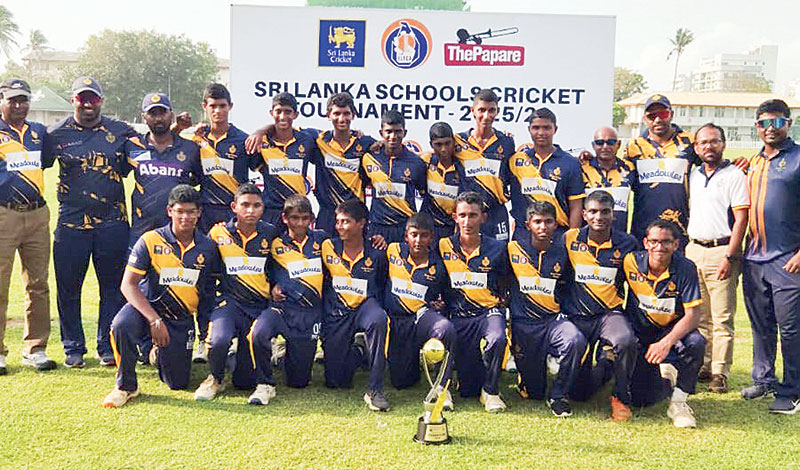
Royal College, Colombo held their nerve to beat Wadduwa Central College by two wickets in a low scoring thriller in the Under 17 Division II final at S. Thomas’ College Grounds, Mount Lavinia on Sunday.
Royal chased down a modest target of 104 with just two wicket in hand and two balls to spare.
Chasing the target Thumindu Somasiri led the way with a fluent 40 off 61 balls studded with eight fours, and he added 61 for the first wicket with Isuka Wickramasinghe (14) to give the innings a strong platform.
But once Somasiri fell in the 19th over, Royal lost their way, sliding from 61 for 1 to 102 for 8 as Imesh Chathuranga and Kaveesha Sayuranga shared seven wickets between them.
Imesh Chathuranga was the pick of the Wadduwa bowlers, claiming 4/26, while Kaveesha Sayuranga backed him up with 3/16 from ten economical overs. With the required target well within reach but wickets tumbling, Royal’s lower order was left to see the side home. Ahamad Rahimdeen (4*) and Senesh Rathnayaka (1*) kept their cool at the death, guiding Royal to 104/8 in 34.5 overs to seal victory by two wickets.
Batting first Wadduwa Central struggled to post 103 as Dinuja Wellahewage ran through the tail with a five wicket haul from six overs. Senesh Rathnayaka took three wicket while Senuth Perera picked up two for 24.
Dinith Newumal top-scored with a brisk 30 off 42 balls, including three boundaries, before falling to Senesh Rathnayaka. Chamesh Mokshan (11) and Kaveesha Sayuranga (10) were the only other batters to reach double figures, as the middle and lower order folded under pressure.
With the victory Royal have now bagged both the Division I and II cricket titles of the Under 17 age category.

Tharanga wins Ultimate Javelin title

CIABOC member’s appointment: Controversy over Speaker under probe heading selection process

GMOA: Countrywide cadre revision not done since 2015

Namal sends defiant message from remand custody

Indo-Lanka naval exercise begins today

Indo-Sri Lanka Chambers forge alliance to drive infrastructure and real estate investment

‘Dates have the highest sugar content to fight Coronavirus’

Sunday Island 27 December – Headlines

#SundayIsland 17th December – Headlines

Sunday Island – 28th March

Sunday Island Headlines – 21 March

Sunday Island – 21st February – Headlines
-

 Sports3 days ago
DDS set to lose Test captaincy
-
 News6 days ago
Thailand shuts door on undesirables from Sri Lanka
-

 News3 days ago
Sri Lanka faces new grid challenge as rooftop solar surges: former CEB GM
-

 Business6 days ago
CEB successor company breaks into top three in competitive BESS tender
-
 Latest News3 days ago
Shafali, Deepti power India into sixth T20 Asia Cup final
-

 Opinion5 days ago
Navigating Sri Lanka’s Israeli Dilemma
-

 Latest News2 days ago
Sri Lanka thwart Fatima Sana challenge to secure Asia Cup final spot
-

 Features4 days ago
Lost for 90 years: Rare Goby resurfaces in Jaffna