
News
Home grown clothing line appeals to expat Lankans to help earn much needed foreign currency


A 100% Lankan clothing brand competing with several global companies on e-commerce platforms appeals to the Sri Lankan expatriate community to help grow the company’s international sales volume and bring in much needed foreign currency to Sri Lanka at this crucial hour for the country.Ranil Willaddarage, CEO & founder of GFlock says, “This is not a charity appeal. This is a win-win transaction for Sri Lankan expatriates across the world that offers value for their hard-earned foreign currency, and the money in turn being used to import essential commodities for their fellow countrymen. As a nation, we have hit the rock bottom. The only way to go if we keep on fighting with each other is six feet under. We cannot start attacking each other again, destroy public property, set fire to private assets and fall even further. Everyone has to come together as a nation and overcome this terrible situation.”
When asked to elaborate on his solution to the foreign exchange crisis, he says “Our company offers a sustainable solution that can help save this country. Most of our Sri Lankan expatriate community purchases their clothing from brands such as Zara, Mango, Myer, Uniqlo, H&M, and Shein. Most of these brands are based in Europe and other developed countries in the Asia-Pacific region. Sri Lankans living in the United States, Canada, Australia and Europe tend to spend an average amount of $300-$500 as their annual clothing budget on aforementioned foreign brands. My kind request to our Sri Lankan communities abroad is to spend their clothing budget at Gflock, and place orders through our global online store, which is brought to them through the efforts of the creative workforce in Sri Lanka.”
“We know that a fashion company is a business that can earn a lot of revenue. If we take Zara, another brand with a fast fashion business model like ours, their annual revenue is between $ 20-25 billion. H&M also has similar revenue. The Shein brand founded 14 years ago in Nanjing, China, now ships to over 220 countries. With highly competitive prices and their online-only B2C model, Shein’s annual revenue is now at a staggering USD 15 billion. With the arrival of the pandemic, their annual revenue increased exponentially within the course of three years and the $3.5 billion revenue in 2019 grew to a massive $15.7 billion by 2021.”
“Taking inspiration from this and with the help of Sri Lankan expats, within 5-7 years it should be possible for us to reach an annual income of USD 5 billion. The Gflock business model is established in a way that can be scaled up as needed. My team and I have the specialized knowledge, experience and integrity required for that. So I request our Sri Lankans living abroad to think about their home country that is on the verge of collapse when spending their monthly clothing budget and buy from Gflock, a brand founded and run by the creative younger generation in their home country. Apart from that, I appeal to them to be a brand ambassador for this business by promoting the goal of saving our country with at least 5 more expats and get them to buy clothes from us. If that can be achieved, we will be able to get rid of the oil and gas queues, the shortage of medicines, and the shortage of food and bring the country back to normalcy sooner than we think.”
“1/3 of the profit from our business is spent on providing a monthly essential goods package worth Rs. 8000 to our indirect employees who function as garment workers. Every week we practice gratitude by publishing photos of such acts on our Facebook page and thanking all our customers who contributed toward these worthy causes. Also, we initiated the project of giving away a free plant with every purchase on World Environment Day -2018. Within the course of 4 years since its inception, we have managed to create over thirty thousand such meaningful bonds that link our brand and customers together with Mother Nature.”
“When the customers realize their purchase contributes to a greater good that goes beyond just a piece of clothing, it gives them a high sense of self-satisfaction, and the next time they make a purchase they do it intending to support a greater good. As owner of Gflock, I am prepared to offer 51% of the business’s shares to the Sri Lankan public in 2025. By implementing this model combined with the expected income, we shall be able to create a strong public movement that can help achieve inclusive prosperity for Sri Lankans.”
Willaddarage said GFlock releases 40-50 new designs every week, categorized under casual wear, work wear, evening wear, menswear, linen and denim for local and international customers through their three retail stores in Sri Lanka and GFlock.com online store, where they ship their products globally.


Sri Lanka Podujana Peramuna (SLPP) Member of Parliament Namal Rajapaksa has been arrested by the Commission to Investigate Allegations of Bribery or Corruption (CIABOC).
Namal Rajapaksa had been summoned by CIABOC to provide a statement in connection with investigations into the controversial Airbus deal. He was subsequently arrested by CIABOC after recording his statement for over 5 hours.
Latest News
Sun directly overhead Nittambuwa, Algama, Malwana, Aranayake, Meegahakiula and Panamkadu about 12.09 noon today (04)


The sun is going to be directly over the latitudes of Sri Lanka from 28th of August to 07th of September due to its apparent southward relative motion.
The nearest places of Sri Lanka over which the sun is overhead today (04) are Nittambuwa, Algama, Malwana, Aranayake, Meegahakiula and Panamkadu about 12.09 noon.
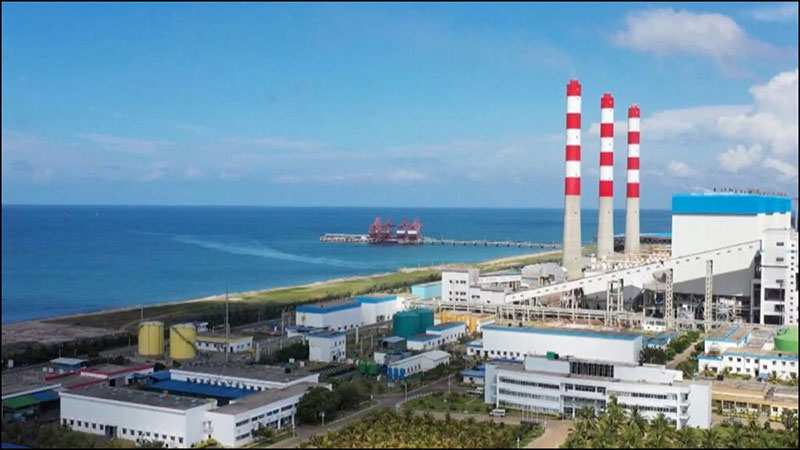
Plant’s output cut from 270 MW to 140 MW amidst dwindling stocks; energy analysts warn system remains “at a razor’s edge”
By Ifham Nizam
The Norochcholai coal-fired power plant is now digging into the last dredges of its coal stock, with two operational units forced to slash generation from around 270 MW to just 140 MW on Sunday as the plant ran critically short of fuel, according to independent energy analysts and sources familiar with the National System Operator (NSO).
The sudden reduction of approximately 130 MW in coal generation has once again exposed the fragile state of the country’s power supply arrangements, with the plant understood to have coal stocks sufficient only until Friday night.
“This is not how a coal plant is expected to operate. They are digging up the last dredges of coal from the plant,” an independent energy analyst told The Island.
The analyst questioned why the units had been allowed to reach this stage without earlier intervention, arguing that at least one unit should have been deloaded around 10 days ago to conserve the remaining coal.
Had that been done, the analyst said, the country could also have reduced its dependence on more expensive diesel-fired generation during the period when
coal stocks were being conserved.
The latest NSO generation figures highlight the continuing pressure on the system.
Around 7 p.m. on Sunday, when the night peak was reached, total demand stood at 2,552.7 MW. Coal contributed only 282 MW, while major hydro accounted for 1,215.8 MW and thermal-oil generation for 791.9 MW.
The night peak of 2,552.7 MW was substantially higher than the daytime peak of 2,246 MW, according to the NSO Generation Summary for August 30.
The most immediate concern is the remaining coal stock at Norochcholai.
Sources said the plant has coal only to Friday night, making the timing of the next shipment critical.
The first shipment under the emergency arrangement is expected to arrive on Friday, September 4, but the coal unloading will have to begin on the same day if
the power plant is to continue operating without further significant deloading.
That creates another potential vulnerability, with rough sea conditions posing an additional challenge to unloading operations.
Energy sector sources said that even the arrival of the September 4 shipment would not completely eliminate the danger.
The next shipment under the new coal tender would need to commence unloading around September 15. Any significant delay beyond that could again force the Norochcholai units to operate at reduced output.
“We are still at a razor’s edge”
The independent energy analyst said the situation should not be viewed merely as a question of whether a particular vessel arrives on time.
The situation also means that any further reduction in coal generation could have a direct impact on the use of oil-fired power generation, potentially increasing the cost of electricity generation.
The latest NSO figures already show the important role being played by thermal-oil generation during the evening peak, when demand rises sharply.
The analyst questioned the rationale behind allowing the coal units to continue operating at higher loading until stocks reached critically low levels instead of taking measures earlier to stretch the available inventory.

SLPP MP Namal Rajapaksa arrested by CIABOC

Devapathiraja clinch U15 Division I title with 33-run win over Royal

Mandhana’s record ton powers India into semi-finals

Sun directly overhead Nittambuwa, Algama, Malwana, Aranayake, Meegahakiula and Panamkadu about 12.09 noon today (04)

Showers expected in the Uva, Central and Eastern provinces and in Polonnaruwa and Mullaittivu districts after 2.00 p.m

Norochcholai digs into dwindling coal stocks, two units slash generation

‘Dates have the highest sugar content to fight Coronavirus’

Sunday Island 27 December – Headlines

#SundayIsland 17th December – Headlines

Sunday Island – 28th March

Sunday Island Headlines – 21 March

Sunday Island – 21st February – Headlines
-

 Features5 days ago
“Wrap Me Up in My Blazer”— A Gentlemanly Bradby Reminiscence
-

 Features4 days ago
When Sri Lankan stories find their own voice
-

 Features5 days ago
JVP/NPP government as seen from outside by Lionel Bopage now domiciled in Australia
-

 News4 days ago
BASL takes exception to Justice Ganepola being denied a place in SC
-

 Editorial6 days ago
Govt. trying to dupe UN Rapporteur?
-

 Features5 days ago
Prof. Savitri Goonesekere: What has she done?
-

 Features5 days ago
World Trade Politics: Canada rebuffs Trump’s tariff blackmail
-

 News1 day ago
Denied of promotion to SC despite vacancies, justice Gurusinghe retires