
Editorial
Patriotism, hypocrisy and croc tears


Monday 21st September, 2020
The government has taken on UNHRC Chief Michelle Bachelet for her criticism of the 20th Amendment (20) to the Constitution. It has dismissed her concerns as unfounded. The Opposition seems to be deriving some perverse pleasure from the rap on the knuckles the government has received in Geneva.
True, 20A in its present form is a draconian Bill, which, if enacted, will jeopardise democracy, but the question is whether the UNHRC is genuinely interested in protecting human rights and democracy in Sri Lanka. The UN human rights arm is a puppet of the western governments that have weaponised human rights, so to speak, to achieve their geo-strategic and economic goals. It did not call for action against terrorism which plagued this country.
It stands to reason that 20A should be attenuated substantially or rejected. But the UNHRC protests will only help the government drum up support at home for the Bill. In fact, the UNHRC is one of the international institutions that, in a manner of speaking, made the SLPP’s stunning electoral win possible. It will be counterproductive for the Opposition to hitch its wagon to the UNHRC or the western members of the international community.
Sri Lanka’s response to the UNHRC chief was not satisfactory. It should have asked her whether she had studied 20A, which she was criticising. For our money, she has not even seen it. One should read and understand the 1978 Constitution, the 17th Amendment, the 18th Amendment and the 19th Amendment before commenting on 20A. The UNHRC head has apparently gone by hearsay.
The government says the people have given it a mandate to do away with 19A. This is as much of a falsehood as the late J. R. Jayewardene’s claim, in 1977, that the people had given the UNP a five-sixths majority to write a Constitution, which he used to suppress democracy and act according to his whims and fancies. People voted overwhelmingly for the SLPP because they were fed up with the yahapalana government, which bungled on all fronts and, above all, compromised national security. There was no need for anyone to topple that administration; it was collapsing. The SLPP regime is misinterpreting its mandate in a bid to bulldoze its way through. Will anyone sane who voted for the SLPP at the last general election ever want the Auditor General’s powers reduced and constitutional safeguards in place to prevent corruption done away with? Who will want a jumbo Cabinet or a President with powers to do anything except making a man a woman and vice versa?
The need is for 20A to be defeated without the help of meddlesome foreign governments, etc., unless it is revised. This is the uphill task before the SJB-led Opposition, which should not play into the hands of the government by trying to internationalise the issue. Its leaders have to stop talking nineteen to the dozen, win over the public and launch an effective campaign against 20A. The SLPP’s strong point is its brand of patriotism, which it markets very effectively to further the interests of its leaders. Proving that the government is not as patriotic as it makes itself out to be and hides its true intentions behind the façade of patriotism is half the battle in making the public realise the need to oppose 20A in its present form.
The SJB has its work cut out to win public trust, given the presence of many undesirables such as the associates of bond scammers within its ranks. But there is one way it could turn the tables on the government. The latter is blowing hot and cold on the Millennium Challenge Corporation Compact, which it condemned as a threat to Sri Lanka’s sovereignty and territorial integrity while it was in the Opposition. The SJB can submit a parliamentary motion calling for rejecting the aforesaid compact so that the government leaders will have to back it or be exposed for their hypocrisy. After all, Opposition Leader Sajith Premadasa has declared that he protested against the proposed MCC deal while he was a member of the yahapalana Cabinet and is opposed to it. He should get cracking.


Wednesday 9th September, 2026
Power is as addictive as narcotics, and those who savour it cannot let go of it. When out of power, they find themselves in the same predicament as drug addicts who kick the habit cold turkey. Hence politicians’ determined efforts to perpetuate their grip on power regardless of the methods used to achieve that end.
NPP General Secretary Dr. Nihal Abeysinghe has declared that his party will remain in power until 2050, as we reported yesterday. He first said so at a political rally in Kalutara over the weekend. His declaration cannot be dismissed as mere platform rhetoric aimed at boosting the morale of his party’s rank and file or provoking the Opposition, for it is the leitmotif of all speeches made by JVP big guns, who even publicly speak of their intention to establish a one-party rule. A few months ago, after returning from a junket in China, JVP General Secretary Tilvin Silva said the Chinese leaders had told a JVP delegation led by him that a political party had to remain in power for about two decades at a stretch to develop a country.
Interestingly, Dr. Abeysinghe’s statement at issue happened to be made on the same day as US President Donald Trump’s absurd claim that the moon, of all things, belonged to the US. Trump went so far as to post a photo of the moon on Truth Social, with the words, “The Moon is Ours”, written across it. He added a US flag next to the picture, sharing AI-generated images of new black uniforms for the US Space Force, according to media reports. This is what happens to politicians when power goes to their heads. Intoxicated with power, they live between fantasy and reality, so much so that they confuse fantasy with reality and vice versa.
As for Trump and the US, one may recall that when President George W. Bush appointed John Bolton as US Ambassador to the UN in 2005, a US newspaper, which was critical of Bolton, famously said that thankfully the problem was now confined to the UN. Likewise, the earthlings troubled by the consequences of Washington’s hard-power projections replete with military force, economic leverage, and coercive diplomacy to influence or compel the behaviour of other global actors, must be wishing that Trump and the coterie of hawks around him were sent to the moon so that the problem would be confined to the earth’s natural satellite.
It is worth recalling that after defeating the LTTE, launching numerous mega development projects, and securing a second term with an impressive majority, President Mahinda Rajapaksa became so cocky in 2010 that he thought he would be able to retain the coveted presidency indefinitely. He amended the Constitution, enabling himself to seek a third term. But five years later, he became the first serving Sri Lankan President to lose a presidential election. When former Defence Secretary Gotabaya Rajapaksa (GR) became President in 2019, with the SLPP mustering a two-thirds majority in Parliament the following year, many thought he would deliver and secure a second term easily, and the Opposition would have its work cut out to return to power, but a couple of years later, he happened to show a clean pair of heels to the Aragalaya protesters. In Bangladesh, Prime Minister Sheik Hasina, who thought no end of her power, ordered a crackdown on a mass uprising against her government, and the SLPP backers here hailed her counterattack, blaming GR for not having done so to suppress Aragalaya. But a few months later, Hasina fled to India.
Nothing is so certain as the unexpected in politics. When pressure builds up in a polity owing to economic hardships, the suppression of democratic rights, etc., with protests spilling over onto the streets, there is no defence for a government that fails to make good on its promises.
The inhabitants of cloud cuckoo land would do well to be mindful of the fact that those who do not learn from history are doomed to repeat it. The only way the incumbent government leaders could avoid the fate that befell the Rajapaksas here, Hasina in Bangladesh, and other such leaders elsewhere is to bear in mind that mandates are fragile and ephemeral, and it is the people who decide whether a government should continue to be in power.
Tuesday 8th September, 2026
President Anura Kumara Dissanayake has embarked on a nationwide tour to drum up support for his government, whose approval rating has declined, according to a Verite Research opinion survey. It is possible that he has launched his re-election campaign, the way his predecessors did, as some political commentators argue. The Opposition has claimed that the President has launched the ongoing campaign with an eye to a possible referendum on the 22nd Amendment Bill. But he is apparently very confident that he will be able to amend the Constitution without a referendum to raise the retirement ages of the superior court judges.
Addressing a rally in Kalutara over the weekend, President Dissanayake rejected allegations that he was planning to do away with elections with the help of a referendum. He said the parliamentary and presidential elections would not be delayed, and the Provincial Council (PC) polls would be held after clearing some legal obstacles.
Elections to some provincial councils have remained in abeyance since 2017. The Eastern, North Central and Sabaragamuwa Provinces last went to the polls in 2012, followed by the Central, Northern and North Western Provinces in 2013. Elections to the Western, Southern and the Uva Provincial Councils were last held in 2014. There have been two presidential elections, two general elections and two local government elections since 2017 and the country has had four Presidents since then.
The PCs have been functioning without elected representatives all these years, and this amounts to a blatant violation of the Constitution, according to former Chairman of the Election Commission Mahinda Deshapriya.
Deshapriya has gone on record as saying that it is a clear violation of the Constitution for bureaucrats to run the PCs without elected representatives. The blame for this situation should be apportioned to all political parties, Deshapriya has said. The media has quoted him as saying that there is no graver sin than postponing elections, and the PC polls must be held urgently.
If the government is not afraid of facing elections, it need not wait until the so-called legal hurdles are cleared to hold the PC polls. There is an easy way around this problem.
The process of redrawing the boundaries of electorates for implementing the mixed proportional system is bound to drag on indefinitely. The best way out is to hold the PC polls under the Proportional Representation (PR) system so that there will be five long years thereafter for completing the delimitation process, etc. In fact, a private member’s motion has already been presented to Parliament to this effect.
MP Shanakiyan Rasamanickam’s private member’s Bill, titled, “Bill to amend the Provincial Council Elections Act, No. 2 of 1988”, seeking to clear the way for the PC elections, was seconded by MP M. Nizam Kariapper. If ratified, this amendment will provide for holding the PC polls soon under the PR system.
Former Election Commission Chief Deshapriya has said it will be possible to hold the PC elections in four months under the PR system if Parliament passes necessary laws. If they are to be held under the proposed mixed representation system, the PCs will be without elections this year as well, he has said.
The JVP-NPP government has a two-thirds parliamentary majority, which it flaunts at every turn, and therefore it can amend the Provincial Council Elections Act anytime. After all, its election manifesto, A Thriving Nation, A Beautiful Life, promised to hold the local government and provincial council elections within one year of forming a government.


Monday 7th September, 2026
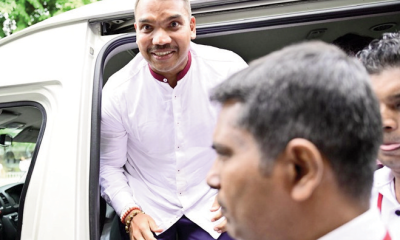
The irony of the JVP and the UNP clashing over last week’s arrest and remand of SLPP National Organiser and MP Namal Rajapaksa over an alleged Rs. 100 million bribe linked to an Airbus deal may not have been lost on political observers. One may recall that during the UNP-led Yahapalana government, arrests were made the way volleyball is played, as it were. The JVP, which was honeymooning with the UNP at the time, raised questions in Parliament about allegations against the common enemies of the two parties, enabling the UNP to make damning statements about them and build a case for their impending arrests, much as a setter places the ball for a hitter to make the approach, jump and spike. The JVP and the UNP have since fallen out, with the latter lambasting the former for having Opposition politicians arrested for political reasons.
Sri Lanka has earned notoriety for politically-motivated arrests under successive governments. Ruling party politicians use arrests to vilify their opponents before or after elections and major political events, such as propaganda rallies. President J. R. Jayewardene misused Emergency regulations to have actor-turned-politician Vijaya Kumaratunga arrested and detained following the 1982 presidential election, falsely accusing him of involvement in what was described as a Naxalite conspiracy to overthrow the UNP government. Kumaratunga was never charged. The SLFP-led government under President Chandrika Kumaratunga was also not immune to allegations of political witch-hunts, the arrest and detention of former UNP Minister Sirisena Cooray being a case in point. President Mahinda Rajapaksa had his main contender in the 2010 presidential election, former war-winning Army Commander Gen. Sarath Fonseka, arrested. The UNP-led Yahapalana also turned arrests into political theatre, with a series of high-profile arrests accompanied by cameras, dramatic police action and publicity. Former head of State Intelligence Maj. Gen. (retd.) Suresh Sallay has been detained since February 2026 under the PTA (Prevention of Terrorism Act) in connection with an investigation into the Easter Sunday terror attacks.
Legislators of the party in power usually abuse their parliamentary privileges to vilify suspects in custody and hold social media kangaroo trials with impunity. They apparently presume suspects guilty until proven innocent. When they do so, the police cannot be expected to conduct impartial investigations. It is no surprise that the police have been accused of fabricating evidence against the political enemies of governments over the decades.
Pretrial arrests, remand or detention should be the exception rather than the rule, especially in a country like Sri Lanka, which cannot even ensure the safety of convicts and remand prisoners. Above all, the conviction rate in this country is as low as 4% to 6%, according to researchers. The police make arrests swiftly but thereafter drag their feet on investigations while objecting to bail for suspects.
Most of the prosecutions under the Yahapalana government collapsed mainly due to lapses on the part of the police and the Attorney General’s Department, which had to make haste under political pressure. The incumbent government stands accused of trying to overcome this problem by manipulating the judiciary through various means instead of resolving the structural problems besetting the legal process. It is only natural that the questionable 22nd constitutional amendment Bill has come to be viewed as part of the government’s strategy to control the judiciary.
Many people have languished in remand prisons due to politically motivated arrests and selective enforcement that the police are notorious for. The police ought to conduct thorough investigations and gather credible evidence before moving to arrest suspects who are not hardcore criminals posing a danger to society. It defies comprehension why so many suspects are arrested and kept in remand prisons for months on end even when there is no reason to suspect that they will flee the country, interfere with witnesses, suppress evidence, commit further serious offences, or pose a significant danger to the public.
Holding a person on remand indefinitely until the conclusion of investigations is not consistent with due process and international best practices; in fact, it amounts to punishment in itself in all but name. The rule of law demands that the police or other investigators establish reasonable grounds to suspect an offence, collect and preserve evidence, interview witnesses, question suspects and assess the facts objectively before depriving anyone of personal liberty. They must not act according to their whims and fancies or at the behest of their political masters.
Premature arrests risk wrongful detention, reputational damage, hardships and expensive legal challenges for suspects, as is public knowledge. They could also compromise public confidence in law enforcement and lead to perceptions that investigations are influenced by political pressure or public sentiment rather than facts. When the rule of law is undermined, the justice system becomes weak.

Justice Minister hits back at CLA

First visit by an Indian Defence Minister since IPKF deployment

“I’m not a war criminal, I fought for my country”: Shavendra Silva

Govt. tells UN 22nd Amendment meant to strengthen judicial independence

Legacy of enforced disappearances: Vital facts conveniently forgotten to whitewash LTTE and India

Quicks, rotate them and look after them

‘Dates have the highest sugar content to fight Coronavirus’

Sunday Island 27 December – Headlines

#SundayIsland 17th December – Headlines

Sunday Island – 28th March

Sunday Island Headlines – 21 March

Sunday Island – 21st February – Headlines
-

 News6 days ago
Denied of promotion to SC despite vacancies, justice Gurusinghe retires
-
 Latest News7 days ago
Grade 5 scholarship exam results released
-

 News6 days ago
22A: SC urged to suspend hearing, appoint full bench
-
 News4 days ago
Namal remanded until Sept. 18 over Airbus deal investigation
-

 Latest News3 days ago
Tharanga creates history with Diamond League crown in Brussels
-
 News6 days ago
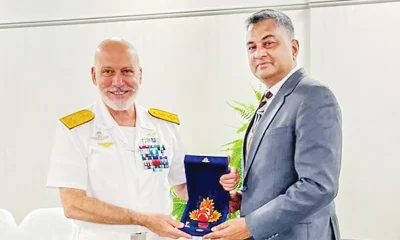
Govt. seeks NATO assistance
-

 Editorial6 days ago
Strange arithmetic goes unchallenged
-

 News3 days ago
Dispute which triggered listed company director being detained at BIA resolved