
News
Let Us Recover From The Socio-Economic Crisis And Avoid Political Disaster

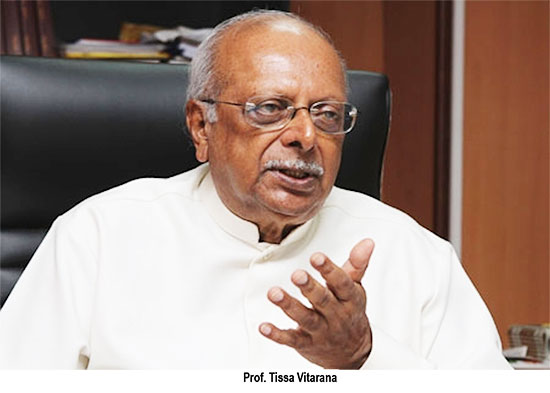
by Prof. Tissa Vitarana
The economic crisis that is affecting Sri Lanka has reached massive proportions and acquired novel social dimensions that threatens the very fabric of our society. The Foreign Exchange (Forex) Reserve, which averaged around USD 7 to 8 Billion before the crisis, has dropped to a mere USD 50 Million, the lowest figure in our history, as revealed by then Finance Minister Ali Sabry. The resulting dollar scarcity has led to a sharp drop in the import of essentials like fuel (diesel and petrol), LP gas, medicines and food items. This has led to mile long queues of vehicles (cars, buses, lorries, motor bikes and scooters) at petrol sheds, often for several days, and similarly for LP gas at gas stations. The Cooperative (Sathosa) and private megastores, like Cargills, and the retail outlets are empty. The outcome is hunger, starvation, unemployment, frustration and anger. This not only affects the poor 60% but aiso the middle and upper classes of society. But only a few unscrupulous mega rich and a few politicians escape the harassment.
This situation has led to the widespread peaceful protest for well over a month, with Galle Face as the epi-center. But the cruel attack on the protestors originating from Temple Trees (the official residence of the Prime Minister) triggered the outbreak of violence on the 9th of May and it spread country wide. While some of the genuine protestors, specially angry youth, turned violent, it also permitted anti-democratic political forces brought up in the past JVP terrorist tradition to burn and destroy houses and property and attack individuals. This was focused largely on MPs of the SLPP who responded to the call from Temple Trees, though they may not have been involved in the attack on 9th May. For instance the LSSP Chairman of the Balapitiya Pradeshiya Sabha had his house destroyed, though he only responded to the Prime Minister’s call, and as a LSSP member was a supporter of the protestors, and did no harm to them, and took no part in the attack on the peaceful protestors. I only hope that the JVP and its off-shoot the Peratugami Party, whose to unite appears to have failed, will not return to the terrorism of 1971 and 1988/9, which was directed mainly against the progressive forces, not the exploiters or the corrupt. Some SJB supporters too have been implicated.
As everyone knows the global economic crisis is getting worse, and the rich ex-colonial powers like the USA, UK, and France, that became rich by exploiting the Third World countries, are badly affected. The USA which was in the top position of the economic ladder has dropped to the 12th place and China is now at the top. In fact while the Imperialist powers have come down. Asia has shown growth, led by China, Vietnam, South Korea, India and Indonesia. But we must ask why is Sri Lanka near the bottom of the ladder, just above Afghanistan. The ruling class here tries to get away from any blame by putting it on our being a social welfare state. We must have economic development from both the private and government sectors, not poverty.
But successive capitalist governments, mainly led by the UNP in Sri Lanka, have not developed our economy, but followed neoliberal policies which have encouraged imports, including luxury goods, and spendthrift policies, leading to an adverse foreign trade balance. This is the basic cause of us having to go begging for dollar aid from foreign countries. In the absence of a clear national development plan we remain a basically agricultural economy barely achieving self-sufficiency in food at the best of times. Little attention has been paid to become an industrial nation by developing a value added economy, using our agricultural and natural resources. The local capitalist class is content to export tea, rubber, spices etc. in the raw form, as was the case when under British rule. For instance we continue to import tires from Britain where the value addition is done, and they make a huge profit by selling the tires in the world market,(including Sri Lanka). The same applies to our extensive natural resources like graphite and ilmenite, which could be the basis of our own large scale industries. For example by the conversion of graphite into graphene abroad a whole range of industrial products are produced at a great profit, but this is something that we can do in Sri Lanka. The sea around Sri Lanka is a rich source of fish and minerals to develop export industries. With a little effort our tourist industry can easily outstrip the Maldives, as we not only have the attraction of the sea, but also beautiful mountain scenery, well preserved ancient ruins and a rich culture.
In view of the above facts, it is sad to see how our people are suffering. The wrong neoliberal policies of the Ranil Wickremasinghe “Yahapalanaya” government (YG) that aggravated the economic crisis has continued with the SLPP Government and will be strengthened now that Ranil is back as Prime Minister. The departure of the former PM, Mahinda Rajapakse, after the May 9th events paves the way for the USA once again to proceed with the objectives of the MCC and SOFA agreements. The fact is that President Gotabhaya renegaded on his promise to our Group of 41 MPs that broke away from the SLPP in Parliament and formed an Independent Group (IG), which stated that an Interim All Party Government should be formed to restore economic, social and political stability in about 6 to 8 months, and then go for a general election. Instead he made the main enemy of the progressive forces, Ranil, the PM. This is a clear indication that he does not wish to serve our people, but follows the oath he swore when becoming an American citizen to serve the USA and even sacrifice his life for it.
Our country is in grave danger. Our economy and society are on the verge of collapse, and it is questionable whether it is through the implementation of wrong policies by ignorance or by design. At the helm are Gotabhaya as the Executive President, Ranil Wickremasinghe as PM, and Basil Rajapaksa as the leader of the main party forming the Government, the SLPP. They are all committed to serve the USA. Ranil may very well help the USA to achieve the objectives of the MCC and SOFA agreements, which he had agreed to sign when PM in the earlier YG. In brief these agreements would allow the USA to exploit our economy as the British rulers did, and to make Sri Lanka as a whole an American military base. The latter has become necessary after the International Criminal Court (ICC) ruled that the USA should quit its main base, Diego Garcia, in the Indian Ocean rim, which is on an island that belongs to the country of Mauritius. If these are done Sri Lanka will lose its independence, sovereignty and territorial integrity. At the end of the Second World War, Japan was forced to allow the USA to establish its military base in Okinawa island. When the women are raped by American soldiers, they cannot be charged in the Japanese Courts of law, but in the Courts of the USA. The final outcome is no or trivial punishment. When this happens to a powerful country like Japan, what will Sri Lanka’s fate be. It is the duty of all who love Sri Lanka to become aware of these dangers and resist all moves that are detrimental to the interest of the nation and all our people.



The NPP government has not taken a final decision regarding filling of the vacancies in the judiciary.
A group of Opposition MPs, led by SJB leader Sajith Premadasa, on 12 June, requested Speaker Dr. Jagath Wickremeratne to take up the issue of judicial vacancies with President Dissanayake. Opposition sources said that there were four vacancies, each in the Court of Appeal and the Supreme Court, and the inordinate delay had adversely affected the judiciary.
Government sources indicated that there was no change in the status quo as regards filling of vacancies. Referring to the government proposal to extend the retirement age of judges, authoritative sources said that no final decision had been taken yet.
SJB lawmaker Dayasiri Jayasekera told The Island that they would raise the issue in Parliament this week.
He said that the deliberate delay in making appointments to superior courts and the move to extend the retirement age couldn’t be taken separately.
The MP noted that the Bar Association of Sri Lanka, the Lawyers’ Collective, the Colombo High Court Lawyers’ Association, Colombo Magistrate’s Court Lawyers’ Association and the Bar Association of Badulla had opposed the government move.
There hadn’t been any public statements in support of the government move, MP Jayasekera said, urging the government to end uncertainty in the judiciary.
by Shamindra Ferdinando
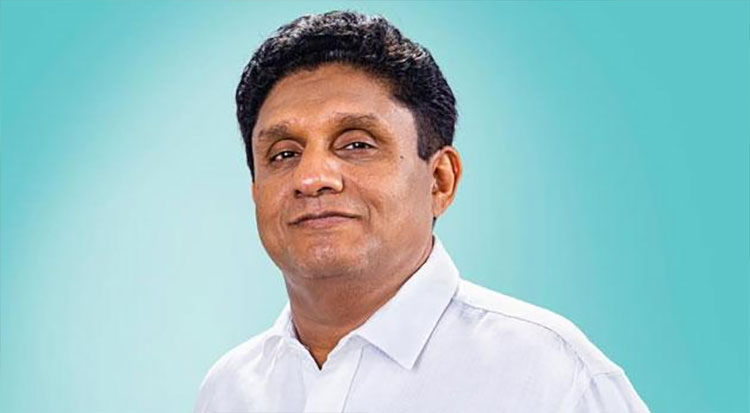
SJB leader Sajith Premadasa has invited the UNP and other political parties to join his party. Premadasa, who is also the leader of the Opposition, has emphasised that the UNP and the SJB could reach a consensus on policies but his party wouldn’t, under any circumstances, accept whatever formula to share positions. Premadasa said so, speaking to the media over the weekend, after meeting the Mahanayaka Thera of the Malwatta Chapter of the Siyam Nikaya Most Venerable Thibbatuwawe Sri Siddhartha Sumangala Thera.
A statement issued by the Opposition Leader’s Office quoted MP Premadasa as having extended an invitation to all political parties to give up extremist policies and join the SJB.
The SJB leader alleged that the NPP government feared facing elections and that was the reason for the inordinate delay in holding Provincial Council polls. PC polls were last held in 2012, 2013 and 2014, on a staggered basis. Premadasa said that if PC polls were held his party would definitely win the majority of PCs.Premadasa also urged the government to reduce electricity tariffs and fuel prices.
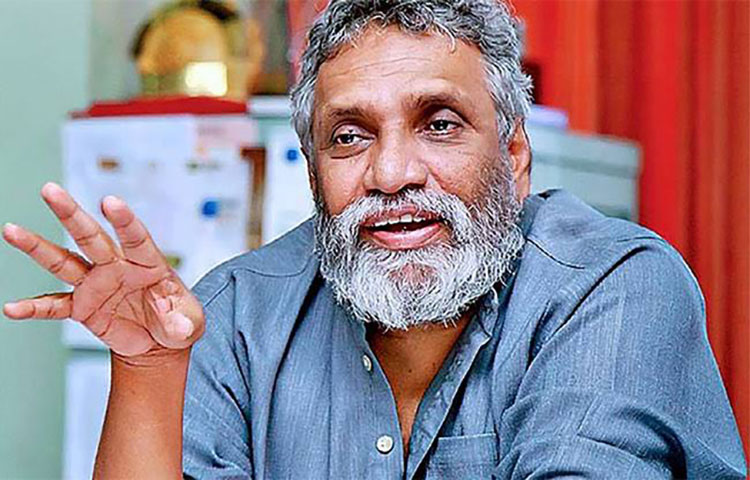
Former Chairman of the Election Commission, Mahinda Deshapriya, on Saturday, strongly criticised the continued postponement of local government elections, declaring that every day without elections constitutes a violation of both the Constitution and democratic principles.
Speaking during an interview with journalist Bhanuka Rajapaksa, on Hiru TV, on Saturday, Deshapriya described the current administration of local government institutions by unelected officials as fundamentally undemocratic and contrary to the spirit of representative governance.
Deshapriya said local authorities, across the country, are presently being managed by secretaries and bureaucrats rather than elected representatives, depriving citizens of their democratic right to be governed by individuals, chosen through the electoral process.
“If the Constitution recognises and provides for local government institutions, then it is the responsibility of the State to ensure that elections are held and that these bodies are administered by representatives, elected by the people,” he said.
Deshapriya rejected attempts to justify the prolonged delay, arguing that responsibility for the situation rests with the government.
He noted that while various political parties have publicly stated their readiness to face elections, the ruling administration possesses the authority to resolve any issues relating to the electoral system.
The former Election Commission chief pointed out that the government enjoyed a two-thirds majority in Parliament, enabling it to enact any legislative amendments required to facilitate the conduct of elections. Instead, he said, successive committees and review processes had been used to postpone a final decision.
He also referred to efforts by opposition legislators who have moved motions seeking to address concerns relating to the electoral framework and expedite the holding of local government polls.
Deshapriya warned that any attempt to appoint a fresh delimitation committee could further delay the electoral process, making it unlikely that local government elections would be held within the current year.
He also dismissed claims that financial constraints have prevented the conduct of elections. Expressing surprise at such assertions, he questioned how funding shortages could be cited as a reason for postponement while expenditure continues in other sectors.
According to Deshapriya, the existence of laws establishing local government institutions imposes an obligation on the State to ensure that those institutions are populated through democratic means.
“The legal framework exists. If elected representatives are not appointed through elections and institutions continue to function under unelected administrators, that is a failure of the State,” he said.

Mohamed Salah scores as Egypt beat New Zealand for first World Cup win

Lamine Yamal scores first World Cup goal as Spain thrash Saudi Arabia

Shahidi sanctioned for running on the pitch during Chennai ODI

Kapp’s 81* seals South Africa’s come-from-behind win against India

Belgium see red in goalless World Cup draw with Iran in Los Angeles

Showers in the Western, Sabaragamuwa and North-western provinces and in Galle, Matara, Kandy and Nuwara-Eliya districts

‘Dates have the highest sugar content to fight Coronavirus’

Sunday Island 27 December – Headlines

#SundayIsland 17th December – Headlines

Sunday Island – 28th March

Sunday Island Headlines – 21 March

Sunday Island – 21st February – Headlines
-

 News6 days ago
Beijing Capital Airlines to resume flights to Colombo signalling boost to tourism
-
 Features5 days ago
Killing of Colombo’s ancient trees — a warning on UN’s World Desertification Day – 17 June
-

 News3 days ago
Creditor receives USD 2.5 mn as Lankan public bears loss from theft of Treasury funds
-

 News2 days ago
Creditor not yet paid
-
 News2 days ago
Consumers bearing 22% tax burden despite 18% VAT claim: Dr. Harsha de Silva
-

 Opinion4 days ago
Beyond diagnosis: A strategic design for 7% growth by 2029 (Part I)
-

 Opinion6 days ago
Fifty years after Soweto uprising
-
 News5 days ago
India provides military stores worth USD 5.5 mn to SL