
Features
Ranil-Rajapaksa Interim Government and Cabinet are a betrayal of the People


by Rajan Philips
Whatever may have been the subjective intentions of Ranil Wickremesinghe in becoming Prime Minister for a beleaguered President, the objective outcomes of the new diarchic arrangement are now clearly in evidence. The desired political response to the protest movement that began in Mirihana, would have been the resignation of Gotabaya Rajapaksa and the setting up of an ‘interim government.’ The interim government would not only provide urgent economic management but implement constitutional and electoral reforms.
One clear objective of the interim government is to reform the presidential system by doing away with the direct election of an executive president and providing for the Head of State to be elected (from among qualified citizens) as President by parliament, and for the Head of Government to be located in parliament as Prime Minister. In this new arrangement, the powers of the President could have been defined to address any implications that the removal of the current system might have for the functioning of the Provincial Councils system.

Specifically for the purpose of economic crisis management, the interim government was expected to bring in experts and professionals as cabinet ministers by first admitting them as MPs through the National List. This idea was widely popular and would have required the SLPP and even the SJB to sacrifice some of its current National List MPs to make way for new and better replacements. But neither party showed any willingness to do this, only the JVP did. Finally, the interim government was expected to achieve its objectives in a period of 12 to 18 months, and set the stage for general elections and for the people to elect a new parliament under a reformed presidency.
It is now clear that the events of May 9 and the appointment of Ranil Wickremesinghe have scuppered the interim government route to economic recovery and political reform. The appointment of nine more (there is nothing new about any of them) cabinet ministers on Friday further confirms that this is all the change that can be expected under the Ranil-Rajapaksa administration. There is no need to pick and parse individual cabinet ministers. The whole thing is a betrayal of the people. On top of all the economic hardships they have been forced to bear.
Political Sedation
It is remarkable how the appointment of Ranil Wickremesinghe has changed the political dynamic from what it was before May 9 to what it is today. On the economic front, RW has brought more than a semblance of ministerial competence, where incompetence has been the rule not only for the last one and a half months but for the whole two and a half years under the current President. While there are furlongs to climb before the economy is out of the hole, the political consequences of RW’s intervention are quite immediate.
First, Mr. Wickremesinghe’s handling of the economic crisis would seem to have had a sedating influence on protest politics. This is possibly due to a general acknowledgement that the ‘new government’ should be given some time and space to implement its economic relief measures. There are and there will be protests over scarcity and prices, but they may not have the same political edge calling for resignations, as they very much were before May 9. This is not to say that that the dynamic will not change quite dramatically without even a moment’s notice. In fact, it can.
Second, there is a new dynamic in parliament, with almost unanimous support from all political parties, alliances and MPs for the Prime Minister’s economic initiatives. There is also reported parliamentary consensus that the Finance portfolio should stay with the Prime Minister, perhaps a recognition of his abilities and not his office. But on political and procedural issues, MPs, especially SLPP MPs, are content to stick with party-line voting. This was quite evident in the quite ridiculous votes for the election (yet again) of a Deputy Speaker and for suspending Standing Orders to debate a Motion of Displeasure on the President, and the even more ridiculous divisions they produced.
At the same time, SLPP MPs have openly started showing their internal cracks in providing multiple and conflicting versions of the background to the morning violence that spilled over from Temple Trees on Monday, May 9, and the afternoon rejoinders to it in other parts of the country. SLPP MPs and (former) Ministers are not only criticizing the police and the Secretaries but also one another for what transpired on that day. The recent spat in parliament between Ramesh Pathirana, former Plantations Minister, and his colleague Chandima Weerakkody MP, is quite indicative of the level of political interference that has been going on in the transfers and OIC appointments creating police incompetence and indiscipline in police stations.
Dr. Pathirana does not seem to have responded to Mr. Weerakkody’s and others’ criticisms over his interference in police matters. He doesn’t have to, because he has been reinstated to his same plantations portfolio in the Ranil-Rajapaksa cabinet. May be that is reward for his standing for the President and criticizing the police for the mayhem that spun out of Temple Trees on May 9. In fairness to him, his is not the only controversial appointment to the cabinet on Friday. In fact, every appointment is a disgrace and an insult to the people who have been protesting for positive changes in government.
The third consequence of Ranil Wickremesinghe becoming Prime Minister is that he has rescued the Rajapkasas even before he could do anything for the economy. The immediate upshot for the family is that they have had a week of respite since RW became PM. For President Rajapaksa, last week must have been the calmest week since the protests against him began in Mirihana on March 31. And after a week of sojourning in a naval safe house in Trincomalee, ex-PM Mahinda Rajapaksa and scion Namal Rajapakse are back in Colombo and even attended parliament.
For all this and more, the President and the rest of the Rajapaksa family, whether they are now a house divided or not, owe a mountain of gratitude to Ranil Wickremesinghe for stepping in so chivalrously and sedating the political situation that was toxically antagonistic towards the whole Rajapaksa family. Without Ranil Wickremesinghe’s intervention the Rajapaksas would not have had the reprieve they are having now. No one knows what their immediate political plans are, and no one knows what plans the police and Attorney General have to question the former Prime Minister on the background to the violence that spilled over from Temple Trees on May 9. Especially since other MPs have been questions, and some even arrested.
Toxic Mix
The political question of the day, however, is the future of the presidency of Gotabaya Rajapaksa. Is the protest against him still strong enough to force an early resignation? Or has he weathered the storm to survive till his single term is over, or will he leave prematurely but when the political dust settles and in a more dignified manner than his brother? A second related question is what prospects are now left for achieving the political and constitutional reforms that seemed to be so within grasp before May 9?
Speaking reflectively in Parliament last week, Chamal Rajapaksa, the oldest of the brothers saw wisdom in hindsight and said that Mahinda Rajapaksa should have retired from politics when his second term as President ended. “One should be prepared to give up positions,” Mr. Rajapaksa, the elder, said. Shouldn’t this apply to Gotabaya Rajapaksa as well? It should and perhaps it would have but for the intervention of Ranil Wickremesinghe.
Friday’s cabinet appointments have destroyed whatever economic goodwill that Prime Minister Ranil Wickremesinghe may have mustered in the few days he has been Prime Minister. There is already bad blood in parliament over the co-option of SLFP and SJP MPs as cabinet ministers ignoring the decision of the two parties not to accept cabinet positions while supporting the economic initiatives of the Ranil-Rajapaksa government. Maithripala Sirisena has warned in parliament that the people will “lose confidence in the government too.”
The fact of the matter is that there is no new government and it has no confidence to lose. Ranil Wickremesinghe may have given some semblance of newness to the government based on his approach to handling the economic crisis. But if he had thought that he could handle the economy independent of politics, that has proved itself to be a gross miscalculation. In a well circulated tweet explaining why he could not accept a cabinet position in the current situation, SJB (ex-UNP) MP, and Economist, Harsha de Silva said that the Sri Lankan crisis “is a toxic combination of economics and politics. The resolution depends on both and my joining Cabinet as an ‘independent MP’ will only worsen the political crisis.” Ranil Wickremesinghe, the more experienced of the two, has just done that.

Reform of the Anti-Corruption Act – Part I
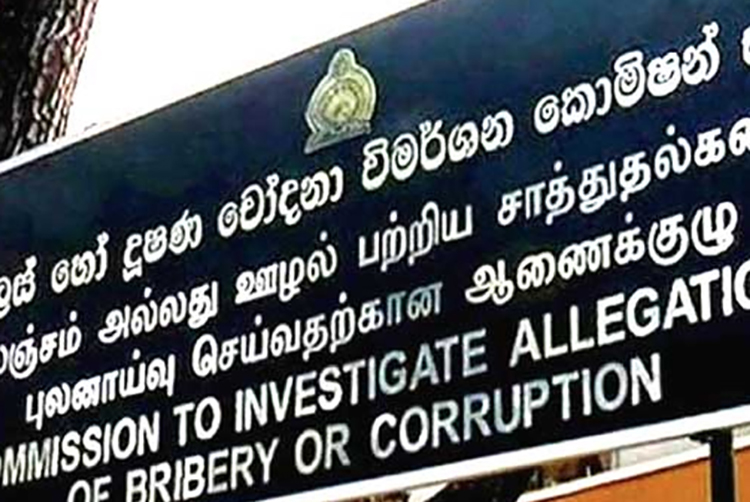
The Director General of the Commission to Investigate Allegations of Bribery or Corruption (CIABOC) announced last month that amendments to the Anti-Corruption Act of 2023 were on the cards so as to restrict public access to the assets and liabilities declarations filed with the Commission. The information, released in 2025, caused profound embarrassment to the present government, but was received very well by the public and any attempt to restrict that information flow at this stage, may prove to be very unpopular.
The popular demand now would be that organisational entities, like political parties and trade unions, also be required to file assets and liabilities declarations with the CIABOC, instead of just the individuals holding positions in such bodies.
Be that as it may, there are some serious issues that need to be rectified in the Anti-Corruption Act of 2023. Foremost among them is Section 31(4) (b) which states that the fund of the CIABOC can receive money “by way of donations, gifts, bequests, or grants from any source whatsoever, whether within or outside Sri Lanka, subject to the approval of the Minister assigned the subject of Finance.”
Those who would be motivated to give gifts and donations to a body like the CIABOC would only be those who want to influence it in some manner to achieve a collateral purpose. While the English version of the Anti-Corruption Act states that the CIABOC can receive such funds “from any source whatsoever whether within or outside Sri Lanka”, the Sinhala version of the Act has sought to disguise that intention by using more opaque wording which goes as: “Sri Lankawa thula ho Sri Lankawen pitatha pihiti yam mulashrayakin”.
The English “any source whatsoever” has been diluted in the Sinhala version by the use of the phrase “yam mulashrayakin” which roughly translates as ‘from a certain source’. When the Sinhala word ‘yam’ is used and nothing more is specified, in practice it becomes “any source whatsoever”! The difference in the way Section 31(4) (b) has been worded in the English and the Sinhala versions of the Anti-Corruption Act of 2023 clearly reveals the villainous intention behind this provision.
Giving the Finance Minister a say in approving such donations gives an incumbent Finance Minister undue leverage over the Commission. We must be mindful of the fact that the Finance portfolio has often been held by the President.
The Indian policy
Section 31(6) of the Anti-Corruption Act states that the source and purpose of such foreign and local private donations have to be made public by the Commission, within one month. However, even if funding is received openly, that does not mean that such funding is given without a collateral purpose. Journalists, like Shamindra Ferdinando, and Malinda Seneviratne, have taken up cudgels in the past about foreign interested parties, like USAID openly funding organisations, such as the Bar Association of Sri Lanka, and certain associations of journalists. Does anyone remember what President Donald Trump said about the activities of USAID? A law enforcement agency, like the CIABOC, should never be left open to the contagion of private funding by local and foreign interested parties.
India imposes strict limitations on all Indian citizens with regard to the receipt of foreign funds under the Foreign Contributions (Regulation) Act of 2010. These limitations apply to politicians at all levels of government, judges, public servants and even journalists, cartoonists and political activists. The Indian restrictions apply not only to money or property but even to foreign trips and other forms of foreign-funded hospitality.
India would never allow its premier anti-corruption law enforcement body to directly receive funding from abroad or from private donors within India. The Indian anti-corruption body that corresponds to Sri Lanka’s CIABOC is the Central Vigilance Commission of India. Section 13 of the Indian Central Vigilance Commission Act of 2003 states that all expenses of the Commission will be charged on the Consolidated Fund of India. In Sri Lanka, too, all expenses of the CIABOC should be a charge on the Consolidated fund of Sri Lanka.
Because of the enormous power that it wields over the lives of all politicians, public servants, and judicial officers in Sri Lanka, the receipt of foreign funding or private donations by the CIABOC impacts negatively on the national interest and even the sovereignty of Sri Lanka. The power of the CIABOC is such that it’s like the Police Department, Attorney General’s Department, parts of the judiciary and the executive presidency all rolled into one. Sections 32 to 72 of the Anti-Corruption Act outlines the wide ranging powers wielded by the CIABOC.
The CIABOC has complete and total control over their officers and employees. The appointment, salaries, conditions of service, promotion, disciplinary control and dismissal of their employees is handled entirely by the Commission itself. In contrast to this, such matters with regard to the Police, the Attorney General’s Department and the Judiciary are handled by the National Police Commission, the Public service Commission and the Judicial Services Commission, respectively. The checks and balances that apply to other law enforcement entities do not apply to the CIABOC.
The CIABOC can recruit staff from other parts of the public service (which includes the Police Department). However, the police officers taken into the Commission do not function under the IGP but under the authority of the Commission which effectively gives the CIABoC its own police force. Authorised officers of the CIABOC can manhandle and arrest suspects without an order from a Magistrate, enter and search any premises, or vehicle, seize any article deemed necessary for their investigations and use force if necessary in carrying out these functions. They can carry out undercover operations and use bugging devices.
The Commission can summon any person and examine him on oath or affirmation; obtain details of transactions and accounts from banks, obtain information from the Inland Revenue Department, freeze bank accounts, order the Controller of Immigration and Emigration to impound passports. With the sanction of a Magistrate the CIABOC can direct any person to unlock or unencrypt digital devices and intercept messages. Following such investigations, the CIABOC can institute criminal proceedings against the persons concerned in the Magistrate’s Court or the High Court.
Under Sections 67 and 71, the CIABOC can withdraw or defer the indictment against the accused after taking into account considerations such as the national interest and public interest; the views of the victims of the offence; and representations that may be made by the accused person or his lawyer. In withdrawing such indictments, the CIABOC may impose on the accused conditions such as publicly expressing remorse and apology before the High Court, providing reparations to victims of the offence, publicly pledging to refrain from committing further offences or to permanently refrain from holding elected or appointed public office.
Most powerful law enforcement agency
Thus, we see that the CIABOC controls the entire gamut of law enforcement in relation to offences coming within its purview. From manhandling and arresting suspects, obtaining statements under oath, seizing documents and other goods, searching premises, freezing bank accounts, impounding passports, to conducting criminal prosecutions in Magistrate’s Courts and High Courts, and even granting clemency to accused individuals, the Commission controls the entire process.
No single institution, whether it be the Police Department, the Attorney General’s Department, the Judiciary or the Executive Presidency, wields such extensive power over the lives of key government functionaries, public servants, judges and ordinary citizens. Even the President’s power to pardon offenders is restricted in so many ways. However, the Commission can grant clemency to anyone facing legal proceedings on nothing more than the representations made by the alleged offender’s lawyer and on the condition of not committing such offences again or agreeing never to hold public office again.
Leaving an exit pathway, such as that envisaged in Section 67 and 71, is a good policy in criminal justice administration, especially when it comes to bringing to a conclusion cases with many grey areas. Hence, we do not question the power conferred on the CIABOC to grant clemency under Sections 67 and 71. However this provision, when taken together with the other powers of the Commission, immeasurably increases its power. In the hands of the wrong people, the powers of the CIABOC can be used to pressurize and remove targeted individuals from public life.
Any foreign or local interested party that provides private donations to the CIABOC, under Section 31(4) (b) of the Anti-Corruption Act, will in effect be buying influence over Sri Lanka’s most powerful law enforcement agency.
In 2010, over half a million US Dollars in cash was found in the possession of a close relative of a candidate at the Presidential election. In December 2014, foreign currency totaling well over one million USD was discovered in the possession of a relative of another presidential candidate. In more recent times, many media personalities have commented on the manner in which the 2025 assets and liabilities declarations of certain government figures reveal large inflows of cash in 2022 – the regime change year.
Against such a backdrop, allowing an all-powerful law enforcement agency, like the CIABOC, to accept donations from foreign and local interested parties, can hardly be in the public interest. Hence, Section 31(4) (b) of the Anti-Corruption Act should be repealed.
(To be continued tomorrow)
by A Special Correspondent
Features
Sri Lankan Airlines Airbus Scandal and the Death of Kapila Chandrasena and my Brother Rajeewa


The death of Mr Kapila Chandrasena (KC), the former CEO of SriLankan Airlines, caused quite a stir in the country. A few politicians, particularly from the opposition, tried to take advantage of the confusion surrounding his death, whilst social media went into a frenzy, with everyone having a theory as to the cause of death.
Even Transparency International Sri Lanka (TISL), the independent anti-corruption watchdog, issued a public statement urging the Government to ensure a full, transparent, and credible investigation into the circumstances surrounding Kapila Chandrasena’s (KC’s) death. TISL further emphasized that the Government bears a responsibility to protect the integrity of the judicial process and to ensure that individuals connected to high-profile investigations are able to participate in proceedings in a safe and secure environment.
While such concerns are understandable, I strongly believe that it is necessary to await the findings of the magisterial inquiry before reaching conclusions regarding the cause of death. To speculate irresponsibly, particularly to fit pre-existing political beliefs, is unfair not only to the deceased but also to his grieving family and loved ones.
First and foremost, I wish to convey my sincere condolences to the family of KC. I understand personally the trauma and anguish associated with losing a loved one unexpectedly and under tragic circumstances.
My brother’s death
Unfortunately, the death of KC also resulted in renewed interest in the death of my brother, Rajeewa Jayaweera, in June 2020. Some individuals on social media attempted to link his death to the newspaper article he published on the Airbus scandal involving SriLankan Airlines, KC and his wife.
Some people even circulated photographs of my brother’s body at the site of the incident across social media platforms. This was deeply insensitive and extremely distressing to my sisters and me. The loss of a sibling under tragic circumstances is something from which one never fully recovers. It took our family years to come to terms with his passing, and to have those painful images resurfaced in connection with an entirely unrelated event reopened old wounds unnecessarily.
On behalf of my sisters and myself, I wish to state unequivocally that my brother, Rajeewa Jayaweera, took his own life in June 2020 due to personal circumstances. His death had absolutely no connection whatsoever to his writings regarding the Airbus scandal. Neither the Rajapaksas, nor any political actor, nor any state agency was involved in his death. The magisterial inquiry into the matter returned a verdict of suicide.
Those who know me personally are aware of my forthright and combative nature. Had there been even the slightest credible suspicion surrounding my brother’s death, I would never have rested until justice was pursued. Since this was clearly established as a case of suicide, I sincerely hope that those who continue to circulate unfounded theories will finally allow the matter to rest with dignity.
The Sri Lankan Airbus scandal
The alleged payment of a USD 2 million bribe by Airbus SE to a shell company established in Brunei by the wife of a senior SriLankan Airlines official came to light following the approval of a Deferred Prosecution Agreement (DPA) between the UK Serious Fraud Office (SFO) and Airbus SE.
The DPA was approved on January 31, 2020 by Dame Victoria Sharp, President of the Queen’s Bench Division, sitting at the Crown Court in Southwark. The award represented one of the largest global anti-corruption settlements in modern corporate history.
The Airbus investigation by the SFO extended far beyond Sri Lanka. It involved allegations of bribery and corrupt practices linked to aircraft purchases by AirAsia and AirAsia X in Malaysia, SriLankan Airlines, TransAsia Airways in Taiwan, PT Garuda Indonesia, Citilink Indonesia, and military aircraft transactions involving the Government of Ghana.
The approved judgment contained specific references to the SriLankan Airlines transaction (page 12, points 41 to 44). It alleged that Airbus employees, contrary to Section 7 of the UK Bribery Act 2010, failed to prevent bribery involving individuals connected to the airline’s aircraft procurement process between July 2011 and June 2015.
According to the Statement of Facts, Airbus engaged the wife of an individual connected to the aircraft acquisition process through a shell entity described as “Company Intermediary 1”. Airbus employees allegedly offered up to USD 16.84 million in commissions in relation to SriLankan Airlines’ purchase of ten Airbus aircraft and the lease of four additional aircraft. Ultimately, only USD 2 million was allegedly paid.
The judgment further stated that Airbus employees sought to disguise the identity of the beneficial owner behind the intermediary company and misled the United Kingdom Export Finance Agency (UKEF) regarding the intermediary’s qualifications, aviation experience, and role in the transaction.
The smoking gun from Sri Lanka that commenced the UK SFO investigation
The matter became particularly significant because it was the concerns raised by UKEF regarding the SriLankan Airlines intermediary that ultimately triggered the wider SFO investigation into Airbus. UKEF questioned why an individual with little aviation experience and who was domiciled outside Sri Lanka had been engaged as a business partner in such a major transaction.
Airbus reportedly provided misleading and inaccurate responses to those concerns in February 2015. Unsatisfied with the explanations provided, UKEF escalated the matter, which subsequently contributed to the formal investigation launched by the SFO in July 2016.
Ironically, what appears to have been a poorly concealed and amateurishly structured bribe involving SriLankan Airlines ultimately became one of the catalysts for a global corruption investigation that resulted in Airbus paying penalties approaching EUR 4 billion across the United Kingdom, France, and the United States.
Under the settlement approved in the UK, Airbus agreed to pay approximately EUR 991 million into the UK Consolidated Fund, including disgorgement of profits and financial penalties. Simultaneously, French and American authorities imposed additional penalties amounting to nearly EUR 3 billion.
Aircraft procurement and corruption
The Airbus matter once again highlighted a longstanding global reality: aircraft procurement has historically been highly vulnerable to corruption. The purchase of aircraft involves enormous financial values, complex financing arrangements, confidential negotiations, intermediaries, export credit agencies, and political influence. These factors create conditions for improper payments and abuse of authority.
Globally, there have been numerous allegations over several decades involving commissions, hidden intermediaries, and questionable consultancy agreements linked to aircraft purchases by both commercial airlines and governments. It is generally believed that the average commissions paid are between 3% to 5% of the order value.
The cost to Sri Lankan taxpayers
One of the most undesirable aspects of the Airbus affair is the financial burden ultimately borne by ordinary Sri Lankan taxpayers.
In 2015, the Government of Sri Lanka decided to cancel the order for four Airbus A350 aircraft as they were deemed unsuitable. As a consequence of that cancellation, SriLankan Airlines incurred penalties estimated at approximately USD 140 million, equivalent to roughly Rs. 19.2 billion at the time.
While Sri Lankan taxpayers absorbed these enormous losses, the United Kingdom taxpayers benefited financially from the Airbus settlement. The UK Consolidated Fund received almost EUR 1 billion arising from the penalties imposed on Airbus.
The contrast is stark. Sri Lanka suffered substantial financial losses as a result of a transaction tainted by allegations of corruption, while foreign governments received the benefit of the resulting fines and penalties.
The questions raised by my brother
My late brother, Rajeewa Jayaweera, wrote an article about the Airbus scandal in an article published in the Sunday Island on February 16, 2020, titled “SriLankan Airlines Airbus Deal”. In the article, he referred to a SriLankan Airlines Board meeting held on October 27, 2016.
According to his article, Board Minute 7.3 dealt specifically with reports that Airbus was under investigation in Europe for bribery-related offences. Rajan Brito, who was then a director of the airline, reportedly informed fellow board members about the investigations and tabled draft letters intended for Airbus, Rolls-Royce, and AerCap.
Those draft letters reportedly suggested that the aircraft transactions may not have been based solely on commercial considerations and sought information regarding the role of facilitators and intermediaries.
However, according to my brother’s article, Brito’s proposal to send those letters was reportedly ignored on the basis that the airline was negotiating favourable terms to cancel aircraft purchase commitments and that sending such letters might sour relations and disadvantage the airline.
However, my brother believed that the decision not to proceed with Brito’s letters was controversial and highly questionable, and that the airline could have sought the assistance of the PNF (Parquet National Financier) to investigate the deal and seek financial restitution, given that the order was allegedly tainted by corruption, particularly given the emerging evidence of corruption surrounding the transaction.
Even today, an important question remains unanswered: did the Government of Sri Lanka or any subsequent board of SriLankan Airlines seriously attempt to recover the USD 140 million cancellation penalty, along with any inflated amounts paid after the global corruption findings against Airbus became public?
The slow pace of Sri Lankan justice
Following the public release of the UK judgment on January 31, 2020, Sri Lankan authorities moved relatively quickly to initiate legal proceedings against KC and his wife.
On February 4, 2020, arrest warrants were reportedly sought. On February 6, 2020, KC and his wife surrendered to the Criminal Investigation Department (CID) and were remanded until March 4, 2020, when they were released on bail.
The allegations reportedly related to accepting a USD 2 million bribe and engaging in money laundering activities. Press reports also indicated that travel restrictions had been imposed.
However, six years later, the matter still appears unresolved. Based on publicly available information, indictments were reportedly filed before the Colombo High Court in 2022. Since then, several hearings dealing with procedural and preliminary issues have reportedly taken place, but the substantive trial itself has yet to properly commence. With KC now deceased and reports suggesting that his wife may have absconded, the prospects of successfully prosecuting the matter appear increasingly uncertain.
Many Sri Lankans understandably feel frustrated by the slow pace at which corruption-related cases proceed through the judicial system. This frustration is particularly acute where allegations involve politically connected individuals or transactions involving massive losses to the public.
The public perception is that investigations move slowly, prosecutions are delayed for years, and accountability is often ultimately avoided through procedural delays, political changes, or the passage of time.
To be fair, corruption cases involving international financial transactions are inherently complex. They require cooperation between multiple jurisdictions, access to banking records, mutual legal assistance processes, forensic accounting, and substantial documentary evidence. Nevertheless, the extraordinary delays contribute to growing public cynicism regarding the administration of justice.
It is also worth noting that the UK proceedings against Airbus did not publicly identify KC by name. Much of the public discussion in Sri Lanka has therefore relied on local investigations and media reporting rather than the UK judgment itself.
According to information available in the public domain, the alleged funds connected to the USD 2 million payment ultimately found their way into an Australian bank account linked to KC. Given the reputation of Australian authorities for cooperating with international law enforcement investigations, many members of the public expected a faster and more decisive legal process in Sri Lanka.
In that context, a detailed public explanation by the Attorney General’s Department regarding the legal and evidentiary challenges affecting the case may help improve public understanding and confidence.
SriLankan Airlines: A continuing national burden
The Airbus controversy cannot be viewed in isolation from the broader failures surrounding SriLankan Airlines over several decades.
The national carrier has accumulated debts estimated at approximately USD 1.2 billion, equivalent to nearly Rs. 350 billion. This translates to a burden of roughly Rs. 16,000 per Sri Lankan citizen, including millions who have never travelled on the airline.
Successive governments have interfered extensively in the airline’s operations. Political appointments, weak governance, lack of commercial discipline, and poor strategic decision-making have contributed significantly to the airline’s decline.
Far too often, individuals lacking meaningful aviation expertise have been appointed to key board and management positions. Political loyalty has frequently taken precedence over competence and experience.
The decision to terminate the management and ownership partnership with Emirates remains one of the most controversial episodes in the airline’s history. Many industry observers believe that decision alone cost Sri Lanka billions of rupees in lost opportunities and operational deterioration.
Despite repeated financial losses and mounting taxpayer burdens, very few individuals have ever been held accountable for the disastrous decisions that contributed to the airline’s decline.
The current Government faces an unavoidable reality. SriLankan Airlines cannot continue indefinitely as a financially unsustainable state enterprise funded by taxpayers already struggling under severe economic hardship. Decisions regarding the future of the airline must be guided by commercial reality rather than political ideology or emotional nationalism.
Ultimately, the Airbus scandal is not merely about one individual or one alleged bribe. It reflects deeper structural weaknesses involving governance, political interference, accountability, and institutional failure within Sri Lanka.
Sadly, a relatively young man has now lost his life amidst these events and controversies. Regardless of the allegations against him, that remains a human tragedy. At the same time, the country must continue to demand transparency, accountability, and institutional reform so that such scandals are never repeated.
(The views and opinions expressed in this article are solely those of the author and do not necessarily reflect the policy or position of any organization or institution with which the author is affiliated).
By Sanjeewa Jayaweera

Electronic or digital financial fraud is the current, extremely distasteful description of a blight that has hit the entire globe; a menace that is perpetrated through an unbelievable labyrinth of interconnected dishonourable and nasty manoeuvres. In an era where our financial lives are increasingly becoming digital, the “perfect financial crime” no longer requires a getaway car. It just needs a high-speed internet connection and stupendously brilliant, depraved and Machiavellian minds.
Modern scams have advanced far beyond the poorly spelt emails of the past. They are now extremely sophisticated operations exploiting psychological manipulation and deep-fake technology. Financial fraud has evolved from simple street-level deception into a complex, multi-billion-dollar industry. It has been manipulated through many different currencies in different parts of the world. In Sri Lanka, the landscape of scams has shifted from traditional “pyramid” schemes to sophisticated digital heists and institutional bond scandals that threaten the very fabric of our national economy. From an international outlook, financial fraud is becoming increasingly transnational. Sri Lanka is currently under intense scrutiny by the FATF (Financial Action Task Force). Sri Lanka falling onto the “Grey List” again would have severe repercussions, potentially causing international banks to suspend payments to the island, severely upsetting our exporters.
The financial fraud profile of Sri Lanka has gone from “Bonds” to “Glitches”. Our country has been rocked by high-profile financial irregularities that serve as a stark warning about institutional integrity. First was the Treasury Bond Scandal. Often cited as the largest financial scam in the nation’s history, the Central Bank bond issuance of 2015 highlighted the risks of Insider Trading and the manipulation of government securities. The fallout cost the public billions of rupees, demonstrating how high-level collusion can bypass traditional safeguards.
The recent problem where the Treasury remitted a very large amount of foreign currency to a different portal to which money should not have been sent is a special type of Financial Fraud problem that seems to have been instigated by a deceptive email. It is under investigation at present, and it appears that it is the money that had been earmarked for foreign debt reconciliation. It is the taxpayers’ money that has been allowed to be swindled by unscrupulous crooks.
Then there is the National Development Bank (NDB) “Glitch” Controversy.
The entire banking sector was shaken to its roots by reports of a massive multi-billion-rupee fraud at the NDB. This incident, often referred to in local circles as “The Glitch,” involved the alleged diversion of funds through a sophisticated manipulation of the bank’s internal accounting systems.
Then there are the perceived Guardians, who often serve as Whistleblowers. The fight against such deep-seated corruption rarely begins with a regulator; it often starts with an individual. It is just someone who smells a rat. Maya Senanayake, a forensic expert at NDB, has emerged as a symbol of integrity in this landscape by identifying anomalies that others chose to ignore. Whistleblowers like Senanayake face immense personal and professional risks. Their role is a “Herculean effort”, very often battling institutional stonewalling to bring the truth to light. Without such individuals, “Suspense Account” spikes and “shell-company diversions” would remain invisible to the public eye.
Having mentioned just two of the buzz phrases in circulation, given in Italics above, it is pertinent to provide definitions for some of these phrases that are being bandied about very frequently in articles on the main subject of this article.
· SCAM – It is a fraudulent scheme or deceptive act performed by an individual or group to trick a victim into giving up something of value, typically money, personal information, or assets. It is a blatant lie or a misrepresentation of the truth. Unlike theft (where something is taken by force), a scam usually involves the victim “willingly” handing over assets because they believe the fraudster’s story. Scams often rely on psychological manipulation, such as creating a sense of urgency, fear, or the promise of a “too good to be true” reward.
· HACKERS –
The term has evolved significantly and carries different meanings depending on the context. In the broadest sense, a hacker is someone who uses technical skills to overcome a problem or bypass a system’s limitations. The cybersecurity industry generally classifies hackers by their intent, often using a “hat” colour system.
The White Hat Hackers are an ethical group that is hired to detect vulnerabilities. They are legal and helpful as they improve security by reporting bugs.
The Black Hat Group are cybercriminals who break into systems illegally. They are malicious, steal data, plant malware, or disrupt services.
The Grey Hats Individuals who may break laws to access a system, but without malicious intent. They are individuals who might find a bug without permission and then offer to fix it for a fee.
· MONEY LAUNDERING – It is the process of “cleaning” illicitly-earned money by passing it through complex bank transfers or commercial transactions.
· TREASURY BOND –
A government debt security that provides a fixed interest rate. Manipulating these affects the nation’s debt and interest rates.
· WHISTLEBLOWER –
It is an “insider” who reports and even makes public, concealment of illegal or unethical activities within an organisation to the public or relevant authorities.
· SUSPENSE ACCOUNT –
A temporary account used to hold funds while their final destination is determined. These are frequently used in fraud to “hide” money during transfers.
· SHELL COMPANY –
No., NO…, it is not the Shell Company that deals with fuel. This terminology refers to a company that exists only on paper and has no active business operations. It is very frequently used to obscure the identity of those moving money. They become “Ghosts”.
· FORENSIC AUDIT –
An examination of financial records to find evidence that can be used in a court of law or for legal proceedings.
When one examines some of these frauds and scams, it becomes clear that at the bottom of the distasteful occurrences lie systemic inadequacies. Scrupulous attention to all details of financial transactions, trustworthy and fool-proof systems dealing with financial transactions, utmost vigilance and a very high degree of suspicion are the incontrovertible needs of the hour. The powers-that-be in all things that deal with financial transactions must consist of people with unblemished honesty, unbridled integrity and honour.
International best practices now emphasise a shift from “rules-based” to “risk-based” oversight, even going to the extent of utilising Artificial Intelligence (AI) to detect suspicious patterns in money laundering and financial fraud that a human eye might miss.
For individuals and the general public, the Three Golden Rules for Protection are as follows”
· Demand Transparency:
Whether you are an investor or a depositor, always ask for the audited financial statements of the institution.
· Verify the Chain:
In government securities, ensure you are dealing through registered primary dealers.
· Support Protections:
Advocate for stronger Whistleblower Protection Acts to ensure that those who speak the truth are not penalised by the system they seek to save.
The trick is to protect ourselves from the Invisible Thief by protecting ourselves from Modern Scams. Here is a breakdown of the most prevalent threats today and how to safeguard your assets.
A. The “Urgent Authority” Tactic
Scammers often impersonate trusted institutions such as banks, financial institutions, tax offices, or law enforcement. They create a sense of artificial urgency, claiming your account has been compromised or you owe an immediate fine.
· The Red Flag: Any request to move money to a “safe account” or pay via untraceable methods like gift cards or cryptocurrency.
· The Defence:
Hang up immediately or delete the message if it is on email. Contact the institution using a verified phone number from their official website or the back of your bank card to check the veracity of the request.
B. Investment and “Get Rich Quick” Schemes
With the rise of digital assets, “pig butchering” scams have become rampant. Fraudsters build a relationship with the victim over weeks (the “fattening”) before suggesting a “guaranteed” investment opportunity in crypto or forex (the “slaughter”).
· The Red Flag: Returns that consistently outperform the market with “zero risk.”
· The Defence:
If an investment opportunity sounds “too good to be true”, it almost always is. Professional financial advisors do not solicit clients via WhatsApp or dating apps.
C. Phishing and Smishing (SMS Phishing)
These are deceptive messages designed to steal login credentials. You might receive a text stating a package delivery failed, or your Netflix subscription has lapsed, followed by a link to a “login” page that looks identical to the real thing.
· The Red Flag: Unusual URLs (e.g., wellsfarg0.net instead of wellsfargo.com) and unexpected attachments.
· The Defence:
Never click links in unsolicited messages. Use Multi-Factor Authentication (MFA) on all sensitive accounts; even if a thief gets your password, they won’t get the secondary code.
4. The AI Impersonation (The Grandparent Scam)
Advancements in AI voice cloning allow scammers to mimic the voice of a loved one in distress. They may call claiming to be in a car accident or legal trouble, begging for immediate funds.
· The Red Flag: High emotional pressure and a demand for secrecy.
· The Defence:
Establish a “family password” – a unique word or phrase only your inner circle knows. If the caller cannot provide it, they are not who they say they are.
The Three Golden Rules for Financial Safety are
· Slow Down and Do Not Get Frightened:
Scammers rely on panic. Taking five minutes to think or consult a friend usually breaks the spell of the scam. It is also important to realise that some scammers try repeatedly.
· Verify the Source:
Never trust Caller ID, as numbers can be easily “spoofed” to look local or official.
· Protect Your Data:
Be wary of how much personal information you share on social media. Scammers use these details to make their impersonations more convincing.
Your bank will NEVER EVER ask for your Personal Identification Number (PIN), your Account Password, One-Time-Password (OTP) or request you to transfer money to an entirely new, unknown account. If any such request comes, do not fall for it and immediately contact the institution through their standard publicised telephone lines to check on the veracity of the request.
If you suspect you have been targeted, report it to the bank or financial institution, your local authorities and the legal investigative portals…, IMMEDIATELY.
(Some of the material presented
in this article was extracted with the help of AI.)
by Dr B. J. C. Perera
MBBS(Cey), DCH(Cey), DCH(Eng), MD(Paediatrics), MRCP(UK), FRCP(Edin), FRCP(Lond), FRCPCH(UK), FSLCPaed, FCCP, Hony. FRCPCH(UK), Hony. FCGP(SL)
Specialist Consultant Paediatrician and Honorary Senior Fellow, Postgraduate Institute of Medicine, University of Colombo, Sri Lanka.
An independent free-lance correspondent.

President meets senior officials of the Urban Development Authority

CEAT Kelani Branch Inter-Company Employees’ Union makes donation to the ‘Rebuilding Sri Lanka’ Fund

Escaped tiger shot by German police after attacking man

Prime Minister off to the United Kingdom to participate in the 22nd Annual Commonwealth Education Forum

Steps initiated to safeguard Sri Lanka’s Maritime Heritage

Fighter jet crews parachute safely after collision at US air show

‘Dates have the highest sugar content to fight Coronavirus’

Sunday Island 27 December – Headlines

#SundayIsland 17th December – Headlines

Sunday Island – 28th March

Sunday Island Headlines – 21 March

Sunday Island – 21st February – Headlines
-
 News6 days ago
Ex-SriLankan CEO’s death: Controversy surrounds execution of bail bond
-

 Features2 days ago
Sri Lankan Airlines Airbus Scandal and the Death of Kapila Chandrasena and my Brother Rajeewa
-
Features7 days ago
High Stakes in Pursuing corruption cases
-
 News3 days ago
Lanka’s eligibility to draw next IMF tranche of USD 700 mn hinges on ‘restoration of cost-recovery pricing for electricity and fuel’
-
 Features7 days ago
When University systems fail:Supreme Court’s landmark intervention in sexual harassment case
-
 Midweek Review6 days ago
A victory that can never be forgotten
-
 News2 days ago
Kapila Chandrasena case: GN phone records under court scrutiny
-
 Features4 days ago
Mysterious Death of United Nations Secretary General Hammarskjöld