
Opinion
Comments on President’s address to the nation


By Neville Ladduwahetty
Following the resignation of former Prime Minister Mahinda Rajapaksa and the Cabinet of Ministers, President Gotabaya Rajapaksa addressed the Nation, during the course of which he is reported to have stated that “a new constitutional amendment containing provisions of the 19th Amendment would be brought in” and furthermore, “some people have asked for the abolition of the Executive Presidency. I will make room for that after discussing with all stakeholders” (The Island, May 12, 2022).What is intended herein is to caution the President that while there are provisions in the 19th Amendment that are noteworthy, certain provisions need to be deleted and others completely revised, and still others included as fresh provisions.
For instance, Article 33A, which requires the President to be responsible to Parliament, and Article 42 (2) should be deleted because they contradict the very core principles of the separation of power enshrined in Presidential Systems. The provision contained in Chapter VIIA establishing “the Constitutional Council”, responsible for appointments to high posts and Independent Commissions needs to be replaced with a fresh arrangement for setting up Independent Commissions because it failed to comply with the specified constitutional obligations. A fresh provision is the one that relates to Article 42 (1) which states, “There shall be a Cabinet of Ministers charged with the direction and control of the Government of the Republic”. However, there is no constitutional provision to ensure how this all-important provision works in practice.
Another issue addressed herein is the abolition of the Executive Presidency. The choices are between been referred to as semi-presidential. Each system has its merits and demerits. Therefore, it is critical that the choice between the two takes into serious consideration the context within which the system operates. For instance, the political structure in Sri Lanka is made up of a multiplicity of political parties representing a variety of interests, ideologies and communities. As such, it could be assured that the formation of any government is inevitably a coalition, which by its very nature is not known for stability. Therefore, in the particular context of Sri Lanka’s political formations, a presidential system should be the preferred option because the Executive and Parliament are elected separately by the people, thereby ensuring that at least, one branch – the Executive – is free of Parliamentary instability.
ARTICLES 33A and 42 (2)
Article 33A states: “The President shall be responsible to Parliament for the due exercise, performance and discharge of his powers, duties and functions under the Constitution ….” AND Article 42 (2) states, “The Cabinet of Ministers shall be collectively responsible and answerable to Parliament.”
Both Articles were first blindly incorporated into the 1978 Constitution that was drafted for a presidential system of government, and later into the 19th Amendment, notwithstanding the fact that they are provisions applicable to a parliamentary system of government. Such serious contradictions reflect poorly on the drafters of the 1978 Constitution and the 19th Amendment.A Supreme Court bench of seven judges unanimously stated in (SC FR 351- 3612/2018), that “the first rule when interpreting Constitutions is that words in a statute must be given their ordinary meaning.” Based on this rule, while Article 3 states, “Sovereignty includes powers of government ….” and Article 4 (b) states, “The executive power of the People including the defence of Sri Lanka shall be exercised by the President of the Republic elected by the People”, how could one organ of government be responsible to another organ of government – the Parliament, which is also separately elected, but by the same People?
Commenting on how the Cabinet of Ministers derives its power, the Supreme Court in (S.D. No. 04/2015) stated, “The Court in the Nineteenth Amendment Determination came to the conclusion that the transfer, relinquishment or removal of a power attributed to one organ of government to another organ or body would be inconsistent with Article 3 read with Article 4 of the Constitution. Though Article 4 provides for the form and manner of exercise of the sovereignty of the people, the ultimate act or decision of the executive functions must be retained by the President. So long as the President remains the Head of the Executive, the exercise of his powers remain (sic) supreme or sovereign in the executive field and others to whom such powers are given must derive the authority from the President or exercise the Executive power vested in the President as a delegate of the President.”
It is therefore crystal clear from the determination of the Supreme Court that the President or the Cabinet of Ministers cannot be responsible to Parliament, and that the Cabinet of Ministers derives its authority from the President and exercises its power as delegated power of the President. Therefore, if the intention is to incorporate provisions of 19 A, the above provisions should be deleted. The fact that they continue to exist despite the SC determination is because of flawed practices resorted to by Parliament.
CONSTITUTIONAL COUNCILS and INDEPENDENT COMMISSIONS
The Constitutional Council (CC) consists of 10 members with the Speaker as its Chairman. Of the 10 members in the CC, seven are members of Parliament and three are outsiders nominated by the Prime Minister and the Leader of the Opposition.Article 41 B (1) states, “No person shall be appointed by the President as the Chairman or a member of any of the Commissions specified in the Schedule to this Article, except on the recommendation of the Council”.
Article 41C (1) states, “No person shall be appointed by the President to any of the Officers specified in the Schedule to this Article, unless such appointment has been approved by the Council upon a recommendation made to the Council by the President.” However, prior to the establishment of the Constitutional Council all appointments of public officers and the judiciary were made by the President in keeping with Articles 54, 55 and 107 of the 1978 Constitution.
Based on the SC Determination cited above, the establishment of a CC is a clear and deliberate attempt to remove and transfer power from one organ of government – the President – to another organ that is predominantly from Parliament. Therefore, the establishment of the CC should have warranted a referendum. However, the SC determined otherwise, based on a determination made by a previous Court in connection with the 17th Amendment.Notwithstanding such contradictions, the fact remains that at the end of the day, appointments to high posts and Independent Commissions are made either by the Executive or by Parliament. If the intention is to foster an independent Public and Judicial Services that is free of political influence, ALL appointments to Administrative and Judicial institutions should be made either by a Public Service Commission or a Judicial Service Commission, as was the practice prior to the politicisation of these institutions.
The need to politicise Administrative and Judicial institutions arose in order to politically control the manner in which these institutions functioned, because those who manned them became a law unto themselves. To overcome such possibilities, instead of attempting to exercise control by directly getting involved in their appointments and how they function, a more effective proposition would be to make the appointments to high posts by independent Public Service and Judicial Service Commissions, and monitor and review regularly their performance through Constitutionally strengthened Parliamentary Oversight and Sectoral Committees.The recommendation therefore is to delete Chapter VIIA that contain provisions for the establishment of a CC incorporated in the 19th Amendment. What is recommended instead is that a Constitutionally empowered Public Service and Judicial Service Commissions recommend for appointment by the President, ALL appointments to high posts stating with Secretaries to Ministries and Heads of Departments. Such a Public Service and a Judicial Service Commission should be vested with executive powers to promote, transfer, exercise disciplinary control and dismissal of public officers, including addressing grievances of the public. An arrangement close to what is recommended already exists with the Police Commission that handles only public grievances. All other functions of the Police Department have already been transferred to the Public Service Commission.
PARLIAMENTARY OVERSIGHT and SECTORAL COMMITTEES
At present, Parliamentary Oversight and Sectoral Committees function under provisions set up under Standing Orders. What is recommended is to make provisions for these Committees to function under provisions of the Constitution, thereby empowering them to fulfil the primary function of reviewing the performance of the policies of the Cabinet of Ministers in respect of the direction and control of the government and the administrative performance of the administrators implementing the policies. Such an arrangement permits Parliament through these Committees to review executive action since the Presidential system does not permit the Cabinet of Ministers to be responsible and answerable to Parliament as stated above. Furthermore, such empowered Committees should have the authority to review the performance of the administrators, notwithstanding the fact that they are appointed by independent Public Service and Judicial Service Commissions.
A significant fact overlooked is that it is the Separation of Power between Parliament responsible for Legislation and the Executive responsible for executive action, that permits the review of executive action by Parliament. However, it must be noted that the review of executive action by these Committees does not mean that the Cabinet of Ministers are collectively responsible and answerable to Parliament. Such a feature where executive action is reviewed by Parliament does not exist under a parliamentary system, because the latter does not recognize separation of power between Parliament and the Cabinet of Ministers.
ABOLITION of the EXECUTIVE PRESIDENCY
Does the slogan of the protesters calling “Gota-go-home” mean for the incumbent President to be replaced by another, or the abolition of the Presidential System? On the other hand, the Executive Committee of the Bar Association is very specific. They want the Executive Presidential System abolished. Having so stated, the President of the Bar Association during the course of an interview stated, “I think the abolition of the Executive Presidency and the reinstatement of the 19th Amendment are the key constitutional changes that should be dealt with” (The Sunday Morning, May 15, 2022).There is a contradiction in the above statement. Since the 19thA is an Amendment to the 1978 Constitution, which for all intents and purposes is a presidential system, how could its “reinstatement” exist if the Executive Presidency is abolished? If 19A is perceived as a weakened Executive Presidency, as some do, the fact remains that 19A has to function within a presidential system, weakened or not.
The perception that 19A weakened the executive powers of the President could be challenged because although the President “shall” act on the advice of the Prime Minister (Article 43 (2), Article 43 (3) states that the President “may at any time change the assignment of subjects and functions and the composition of the Cabinet of Ministers”. This means the President “may at any time” undermine the “advice” of the Prime Minister. As for appointment of State Ministers and Deputy Ministers, 19A states that the President “may” on the advice of the Prime Minister make such appointments. Such discretionary provisions cannot amount to a weakening of Executive Power. On the other hand, the establishment of The Constitutional Council is a clear instance of transfer and removal of the executive power that should have required a referendum. Under the circumstances, the perception that reinstating 19A amounts to abolishing the executive presidency is seriously flawed.If the attempt is to abolish the executive presidency, what is it to be replaced with? If it is to reinstate a parliamentary system, it is absolutely critical that hard realities that currently exist in Parliament be recognized. For instance, the present Parliament is made up of 15 political parties. This means that the formation of any government must necessarily be a coalition representing a variety of interests, ideologies, and communities. The stability of such a conglomerate is tenuous, and since the executive and the legislature are represented by a coalition under a parliamentary system, the inevitable outcome would be the instability of the whole government. For instance, between the years 1948 to 1972, only one out of eight governments successfully completed the five-year term (Daily FT, January 30, 2018).
Such instability is not inherent under presidential systems because the sovereignty of the people is exercised separately by a President responsible for exercising the executive power of the People and a Parliament elected separately to exercise the legislative power of the People. Therefore, even if Parliament is made up of coalition governments that inherently are unstable, at least the Executive would continue, thus ensuring the stability of at least one branch of the government. Therefore, the Executive Presidential System should be retained. Furthermore, the attempt should not be a towards a weakened Presidency or one that is responsible to Parliament, but one that functions well under constitutional checks and balances exercised by Parliament.
CONCLUSION
The President during the course of his address to the nation following the resignation of former Prime Minister and the Cabinet of Ministers, stated that a new Amendment would be presented “containing the provisions of the 19th Amendment”. Furthermore, he stated that he would consider abolishing the Executive Presidency.The need to contain provisions of 19A in a new Constitutional Amendment is because of the popular belief that 19A diluted the executive power the President enjoyed under the original 1978 Constitution. How realistic is this belief? The claim that the executive power of the President was diluted under 19A is because Article 43 (2) states the Cabinet “shall” be appointed on the advice of the Prime Minister, whereas the original 1978 Constitution stated that the President would appoint the Cabinet “in consultation with the Prime Minister where he considers such consultation to be necessary”, which indeed is less obligatory than the wording in 19A. However, the 1978 Constitution as well as 19A contains the provision that the President “may, at any time change the assignment of subjects and functions and the composition of the Cabinet of Ministers….” Since this provision overrides the intended compulsion to dilute executive power, there is in fact no removal or transfer of power from one authority to another. If the interpretation is that power was in fact transferred, relinquished or removed, it would have required a referendum since it would be inconsistent with Article 3 read with Article 4, as determined by the Supreme Court cited above.
Other provisions that should be deleted from 19A are Article 33A, which states that the President is responsible to Parliament, and Article 42 (2), which states that the Cabinet of Ministers “are collectively responsible and answerable to Parliament” because they are inconsistent with Article 3 read with Article 4, that separate legislative and executive powers into two organs of government that are separately elected by the People. Therefore, one organ cannot be responsible to another of equal standing. Furthermore, since the Cabinet of Ministers operates on the delegated power of the President, it cannot be responsible to Parliament either. How such misreading of separation of power could have survived from 1978 and continue to exist in 19A reflects poorly on the framers of the Constitutions.A key provision that should be deleted is Chapter VIIA in 19A, which establishes the Constitutional Council. Prior to 19A, the Executive headed by the President was responsible for ALL appointments to high posts. In order to dilute the power of the President, 19A transferred the responsibility of recommending officers to high posts and Independent Commissions to the Constitutional Council, seven of whose 10 members are from Parliament. It is therefore apparent that appointments are subject to the influence of either the Executive or the Parliament.
Since such arrangements are not conducive to the independence of administration, what is recommended herein is to scrap the concept of the Constitutional Council making recommendations for appointment to high posts and Independent Commissions, and pass on such responsibilities to the Independent Public Service and the Judicial Service Commissions. The performance of personnel so recommended and appointed by the President would be subject to the review of Constitutionally empowered Parliamentary Oversight and Sectoral Committees. Furthermore, the reviews would also enable such Committees to oversee executive action. Thus, since such Committees would be fulfilling two functions, it is absolutely vital that the provision is constitutionally empowered so that these Committees are incorporated into the new amendment to the Constitution.As for abolishing the executive presidency and reinstating 19A, it is a contradiction because 19A cannot exist after abolishing the Executive Presidency; 19A exists within the framework of a Presidential System, weakened or not.What is intended herein are recommendations that should be given serious consideration if the intention of a new Amendment is to introduce a new and improved 19th Amendment.



Here is what you can do!
Comedy and the ability to have a good laugh are what keep us sane. The good news to announce is that there are many British and American comedy shows posted up and available on the internet.
They will bring a few hours of welcome relief from our present doldrums.
Firstly, and in a class of its own, are the many Benny Hill shows. Benny is a British comedian who comes from a circus family, and was brought up in an atmosphere of circus clowning. Each show is carefully polished and rehearsed to get the comedy across and understood successfully. These clips have the most beautiful stage props and settings with suitable, amusing costumes. This is really good comedy for the mature, older viewer.
Benny Hill has produced shows that are “Master-Class” in quality adult entertainment. All his shows are good.
Then comes the “Not the Nine o’clock news” with Rowan Atkinson and his comedy team producing good entertainment suitable for all.
And then comes the “Two Ronnies” – Ronnie Barker and Ronnie Corbett, with their dry sense of humour and wit. Search and you will find other uplifting shows such as Dave Allen, with his monologues and humour.
All these shows have been broadcast in Britain over the last 50 years and are well worth viewing on the Internet.
Similarly, in The USA of America. There are some really great entertainment shows. And never forget Fats Waller in the film “Stormy Weather,” where he was the pianist in the unforgettable, epic, comedy song “Ain’t Misbehavin”. And then there is “Bewitched” with young and glamorous Samantha Stevens and her mother, Endora who can perform magic. It is amazing entertainment! This show, although from the 1970s was a milestone in US light entertainment, along with many more.
And do not overlook Charlie Chaplin and Laurel and Hardy, and all the Disney films. Donald Duck gives us a great wealth of simple comedy.
The US offers you a mountain of comedy and good humour on Youtube. All these shows await you, just by accessing the Internet! The internet channel, ‘You tube’ itself, comes from America! The Americans reach out to you with good, happy things right into your own living room!
Those few people with the ability to understand English have the key to a great- great storehouse of uplifting humour and entertainment. They are rich indeed!
Priyantha Hettige

After the recent disaster, a great deal of information has been circulating on WhatsApp and YouTube regarding our reservoirs, highways, etc.
In many of these discussions, people have analysed what went wrong and how the damage could have been prevented. My question is this: why do all these knowledgeable voices emerge only after disaster strikes? One simple reason may be that our self-proclaimed, all-knowing governing messiahs refuse to listen to anyone outside their circles. It is never too late to learn, but has any government decision-maker read or listened to these suggestions?
When the whole world is offering help to overcome this tragedy, has the government even considered seeking modern forecasting equipment and the essential resources currently not available to our armed forces, police, and disaster-management centres?
B Perera
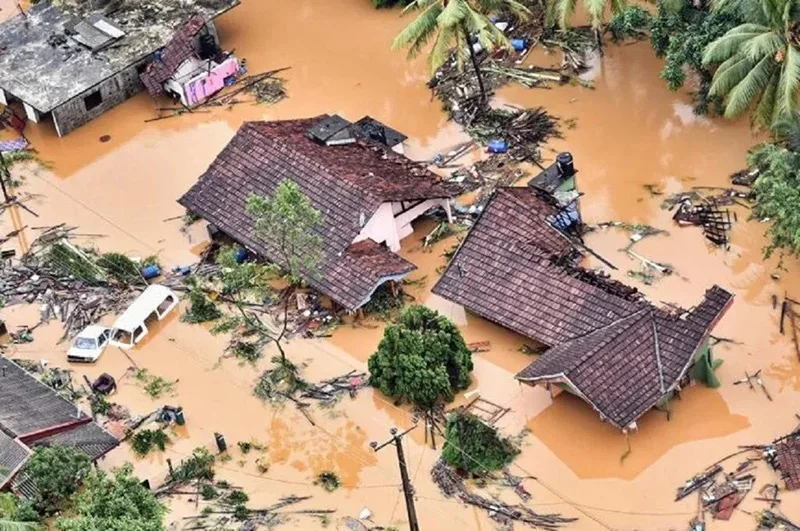
A great deal has been said about Cyclone Ditwah and its impact. To my mind one important aspect of it has not been addressed.
During the 1,400 odd landslides, it washed off a vast volume of soil which entered the various water bodies like tanks, lakes, rivers and streams etc. This process has raised their water levels reducing the water holding capacities (water holding capacity has a different meaning in soil science). What it means is that they cannot hold the same amount of water as before without spilling. Therefore, a precipitation which would not have been significant then can cause spilling of tanks leading to floods now. Hence there is a possibility of experiencing more floods in the future. Due to silting the tanks will carry less water than before, thus reducing the irrigable areas under their command. They will not be able to irrigate the same extents of paddy, thus affecting production.
How do we rectify this situation? It is desilting which can be very expensive.
It is good if these are considered in future planning.
Gamini Peiris
Panadura
Experienced agriculturist

Trump files $5bn defamation lawsuit against BBC over Panorama speech edit

UK and South Korea strike trade deal

Rob Reiner’s son Nick arrested for murder after director and wife found dead

70,297 persons still in safety centers

Showers will occur at times in the Northern, North-Central, Eastern, Uva and Central provinces

MEPA to crack down on marine polluters

‘Dates have the highest sugar content to fight Coronavirus’

Sunday Island 27 December – Headlines

#SundayIsland 17th December – Headlines

Sunday Island – 28th March

Sunday Island Headlines – 21 March

Sunday Island – 21st February – Headlines
-
 Features6 days ago
Finally, Mahinda Yapa sets the record straight
-
 Features6 days ago
Handunnetti and Colonial Shackles of English in Sri Lanka
-
 Business5 days ago
Cabinet approves establishment of two 50 MW wind power stations in Mullikulum, Mannar region
-
 News5 days ago
Gota ordered to give court evidence of life threats
-
 Features5 days ago
Cliff and Hank recreate golden era of ‘The Young Ones’
-

 Opinion6 days ago
A national post-cyclone reflection period?
-
 Features5 days ago
Sri Lanka and Global Climate Emergency: Lessons of Cyclone Ditwah
-

 Latest News6 days ago
Sri Lanka squad named for ACC Men’s U19 Asia Cup