
Editorial
No light yet at tunnel’s end


Whether President Gotabaya Rajapaksa is going to hang on to the executive presidency he won comfortably in a free and fair election in 2019 or not remains an open question. The ‘Gota go home’ pressure is mounting by the day and whether or not the proportions it is expected to reach over the weekend, after this comment has been written, will force the president to throw in the towel remains to be seen. But the whole country must clearly understand that Gota going home is not going to end the deep financial distress now gripping this country. Sri Lanka, in this past week, has been privy to the opinions of many of its 225 legislators on what is happening in the country, and what needs to be done. It what was almost like a committee stage discussion in a budget debate but with a lot of thunder and lightening thrown in. Almost all MPs had their individual say but there is little light emerging at the end of a long dark tunnel.
Tarzie Vitachchi, one of this country’s best known journalists, in the days after he retired from writing his famed Flybynight column in the Sunday Observer and joined the UN system as an international civil servant, would often talk of events and processes. He urged that events, that grab the day’s headlines, are always preceded by processes that take time to unwind. He would urge journalists to analyze the processes without being only focused on the events. We are now treated to many of these process analyses going back to the time we won – or was granted – our independence from the British. It is claimed that the failure of the political class post-1948 is what has landed us in the current mess. There are many who hark back to the good old days when everything was tickety boo with leaders of quality and integrity as opposed to the riff-raff we live with today. Be that as it may, there will be little debate that it is the political class, rather than the people as a whole, who benefited most from independence.
Going back to events and processes, many will agree that among such Rajapaksa clansmanship stands out like the proverbial sore thumbs. Few countries could claim to have three siblings and a scion as members of a single cabinet headed by a fourth sibling. Given the sundry other members scattered in the political space and have held coveted offices elsewhere in government, there is little surprise that the demand that the whole lot should go has risen to the present crescendo. But let us not forget that the UNP was called the Uncle Nephew Party in the early post-independence years for very good reason and dynastic political projects were afoot from the time of D.S. Senanayake.
Mr. Mahinda Rajapaksa must probably be glad that he was born into a large family. But does this country deserve as many Rajapaksas as we have in the corridors of power. President Gotabaya briefly took a seat next to his brother, Prime Minister Mahinda in the legislative chamber a couple of days ago to be seen but not heard. But there are stories afloat, whether right or wrong we do not know, that cracks have appeared in the upper echelons of the ruling clan as the legitimacy of the much touted 6.9 million votes and the two thirds majority is in clear decline if not altogether gone. That is very obvious to all with eyes to see and ears to hear. The president has said nothing about resigning although his proxy in the legislature, Chief Government Whip Johnston Fernando, rather than his brother Prime Minister Mahinda Rajapaksa, has categorically stated he will not resign. All that the back to the wall president who has been imploring for a national government/interim administration these past several days has said is: Let anybody show me 113 (over half the 225-member legislature) and I will call upon that group to form the government.
We had a little positive news during the past few tumultuous days when former Central Bank Senior Deputy Governor Nandalal Weerasinghe, who was in Australia (whether as visitor, migrant or any other basis we do not know) agreed to the president’s request to accept the position he was previously denied. He has returned to the country and has been appointed to the job. We’ve also got a new Secretary to the Finance Ministry, also from the Central Bank hierarchy, but no Finance Minister since Mr. Ali Sabry’s remarkably short tenure. What the former justice minister told Parliament on Friday – on what constitutional/legal basis is unclear – is that he is compelled to remain minister as there is no other taker!
Whether a president who not long ago tried hard to keep his cabinet within reasonable limits, fending off clamorous supplicants staking claims for office, plans to gift the country its smallest ever cabinet of all time remains to be seen. He seems to be keeping the positions open in the desperate hope of attaining the national/interim government he desires. Most probably he sincerely believes this is what the country now desperately needs. But it is abundantly clear that there will be no takers in the current political and economic deadlock.



Oil prices are surging again. The global benchmark, Brent crude, has surpassed USD 108 per barrel, and West Texas Intermediate has risen to USD 102 per barrel for the first time since May. They are expected to rise higher, making the global economy scream. At this rate, most countries, including Sri Lanka, will have to tighten restrictions on fuel consumption and increase prices.
US President Donald Trump and Israeli Prime Minister Benjamin Netanyahu obviously did not bargain for the unfolding situation, when they plunged head first into attacking Iran. They claimed to have decapitated Iran after killing its spiritual leader and destroying some key military installations. They overestimated their military prowess and hoped to bomb Iran into submission in a matter of days, but now all signs are that the US is heading for another military imbroglio. If only Trump and Netanyahu had heeded Sun Tzu’s advice, in The Art of War, that in a conflict one must know one’s enemy as well as oneself.
It was obvious from the very beginning that defeating Iran would not be a walk in the park for the US and Israel, and unforeseen circumstances would upend the dynamics of the conflict, but they were impervious to reason.
Iran has apparently shifted from merely threatening US naval forces to targeting American warships, including an aircraft carrier. Recent reporting describes this as a significant escalation, with the US claiming that it has either intercepted or evaded Iranian missiles. But the US vessels are far from invulnerable.
In what could be considered another dramatic turn of events, Iran-aligned Houthis have captured Mocha, a port city in Yemen. They have since been sighted advancing along the Red Sea coast to strategic islands. They are on a mission to seize control of the Bab el-Mandeb Strait. The Houthis have declared that the strategic strait is safe for all shipping companies except for Saudi vessels. Saudi Arabia, the world’s largest oil exporter, has become heavily dependent on this strategically vital sea passage, due to the closure of Hormuz Strait, which has affected about 20% of global oil exports.
The Houthis have said their military action is defensive and in response to Saudi attacks on their interests, but it will lead to a further escalation of the conflict as they have demonstrated their ability to disrupt shipping through the Bab el-Mandeb Strait. The US now has another big problem to contend with, and the unfolding Red Sea development may cost American taxpayers billions of dollars if Trump decides to intensify attacks on Houthi targets.
Iran has already shifted the West Asia conflict to the global economic front effectively by closing the Hormuz choke point, and the Houthis’ control over Bab el-Mandeb will stand it in good stead, but the closure of such chokepoints has the potential to deal a crippling blow to the world economy. The developing world will be the worst affected.
Trump’s over-optimism knows no bounds. He has stated that the Iran war will end after the US midterms due in November, but the deadlines he set in the past were not met. The Republican Party led by him is expected to suffer a huge electoral setback in November owing to his handling of the Iran conflict and domestic issues.
The Iran war is reported to have exacerbated a shortage of US missile defence weaponry, and the Department of Defence has reportedly made several deals to increase missile production urgently, but sophisticated missiles cannot be churned out overnight; it takes several years to produce some types in sufficient quantities to meet military requirements. It is believed that this kind of depletion of munition inventories could ‘constrain US military options for years and leave American troops, bases and allies more exposed in case of attacks’.
Meanwhile, the West Asia conflict has drastically changed global power dynamics. It may be too early to predict how long Iran will be able to hold out against US aggression, whether the US can continue offensive action amidst munition and economic constraints, and what the outcome of the current conflict will be, but one thing is clear; the American allies in West Asia as well as elsewhere must be demoralised perhaps to the extent of questioning their own wisdom of relying on Washington for their protection, when the best that Washington can hope for in the ongoing war with a non-nuclear power appears to be a Pyrrhic victory.

Saturday 12th September, 2026
Killings are reported with monotonous regularity in this country. Two children were killed in a grenade attack on a house in Dehiwala in the early hours yesterday. Their father, who sustained serious injury in the attack, is receiving treatment in hospital. The attackers came, lobbed the grenade and fled in a trishaw. The police have blamed an underworld gang for the attack, claiming that the attackers had mistaken the victims’ house for the residence of an associate of a rival drug dealer.
Whenever a shooting incident occurs, the police promptly attribute it to gang rivalries. True as their claims may be, the fact remains that the underworld has demonstrated its ability to strike anywhere at will. Nobody is safe. When the members of dangerous criminal gangs become targets of assassins, the vulnerability of law-abiding citizens goes without saying. The government and the police insist that their operations against underworld gangs have weakened crime syndicates considerably. If so, how is it possible that criminal gangs are operating so freely?
Crime syndicates have emerged so powerful that they even intimidate the lay custodians of holy shrines dedicated to the guardian deities of this country. They threaten to attack religious processions. One may recall that two months ago a drug dealer, known as Kanjipani Imran, operating from overseas, threatened to kill the Basnayake Nilame of the Devinuwara Devale if the annual perahera of the shrine included the popular kavadi segment without the participation of a group of dancers banned by the Devale authorities on disciplinary grounds. Imran demanded that the ban be lifted so that the dancers loyal to him could perform in the procession. The Basnayake Nilame refused to give in despite repeated threats. The police decided to have the kavadi dance scrapped in view of underworld threats and announced their decision. They claimed they had been compelled to do so as there were complaints of indecent exposure against sarong-clad kavadi dancers. No sooner had they made that announcement than they had to make an about-turn under government pressure, allowing all kavadi groups, including the one backed by Imran, to participate in the perahera. Thus, Kanjipani Imran had the last laugh.
Previous governments had their favourites in the underworld and shielded them. The J. R. Jayewardene government had criminals, such as Gonawala Sunil and Kalu Lucky, to do its dirty work. Kalu Lucky threw stones at the Supreme Court judges’ houses at the behest of his political masters who were resentful over some apex court judgements. The Ranasinghe Premadasa government shielded the likes of Soththi Upali. Beddegana Sanjeewa worked for the Chandrika Kumaratunga government, and the Mahinda Rajapaksa government had an underworld army led by notorious criminals like Julampitiya Amare and Wambotta. It is being asked in some quarters why Kanjipani Imran has not been arrested overseas and brought back. Even Makandure Madush, known as Sri Lanka’s Napoleon of Crime, was arrested in Dubai and brought here in 2019.
Frequent incidents of violence that snuff out lives may arise from fierce turf wars among drug dealers, as the police claim, but they pose a serious threat to public security. Hence the need for stringent action to prevent them. Informants are also among the victims of underworld violence. It is incumbent upon the police to redouble their efforts to neutralise the underworld.
Friday 11th September, 2026
President Anura Kumara Dissanayake’s recent announcement that the government would set up 50 new universities came while university teachers were urging the government to solve a host of issues affecting their institutions. The Federation of University Teachers’ Associations (FUTA) lost no time in responding to the President’s grand plan.
FUTA Secretary Senior Lecturer Charudatta Ilangasinghe stressed that the government should focus on maintaining, funding, and improving the existing 17 state universities. Several key Opposition figures and opinion makers have also questioned the feasibility and prioritisation of establishing 50 more universities.
FUTA staged a protest the other day to pressure the government into addressing the structural problems affecting the university system. It is doubtful whether the government took any notice of the FUTA trade union action. Power blinds rulers to ground reality and drives them to bulldoze their way through.
The JVP-NPP government ought to get its priorities right. True, it cannot be held responsible for the current university crisis, which is not of recent origin. But it will have to take urgent steps to address the problems besetting the state universities. Previous governments let their political agendas take precedence over the wellbeing of the university system. They increased university admissions without adequately expanding academic staff and infrastructure. There is no gainsaying that university intakes should be increased for the benefit of students, but there should be a corresponding increase in resource allocations if universities are to function efficiently. FUTA has warned that university admissions based on the 2025 GCE A/L results could be delayed by one to two years until the enrolment of two previous batches.
All state universities in this country are being pushed beyond their capacity. Rising student numbers have placed enormous pressure on the already inadequate academic and physical resources. In 2025, FUTA pointed out that the annual student intake had steeply increased from around 25,000 in 2015/2016 to about 45,000, causing a severe strain on the entire university system. According to media reports quoting FUTA, state universities are operating with only about 6,800 permanent academics though there is a requirement of 12,000–13,000 teachers. FUTA has stated that PhD holders are unwilling to work for the current salaries, which are heavily taxed. Universities are among the state institutions worst affected by the human capital flight.
Among the burning issues highlighted by FUTA over the years are chronic staff shortages, brain drain, funding constraints and insufficient remuneration, lack of infrastructure and research, challenges to university autonomy and academic freedom, deterioration of the quality of higher education, and the misdirection of education reforms. Successive governments have sought political solutions to serious structural problems affecting the state university system.
As we pointed out in a previous comment, students in other Asian countries typically complete their first university degrees before they turn 21–24 years, but Sri Lankan students, particularly those in the state university system, often graduate in their mid-20s, with 24–26 years being a commonly observed range, according to the OECD (Organisation for Economic Co-operation and Development) data. The late entry of Sri Lankan graduates into the workforce has economic, political and social consequences, and, above all, the delayed graduation places Sri Lankan graduates at a disadvantage in the global job market. This sorry state of affairs is basically due to cumulative institutional delays involving, among other things, the GCE A/L examination, university admissions, disruptions caused by strikes, irregular academic calendars, a shortage of academic and non-academic staff, student protests and university closures.
Modern universities are more than centres of academic excellence. They are central to the development of nations; they not only educate graduates in the conventional sense of the term but also generate new knowledge, skills and innovations, driving modern economies. The OECD has identified higher education as a key source of advanced skills in many countries, universities being the main providers of basic research that underpins innovation.
It is hoped that the government will put its grandiose plan to set up 50 universities on hold and intensify its focus on equipping the existing 17 seats of higher learning to meet current and future challenges.

If we are to live fulfilling and happy lives, we need unity, mutual understanding, harmony, as well as art – PM

Dr. Roshanie Dissanayake appointed Secretary to the Ministry of Science and Technology

Death toll from Philippines ferry fire rises to 76, with more still missing

Anthropic boss Dario Amodei calls for AI development to slow down

It’s spin vs spin as India and Sri Lanka battle for Asia Cup title

Atmospheric conditions are favorable for afternoon thundershowers in most parts of the Island today [13]

‘Dates have the highest sugar content to fight Coronavirus’

Sunday Island 27 December – Headlines

#SundayIsland 17th December – Headlines

Sunday Island – 28th March

Sunday Island Headlines – 21 March

Sunday Island – 21st February – Headlines
-

 Sports3 days ago
DDS set to lose Test captaincy
-

 Features7 days ago
After the parade: What a traffic OIC’s walk-out tells us
-

 Editorial7 days ago
Arrests as theatre
-
 News6 days ago
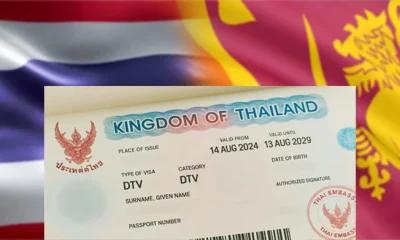
Thailand shuts door on undesirables from Sri Lanka
-

 News3 days ago
Sri Lanka faces new grid challenge as rooftop solar surges: former CEB GM
-

 Latest News7 days ago
Harshitha’s composed knock seals Sri Lanka’s semi-final berth
-
 Business6 days ago
CEB successor company breaks into top three in competitive BESS tender
-

 Latest News3 days ago
Shafali, Deepti power India into sixth T20 Asia Cup final