
Features
On a Desert Island


by Dr Nihal D Amerasekera
We’ve had a turbulent couple of years with Covid-19 and its variants. Lockdowns and its inescapable incarcerations were a trial on how to cope with loneliness. Solitude is also an opportunity to think rationally. I was shut out from the outside world for long periods. The mind then began to concentrate on what is important in life and what I can do without. It was an interesting exercise to think of the bare minimum required to maintain my sanity and survive until I was able to join the rest of the world. Money cannot buy happiness. Happiness is a state of mind which is difficult to define and often hard to achieve even if we have everything we need.
Desert Island discs is a BBC Radio programme which has been on the air since 1942. This year marks its 80th anniversary. This has been named the greatest radio programme of all time by a panel of industry experts. It is now a great British Institution.
The programme invites high-profile guests to appear on the show. Each guest is called a “castaway” and is asked to select pieces of music, books and any luxury items they wish to take with them if they were to drift away inexorably into an uninhabited island. It is an interesting exercise to think what your choices would be and what really matters to you.
We take so much for granted in our lives. It is so hard to imagine a situation being alone and so far removed from people and current events. I vividly recall reading Jonathan Swift’s Gulliver’s Travels and Daniel Defoe’s Robinson Crusoe as a teenager which brought home to me the perils, desolation and the utter loneliness of being marooned in an island. Sleeping beneath the trees one could also find true peace and freedom there. The stories made me appreciate company, courage and human endurance.
The castaway’s choice is limited to eight recordings, one book and one luxury item. A music player is included. The luxury item has to be inanimate – so no mobile phones, laptops, iPads, TV etc. Call it divine help – food and drink will be provided!! It is not known when and how one will be rescued – No divine help there!!
The past programmes of Desert Island Discs are available online. It is interesting to discover what people like Alfred Hitchcock, David Attenborough, Margaret Thatcher, Bill Gates, Helen Mirren, Whoopi Goldberg, Ted Dexter and Tony Blair have selected and the reasons for their choice. One famous British TV personality chose Rod Stewarts “Sailing” in her grief to remember the death of her son. The lyrics of that piece of music encompasses her despair. I found it hard to hold back my tears. Our selections will always resonate with our own experiences of life. I sincerely hope you would find this an interesting exercise and also give you a useful insight into your psyche. Do share your experiences of being a castaway.
The opening theme music for Desert Island discs was composed in 1942 by Eric Coates. The theme music is a haunting melody called Sleepy Lagoon which is so simple yet so bewitchingly beautiful. The tune begins with the squawking seagulls and the crashing of waves. This fine melody transports me across the wide oceans and vast stretches of land to the peace and tranquillity of the Negombo Lagoon. From 1956-58, my parents lived in Katunayake when it was a beguilingly attractive small town. The lagoon was at the back of our house. On an evening, with the setting sun, I often sat at the waters-edge with the wind whistling on my face. I watched the fishermen go out to work. The sky took on a deep crimson glow at sunset as flocks of birds flew in V-formation. This enchanting scene captures the beauty of old Ceylon which has now largely disappeared.
Music:
Making this selection is not easy. It is virtually the soundtrack of my life’s journey. The advice is to let your heart rule your head. The choice is made more for the memories they bring than for the music. I have thought long and hard and made my selections.
1. Sunil Santha – Ambilimame It brings back wonderful memories of my childhood growing up in Nugegoda in the 1940’s and 50’s. When visitors arrived we were encouraged to sing a song. I sang Ambilimame with my three cousins. Sadly two of them are now no more. Humans have been fascinated by the moon since the beginning of time. It now seems like the moon was bigger and brighter when we were kids!! The fine lyrics of the song depicts childhood innocence and their magical world of fantasy.
2. Yaad Kiye Dile Ne – The music is from the Hindi film of 1953 called Patita. The song was so beautifully sung by Lata Mangheskar and Hemant Kumar. When I hear the melody it always takes me back to the love and affection of my grandfather. I loved him dearly. He was gentle, kind and a noble man from Kandy. He was a sage, a philosopher, a man with many stories and an expert in country lore. Grandfather took me to the Metro Theatre, Nugegoda to watch Hindi and Sinhala films. I was given an ice cream at the interval and a pocket full of sweets for later. These just about made up for being bitten by bugs in those theatre seats.
3. During the morning Christian worship at my old school we sang many beautiful Hymns. One that stuck with me is “Guide Me O Thou Great Jehovah” for the sheer beauty of its melody and the lyrics. This was a popular hymn with the boys. We sang it with such gusto and so much feeling we nearly lifted the roof. This hymn is still very popular and was sung at the wedding of Prince William & Catherine Middleton in Westminster Abbey. The Hymn brings back wonderful memories of those carefree schooldays.
4. Nothing brings back memories of the Faculty of Medicine than the music of the Beatles. One that stands-out is that timeless piece called “Hard days Night“. It’s a reminder of the feeling of release from the hard grind and study while dancing at King George’s Hall to the music of the Harold Seneviratne Combo. Looking around the dance hall I can still picture Razaque Ahamat, Sidath Jayanetti and Bernard Randeniya gyrate in gay abandon. Sadly, none of them are alive today.
5. In 1991 our elder son Steve was leaving the Kingshott Preparatory School in Hertfordshire, UK. He was called upon to play Mozart Clarinet Concerto which he played with zest and eloquence, age 13. I was in the audience and felt deeply emotional and so very proud. This piece was published posthumously and was Mozart’s last major instrumental composition. The piece reminds me of a very happy time in my life.
6. In the Summer of 1996 my younger son, Andrew, was leaving Bedford School in UK. At the School’s Annual Festival of Music he played George Gershwin’s Rhapsody in Blue on the piano with the school orchestra. Andrew looked so dapper in his cream formal attire and blue bow tie. With the integration of jazz rhythms with classical music this composition soon became very popular and the most performed of all American concert works. Being biased, I would say it was beautifully played and a polished performance. This will indeed remain in my memory for the rest of my days.
7. The 1945 romantic drama Brief Encounter is a film I remember for its simple story and the brilliant acting of Trevor Howard and Celia Johnson. It is enduringly popular and considered as one of the greatest films of all time. Sergei Rachmaninoff’s Piano Concerto No. 2 is played all through the film where its beautiful melody wraps around the story most elegantly. This piece of music is also considered as one of the finest concertos of all time. I have such fond memories of watching this film with my younger son, Andrew, in his flat on the 23rd floor on a warm night in Hong Kong.
8. I was born in Kandy, that beautiful citadel in the hills. Although I have lived in the UK for nearly half a century the love and yearning for that warm tropical sunshine has never left me. Every winter I wait patiently for the Spring to arrive and the leaves to appear and the flowers to bloom. All through those cold and wet days and dark nights of winter it is Beethoven’s Spring Sonata that brings life to my soul. It is also called the Violin Sonata No. 5 in F major, Op. 24. The sonata is for violin and piano and is in four movements. All four of them are brilliant pieces of music but I have a special preference for the sublime and heart-rending second movement also called Adagio molto espressivo.
Books:
Every castaway receives a religious text of his/her choice and the Complete Works of Shakespeare as a matter of routine. I would take the King James version of the Holy Bible which was a large part of my life growing up in Ceylon.
Princess Margaret and Ian Fleming are among the many castaways who’ve selected Tolstoy’s War and Peace as their book choice. To select just one book to take with me isn’t easy. For a long spell as a castaway, I did think of The Prophet by Kahlil Gibran and The Art of Happiness by the Dalai Lama. These would help me to clean up my act when I am rescued!! After much thought I have selected Nelson Mandela’a autobiography “Long Walk to Freedom“.
As a country South Africa has been through the mill. It is now on a roller-coaster. From 1948-94 politics was dominated by Afrikaner nationalism with racial segregation and white minority rule, known officially as apartheid. From 1962 the armed struggle of the ANC against apartheid was led by Nelson Mandela. From 1964 to 1982 Mandela was incarcerated at Robben Island Prison, off Cape Town. I have visited the prison and seen for myself the rigid and harsh conditions.
It is so hard to imagine how he maintained his sanity being behind bars for so long. The regime was brutal. He had tremendous courage to stand up to the tyranny. Nelson Mandela returned to normal life after 28 years of incarceration. He led the country to majority rule and showed great willingness to forgive and reconcile. This indeed showed his wisdom and true greatness. The probity, dignity and honesty with which he led the country is a lesson for all politicians.
Luxury item:
The desert Island discs radio programme lasts approximately 45 minutes. During this time there is an interesting dialogue between the presenter and the castaway. Often the discussion is amusing and entertaining. Occasionally it takes a naughty turn. When pretty Kirsty Young was the presenter, one of the castaways wanted to take her as the luxury item, which of course she flatly refused.
Pianos, guitars and binoculars are the most-requested luxuries. But I would go for pen and paper. Writing is one of the greatest of human inventions. This has helped mankind enormously to learn, teach, discover, communicate, invent and make life so wonderful for everyone. I cannot imagine a world without writing and the written word.

Features
‘There are no private universities in Sri Lanka’ – some considerations for higher education reform

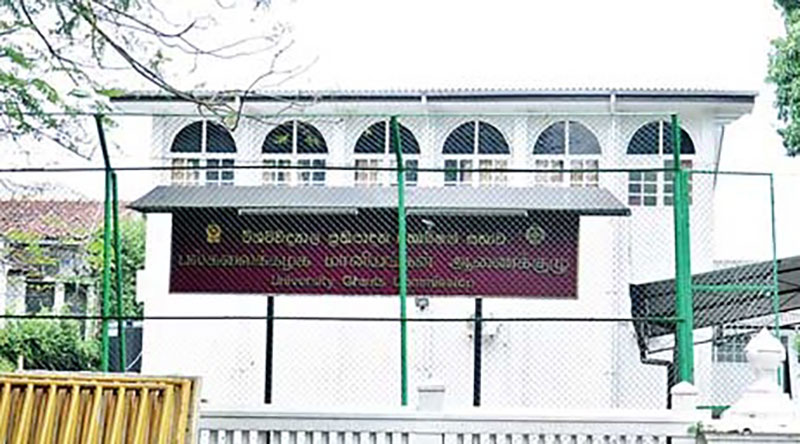
 Academics involved in education policy like to say that there is no such thing as a private university in Sri Lanka. The only ‘universities’ in the country are state universities; anything else offering degrees is a private higher education institution (HEI). This position is technically accurate. Yet, in the discourse and imagination of the public, private universities are very real – people teach in them, students register in them, families pay fees, and such degree holders enter job markets in Sri Lanka and outside.
For decades, activists concerned for public higher education have ignored or resisted looking at private HEIs, as if such scrutiny would taint them. Others have worked in both types of institutions, carrying practices from each to the other. The apex body governing state universities, the UGC, has, meanwhile, ignored the concept of conflict of interest and appointed individuals in private higher education in committees and leadership positions. It is unsurprising then that some of the ideologies informing private higher education appear in reform agendas in the state sector.
This is a good time then to consider the varying types of private HEIs around us, and to take a look at some of the issues within them in the hope that higher education reform agendas will include private, as well as state higher education.
What is a ‘private university’?
First, some clarifications. In the public imaginary, a ‘private university’ is typically an institution that provides a foreign or local degree for which the student makes a payment. But this broad classification encompasses a host of diverse institutions and types of degrees which I detail below.
The Non-State Higher Education Division (NSHE) of the Ministry of Education has recognised 295 degrees by 32 institutions. Most of these are private companies and include a handful of established, well-known private HEIs that are ‘university like’. The degrees are local degrees conferred by the institutions accredited by the NSHE Division. While private HEIs conferring local degrees must be accredited by the NSHE Division, there appears to be no legal consequence for not doing so. In addition, there are several permutations of the private degree that miss the net of this Division and the Standing Committee on Accreditation and Quality Assurance (SCAQA) that assists this Division.
For one, degrees conferred by foreign universities offered, via these same private HEIs, are not vetted by the NSHE Division. Secondly, there is a growing plethora of private HEIs which have either no physical presence locally or only a dubious presence. The University Grants Commission has notified the public, through their website, that foreign universities listed in the Commonwealth Universities Yearbook and the World Higher Education Database are recognised, but refrained from giving any other details – which degrees? Offered by what modes? These details are not known. Some of the foreign universities in the lists may be legitimate entities in their own land but the degrees conferred locally, in their name, may not adhere to curriculum or teaching specifications of the NSHE Division or the UGC.
Another troubling phenomenon is the ‘top up degree’, which appears to work on the same principle as that of a pre-paid mobile connection: if I have a Diploma or an HND of a sort, I am eligible to complete a course of study which provides me with a degree, usually from a foreign university. The idea that someone who does not initially qualify for a degree programme should be able to work their way towards one is a progressive notion. This is the concept that open and distance learning (ODL) was based on initially, but which is now sadly exploited. ODL models are expected to provide opportunity for learning for those who may be excluded from traditional learning institutions. In Sri Lanka, however, we have seen ODL become a marketplace offering easy to obtain, for-fee qualifications by institutions with little commitment to superior teaching and learning.
Finally, a perusal of the many types of private HEIs and their varied degrees bring to mind another question – how should the private degrees, provided by state institutions (that are not educational institutions), be regulated? Who should do so?
All of these create a host of problems for the public – for hopeful students and parents and trusting employers. For the higher education sector, recruitment of academic staff, too, has become difficult due to this plethora of ambiguous higher education qualifications, as I discussed in a previous Kuppi article (‘Recruiting academics to state universities’).
Some issues in private HEIs – a bellwether for change in state universities
In this second part of this article, I will discuss some aspects of work in private HEIs – albeit the more established institutions – given that such issues may appear in reform agendas in future.
Across state universities, all permanent staff of a specific category are paid according to the same criteria. The picture is not so clear when it comes to private HEIs since they are different entities legally, typically companies. Private HEIs have salary scales and financial incentives that are different to each other. The more established private HEIs reportedly have attractive renumeration packages, possibly a reason for academics of state universities migrating eagerly to such institutions during sabbatical years and on retirement. This may not of course be the case with other less established, or improperly registered HEIs of which we know little. Academic staff of these more accepted private HEIs seem to value the high financial remuneration they receive (in comparison to state universities) as something that makes their work rewarding.
Attractive remuneration is important to sustain the good life and is at times seen as the institution’s way of encouraging good work. Yet, this has implications for the future of the institution: to continue to deliver on promised financial packages, institutions must continue to have large profit margins. One strategy has been to enroll multiple cohorts of students per year, even up to three or four intakes per year. This can result in exploitative work conditions, since staff must cater to all these cohorts in that same year. If there is inadequate staff, employees are further burdened. On the other hand, if there is a sudden drop in enrolments (degrees can go out of fashion) unexpected layoffs occur. Similar to other sectors that employ short-term contract staff – including state universities – in private HEIs, too, individual teachers, who are on short term contracts that need regular renewal, can feel pressured to work under difficult or exploitative conditions.
At the same time, even in the more established private HEIs, work norms differ from those of state universities in that they include promotional work that keeps the institution’s name in the eye of the public. The Marketing (or similarly named) unit comes up in conversations as one of the most important departments. It appears to weigh in on decision-making related to the number of staff, the amount of re-sits per exams, and other pedagogically important matters. This is a worrying example of how financial rationales interfere with pedagogically or academically sound processes, resulting in problematic results in the classroom. On the plus side, junior colleagues, who had experience in both state and private HEIs, also felt that they faced less harassment in private HEIs – primarily due to the private HEIs ability to take swift action in reported cases of harassment. This is a real indictment on state institutions and their reluctance to address chronic issues of harassment in our universities.
Yet, while we hear much about problems in state universities, we hardly hear of problems that staff in private HEIs face. One rationale for a lack of public expressions by staff is that expressions of discontent might lead to trouble given the importance of reputation for private HEIs. The worry about reputational damage is a growing concern in state universities, too, as evidenced by social media policies and internal conversations on reputational damage, consequent to negative publicity. Institutional worries of reputational damage are harmful in the long run since these impact not only freedom of expression by student and staff, but also research that is possible in and about the education sector.
Some thoughts at the end…
A close look at the private higher education sector is important given its strong presence in the country. Impending reform needs to regulate this diverse array of higher education offerings in the private sector, as well as the state institutions that offer privately-funded options of higher education (a topic for a separate Kuppi on its own). It is time we carefully considered how to build a whole system of higher education out of this broken mess.
Kaushalya Perera is a senior lecturer at the University of Colombo.
Kuppi is a politics and pedagogy happening on the margins of the lecture hall that parodies, subverts, and simultaneously reaffirms social hierarchies.

Singer Nish Peiris is set to take the next big step in her music journey.
The talented vocalist, who has been seen and heard in the scene here for a short while, and was also featured with the now-defunct band, Inner Vision, has announced that she will be fully committing to her solo career, after completing her degree this year.
“I’m finishing my degree this year, and after that I’ll be fully committing to my solo music career,” Nish told The Island.
“I’ve already got a few tours lined up for next year, so I’m really excited for what’s ahead.”
Fans, no doubt, will remember Nish for her smooth voice and stage presence, and the good news is that she is now ready to chart her own path and bring new music to audiences at home and abroad.
With tours already planned for 2027, the year 2026 promises to be an exciting year for the young artiste as she steps into the spotlight on her own.
We wish Nish every success in this new chapter!

 While Sri Lankan music lovers, in Dubai, are eagerly looking forward to being a part of the action on Saturday, 25th July, with Rajiv Sebastian in the limelight, Sri Lankans, in Toronto, Canada, are equally excited and are anxiously awaiting the arrival of Sri Lanka’s famous singer/entertainer Sohan Weerasinghe.
Having done the needful with The X-Periments, the legendary performer has now embarked on an exciting new chapter – a solo career – and Toronto, Canada, will see him do the needful, on Friday, 31st July, 2026, from 8.00 pm to 12.00 am, at the Angus Glen Golf Club.

Sohan Weerasinghe: In Canada, and ready to do the needful on 31st July
Reports indicate that it’s a ‘sold out’ event – naturally with Sohan in the spotlight.

Gamini Hemalal: Creating all the excitement for Sri Lankans in Toronto
Having built his reputation through years of unforgettable performances, and hits that became part of our musical fabric, Sohan is ready to bring his own vision, sound, and stories directly to the audience, in Toronto, Canada, backed by the phenomenal Toronto Ceymphony Live Band.
Says Gamini Hemalal, who has been instrumental in reviving the Sri Lankan entertainment scene, in that part of the world:
“The countdown begins for the most exclusive musical event of the summer! Join us for a premium night of incredible music, elite hospitality, and a lavish buffet as the legendary Sohan Weerasinghe takes the stage live in Toronto!
“This is a high-end event, designed for those who appreciate exceptional entertainment and great food.”
Gamini, who is also a member of the Toronto Ceymphony Live Band, mentioned that it’s going to be an intimate musical evening with the celebrated Sohan Weerasinghe.
From packed auditoriums to intimate shows, Sohan continues to prove why he remains one of Sri Lanka’s most beloved entertainers.
For decades, Sohan Weerasinghe has been a household name in Sri Lankan entertainment.
Known for his captivating smooth voice and charismatic stage presence, Canada will experience it all on Friday, 31st July.
Next on the list of events, Gamini Hemal is working on, is Halloween night and he says “what we plan to do will be very interesting and unique … with a surprise guest star, as well!”

Trump slaps 50% tariffs on Canada and Carney vows to ‘intensify’ trade talks

Showers will occur in the Western, Sabaragamuwa and North-western provinces and in Kandy, Nuwara-Eliya, Galle and Matara districts

Move to extend judges’ retirement ages could damage Sri Lanka’s global image, warns Prof. Peiris

Dengue surge infects 76,000, claims about 53 lives

SC dismisses challenge to gender change procedures

BASL urges Justice Minister not to amend Constitution to increase retirement ages of superior court judges

‘Dates have the highest sugar content to fight Coronavirus’

Sunday Island 27 December – Headlines

#SundayIsland 17th December – Headlines

Sunday Island – 28th March

Sunday Island Headlines – 21 March

Sunday Island – 21st February – Headlines
-

 Business2 days ago
‘Giving up was never an option’: The fisherman who fought back after losing millions in SL
-
 Features2 days ago
Two memorable excerpts from a former SLAF commander’s memoir
-

 Latest News3 days ago
Davis cup Asia/Oceania Group IV 2026 to be held in Colombo from 20th to 25th July
-

 Features2 days ago
Erdoğan’s New Republic
-
 Life style2 days ago
Taste of the Swiss Alps comes to Colombo
-
 Features6 days ago
Dirty Money
-

 News3 days ago
Dengue outbreak gallops ahead: Infections surpasses 73,455, leaving 50 dead
-
 News3 days ago
Evidence recorded in money laundering case against Yoshitha Rajapaksa