
Sports
Cricket’s invisible men

Rex Clementine in Mohali
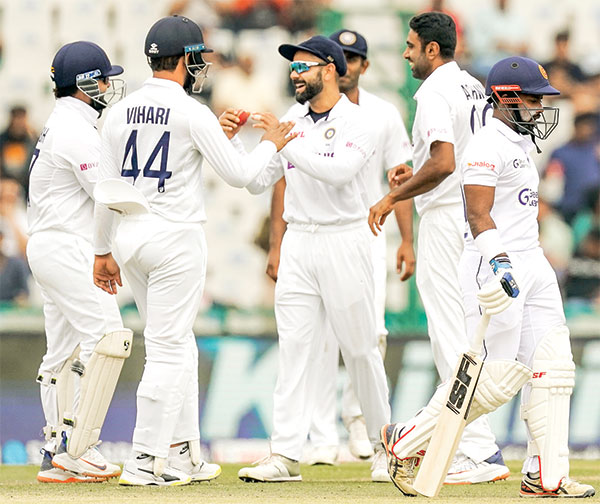
As the national cricket team made a mockery out of the opening Test match against India here in Mohali with wrong selections and combinations the team is faced with more trouble as they are unable to fly in replacements due to delay in processing visas.
Asitha Fernando, who has featured in three Test matches was the possible replacement Sri Lanka were trying to bring in but that’s not gone to plan and even if he gets the visa, he is unlikely to be available for selections for the second Test in Bangalore as he has to undergo a three day quarantine before joining the team.
 With Lahiru Kumara ruled out with a hamstring injury, Dushmantha Chameera, who was expected to feature in the second Test is complaining of ankle pain and Sri Lanka are wary of exposing the injury prone fast bowler ahead of a hectic cricket season. Although Binura Fernando is the automatic choice, the team management have concerns about him as he has previously broken down in middle of games. That makes Chamika Karunaratne the Hobson’s choice and he’s expected to feature in the side along with Suranga Lakmal and Vishwa Fernando. If Chameera doesn’t play, it will be a killer blow for Sri Lanka.
In the first Test, playing Kumara without a single First Class game under his belt since his last injury as if weren’t a bad enough, it surprised many when he limped out to bat struggling to move his feet. Assuming it was a case of Sri Lanka needing ten runs to avoid the follow on, sending out the injured last man would have made sense. But here Sri Lanka were trailing by 400 runs. Then with the team all set for a massive defeat, Kumara was sent out again in the second innings. Surely, your number 11 is not going to make a hundred. The only thing that could have happened with him coming out to bat was the fast bowler aggravating the injury.
The coaching staff seems to be heavily relying for input from Colombo, worried to take decisions independently. Video footage of the Mohali pitch was sent to Colombo to ask what combination the team should play. Sri Lanka went with three seamers and one spinner whereas India went with three spin options. Eventually, the team became the laughing stock as seamers got little purchase while India’s spinners were handful with Ravindra Jadeja and Ravichandran Ashwin accounting for 15 of the 20 wickets.
Young Pathum Nissanka had done a terrific job as an opener having scored three half-centuries in the two match series against West Indies in December. What crime he had committed to be demoted to number three remains a mystery. Interestingly, his replacement Lahiru Thirimanne since playing the Bangladesh Test match last year had not featured in any First Class games. Tactically, it was a blunder sending two left-handed batsmen against the off-spin of Ravichandran Ashwin.
As expected, Ashwin came onto the attack in the fifth over of the innings and had his man. In the second innings, Ashwin didn’t wait that long. He bowled the first over and once again dismissed Thirimanne, this time for a duck. The invisible men in Colombo had thought it was fit that Thirimanne was good enough to open batting against world’s best bowling attack having not featured in a First Class game for nearly a year.
The confidence level of the team is at a low ebb. The coaching staff seems to be not putting their foot down in areas where they need to show authority as they know they are all on borrowed time with interim appointments.
For every minute thing the invisible men in Colombo are consulted and the results have been disastrous with Sri Lanka suffering their third heaviest Test defeat in history. Team’s planning has been awful.
Sri Lanka Cricket often gets the blame for team’s sorry performances, but this debacle can not be placed on the doorstep of the board for they clearly mange only the administrative part with cricket being run by invisible men. They are not in India with the team but very soon will arrive here after the Test match is over as the carnival is set to begin. By then, the horse has bolted and the image of nation’s cricket team would have taken a huge blow. The invisible men will not get exposed. They will get their men like Mubaraks and Kandambys to run the show now that they have failed to bring in Farbrace and Ford. Cricket remains their private property and only their friends will play a role in cricket. Invisible men will continue to be invisible.



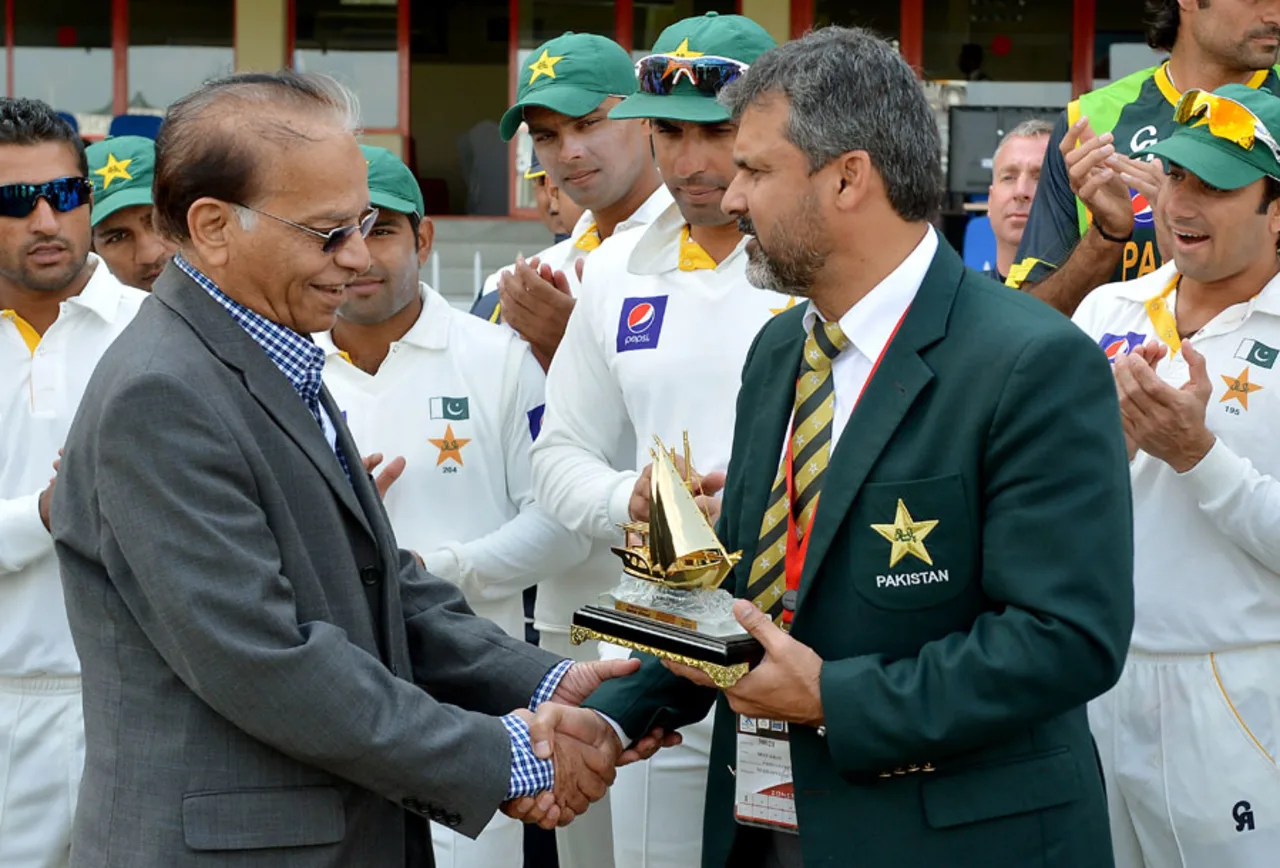
Qamar Ahmed, the cricket journalist and broadcaster, as well as a former first-class cricketer, has passed away in Karachi, Pakistan. He was 88 years old.
Ahmed – or ‘Q’ as he was fondly and widely known to his fellow journalists – was for a long time, arguably Pakistan’s most accomplished and best-known cricket journalist and broadcaster, a career he embarked upon in London after leaving behind a fledgling first-class career in Pakistan in the 1950s. Eventually he would travel the world covering international cricket for a number of newspapers and magazines, and news agencies such as Reuters and AFP. He also worked for the BBC.
Additionally, he also did broadcast work for various TV channels and radio stations, including for TVNZ during the 1992 World Cup in Australia and New Zealand – which Pakistan won. He covered every single World Cup until the 2007 one in the Caribbean. By then he had stopped covering ODIs – “pyjama cricket,” as he called it – and focused purely on Tests. The third Test between Pakistan and Sri Lanka in Sharjah in January 2014, marked his 400th Test as a journalist – only a handful have covered more.
His long and well-travelled career meant he was an eyewitness to many of Pakistan cricket’s most seminal moments, including that 1992 World Cup triumph. He was in the hotel rooms of players when the famous pay dispute of 1976-77 happened, paving the way for the professionalisation of Pakistan’s cricketers. He was also present on Pakistan’s tour of the West Indies in 1992-93, when four players – Wasim Akram, Waqar Younis, Mushtaq Ahmed and Aaqib Javed – were briefly detained for marijuana possession, chronicling it in his book ‘Testing Times’. He was also present during the terror attacks on the Sri Lanka cricket team in Lahore in March 2009. Not just Pakistan’s moments either: Q was witness to Sunil Gavaskar’s 10,000th run, Richard Hadlee’s 400th wicket, Anil Kumble’s 10-for, cricket’s 1000th Test and its 2000th in 2011.
He was also the writer of the autobiographies of Hanif Mohammad and Waqar Hasan. His last book, ‘Far More than A Game’ came out in 2020 and was a memoir of his life in the game. It was a rich life, and it meant he was a lively raconteur around press boxes and cricket circles. The most popular of his stories invariably revolved around some of Pakistan’s biggest stars in the 1970s and 80s, such as Imran Khan and Javed Miandad, both of whom were regular guests at his London home. Many of them are too salacious to publish here but are well-known to journalists who had spent time with Q. Indeed, a visit to Q’s London home was a fixture for touring cricketers (and journalists) of the time, an opportunity to enjoy not only his generous hospitality and company but also – and this was not to be missed – his culinary skills.
These relations were reflective of a different era for the sport and journalism, when there was less distance between journalists and their subjects. Q could count for instance, Mushtaq Mohammad, one of Pakistan’s most influential captains and allrounders, and Zaheer Abbas, one of their greatest batters, among his closest friends. But in truth, there are few cricketers from that time who would not have come across or engaged with Q. Another of his closest friends was the late actor Mohammad Ali, one of the great superstars of the Pakistan film industry . He was also the subject of some of Q’s funniest stories and proof of a rich life outside the game.
Even though he had stopped covering cricket regularly over the last few years, he remained a fixture in cricket circles. Last October, he attended the UK’s Cricket Media Club lunch (of which he was a member) and was the recipient of a generous and cheery birthday toast. He seemed, as ever, in good health, the result of a disciplined lifestyle and, no doubt, an athletic early career.
Indeed, it was as a left-arm spinner in Pakistan’s fledgling domestic circuit that he first rose to prominence in the mid-1950s. He did well enough across 17 first-class matches to push for a Pakistan spot, most notably for the 1957-58 tour to the Caribbean. Living in Hyderabad, however, meant he was outside the radar of selectors who, in those days, focused on the urban centres of Lahore and Karachi. Still, he does hold the rare distinction of having dismissed all the Mohammad brothers, including Hanif, Sadiq and Mushtaq on their debuts; his friendship with Mushtaq began, no doubt, when they made their first-class debuts in the same game.
One of his favourite stories was that he dismissed Hanif in the game before Hanif made his world record 499. The punchline was that Hanif had made 129 by the time Q got him, and that he holed out to long-on. He was still turning that left arm over in media games until the mid-2000s, and standing as umpire after he stopped playing, his love for the game undimmed until the very end.
[Cricinfo]

Stafanie Taylor navigated a huge scare at the hands of Scotland as West Indies scrapped their way to a second win of the Women’s T20 World Cup.
Taylor, playing her first match of the tournament, injected much-needed impetus to the West Indies’ innings with a boundary-laden 47 not out off just 19 deliveries striking at 247.36 after West Indies had slumped to 85 for 5 in the 15th over of the match.
A spirited half-century by just-turned 21-year-old opener Darcey Carter while battling a leg injury took Scotland close to victory in the face of a nervy performance with the ball and in the field from West Indies. She shared half-century partnerships with Latherine Fraser and Ailsa Lister, but Hayley Matthews’ 3 for 19 in four overs, which included 13 dot balls, gave her side just enough hope to hold onto and Aaliyah Alleyne’s three wickets in the 19th over stifled Scotland just as they threatened to take the match away once more.
Fraser had been outstanding for Scotland with 2 for 34, a spectacular catch on the boundary’s edge to remove opener Qiana Joseph and the sharp run-out of Shemaine Campbelle, West Indies’ star in their nail-biting victory over New Zealand on Saturday.
West Indies became bogged down by a disciplined Scotland bowling attack complemented by excellent fielding all round. But, led by Taylor, they scored 69 runs in the last six overs to set Scotland a sizeable target – one the qualifiers came far closer to reaching than their opponents would have liked.
Taylor came in with her side floundering and in desperate need of someone to give their innings a belated jump start. Jahzara Claxon struck West Indies’ first six on the last ball of the 17th over, heaving a short one down the leg side from Kathryn Bryce over cow corner as she and Taylor looked to accelerate. But Bryce, stationed in the same spot in the field four balls later, claimed a straightforward catch to remove Claxton and give Fraser her second wicket.
Taylor picked off boundaries down the ground and over the covers then launched twin sixes back over the bowler’s head and over deep extra cover before a third, 83m maximum over deep midwicket to give West Indies’ bowlers plenty to defend.
Scotland were sharp in the field from the outset and their bowlers kept a lid on West Indies’ openers Matthews and Joseph, who managed just 13 runs in the first three overs. Rachel Slater was particularly frugal, conceding only a wide from her opening over. An out-of-sorts Matthews produced a premeditated release shot over midwicket for four off Gabriella Fontenla, who was making the ball swing nicely. But it was Joseph’s attempt to properly break the shackles which proved her undoing and demonstrated just how up for the contest Scotland were.
Fraser offered a contender for catch of the tournament so far when Joseph muscled a Slater delivery to deep midwicket. Fraser leapt to pluck the ball from the air just inside the boundary then showed wonderful spatial awareness to avoid touching the sponge with her elbow by mere centimetres as she landed. By the end of the powerplay, West Indies were 33 for 1 and Matthews had scored 12 off 17. She managed just two more before backing away to a quicker delivery from Fraser and losing her middle stump as Scotland celebrated a spectacular start.
Sarah Bryce dropped a tough chance behind the stumps off Campbelle, on 28 when she walked past a Fraser delivery which deflected off the keeper’s gloves and ran through fine leg to the boundary. She made no mistake as sister Kathryn, who had frustrated West Indies with her superb lengths, lobbed one up outside off as Deandra Dottin advanced and turned to see her bails whipped off.
West Indies had only found the boundary seven times up to that point, at the end of the 13th over, so they were scampering singles wherever they could get them. There was to be no reprise of Campelle’s previous innings when she was run-out by Fraser on the next ball and then Kirstie Gordon pinned Chinelle Henry lbw to plunge West Indies further into danger.
Scotland began the run chase at a far more impressive clip than their opponents, Carter reeling off four boundaries in the first three overs and Fraser again in the action with 13 runs off six deliveries. Carter appeared to hurt her leg while trying to work a Matthews delivery down the leg side and she received a life on 19 when Joseph dropped what should have been a sitter for Campbelle high behind the stumps. Running between the wickets became increasingly laboured for Carter but she refused to give up and she raised her ninth half-century in T20Is off 53 balls.
After five overs, Scotland were 51 without loss, but then Matthews made the crucial strike, beating Fraser on the sweep with a faster ball that kept low. That sparked a collapse of four wickets for seven runs in the space of two overs. Matthews removed Kathryn for a second-ball duck, miscuing to mid-off and claimed her third when she trapped Megan McColl lbw attempting a reverse sweep.
Three balls earlier, McColl had been dropped by Campbelle, running from behind the stumps almost to midwicket and, shortly after McColl was dismissed, Campbelle left the field, apparently feeling unwell, to be replaced by substitute wicketkeeper Mandy Mangru. Carter and Lister stuck at their task, however, in the face of some wayward bowling and clumsy fielding as the tension started to show on West Indies. Dottin, playing her 150th T20I, sent down three wides in a row to start the 18th over then, after two fours in three balls to Carter, she broke down in tears. Her team-mates rallied round her and she managed to concede just one more run.
With Scotland needing 22 runs off the last two overs, Alleyne finally ended Carter’s knock with a return catch off a top edge then removed Lister and Gordon with consecutive balls. While West Indies continued to struggle with their ground fielding, they scraped home as Joseph removed Slater and Fontenla in the space of three balls right at the end.
SCORES:
West Indies Women 153 for 6 in 20 overs (Qiana Joseph 13, Hayley Matthews 14, Shermaine Campbelle 36, Deandra Dottin 14, Jahzara Claxton 16, Stafanie Taylor 47*; Kathryn Bryce 1-30, Rachel Slater 1-23, Katherine Fraser 2-34, Kirstie Gordon 1-36) beat Scotland Women 146 in 20 overs (Darcey Carter 59, Katheryne Fraser 20, Ailsa Lister 33; Aaliah Alleyne 3-11, Hayley Matthews 3-19, Afy Fletcher 2-16, Qiana Joseph 1-29) by seven runs
[Cricinfo]


The Vision Care 111st Colombo Tennis Championships 2026 will begin today at the Sri Lanka Tennis Association (SLTA) clay courts in Colombo with a record number of entries and the biggest prize fund in the tournament’s history worth Rs. 3 million, officials announced at a press conference.
The prestigious three-week championship, one of Sri Lanka’s oldest and most respected ‘A’ Grade tournaments, is expected to bring together the country’s leading players while providing a major stage for emerging talent from across the island.
SLTA Playing Section President Sriya Munasinghe said the tournament continues to play a key role in developing local tennis and helping young players progress to higher levels.
”This is one of the oldest ‘A’ Grade tournaments in Sri Lanka. We are honoured to host it once again on our six clay courts, especially with a record number of entries this year,” Munasinghe said.
He said the championship offers valuable opportunities for players from all regions, including Ampara and Matara, and helps identify future stars of Sri Lankan tennis.
SLTA Playing Section Captain Prashanth Dissanayake said the governing body aims to raise the standard of the competition through greater investment and long-term development plans.
”Last year we offered Rs. 2.5 million in prize money, and this year the prize fund has increased significantly. We believe greater investment will raise the standard of competition and strengthen Sri Lankan tennis,” Dissanayake said.
He revealed plans to eventually transform the event into a major South Asian tournament under the name “Colombo Open”.
”We dream of this becoming the Colombo Open, attracting the best players from South Asia. This is not only about tennis but also about building a sporting identity for Sri Lanka,” he said.
The tournament will feature Men’s and Women’s Singles and Doubles, Mixed Doubles, Junior Singles and Doubles from Under-12 to Under-18 age groups, as well as several Senior events for players over 35 years.
Vision Care will continue as the title sponsor for the 12th successive year, highlighting its long-standing commitment to Sri Lankan tennis.
Vision Care Optical Services Managing Director Janaka Fonseka said the company was proud to continue supporting the championship and promoting healthy lifestyles through sport.
”We believe sport is vital for the health of the nation and are proud to continue supporting the Colombo Championships,” Fonseka said.
Wilson will be the Official Ball Partner.

Cricket journalist and broadcast legend Qamar Ahmed dies aged 88

Stafanie Taylor, spinners help West Indies overcome Scotland threat

Showers will occur at times in the Western, Sabaragamuwa and North-western provinces and in Galle, Matara, Kandy and Nuwara-Eliya districts

Thirty-five killed as gunmen attack Niger’s biggest airport

Creditor receives USD 2.5 mn as Lankan public bears loss from theft of Treasury funds

Former Minister Nalin raises defence of double jeopardy

‘Dates have the highest sugar content to fight Coronavirus’

Sunday Island 27 December – Headlines

#SundayIsland 17th December – Headlines

Sunday Island – 28th March

Sunday Island Headlines – 21 March

Sunday Island – 21st February – Headlines
-

 News4 days ago
Release of 2025 O/L results likely to be delayed
-

 Sports4 days ago
Tharanga set for high-profile javelin clash in Ostrava
-

 Features5 days ago
Politics of protected species
-

 News3 days ago
Beijing Capital Airlines to resume flights to Colombo signalling boost to tourism
-

 News4 days ago
Theft of USD 2.5 mn from Treasury: CoPF accused of complicity in NPP cover-up
-

 News6 days ago
Commonwealth lawyers urge Lanka to uphold rule of law
-

 Opinion4 days ago
Decoding Trump’s 12.5% “Forced Labor Tariff” on Sri Lanka
-
 Features2 days ago
Killing of Colombo’s ancient trees — a warning on UN’s World Desertification Day – 17 June