
Opinion
Is religion to be at the service of humans?


The above question may generate different reactions. Some may regard it as flippant as it appears to put religion in a subservient position to humans and reduce it to something with only a utility value. This may upset a significant number of people who regard religion as occupying the most elevated station in all human affairs. Thus, there is little wonder if an overwhelming majority would take exception to this rather ‘wicked’ and reductionist view, for religion has an inviolable place in our minds, manifestly, in theory. Surely, we would defend to the hilt our religion’s unique capacity for guiding us towards that ‘good life’ although we wouldn’t be too keen to play the game, as it were. Experience tells us that, frequently, the precepts are more useful “in the breach than the observance” (with apologies to Shakespeare).
The followers of every religion consider theirs to be the definitive path to ‘redemption’, although in no way does it mean the same to devotees of different religions. In day-to-day affairs, the term “redemption” may be used broadly to mean freeing, rescue, protection, restoration, recovery, liberation, emancipation, and the like. However, each religion gives its specific meaning to what it calls “redemption”, which may not see eye to eye with that of any other. In all honesty, depending on who looks at which religion, one’s response to the idea of ‘redemption’ may shift between two extremes: the sublime and the absurd.
Let’s come back to the rather contentious issue of the relative positions of religion and human beings in the hierarchical order of importance. Surely, we will have no problem thinking of education, ethics, philosophy, art, aesthetics, science, technology, etc., as systems that are, in a sense, at the service of humans and not vice versa. Of course, you may, agree or disagree on “art for art’s sake” based on a set of criteria, but whichever side you may belong to, you wouldn’t consider it sensible to take sides in a debate on “religion for religion’s sake”. How come? When it comes to art, you may argue, with justification, either for or against the idea that art has an intrinsic value devoid of any social, political or ethical innuendo. Yet, religion with its inextricable links with an afterlife is unanimously regarded as the fail-safe entry permit to that blissful afterlife. Thus, considering our deep-seated desire for a ‘blissful’, or at least an improved existence after death, “religion for man’s sake” will have more weight than “religion for religion’s sake”. In this light, thinking of religion as something to be put at the service of the humanity wouldn’t necessarily be construed as deserving hellfire.
The other reason which justifies our tendency to see religion as having a utility value is our deep conviction of its overt ‘ethical’ significance. Consequently, it may support the seemingly impious assertion that religion had little significance if it wouldn’t serve some purpose. The historian, Noah Harari who makes a distinction between religion and spirituality says that many would resent religion being shown as a “tool”. He says, “The assertion that religion is a tool for preserving social order and for organising a large-scale cooperation may vex those for whom it represents first and foremost a spiritual path”. In other words, depending on their devoutness, people may have their reservations about religion being seen as a discipline like education, philosophy, science, etc. Couldn’t this fervent regard of awe and reverence towards one’s own religion to the exclusion of all the others have contributed in some degree to triggering enmities between different religious communities, which have sullied our history time and time again?
Perhaps, peoples’ acquired feeling that religion is way above all sciences and arts, it being the supreme path to a ‘salvation’, which means different things to the followers of different religions, contributes in some measure to religion-based discrimination. How so?
Firstly, as all will agree, our religion, which contains the ‘ultimate truth’, eclipses all the other religions and we rarely stoop to look at them. As such, for those who place religion above all other human attainments aiming at ‘ultimate happiness’, the religion that occupies this grand position is only theirs. No other religion, notwithstanding what you would say about them in public, is fit to take its place. Will this bias leave any room for them to have any respect for the followers of other religions, who, by implication, appear to them to be pathetically misguided? Wouldn’t this partiality make the devotees of each religion feel ‘superior’ to all other ‘fellow sufferers in this temporary abode of earthly existence’?
Perhaps, religion, as a social institution, would be a much less discordant topic if we could become aware of its uncommon hold on us and feel less self-righteous and complacent about our own religion’s ‘superiority’. After all, in religious conflicts, like in all other conflicts based on race, ethnicity, wealth, political power etc., the “first casualty” (also the last) is human life and not “religion” as such. Above all, what is most pathetic is that emotionally volatile issues like religion, race and ethnicity, can easily become the handiest weapon in political maneuvering. If religions, which were meant to morally elevate people, were to be an irritant and a convenient divide-and-rule tactic, it is a cause for concern. Disconcertingly, the more fervent you get about your religion, the more indifferent it makes you view other religions and the more easily you become putty in the hands of shrewd tacticians. It’s not so infrequently that such strong ‘identities’ have been used to deflect people’s opposition against the status quo.
Thus, it would be good for the sanity of society and the common wellbeing of all to not shy away from looking at the different ways in which religion influences us and, particularly, is made to influence us. Perhaps, the first step towards such a constructive scheme is to look impartially at how religion can serve us. Because, the idea that humans are “at the service of religion”, however mystical or uplifting it may sound, may entail more minuses than pluses in a multi-religious milieu. Human concerns have to take primacy over everything else, secular or religious.
Susantha Hewa


‘Ferocious in battle, Magnanimous in victory (Col Tim Collins- Brit Army)
Sri Lanka commemorated the 17th anniversary of the end of the 30-year Eelam conflict with a moving War Heroes Remembrance Day ceremony on 19 May 26 at the monument on the Parliament grounds. It was a solemn occasion when the Nation paid tribute to over 29,000 Defence and Police people (women and men) who died in the conflict. Sadly, politics, aberrations and theatrics were also on display.
The gravity of the sacrifices made and consequences of the Eelam war and two Southern terrorist insurgencies (1971 and 1988-9), are felt mostly by those who lost their loved ones in the conflicts as the nation mourns with them. Any hesitation to pay tribute belittle the fallen.
It was regrettable to see that the ceremony was also political. Why were the general public excluded from honouring the fallen? It defies understanding that such actions could take place at an event held sacred by the nation. Is there any other country where citizens are prevented from laying wreaths at a National Remembrance monument?
In the UK, from where this ceremony originates, 10,000 veterans (of an army of 109,000 -just half of Sri Lanka’s) take part in the march past every November. They are selected by their regimental associations from thousands of applications on a first come first served basis. Public access is unrestricted with numbers attending being the only barrier to viewing.
It is shocking that in Sri Lanka while public access is denied (selectively?), ‘invitations’ are given to attend a national Remembrance Day. They were restricted to just three government nominees! Who made this unwise decision and why?
Did the other government cohorts object to being invited? Would they have been embarrassed to come? Is the purpose of this to prevent prominent actors in the victory from receiving overwhelming accolades if they attended? Was there a fear of gate crashing? Perish the thought.
What is the need to make political speeches at an event to honour the nation’s dead? Couldn’t the speeches be made in Parliament or broadcast the day before? Seeing VIPs enjoying a joke at this ceremony hurts.
When laying wreaths at the monument, national customs should be followed by all, as in the past. A traditional low bow with hands clasped humbly, as at funerals, should be the form. In the West the head is bowed. It is unnecessary to imitate Americans by placing one hand over the heart when bowing, as on CNN. Bringing the other hand over the midriff elaborates but is an awkward addition.
The dress for all civilians attending should be similar, respectful and appropriate as for formal events and uniform, matching that of the retired military.
This is the time for the nation to remember and reflect for a moment on the dead in conflict, not only of the Military and Police who sacrificed their lives in thousands doing their duty but also of the innocent civilians who died in tens of thousands. Or, is it that some, other than the NOK, who survived in the North and South, have become hardened to death and do not wish to recall how appalling the losses were? Has death lost its meaning if also not its sting?
During 1988-9, when 60,000 died in 13 months (over 100 a day), a tea planter in Bandarawella was shot dead by Southern terrorists for hoisting the national flag on Independence day.
In the Eelam conflict just one regiment, (regiments are the core and heart of the Army), Gemunu Watch, lost 3,424 KIA and 4,272 WIA. The Imperial British Army after WWII lost 2551 (just over half of the Gemunu Watch number) in war in Korea (1949-51), Falklands (1982), Iraq, Afghanistan (20 years) and 40 years of insurgency in Northern Ireland. (SL Army infantry regiments (SL Light Infantry, Sinha, Gemunu, Gajaba and Vijayba) had about 19,000 of 21,000 of the Army KIA. That is the enormity of the sacrifices made by our indomitable military. Who then struggled to find heroes in the military?
Fisher Weerasuriya from Matara and farmer Vernugopal from Jaffna who never knew each other were brought to a place hundreds of miles from their villages, to blow each other’s brains out. ‘Had they a quarrel? Busy as the devil is, not the smallest. Their political leaders had fallen out; and instead of shooting one another had the cunning to get these blockheads to shoot each other’ (transcribed from ‘Sartor Resartus’ – Carlyle). Do Sri Lankan politicians who stirred the pot not know this when they fervently say they hope to prevent conflict in the future?
Is it correct then to exult that 6,000 troops died in the last phase of the war? Is that an achievement? As FM Montgomery said of the WW1 British Army “Good fighting Generals of the war appeared to have complete disregard for life’.
Reparations are claimed by the winners in wars between nations. After civil conflicts there should be reconciliation. There should be no humiliation. When will commemoration of the dead be national in Sri Lanka? How many from communal minorities attend this ceremony? Every citizen from North to South should be welcomed to attend Remembrance ceremonies in the future. That will hopefully help to sow unity.
The military died without a murmur for their companions so that the nation would survive. Let next year’s commemoration be a truly national event where the focus is on those who died while veterans in large numbers and the next of kin together with the general public, are warmly welcomed.
“If it be life that awaits, I shall live forever unconquered: If Death I shall die at last strong in my pride and free”. – Scottish National Memorial
by Old Soldier
Aragalaya betrayed? ‘The treason of the intellectuals’ in the age of populism – Part II
The JVP/NPP conceptualisation of the ‘Jathika punarudaya’ (national renaissance) interpreted the Sri Lankan Renaissance as the aspiration to regain the moment we lost in the global modernisation project, which is believed to have emerged in the twentieth century as a result of the Western European Renaissance and Enlightenment imagination. Jathika punarudaya values modernity as the era of citizens based on a representative democratic model founded on a common social contract. It values human rights, civil rights, and political rights as the core of modernity. It values social interventions based on the values of social justice and collectivism. But is the current government acting on the basis of those renaissance beliefs that they claim to believe in?
This government came to power within the framework of bourgeois parliamentary democracy. However, the opposition alleges that the government is working to limit the right of the opposition to question the government’s actions within that framework, and within Parliament itself. The continued postponement of provincial council elections by the government has been criticized as a delay in the implementation of decentralised political power, especially in provinces inhabited by Tamils and Muslims.
The promise to abolish the executive presidency and restore a parliamentary-based political power structure continues to be postponed. This has drawn attention as a possible way to suppress trade union activities and intimidate political activists through repressive laws such as the Public Security Act and the Emergency Law, which are continuously implemented through the authoritarian use of the power of the executive presidency.
‘Honest party leadership,’ not the institutional system
The JVP, the core political party of the current government, which insists that its members are honest, claims that even if they violate certain rules and regulations in the course of governing, there is nothing wrong with it because it is not done for personal interest but for the common good. This implies that this government does not rely on rules, regulations, and a system of institutions built to last, but rather on the leaders of its own party, the JVP, whose leaders believe themselves to be honest. The system of institutions established on rules and regulations is for the rest of the people.
Attempts to subjugate institutions and public opinion to the government’s opinion
It is apparent that the government wants to implement its pre-designed agenda without any hindrance. To that end, the government is trying to subjugate all institutions and public opinion to its sole opinion. The most striking example of this approach is the government’s attempt to implement, without any genuine public discussion, neoliberal reforms formulated by previous governments regarding national education, which will have a decisive impact on the future of the country. The leadership brags that the proposed education reforms will be implemented as originally designed, regardless of any criticism or objections.
The government sets up committees at the local level claiming to represent the public, but people complain that they exclude anyone who does not conform to their way of thinking.
Freedom of expression
Civil rights activists say the current government’s continued use of the Online Safety Act, which was passed by the previous government despite public opposition, poses a serious threat to freedom of expression. Freedom of expression has been suppressed under the guise of legality. The government has made it a policy to summon and question individuals who criticise the government—even national-level politicians—at the CID. This amounts to intimidating its critics.
The government has not only broken its promises by failing to repeal the existing PTA but is also attempting to pass a new anti-terrorism law that local and international civil rights organizations have unanimously condemned as even more repressive. It has been stated that there is scope for the proposed new law to intensify the current use of anti-terrorism law as a weapon to suppress freedom of expression.
“The Arts Council has become an arts police!”
The latest instance of the government’s attempt to curb freedom of expression that has come under serious public criticism is the detention of four books by a Sri Lankan writer, Theebachelvan, who writes in Tamil, by Sri Lankan Customs when they were brought into the country from India. Later, a statement issued by the Director of Customs said that two of the novels would be released based on recommendations issued by the National Arts Council and the Literary Council, while the other two would not be released based on the recommendations of those boards and the Ministry of Defense.
The statement that “The Arts Council has become an arts police!” sums up the public protest that arose questioning the “legal and moral rights of the members of the Arts Council and the Literary Council who have received political appointments” to “measure and mark the boundaries of freedom of speech and expression at their own discretion” by giving such recommendations and assuming a power that they do not have.
Going beyond this general situation, the serious question that has been raised is: on what basis did Customs consider the views expressed in the two books by Theebachelvan that have been censored to be equivalent to the crime of ‘sedition’ under Section 120 of the Penal Code, which was cited as the reason for the detention? A related question is whether there is a connection between the allegation of sedition and the fact that the writer is a Tamil from Kilinochchi.
The irony here is the intervention of the current government’s Minister of Culture, the heads of the Arts Council under the Ministry of Culture, and its own literary sub-council in deciding this matter, along with the follow-up statements defending the government’s decision made by the same authorities, as well as by writers, artists, intellectuals, and academics who have been holding positions under the current government and those who have not.
There was strong public criticism that these individuals—who were believed to have held radical, liberal views on freedom of expression and ethnic rights before the current government came to power—have been appointed to various positions under the current government and now approve its repressive decisions in the name of ethnic reconciliation.
The following sentiments extracted from the comments made by Sumathy Sivamohan on her FB page, expressing her shock at a statement made by one of the leading Sinhala writers involved in making such statements, encapsulate the essence of the public criticism of the issue:
” I am shocked at [name of the person]’s words on the detainment of Theebachelvan’s works by Customs. … The radicalness, the liberalness, are just thin veneers of their Sinhala-only stances. …. Now, they talk of Reconciliation. Reconciliation via Repression. …. Reconciliation, my foot! …. reconciliation is in your head, I think …. [I am] outraged. But now, [I] am certain of one thing. This is the bluff and bluster of liberals. …. That [name of the person] and others think, when Sinhala people think there’s reconciliation, there’s reconciliation, smacks of very deep-rooted racism
I don’t understand the argument, ‘we have to protect this government’ sentiment, touted by many liberals, who in intimate circles voice criticism. And these are the same people who supported the LTTE too, when it suited them—their liberal Sinhala agendas. … Now, they are blubbering …. it is shocking, for it whisks the mask off the faces of these liberal faces. There is a side of Sinhala liberalism that slavishly supports sentiments pertaining to the LTTE. They are the same, they are all the same. Those radicals, those liberals, those everybody, who think because they are Sinhala they have superior knowledge of matters. Sickening.” (reproduced with permission). (To be continued)
by Kumudu Kusum Kumara


 (The author is on X as @sasmester)
On 6 May 2026, I wrote an essay in this column titled, ‘Monks, the Law and the Future of the Buddhist Monastic Order.’ While my point of departure was the arrest of 22 Buddhist monks on narcotics charges, my focus was the need to treat everyone in this country equally before the law – including Buddhist monks. The fact that the Mahanayaka Theros had requested in a statement that the errant monks be thoroughly investigated and legally dealt with was encouraging given their usual silence in such cases. Now, another – and an even more visible case – has come to the fore. This time, the Chief Prelate of the Atamasthana, Venerable Pallegama Hemarathana Thero, has been accused of sexually abusing an underage girl from Anuradhapura. The National Child Protection Authority reported the facts of the incident that had been discovered to the Anuradhapura Magistrate’s Court on 8 May 2026, and the court subsequently ordered the arrest of the suspect monk and the girl’s mother. Anuradhapura Chief Magistrate has also imposed a foreign travel ban on the suspect monk.
But unlike with the 22 monks in the earlier case, the usual silence on the part of the Reverend Mahanayakas and other senior monks have descended upon Venerable Hemarathana’s case and the seeming non-equality before the law seems to prevail again – at least to some extent. This time, there are no public statements or meetings with the President to urge action to the ‘fullest extent of the law’ as was the case earlier. One must assume this is because the accused this time is a senior and influential prelate as opposed to a group of unknown young monks in the earlier case.
While his case was gathering momentum both in the courts and in public discourse, Ven Hemaratana promptly admitted himself to a comfortable private hospital in Colombo following the established path already followed by many affluent suspects. However, he was officially arrested on 8 May 2026. It is unfortunate that he resorted to this course of action rather than presenting himself to the prison authorities through the courts. This is because this action of anticipated privilege places him on par with all the powerful suspects in this country in recent times who have taken the same path. This is a matter of his own choice. My understanding is Venerable Hemarathana, after being arrested at the private hospital has been officially placed under remand and held in a government hospital under prison custody. While the law has worked here in terms of the arrest and the preceding action unlike numerous other occasions in recent decades when it comes to powerful individuals, many commentators claim it has still been somewhat slow. This perception also comes from the long history of negative experiences society has witnessed and the expectation of better delivery of justice under the watch of the present government. Overall, however, I think the procedure so far indicates a somewhat positive development given the unenviable history involving such high-profile cases in the past. But the public vigilance over the case should not diminish.
However, despite the typical silence within the formal Buddhist ecclesiastical establishment, there is considerable debate and often unmitigated noise mostly emanating from social media clamouring for the need for justice for the allegedly abused girl. If not for this noise, my sense is, the present case too might have been swept under the carpet as has been done many times before in similar circumstances.
But the social media clamour, despite its positive impact on pressuring government agencies towards action, has its own major failings. Many of these articulations have already decided upon Venerable Hemarathana’s guilt as if they had access to all the evidence in the case and have unparalleled legal expertise that would allow them to act as judge, jury and executioner in a court of public popularity. This approach itself is very dangerous. Irrespective of how we may feel about the case and the plight of the young girl who has been victimised in more ways than one, Venerable Hemarathana is still merely an accused or suspect. Nothing has been proven beyond any doubt in a court of law. Social media acting as an all-inclusive judicial mechanism is simply dangerous and unintelligent. The next victim can easily be any one of us for no good reason and the present social media trend-setters have already set the precedent.
The only sensible thing the social media and intelligent citizens, particularly Buddhists can do is not to make judgements in a situation where they simply cannot, but contribute to sensible and thoughtful debate and pressure the Buddhist establishment as well as the government to initiate urgent ecclesiastical reforms and ensure monks are treated exactly the same as all other citizens when they violate the law of the land. Hiding or protecting wrongdoers is not the solution as it will only make matters worse in the long run.
A somewhat comparative but limited global example is the Catholic Church which has faced extensive and recurring controversies regarding child sexual abuse across almost all continents, mostly as a vocal public discourse from the 1980s onward. It would be good to see how these controversies emerged and what happened.
The controversies in the United States emerged in 1985, 2002, 2018 even though it is the 2002 Boston Globe exposé that is considered the most damaging and became a global turning point indicating systemic institutional silence within the church. The controversies in Ireland emerged between the 1990s and 2009 mostly emanating from several government-commissioned reports that include the Ryan Report (2009) and Murphy Report (2009), which documented widespread physical and sexual abuse in Church-controlled institutions from 1936 to 1999, which concluded both the Church and state failed to protect children. Similar conservatories concerning the Catholic Church have emerged in Canada between the 1990s and 2015; in Australia between 2012 and 2018 as well as in other countries like Germany, Belgium, the Netherlands, France, Spain, Mexico and Chile.
What is important is these controversies created considerable public concern, characterised by a profound loss of institutional trust and demands for transparency. Crucially, these scandals fundamentally transformed the public perception of the Church and prompted significant legal and institutional reforms globally. This sense of public outrage, concern, demand for institutional reform and follow-up action is what is woefully lacking in Sri Lanka when it comes to the Buddhist monastic order.
But the Buddhist order certainly needs reform. And it needs such reform urgently and we must see these reforms in action without delay. Monastic orders should not be allowed to deal with or protect wrongdoers when they violate the law. Dealing with such situations should only be up to the legal and judicial system of the country.
Venerable Galkande Dammananda, in a YouTube interview with Saroj Pathirana on 18 May 2026 clearly noted that any member of the clergy who has violated the law should be dealt with by the law and it would simply be wrong not to do so. He was very clear in his explanation that no exemptions should be provided to monks. This basic legal and commonsense position which we seem to have forgotten in this country when it comes to powerful people in general and Buddhist monks in particular, should be the point of departure for reforming the Buddhist monastic order.
It would be instructive to understand the dilemmas faced by the Catholic Church globally if we are serious about getting Buddhist institutional network reformed. The crisis in the Catholic Church and its long-term neglect of justice and silence over wrongdoing ensured many people, particularly in countries like the United States distanced themselves from the church. Any inaction on the part of the Buddhist order and the government might lead the future of the Buddhist establishment in this direction too. One should not disregard the present unhappiness that is clearly visible and felt in society, mostly articulated in social media. These are mostly Buddhist voices.
We need to decide whether we want to reform our institutions and go forward or allow them to collapse and descend into chaos. The people should not forget that like any elected government, the Buddhist as well as other religious establishments survive on our collective kindness. And that kindness should not be based on blind and unintelligent faith. If they do not reform themselves and reinvent themselves, they certainly do not deserve our support.

Let us all build a society valued with peace and harmony, guided by unity and solidarity beyond all differences – PM

Showers will occur at times in the Western, Sabaragamuwa and North-western provinces and in Galle, Matara, Kandy and Nuwara-Eliya districts

Rajitha calls for combined lists, denounces those unwilling to join as traitors

20 lawmakers, four officials visiting China

More Japanese funds for demining operations in the north

Clingendael Institute delegation visits Pathfinder Foundation

‘Dates have the highest sugar content to fight Coronavirus’

Sunday Island 27 December – Headlines

#SundayIsland 17th December – Headlines

Sunday Island – 28th March

Sunday Island Headlines – 21 March

Sunday Island – 21st February – Headlines
-

 Business6 days ago
Historic launch of CCWE Fashion Week & International Summit 2026
-

 News4 days ago
All-New GRAVITE launches at LKR 6.99 Mn
-
 News3 days ago
Police probe underway to ascertain links between criminals deported from UAE and local politicians
-
 Features4 days ago
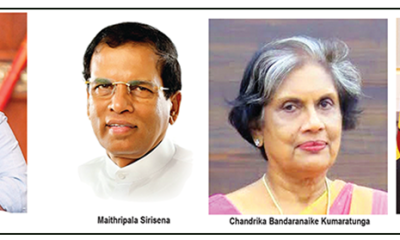
The NPP’s pivot to the past
-
 News2 days ago
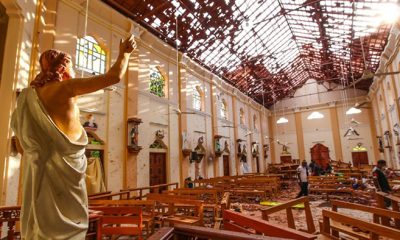
Easter Sunday carnage: Court told Maulana’s statement cannot be accepted without cross-examination
-

 Opinion6 days ago
The need to reform Buddhist ecclesiastical order
-
 Features4 days ago
End of Peacekeeping
-
 News3 days ago
Dickoya double murder suspect arrested