
Features
MINISTRY of JUSTICE LEGAL REFORMS: Sudden withdrawal of prohibition of obscene publications

by Kalyananda Tiranagama
Executive Director
Lawyers for Human Rights and Development
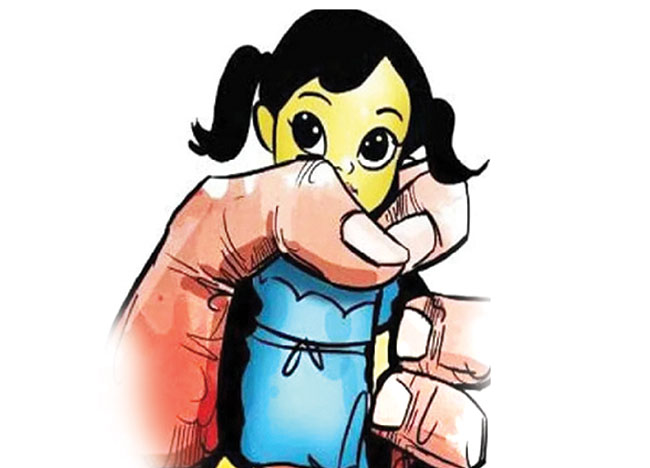
The Ministry of Justice has published in the Gazette on December 24, 2021 the Prohibition of Obscene Publications Bill aimed at prohibiting the publication, distribution, sale, import and export of any matter, object or thing which is obscene. The Bill was to be enacted to curb child pornography as well as to safeguard those who fall victim to harassment and exploitation due to absence of strict laws to deal with offenders.
The word ‘obscene’ has been described in the Bill as ‘any matter, object or thing, which by itself or where it comprises more than one distinct component taken by itself, is sufficient to deprave and corrupt the mind of a reasonable person, but does not include any matter, object or thing containing anything done in the interest of science, literature, art, education or learning’.
As reported in the press, in a dramatic turn of events, the Bill has been withdrawn by the Minister of Justice just 48 hours after its publication. The Secretary to the Ministry has stated that the decision to withdraw the Bill was taken due to concerns raised by civil society activists and other stakeholders, objecting to the bill on several grounds including copyrights. An amended Bill will be presented to Cabinet for approval, once discussions are held with interested parties, including the BASL.
This is an amendment long overdue. To combat increasing sexual abuse of women and children, there is an urgent need of strengthening the law against obscene publications.
On a perusal of Police statistics relating to sexual offences against women and children during the last 25 years, it clearly appears that there has been a continuous increase in the number of sexual offences against women and children.
There are a large number of obscene and pornographic publications brought out in our country. There can be no doubt that the pornographic and obscene material easily available in our society have heavily contributed to the continuous increase in the number of sexual offences against women and children throughout the country.
Soft pornographic materials openly displayed and freely available throughout the country are more harmful than hard pornographic publications which have a very limited circulation, being patently illegal and circulated stealthily.
Much of the material contained in the soft pornographic publications will have a destructive effect in the long term on the reader, corrupting his mind and debasing his character. Any person including children can have easy access to them.
Soft pornographic publications can have the effect of: a. Corrupting the minds of those who read them; b. Destroying the moral base of the society; c. Prompting children to prematurely engage in sex; d. Promoting sexual abuse of women and children; e. Promoting perverse sexual habits; and f. Promoting prostitution.
Existing Law on Obscene Publications
Legal provisions dealing with obscene publications in Sri Lanka are found in Sections 285 and 286 of the Penal Code and in the Obscene Publications Ordinance No. 4 of 1927 as amended by Act No. 22 of 1983. Two new Sections -S. 286A and S. 360B. were introduced by the 1995 Amendment to the Penal Code. While Sections 285 and 286 deal with printing, importing, distribution, sale and possession of obscene publications in general, sections 286A and 360B deal with employing, using or permitting children to appear or perform in obscene or indecent exhibitions, shows or photographs.
A. Penal Code Provisions:
S. 285 Whoever sells or distributes, imports, or prints for sale or hire, or willfully exhibits to public view, any obscene book, pamphlet, paper drawing, painting, photograph, representation or figure or attempts or offers so to do, shall be punished with imprisonment of either description for a term which may extend to three months or with fine or both.
S. 286 Whoever has in his possession any such obscene book or other thing as is mentioned in the last preceding section shall be punished with imprisonment which may extend to three months or with fine, or with both.
S. 286A (1) Any person who –
(a)
hires, employs, assists, persuades, uses, induces or coerces any child to appear or perform in any obscene or indecent exhibition or show or to pose or model for or to appear in, any obscene or indecent photograph or film or who sells or distributes, or otherwise publishes, or has in his possession, any such photograph or film; or
(b)
being a parent, guardian or person having the custody of a child, causes or allows such child to be employed, or to participate, in any obscene or indecent exhibition or show or to pose or model for or to appear in, any obscene or indecent photograph or film as is referred to in paragraph (a);
(i)
takes or assists in taking of any indecent photographs of a child; or
(ii)
distributes or shows any such photograph or any publication containing such photograph;
(iii)
has in his possession for distribution or showing, any such photograph or publication;
(iv)
publishes or causes to be published, any such photograph or publishes or causes to be published, any advertisement capable of conveying the message that the advertiser or person named in the advertisement distributes or shows any such photograph or any publication or intends to do so –
commits the offence of obscene publication and exhibition relating to children and shall on conviction be punished with imprisonment of either description for a term not less than two years and not exceeding ten years and may also be punished with a fine.
(2)
In this section – “child means ‘a person under eighteen years of age; and ‘film’ includes ‘any form of video recording’.
S. 360B (1) Whoever –
(a)
knowingly permits any child to remain in any premises, for the purposes of causing such child to be sexually abused or to participate in any form of sexual activity or in any obscene or indecent exhibition or show;
(b)
acts as a procurer of a child for the purposes of sexual intercourse or for any form of sexual abuse;
©
induces a person to be a client of a child for sexual intercourse or for any form of sexual abuse, by means of print or other media, oral advertisements or other similar means;
(d)
takes advantage of his influence over, or his relationship to, a child, to procure such child for sexual intercourse or for any form of sexual abuse;
(e)
threatens or uses violence towards a child to procure such child for sexual intercourse or for any form of sexual abuse;
(f)
gives monetary consideration, goods or other benefits to a child or his parents with intent to procure such child for sexual intercourse or for any form of sexual abuse, – commits the offence of ‘sexual exploitation of children’ and shall on conviction be punished with imprisonment of either description for a term not less than five years and not exceeding twenty years and may also be punished with a fine.
B. Obscene Publications Ordinance Provisions
S. 2 It shall be an offence against this Ordinance punishable on conviction by a Magistrate –
(1)
for the first offence, with a fine not exceeding two thousand rupees (one thousand rupees before the (1983) amendment) or imprisonment of either description for a term not exceeding six months (three months before the amendment), or with both such fine and imprisonment; and
(2)
for a subsequent offence committed after a conviction for the first offence, with imprisonment of either description for a term not exceeding six months and in addition with a fine not exceeding two thousand rupees, to do any of the following acts namely : –
(a)
for purposes of or by way of trade or for distribution or public exhibition to make or produce or have in possession for purposes stated or otherwise, obscene writings, drawings, prints, paintings, printed matter, pictures, posters, emblems, photographs, cinematographs films, video cassettes or any other obscene objects;
(b)
for the purposes above mentioned to import, convey or export or cause to be imported, conveyed, or exported any of the said obscene matters or things, or in any manner whatsoever to put them into circulation;
(c)
to carry on or take part in a business, whether public or private, concerned with any of the said obscene matters or things, or to deal in the said matters or things in any manner whatsoever, or to distribute them or to exhibit them publicly or to make a business of lending them;
(d)
to advertise or make known by any means whatsoever, in view of assisting in the said punishable circulation or traffic, that a person is engaged in any of the above punishable acts, or to advertise or to make known how or from whom the said obscene matters or things can be procured either directly or indirectly.
(To be continued)



By a Concerned Aficionado
In my article “Whatever on earth happened to meritocracy, pragmatism and honesty in Sri Lanka?” published in The Island on 08 September 2026, I examined the total and systematic decay of our public institutions, the collapse of administrative rigour, as well as the ubiquitous and universal spread of corruption. The response from a plethora of readers who knew the originator of that article was overwhelming.
However, one particular message from a long-time friend stopped me in my tracks. “Superb article“, he wrote, before delivering a sharp, uncomfortable counterpunch: “One thing you missed. It is not just the politicians. In a democracy, we elect the politicians we deserve.” I have known that friend of mine as one who responds only when he has something really worthwhile to say. True to that perspective, I must admit that he was absolutely right, and this article is an extension of the original one to justify that ever-so-true contention. It is best considered to be an addendum to the original literary piece.
It is perhaps easy and even reassuring to direct our collective rage at the occupants of the Parliament premises. It is a well-known axiom that blaming the ruling class is our ever-present national pastime. We point to their venality, their incompetence, their flagrant disregard for the rule of law, and their insatiable appetite for plunder. However, in doing so, we conveniently ignore a fundamental truth of democratic governance: politicians do not drop from the sky, nor do they seize power in a vacuum. They are elected by us, chosen by our ballots, sustained by our applause, and very often protected by our silence.
If Sri Lanka has spent three-quarters of a century careening from one avoidable disaster to another, it is not merely because we have been cursed with poor leadership. It is because we, as an electorate, have repeatedly rewarded short-sightedness, bigotry, and outright criminality. Until we are willing to hold up the mirror and confront the stupidity, greed, and moral complacency of our own populace, no political shift will be able to save us.
The Legacy of 1956: Buying Short-Term Dominance at the Cost of the Nation
To understand the decay of Sri Lankan meritocracy, one must trace the line back to 1956; the watershed moment when identity politics officially displaced institutional competence. That is the time when the concept of harnessing the best qualified and the eminently suitable persons for positions in our governing infrastructure was put on the back burner.
In the pursuit of electoral victory, the ultimately successful political establishment offered the majority community, the Sinhalese, an irresistible bargain: language-based domination over public sector jobs, university admissions, and state resources. It was a classic appeal to tribal prejudice over merit, and the electorate swallowed it whole; hook, line and sinker. Rather than building a modern, competitive economy capable of offering world-class education and opportunity for all, the public demanded, and received, a system that prioritised ethnic identity over capability.
The long-term consequences of such injudicious attempts were absolutely catastrophic. By replacing meritocracy with communal quotas and political favouritism, we systematically dismantled our administrative civil service, alienated talented minorities, and sowed the seeds of a bloody, three-decade-long civil war that came as an inevitable aftermath. Yet for all that, we never learnt, and generation after generation of voters continued to validate this broken, unsuccessful formula. We repeatedly chose political platforms that promised dominance over our neighbours rather than excellence for our children.
The Free Rice Fallacy: Entitlement, Socialism, and Economic Illiteracy
If 1956 institutionalised sectarian division, the elections of the 1970s established a state of economic delusion.
Promising “free rice from the moon” became the standard currency of Sri Lankan electioneering. The public enthusiastically embraced political movements that preached state-controlled redistribution, the confiscation of private enterprise, and the handing out of unearned doles and unjustified bonuses. Socialism, in its Sri Lankan format, was rarely about building productive capacity; it was about taking from one group to give to another, while starving the state of the capital required for modernisation and development.
In that scenario, we demanded that the state subsidise our fuel, our electricity, our food, and our employment, entirely indifferent to whether the national treasury had the funds to pay for it. When governments attempted sensible, long-term structural reforms, voters promptly threw them out of office in favour of firebrands promising cheaper bread and risk-free state jobs. The electorate nurtured a culture of entitlement while despising the enterprise and productivity required to sustain it. We wanted the standard of living of a developed nation without doing the really hard work needed for building one. The total economic collapse in recent years was not a sudden act of fate; it was the inevitable final invoice for decades of economic illiteracy that the voters insisted on being fed and perpetuated.
The Moral Bankruptcy: Elevating the Totally Unfit into Power
Perhaps the most damning evidence of electoral collusion and intense folly is our choice of our political representatives.
In a healthy democracy, a criminal record, a record of violence, or a history of predatory behaviour, would immediately disqualify an individual from public life. However, in our beautiful Sri Lanka, such credentials often appear to be electoral assets of one form or another.
Consider our voting patterns over the decades. We have elected individuals convicted of murder. We have returned to power figures implicated in extortion, assault, rape and child abuse. We have cheered for despicable thugs who entered parliament not to legislate, but to intimidate. When a political figure delivers a local road, secures a government clerk job for a relative, or distributes liquor and roofing sheets before an election, their moral failures and criminal convictions are instantly forgiven and forgotten.
In 2005, 2019, and multiple instances in between and extending on to a time even after that, the electorate rallied around hyper-nationalist rhetoric, willingly trading civil liberties, institutional integrity, and minority rights for the illusion of strongman protection. We repeatedly voted for political actors who weaponised fear, played on deeply ingrained prejudices, and subverted judicial independence.
When a society consistently sends convicts, rapists, and crooks to the legislature, it can no longer pretend to be the innocent victim of bad leadership. The parliament simply becomes a concentrated mirror of various misdemeanours that are rampant on the streets.
The Myth of the Saviour: Waiting for a Moses Who Will Never Come
A recurring theme in Sri Lankan political discourse is the longing for a benevolent strongman: a Lee Kuan Yew, or even a “Moses” who will part the Red Sea of our troubles and lead us single-handedly to the promised land. This is indeed an ever so dangerous fantasy. We are yet to find statesmen or stateswomen who come even close to such hallowed sets of legislators who could provide the ultimate political benefits to the populace.
Singapore’s transformation under Lee Kuan Yew was not achieved through political magic; it was built on an uncompromising commitment to meritocracy, rule of law, zero tolerance for corruption, and a disciplined citizen body willing to make short-term sacrifices for long-term survival. Lee Kuan Yew did not pander to racial majoritarianism, nor did he offer free doles to win votes. If a leader with Lee Kuan Yew’s platform were to run for office in Sri Lanka tomorrow, promising hard work, strict discipline, the removal of state subsidies, equal rights for all communities, and absolute meritocracy, he or she would most likely lose his or her money that was paid as the election deposit.
Our public does not actually want a Lee Kuan Yew. We want a patron who will give us special privileges while enforcing the rules on everyone else. We generally crave a government that hires our unqualified sycophants while expecting the state administration to run with world-class efficiency.
Corruption in Sri Lanka is not isolated to the top of the pyramid. It is a capillary system that reaches every level of society. It is the driver paying a bribe to avoid a traffic fine, the parent paying a gift to secure a school admission, the clerk expecting a kickback to process a permit, and the voter trading a ballot for a bag of fertiliser, a lunch or dinner packet or even a bottle of arrack. The politician is merely the professionalised version of the dastardly, arrogant members that are a part and parcel of the broader public.
Time to Call a Spade a Spade: The Path to Electoral Maturity
If Sri Lanka is ever to recover from its present torrid state, the shift cannot begin in the Cabinet of Ministers; it must begin in the mind of the voter. We must develop the maturity to call a spade just what it is: a spade, starting with our own complicity.
What should real electoral maturity look like?
· Abandoning the Culture of Doles: We must stop voting for politicians who promise free handouts, unearned subsidies, and artificial price controls. A nation cannot borrow its way to prosperity, and any candidate promising something for nothing is two-faced and telling blatant lies to you.
· Rejecting Ethnic and Religious Polarisation:
Manipulators use identity politics for one reason only: which is the proven concept that it works. As long as voters respond to tribal fear-mongering and majoritarian posturing, politicians will continue to use it as a smoke screen to cover up thuggery, theft and incompetence.
· Demanding Moral Disqualification:
We must enforce a zero-tolerance policy at the ballot box for candidates with records of violence, corruption, and lawlessness. If a party nominates a known crook, their entire political ticket must be drastically and completely punished at the polls.
· Insisting on Meritocracy in All Things:
Meritocracy cannot be something we demand only when it suits us. It requires a willingness to accept that irrefutable adage: the best person gets the job, the admission, or the contract; regardless of their ethnicity, religion, or political connections. The working principle should be that the best qualified and the most competent would be chosen
The Choice Ahead
The current crisis has exposed the bankruptcy of our age-old political model. Yet for all that, from a worthwhile perspective, changing the actors performing on the stage without totally changing the standards and expectations of the audience will yield the same calamity through a different performance by an identical cohort of performers. The recipients of the performance in the audience, which is the voting general public, are the ones who should matter and in whose telling response the future lies.
Very many of our politicians have been corrupt, opportunistic, and incompetent, simply because we, as the electorate, have permitted, encouraged, and rewarded those exact traits for seventy years. They are a reflection of our priorities: priorities that are totally ill-advised and even significantly misled.
If we want honest, realistic, and far-sighted leaders, we must first become an electorate that values morality, practicality, and vision; a constituency that is totally above quick favours and communal tribalism. The promised land is not a destination to which a single leader can carry us on his or her shoulders. It is a state of society that must be earned through collective discipline, moral clarity, and the courage to stop being deceitful to ourselves. Ultimately, it will be the court of public opinion that should deliver a suitable and appropriate verdict to our politicians.
Fate often provides no abiding support and backing to the favourites of others, and time keeps an honest score in its own right. As far as the electorate goes, what we bring to the arena in our expectations and perspectives is precisely what we take home. The game will challenge us, test us, and occasionally break us; but it never cheats us. We must stand firm, play the long game, unwaveringly insist on excellence, and let the results speak for themselves. The future does not belong to politicians of varying hues and self-serving goals; it rests, as it always should, in the hands of our own general public, as the discerning electorate of this thrice-blessed land.

‘A parliamentary majority cannot change elephant behaviour,’ says Supun Lahiru Prakash, warning that failed holding ground has become a death trap
By Ifham Nizam
Sri Lanka cannot solve its escalating human-elephant conflict (HEC) by repeatedly capturing elephants, removing them from their home ranges and locking them inside an enclosure, says biodiversity conservationist Supun Lahiru Prakash, who has called for an immediate rethink of the country’s continued reliance on the Horowpothana Elephant Holding Ground.
“A parliamentary majority cannot change elephant behaviour,” Supun said, warning that political decisions cannot override the biological and behavioural realities of one of Sri Lanka’s most iconic wild animals.
He described the Horowpothana facility as an “open-air elephant prison camp” founded on the failed premise of elephant “rehabilitation”, arguing that it had become a costly death trap rather than a solution to HEC.
His comments follow the reported capture of yet another elephant in the Thalawa area of Anuradhapura and its transfer to Horowpothana. The operation reportedly involved military veterinarians while Wildlife veterinary surgeons were engaged in trade union action.
According to reports, two other elephants were accidentally injected with anaesthetic during the operation but subsequently escaped, while a third elephant was captured and taken to the holding ground.
Supun questioned whether the elephant ultimately captured was actually the individual responsible for the reported conflict, while also raising serious questions about the fate of the two elephants that escaped after being anaesthetised.
He said such incidents should not be dismissed as isolated operational mistakes, but should instead prompt a much wider examination of the policy of capturing and translocating elephants.
“The human-elephant conflict in Sri Lanka is becoming increasingly severe and geographically widespread,” Supun said, warning that outdated mitigation measures were consuming public money without addressing the ecological causes of the conflict.
A failed experiment repeated
The Horowpothana Elephant Holding Ground was established pursuant to Cabinet Memorandum No. 12/0151/549/001 dated 17 March 2012 and was among four Elephant Holding Grounds proposed under the 2012 Budget.
The facility was intended to receive elephants accused of causing serious conflict, confine them, rehabilitate them and eventually release them back into the wild.
But the experience at Horowpothana has raised fundamental questions about whether that objective has ever been achieved.
According to the Auditor General’s findings, elephants were brought to the facility on 52 occasions, between 4 September 2015, and 25 June 2019. Yet by June 2019, only nine elephants remained.
Twelve elephants had reportedly died, while 31 were listed as missing.
For Supun, the figures expose the fundamental failure of the holding-ground concept.
Not a single elephant, he pointed out, has been successfully rehabilitated and released back into the wild from Horowpothana as envisaged when the facility was established.
Sri Lanka had already experimented with an elephant holding ground at Lunugamvehera in 2007. That initiative also failed after an area of the national park was fenced and trenched in an attempt to confine elephants.
Yet, instead of abandoning the concept, the government went on to establish Horowpothana at a cost exceeding Rs. 500 million.
Supun argues that Sri Lanka is now in danger of repeating the same mistake yet again.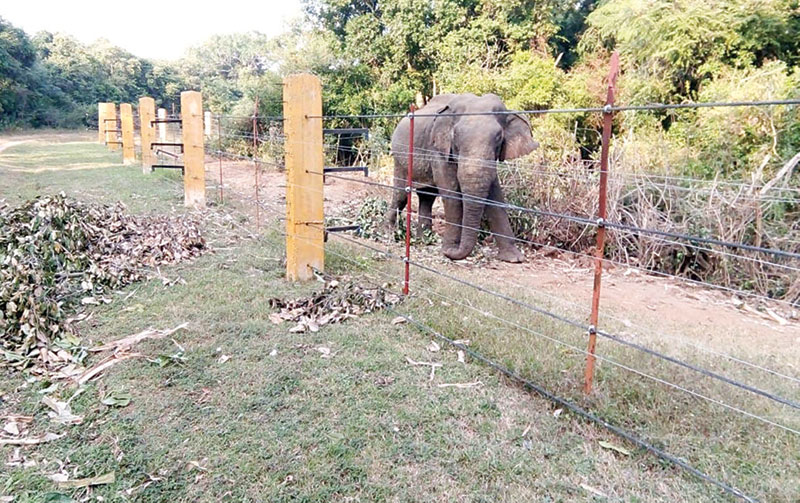
The elephant does not forget its home
One of the biggest weaknesses in the translocation approach is the assumption that removing an elephant from a conflict area will permanently remove the problem.
Wild elephants, however, have strong fidelity to their traditional home ranges.
Supun cited the well-known case of the Galgamuwa tusker “Chandi”, which was taken to Horowpothana on several occasions but repeatedly managed to find its way back to its original range.
For Supun, Chandi’s behaviour was not evidence of an animal that needed to be “rehabilitated”. It was evidence of an elephant attempting to return to the landscape it knew.
Such displaced elephants may travel long distances, through unfamiliar areas, in their attempts to return home. In doing so, they can enter villages where communities have little experience of living with elephants, potentially creating entirely new conflict zones.
An elephant that eventually returns to its original range may also become more difficult to manage, particularly if repeated capture and translocation have increased its stress and aggression.
Thus, rather than solving HEC, translocation can simply move the problem geographically and make it more complicated.
A prison without a solution
Supun said the holding-ground model fundamentally fails to recognise that elephants are wild, highly intelligent, social animals requiring space to move, forage, interact and express natural behaviour.
An elephant confined within an artificial enclosure cannot fulfil many of these biological requirements.
The result, he warned, can be severe physical and psychological stress.
An elephant attempting to escape may injure itself or break through barriers and return to the wild. One that cannot escape may remain confined, deteriorate physically and psychologically, and eventually die.
The elephant known as “Kaladi Dala Kota”, whose photograph appeared on the cover of the Auditor General’s report, became a symbol of the human and institutional failure surrounding the facility.
Supun also warned about the consequences of concentrating adult male elephants in a restricted area.
Because the elephants held at such facilities are predominantly males, increased density can generate competition and aggression, potentially resulting in injuries and deaths.
There is also a less visible conservation cost.
When adult male elephants are removed from wild populations and confined for years or for life, they are prevented from contributing to the reproductive population. Supun warned that continued removal of breeding males could eventually have implications for the genetic strength of Sri Lanka’s elephant population.
Millions spent—and elephants still starved
Perhaps the most damning evidence against the facility comes from the Auditor General’s findings concerning food supplies.
Between 1 November 2018 and 31 October 2019, a contract worth Rs. 26,133,700 was awarded for food for 30 elephants.
Yet only nine elephants were reportedly present at the holding ground by June 2019.
The audit found inadequate supervision of the quality of food supplied and noted that supply agreements had been prepared without proper studies of the foliage consumed by elephants.
Foliage that elephants did not eat was nevertheless included in the contract, supplied and paid for.
The weighing of food was also carried out at a private rice mill, without an official assigned to supervise the weighing process.
Payments were made without adequate verification of whether the quantities recorded were accurate.
According to the audit findings, food worth approximately Rs. 6.56 million was supplied in excess during part of the period despite the much smaller number of elephants actually present.
Yet, astonishingly, five of the 12 elephants reportedly died from lack of food and malnutrition.
For Supun, this contradiction alone should force the government to ask whether the facility has any legitimate future.
A place established ostensibly to rehabilitate elephants cannot credibly be defended as a conservation success when elephants confined there die from starvation and malnutrition.
Public money, political pressure
Supun said continuing to maintain such a facility and repeatedly sending elephants there was particularly difficult to justify at a time when Sri Lanka was demanding fiscal discipline and recovering from its economic crisis.
“The country cannot continue throwing public money down a bottomless pit,” he said.
However, he cautioned against placing the entire blame on the Department of Wildlife Conservation.
Wildlife officials can be caught between scientific evidence and political directives, particularly when political leaders believe that HEC can be solved through administrative orders or parliamentary decisions.
There was, he noted, a period when the Department itself had taken steps to prevent elephants from being confined at Horowpothana.
The fundamental problem, Supun stressed, is that elephant behaviour is governed by biology, ecology and evolutionary history—not by parliamentary majorities.
Time to abandon the failed model
Sri Lanka’s HEC crisis is far too serious to be reduced to a cycle of capture, translocation, escape, recapture and confinement.
Every elephant moved away from a village does not necessarily represent a problem solved. The animal may attempt to return, another elephant may occupy the vacated range, or the underlying environmental conditions that generated the conflict may remain unchanged.
Supun, therefore, called on the government to match its stated commitment to “proper studies” and “biological and modern technological approaches” with a genuine science-based HEC policy.
The country needs to understand elephant movement, habitat fragmentation, land-use change, food availability, seasonal behaviour and the circumstances that bring elephants and people into conflict.
It also needs measures that protect communities without treating the elephant as the problem that must simply be removed.
For Supun, the lesson from Horowpothana is already clear.
Sri Lanka has spent millions on an experiment that has failed to deliver its promised rehabilitation programme, while elephants have died, disappeared or spent years in confinement.
“Do not sacrifice more elephants to the Horowpothana open-air elephant prison camp,” he asked.

It is inevitable, based on the law of averages, that aircraft will overrun on landing. While we wait for the USA’s National Transportation Safety Board (NTSB) to present a detailed report on the ‘why’ and ‘how’ of the Miami accident, Sri Lankan aviation authorities should take immediate steps, as an urgent safety measure, to remove the ‘offending’ wall (at Ratmalana) and replace it with a frangible (i.e. breaking on impact) fence.
On Sunday, 6th September 2026, a Boeing 767 300 of 21 Air, an all-cargo airline on contract to Amazon Prime, overran the active runway at Miami International airport in Florida, killing five passengers and injuring five more in two vehicles travelling on two perimeter roads.
Historically, the aviation industry averages approximately 30 runway excursion (overrun) accidents per year, globally, as referenced in safety records.
In response to concerns expressed by this writer and others in the wake of the fatal overrun by a Jeju Air Boeing 737-800 at Muan International Airport ,in South Korea, on 29th December 2024, Civil Aviation Authority-Sri Lanka (CAASL) did a study on the risk probability with respect to the concrete wall at the Galle Road end of the runway at Colombo International Airport, Ratmalana (CIAR). They declared that it was improbable that a landing aircraft would overrun (i.e. exit the end of the runway) and collide with the wall. In reporting thus, CAASL falsely justified to the President and Aviation Minister that this hazardous wall could be kept and need not be replaced by a fence, as demanded by Annex 14 to the ICAO Convention of 1944.
This ‘Seeya’ has been insisting that ‘anything that can go wrong, will go wrong’ (Murphy’s Law), and sure enough, an accident of that type happened again in Miami.
So as suggested by me, the ‘risk probability’ in the Risk Analysis Matrix (above) must now be shifted from ‘Improbable’ to ‘Remote’, thus putting the ‘Risk Impact/ Severity’ in the red (2A to 3A).
It is inevitable, based on the law of averages, that aircraft will overrun on landing. While we wait for the USA’s National Transportation Safety Board (NTSB) to present a detailed report on the ‘why’ and ‘how’ of the Miami accident, Sri Lankan aviation authorities should take immediate steps, as an urgent safety measure, to remove the ‘offending’ wall and replace it with a frangible (i.e. breaking on impact) fence.
It may be argued that because the 21 Air (Amazon) Boeing 767 crashed into the fence, five innocent lives were lost, while another five persons on the ground were hospitalized with severe injuries, the presence of a wall would have prevented that. Remember that if it was a passenger aircraft and not a cargo aircraft, as in Muan, South Korea, this latest accident would have been ‘catastrophic’ (i.e. exploding on impact) with more lives lost. Most airports in the world have roads on the perimeter but they do not have concrete walls.
GUWAN SEEYA

Hettich celebrates a decade in Sri Lanka with partner meet in Colombo

The mirror of our discontent: Is our electorate the root cause?

Maris Stella Thimbirigaskatuwa, Lyceum Wattala clinch Western Province Schools Games athletics titles

GS Evo Motors launches all-new JMEV EWIND

People’s Bank powers inter-school Basketball Championship 2026

Muscle flexing, astroturfing and dog-and-pony shows

‘Dates have the highest sugar content to fight Coronavirus’

Sunday Island 27 December – Headlines

#SundayIsland 17th December – Headlines

Sunday Island – 28th March

Sunday Island Headlines – 21 March

Sunday Island – 21st February – Headlines
-

 Sports3 days ago
DDS set to lose Test captaincy
-

 Editorial7 days ago
Arrests as theatre
-

 News6 days ago
Thailand shuts door on undesirables from Sri Lanka
-

 News3 days ago
Sri Lanka faces new grid challenge as rooftop solar surges: former CEB GM
-

 Latest News7 days ago
Harshitha’s composed knock seals Sri Lanka’s semi-final berth
-

 Business6 days ago
CEB successor company breaks into top three in competitive BESS tender
-

 Latest News3 days ago
Shafali, Deepti power India into sixth T20 Asia Cup final
-

 News7 days ago
‘Choka Malli’ slips out of country before travel ban