
Features
Reminiscing a beloved brother…..

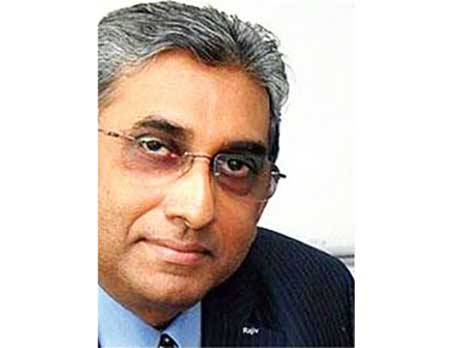
June 12, 2020, has so far been the worst day of my life. No sooner, I woke up to a normal working day, to receive a call from my younger brother telling me in a broken voice, that our beloved elder brother may have taken his own life was the most tragic piece of news I had ever received to date. I have no words to define my shock and despair. It was only a week before that we all met at a family occasion, and none of us saw anything untoward in his demeanor. To date, I am absolutely astonished at his precise planning of several months to depart from this life, and never showing any aversion to his final decision.
That was so characteristic of my brother, Rajeewa Jayaweera. He was always precise, methodical and organized and would always attend to any task with minute planning, looking into every little detail. He made decisions based on principles, rules and regulations. He possessed excellent work ethics and would never hesitate to call a spade a spade. These qualities were appreciated only by some people, as such people are rare in our present day society. However, these same qualities made him unpopular amongst some who were averse to such qualities.
His role model in life was our father, Stanley Jayaweera. He fully appreciated the qualities that our father instilled in all of us. I still recall our father telling us to always stand up and speak up for what is right and decent no matter what the consequences would be, and I must say my brother lived up to it.
Our father was a fierce patriot and so was my brother. They both were proud to be Sri Lankans and defended our country passionately in all forums. My brother was a tough administrator demanding total commitment from his staff in line with his own. Yet, at the same time I know of numerous occasions when he funded medical treatment to the less fortunate amongst his staff. He alone took on the responsibility of caring for our father in his final years in his customary precise and organized style. He hid so well the compassionate side of his nature which came to the surface on rare occasions.
When a friend asked him why he contributed half a million rupee to the Covid – 19 fund, he had responded saying ” I received a free education in this country, take it as payback”, though he studied in Sri Lanka only up to grade eight.
His hard work, integrity and commitment to work made him rise fast in the aviation industry. On retirement, he pursued writing to the papers with the same enthusiasm though he had no training in journalism. I believe I would have read all his articles on Sri Lankan Airlines, bribery and corruption and diplomatic blunders made by our leaders. It never ceased to amaze me at the amount of research done to produce an authentic story, and how well read he was. He possessed a vast array of books comprising fiction, autobiographies, classics and historical books in his home library. He also owned a huge collection of classical, semi-classical and Golden Oldies music which he enjoyed listening to in the evenings for relaxation. He played the piano, the organ and the accordion by ear, and was a treat to listen to. He was also a great dancer. He enlivened any party he attended with his chatter and humour and I can still recall how he used to entertain us all with his anecdotes when visiting home during his student days.
He was a qualified hotelier having graduated from the School of Economics for Catering and Trade in Dortmund, West Germany. When the hotel industry collapsed during the eighties due to the civil war in Sri Lanka, he joined Air Lanka, thus, commenced his career in the airline industry. However, the training he received in the hotel industry for fine dining was practised to the end, and he was a master of fine cuisine and wine.
Life would never be the same for any of us with him gone. It is very sad that he was unaware how much we all cared for his well being, and the length we would have gone to ease his problems had we been taken into his confidence. His unexpected and premature death has affected not only his siblings but also his close friends and colleagues. I can only end by bestowing blessings on him and wishing that his journey through Samsara be an easy one in attaining the bliss of Nibbana.
Dushyanthi Jayaweera



by Dr Upul Wijayawardhana
We are living in an era of astonishingly rapid scientific advancement. From the time Apple launched the ‘iPhone’ in January 2007, the first targeting the mass market, smartphones have taken over the world, making them indispensable. According to the latest statistics, there are around 8.1 billion mobile phones with 7.4 billion active smartphones, for the world population of 8.25 billion. Except for a tiny minority of the very poor, most people have at least one smartphone.
We are now entering the era of Artificial Intelligence (AI) and smart robots. Recently, a ‘Chinese’ robot ran 100 metres faster than Usain Bolt! Though Alan Turing proposed the idea of ‘Thinking Machines’ way back in 1950, the real AI boom commenced with the release of the generative AI chatbot, ChatGPT, by OpenAI in November 2020. Number of technology firms in the US as well as in China have joined the race, China catching up very fast, quite unexpectedly. There is a frenzy at the moment, raising expectations, as the imminent floating of these companies is likely to value the two leaders, OpenAI and Anthropic, trillion dollars each!
However, trouble is brewing in the AI field. On top of the concerns raised by environmentalists regarding the huge power drain by AI centres, there are recent reports of some AI models hacking independently into other systems, without human input. Worse still, a senior researcher at Anthropic, who has previously worked for OpenAI as well, resigned in early September on ethical grounds stating that the way the two companies are fast-tracking AI poses an existential threat to humanity. Surprisingly, instead of a rebuttal the head of Anthropic supported his view, soon joined by three more heads of leading AI developers. Whilst they agreed on slowing progress, President Trump has claimed that slowing is totally unnecessary as long as a super intelligent President like himself is at the helm! There does not seem to be an end to Trump’s grandiosity! He was joined by Tony Blair. In contrast, King Charles held a summit with representatives of all AI developers to find a way AI could be developed without a threat to humanity. That is how wise leaders act!
Less sophisticated AI tools are already in widespread use and installed in computers, laptops and smartphones. Some of us are using these automatically. However, the more advanced AI tools like ChatGPT can change even reality. For instance, AI can generate videos hardly distinguishable from real ones. What you enjoy watching on YouTube may be just the creations of AI! Some people use AI to write articles; only a few of them admit that they do so. Very soon we may be reading stories AI creates and listening to music, courtesy of AI. Technology seems to be fast becoming the new religion? Or, will the existential threat move us more towards religion?
Religion, perhaps, is as old as humanity itself; various belief systems evolving and disappearing coupled with the fortunes of the associated civilizations. Just like AI, religion is also a creation of the human mind which our ancestors did to explain many phenomena which appeared, at that time, to be supernatural. Starting with Animism, perceiving the divine in the natural world around, humans went on to Polytheism, believing in many gods like in Hinduism, culminating in the concept of Monotheism.
World’s oldest religion, Hinduism, still in wide practice, is devoid of a founder or a single text. The earliest scriptures, Rigveda, is considered to be around 3,500 years old but archaeologists have discovered symbols of importance to Hinduism as far back as 7,000 BCE. Though it is considered to be Polytheistic, it can be argued that it was the precursor of Monotheism, the concept of a creator God, as Brahma was the creator in the triad, Trimurti, Vishnu being the preserver and Shiva being the destroyer. It seems to be a sensible balancing act; create, destroy and repair with improvements.
It is pretty obvious that as science expands, the importance of religion contracts but it is hardly likely religions would be totally redundant. We have no choice as to which family we are born to and that invariably determines what your religion would be, if any. Religion is the first brainwashing a child encounters and most remain in the same faith, often trying to defend even the indefensible, but some change through conviction or conversion due to one of many reasons. Further, religious rituals have social values and religious practices often come to one’s solace at times of distress. Therefore, many will continue with the religion they were born to but with declining enthusiasm, at times. However, some religions seem to be facing problems like falling attendances in places of worship. With education and tech savviness expanding, one would expect the youth to be less enthusiastic about religion but the converse is true in some religions, some youth becoming very militant unfortunately.
While most religions make you subservient to a supernatural power, the Buddha was wise and bold enough to remove those shackles. He proclaimed that one’s destiny is in one’s own hands. However, many Buddhists appear to attach greater significance to rituals than to practising the Dhamma.
Buddhism as a religion may become less relevant as the frontiers of science expands but the Buddha Dhamma, especially Abhidhamma and Vipassana, would receive increasing recognition, the Buddha remaining an authority on consciousness and the mind.
Scientific progress should be for the betterment of society but AI developers are taking huge risks, taking massive loans threatening the world economy, for one aim: profit! Some do not seem to care even if their actions pose an existential threat to humanity.
Perhaps, if the Four Sublime Attitudes (Sathara Brahma Vihara) expounded by the Buddha; loving kindness (Metta), compassion (Karuna), empathetic joy (Muditha) and equanimity (Upekkha) are adopted as universal values, the world would become a safer place to live in, with or without AI.
Tales of Mystery and Suspense 21
by Prof. Rajiva Wijesinha
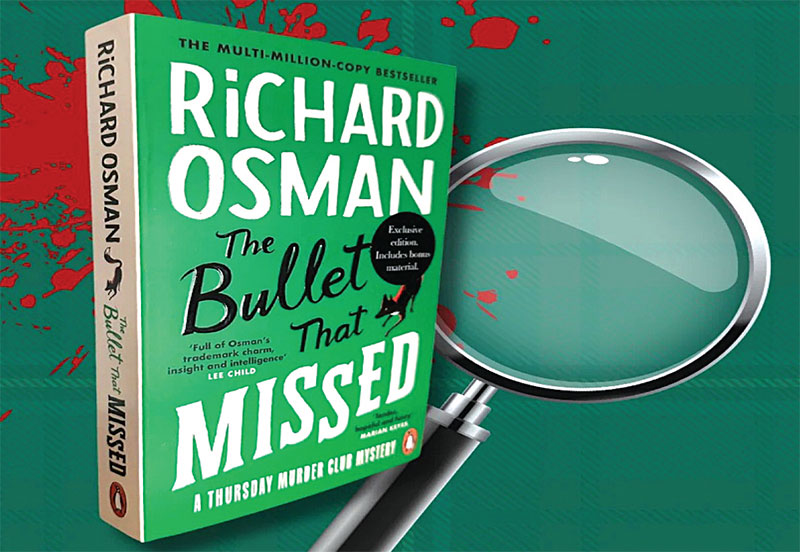
Another book that is part of a series, today—one that is fun without the brooding concentration on criminality in different forms that marks the Rebus novels. This one about the Thursday Murder Club, is a romp as its two predecessors were interspersed with deaths and what might be deaths.
The Bullet that Missed
begins with a meeting with the presenter of ‘South East Tonight’, a programme about the area, in which Coopers Chase is situated. The meeting is held because the club has decided to look into the murder of the producer’s assistant, Bethany Waites, whose car was found at the bottom of a cliff ten years ago. There was blood in it, but the body was never found.
Or, rather, the book begins with an account of Bethany Waites deciding, on the night she vanished, to meet someone in connection with a case of massive fraud that she had been investigating, after sending the producer, Mike Waghorn, a message that she had found new evidence though he had no idea what it was. The night she died, she sent him another message: “I don’t say this often enough, but thank you.”
CCTV cameras showed her leaving her place, but then the vehicle vanished, before being sighted near the cliff, with two people in it. Investigation of the fraud had led to the imprisonment of a woman, Heather Garbutt, though it proved impossible to pin anything on Jack Mason, the mastermind for whom she had worked.
The Club conducts investigations on several fronts, including through Connie Johnson, the drug dealer they had helped imprison in the earlier book. The psychiatrist Ibrahim, the most respectable member of the Club, interviews her in an attempt to get her to find out more from Heather, who is in the same prison as she. They also investigate the CCTV record of the night Bethany vanished, and deduce that she went to an apartment block and exited from its other side, and that is why she was not seen leaving the town. But some time had elapsed between her being seen in the town and then on the cliff.
Meanwhile, Elizabeth has been kidnapped, along with her husband, and taken to a house in Staffordshire, where she is told by a man called the Viking that she must kill a former KGB agent now in London, who has a profitable career in money laundering. The Viking tells her he will inform Viktor that she was responsible for stealing the diamonds, the story of which is told in the previous Murder Club Mystery, and Viktor will then kill her.
Elizabeth, who has an affair with Viktor, knows he will not kill her, but when the Viking says he will also send Viktor a picture of Joyce, she decides she must act, and goes to see Viktor, and fires when she gets him in the bathroom. But, of course, she fired into the ceiling, and Viktor is then taken to Coopers Chase, to stay with Joyce until they have dealt with the Viking. And Viktor then enjoys the camaraderie of the retirement home so much that he wonders whether he too should settle there.
Elizabeth does trace the Viking, or rather her husband does, for he has noticed rare books on the shelves in his library, and an antiquarian book dealer friend managed to find out who bought them. But before they could confront him, he comes to Coopers Chase, for he has seen the bullet hole in the bathroom of Viktor’s flat and realized he was fooled.
But he cannot bring himself to kill Joyce straight away, and she knocks him out with a drug in a cup of tea. When he meets Viktor, they both decide to fall in with the plans of the Club.
Before this, Heather has been found dead in her cell, with a note saying that ‘they’ were going to kill her, and only Connie could help. Before that she had admitted that she was frightened to name the man behind the fraud. Jack Mason said the same, after Ron had won his confidence. The Club had deduced by then that the body was buried in the garden of Heather’s house which Jack had bought, after she had been jailed, and digging reveals a gun and money, but no body. Jack tells them that the mastermind had said that Bethany was buried with a bullet with his DNA on it.
The Club is now working with the Chief Constable of Kent, Andrew Everton, who writes thrillers himself, but in the form of e-books. He is in search of a publisher, and delighted when Mike Waghorn puts him on his programme, as is Donna, who is substituted at the last minute for Chris.
The Club finds out whom Bethany visited in the apartment block—Mike’s assistant Pauline, who tells them later what she and Bethany had been doing. But this is after the man behind the fraud has been unmasked up in the house in Staffordshire, where he was trying to hire the Viking and Viktor to find the money that he had stashed away, using accounts that he could no longer trace. He has also confessed to murdering Bethany, hoping this will persuade the two money launderers to help him, but it turns out that he did not do this. Nor did he kill Heather, the incriminating note having been placed in her room by Connie, who decided that Heather’s suicide should be treated as murder so that the person who had been blackmailing her should be found out.
It was Jack Mason’s murder that was brought home to the crook. It turns out that Bethany, her appearance altered by Pauline, has vanished, to a new life in Dubai, where she has taken control of the missing millions. She has gone there because the threat, she received through the bullet she was looking at in the preamble, was to Mike and she wanted him out of danger.
Yet another whimsical conclusion to a whimsical book with enough loose ends left hanging for another sequel.
 At a time when Sri Lanka’s foreign policy is coming under intense scrutiny by some local sections it is only right that impartial and independent commentators shed some clarity on what fundamental foreign policy directions Sri Lanka ought to take. The extremely fluid and complex nature of current international politics renders such an understanding crucially important.
Given its vulnerabilities in a number of spheres Sri Lanka has no choice but to persist in broadly following the path of Non-alignment. That is, it should be ‘a friend of all and an enemy of none’, to the extent possible. However, it does not follow that in the process it could compromise what is seen as its national interest.
The latter point needs stressing against the backdrop of the criticisms the Sri Lankan government has been attracting from some quarters over what is made out to be some opaqueness in security and defence cooperation agreements it has entered into with India. It remains advisable for the Sri Lankan government to enter into pacts of this nature with India, but the government is obliged to disclose the contents of these agreements to the Sri Lankan people without undue delay in consideration of the uncompromisable sovereign rights of a people in a democracy.
However, there is no denying that the government should make it a central foreign policy premise to always work in cooperation with India. A consideration of what it cost Sri Lanka in the past to be in a disharmonious relationship with India and how such policy missteps worked against Sri Lanka’s best interests ought to dictate to Sri Lanka the advisability of maintaining uninterrupted cordial ties with India. Moreover, common sense ought to drive home to a country the costs of being at loggerheads with one’s closest neighbour who has also proved a ‘ready friend in deed.’
That said, it is the bounden duty of Sri Lanka’s diplomatic community or establishment to ensure that such cooperation does not degenerate into a policy of subservience towards India. That is, finesse and farsightedness in local diplomacy become prime requirements.
While India’s geographical location and physical size, besides her other strengths, contribute towards her centrality in regional and world affairs, her neighbours would be thinking and acting far-sightedly if they not only focus on India and her legitimate interests but also ensure continuous friction-free intra-South Asian relations. That is, for them collective South Asian well being should be of fundamental importance.
Much more than for India perhaps, such harmonious ties are of inestimable importance to India’s neigbours who are up against multiple vulnerabilities which are to a great extent regionally rooted. The latter could never, that is, afford to take their minds off the region’s collective development prospects.
The above are some of the reasons why it could prove highly counter-productive and self-defeating for the ‘South Asian Eight’ to render dormant and ineffective the historic SAARC organization. Rather than ‘dead’ SAARC has been allowed to drift into the ‘Limbo of Forgotten Things.’
The growing inter-dependence of the ‘SAARC Eight’ ought to impress on the collectivity the need to step-up regional cooperation in multiple areas which impinge on its members’ legitimate interests. For instance, the youth-led ‘Cockroach’ revolts, first in India and subsequently outside, should convince South Asia that it is continuing to be plagued in a major way by poverty and equity-linked issues. That is, West-inspired, largely market economics-dictated ways to see an end to poverty are simply not working completely.
Likewise climate-related questions are ravaging South Asia in unimaginable ways; Nepal being just one case in point. The rationale for regional cooperation remains valid and undefeated. It is time for revived and stepped-up SAARC cooperation. That is, the solutions to the region’s development dilemmas need to be found in mainly the region.
This amounts to making a case for a continued sense of ‘Southasianness’ among the SAARC countries. That is the conviction should be firm that they know their developmental challenges best and that answers to these issues must be primarily evolved by the grouping itself in cooperation with concerned sections.
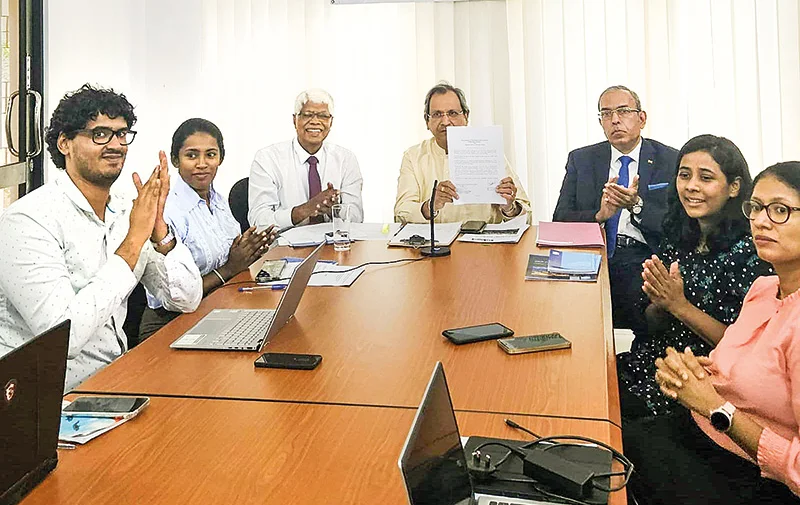
From the above viewpoints the Regional Centre for Strategic Studies (RCSS), Colombo did very well to tie-up with the South Asian University (SAU), India, to increase public awareness on the developmental problems affecting South Asia and for initiating a number collaborative measures that aim at ameliorating them. The relevant agreement was formalized in early September at the RCSS. The sealing of the pact took place under the aegis of SAU President Prof. K.K. Aggarwal and RCSS Executive Director Ambassador Ravinatha Aryasinha.
A press release issued by the organizations said the collaboration aims ‘to foster research networks, partnerships and collaborations for transformative change across South Asia.’ It also mentioned that the partnership marked the first agreement to be signed by SAU with an independent think tank in Sri Lanka.
Among other things, pacts such as the above are bold moves in the direction of fostering a spirit of intellectual independence in those areas of the South facing some of the stiffest developmental challenges. Rather than ‘import’ solutions to these challenges from outside the region, the SAU-RCSS initiative aims at fostering fresh approaches to evolving solutions to problems that are uniquely South Asian.
It is hoped that the SAU and RCSS initiative while leading a to a greater degree of Southern intellectual independence in the area of development thinking would also help in kick-starting the SAARC process all over again in a major way.
What ought to lend fresh urgency to the latter undertakings are fast-breaking current developments in international politics. It ought to be perceived by the most underdeveloped regions of the South that going forward their well being would matter least or not at all to the major powers of both East and West.
For example at the time of writing the foremost among US and Chinese political leaders are meeting in the US in what is made out to be a historic coming together of sorts to address issues of common concern. It is highly unlikely that the parties would be addressing the economic preoccupations of the least developed countries. The same goes for other states that matter from the East and West.
Essentially, the US and China would be looking at ways of strengthening business ties that matter majorly for them. The South and its issues would prove to be of peripheral interest, if at all they happen to matter to the protagonists. Such developments ought to be fresh reminders to the South and their collaborative organizations that there is no escaping self-help and joint solidarity.

Are religions getting redundant in the modern world?

‘The Bullet that Missed’

Four arrested with 62,100 narcotic pills in Kotahena

Police probe abduction and sexual abuse of 13-year-old girl at Galle Face

National media guidelines for reporting on children ready

One dead, another missing in Kitulgala drowning

‘Dates have the highest sugar content to fight Coronavirus’

Sunday Island 27 December – Headlines

#SundayIsland 17th December – Headlines

Sunday Island – 28th March

Sunday Island Headlines – 21 March

Sunday Island – 21st February – Headlines
-

 News6 days ago
Shanakiyan urges urgent action over reported death sentence for Lankan in Saudi Arabia
-

 News7 days ago
Bid for Basil’s extradition nears final stage: Police
-

 News5 days ago
Namal Rajapaksa Buddhist gambit fails, bail denied
-

 Features5 days ago
Why the spelling Sri Lankan names in English vary
-

 Features5 days ago
Three bands, a new identity: Sri Lankan wolf snake recognised as distinct species
-
 Business5 days ago
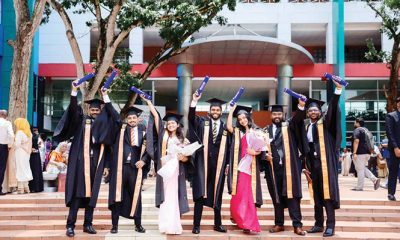
SLIIT holds largest-ever convocation
-

 News5 days ago
Govt monitors reported Saudi death sentence – Foreign Ministry
-

 News5 days ago
Vehicle prices drop by up to Rs. 1 mn, says importers’ body