
News
Govt., Opposition clash over alleged bid to tax EPF

By Saman Indrajith
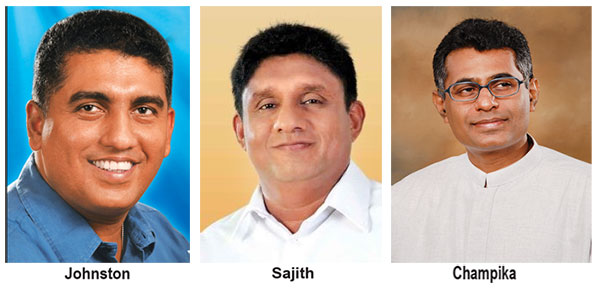
Chief Government Whip and Highways Minister Johnston Fernando told Parliament yesterday that there was a cold war within the SJB for the Opposition Leader’s post.
“Incumbent Opposition Leader is so upset and is trying to prove his relevance as other members in his party see a better and qualified leader in Patali Champika Ranawaka. Owing to this pressure, Opposition Leader Sajith Premadasa has lost control of his mind and speaks whatever comes to his mind,” Minister Fernando said.
He said so during a heated debate that ensued in Parliament yesterday following Opposition Leader Premadasa, asking the government to withdraw a gazette announcing the Surcharge Tax Bill, which seeks to tax the Employees’ Provident Fund (EPF).
Opposition Leader Premadasa said that the new Bill was a government plan to help itself to workers’ savings.
The Opposition Leader making a special statement demanded to know the government’s position with regard to the decline of usable foreign reserves to US $ 700 million. He questioned the measures taken by the Finance Ministry to contain the rising cost of goods, reasons for high inflation, among other key economic issues. He asked whether the Minister of Finance Basil Rajapaksa had requested a report on the financial situation under Financial Bill no 58 of 1948. He questioned the gazette notification issued on Monday 07 February 2022, according to which the government proposes a 25 percent tax on EPF. The Opposition Leader insisted that the government should answer his question.
Minister Fernando said that the government would not be able to reply to the gossip spread by the Opposition Leader.
“Opposition Leader Premadasa has come up with gossip. However, the Finance Minister will answer all questions he has raised in writing on another date,” he said.
Opposition Leader Premadasa:
“I only raised concerns about the financial crisis and never gossip.”
Presiding Member Deputy Chairman of Committees Angajan Ramanathan
said that the government would respond to the latter’s questions later. “The Leader of Opposition, the government will answer your question on another day,” he said.
Opposition Leader Premadasa:
“What nonsense is this? I raised pertinent questions which should be answered.”
Presiding Member Angajan Ramadanan:
The government will respond. I cannot allow more time than this. The Opposition Leader is not confining himself to the topic and then the government opposes that. This cannot go on.
SJB MP Dr Harsha de Silva
said that the government was trying to take over the workers’ savings.
SJB MP Kabir Hashim
also said that the government should provide an answer to the questions raised by his leader, and the Chief Government Whip had no brains.
Opposition Leader Premadasa:
I need a microphone. The Finance Minister is not in the House.
Chief Government Whip Fernando:
The Finance Minister and State Minister both are attending another function. We will respond to your questions soon.
Opposition Leader Premadasa:
According to parliamentary tradition, when the Opposition Leader is on his feet, his microphone should be on. But mine has been switched off.
Chief Government Whip Fernando:
We have clearly stated that we would respond. MP Hashim said I have no brains. But the capacity of the brains of those in the Opposition was shown when they had to lose power in four and half years. The Opposition Leader is scared that he would lose his post to Champika Ranawaka.

Latest News
Import and Export (Control) Regulations No. 01 of 2026, issued under the Imports and Exports (Control) Act, No. 1 of 1969, to be submitted for concurrence of the Parliament

The Special Import Licence Regulations No. 01 of 2023, published in Extraordinary Gazette No. 2312/77 dated 01-01-2023, prohibit the importation of retreaded tires, including those used for aircraft.
However, the Ministry of Ports and Civil Aviation has made a request that an exemption be granted to permit the importation of retreaded aircraft tires classified under HS Code 4012.13 for Sri Lankan Airlines.
Taking into consideration essential operational and safety requirements, it has been decided to permit the importation of retreaded aircraft tires classified under HS Code 4012.13, subject to the recommendation of the Ministry of Ports and Civil Aviation, provided that such tires comply with the requirements specified by internationally recognized aviation authorities and are imported by Sri Lankan airline operators engaged in international air services under a duly executed supply agreement between the airline and a certified international supplier.
Accordingly, the Cabinet of Ministers has approved the resolution furnished by the President, in his capacity as the Minister of Finance, Planning and Economic Development, to submit the Import and Export (Control) Regulations No. 01 of 2026, published in Extraordinary Gazette No. 2481/02 dated 23-03-2026 under the provisions of the Imports and Exports (Control) Act, No. 1 of 1969, for the concurrence of the Parliament.
An Officials’ Committee appointed under the chairmanship of the Secretary to the Prime Minister to review non-commercial state-owned institutions has recommended the consolidation of the Industrial Development Board, the National Enterprise Development Authority, and the Small Enterprise Development Division into a single entity.
Based on the aforementioned recommendations, policy approval was granted at the Cabinet Meeting held on 29-12-2025 to establish the Sri Lanka Industrial Transformation and Innovation Authority.
Accordingly, the Ministry of Industry and Entrepreneurship Development, in consultation with all relevant stakeholders and with technical assistance from the Asian Development Bank, has prepared a draft legal framework for this purpose.
The Cabinet of Ministers has approved the resolution furnished by the Minister of Industry and Entrepreneurship Development to instruct the Legal Draftsman to draft a Bill to establish the “Sri Lanka Industrial Transformation and Innovation Authority” based on the said draft framework.
The Cabinet of Ministers approved the resolution furnished by the Minister of Public Security and Parliamentary Affairs to appoint Iraj Chaminda Pathiraja, an officer in the Special Grade of the Sri Lanka Administrative Service to the post of Controller General of Immigration and Emigration on a permanent basis.

Import and Export (Control) Regulations No. 01 of 2026, issued under the Imports and Exports (Control) Act, No. 1 of 1969, to be submitted for concurrence of the Parliament

Cabinet nod to establish ‘Sri Lanka Industrial Transformation and Innovation Authority ‘
Iraj Chaminda Pathiraja appointed Controller General of Immigration and Emigration
Implementation of the recommendations of the Report submitted by the Presidential Commission appointed to Inquiry on the Easter Sunday attacks and the Then Sectoral Oversight Committee on National Security.

All-round Athapaththu helps Sri Lanka level series against Bangladesh

Dates Set for Lanka Premier League 2026

‘Dates have the highest sugar content to fight Coronavirus’

Sunday Island 27 December – Headlines

#SundayIsland 17th December – Headlines

Sunday Island – 28th March

Sunday Island Headlines – 21 March

Sunday Island – 21st February – Headlines
-
 News1 day ago
Rs 13 bn NDB fraud: Int’l forensic audit ordered
-

 Business4 days ago
Harnessing nature’s wisdom: Experts highlight “Resist–Align” path to resilience
-

 News7 days ago
PNS TAIMUR & ASLAT set sail from Colombo
-

 News4 days ago
Gratiaen Trust announces longlist for the 33rd Annual Gratiaen Prize
-

 News3 days ago
From Nuwara Eliya to Dubai: Isha Holdings markets Agri products abroad
-

 Opinion2 days ago
Shutting roof top solar panels – a crime
-
 News4 days ago
Heroin haul transported on 50-million-rupee contract
-

 Latest News6 days ago
Singapore Zoo’s first Sri Lankan leopard cubs make their public debut