
News
Udaya warns of longer power cuts as situation deteriorates further

‘Electricity deficit growing due to continuing drop in hydro-power generation
By Shamindra Ferdinando
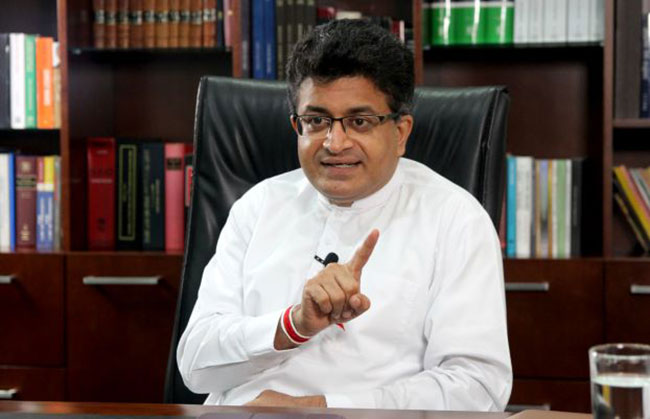
Energy Minister Udaya Gammanpila says the country is paying a very heavy price for failing to enhance electricity generation capacity since 2014.
Attorney-at-law Gammanpila, who is also the leader of Pivithuru Hela Urumaya (PHU) stresses ongoing unannounced power cuts are likely to be a regular feature due to what he called ‘system imbalance’ caused by sufficient power to meet the regular requirement.
The outspoken lawmaker warned that the duration of power cuts would be further extended sooner when the supply and demand gap widened.
Responding to another query, the Colombo District MP said that the CEB had no option but to switch off selected sections to avoid countrywide disruption of electricity. Whatever various interested parties say, power cuts were necessary and couldn’t be avoided, Minister Gammanpila said.
Minister Gammanpila said that he recently suggested a daily 90 minute power cut as there was no other option. Acknowledging that his proposal hadn’t received the required attention, Minister Gammanpila said that the situation would continue to deteriorate until all stakeholders reach a consensus on the issue.
According to the Minister, those who had been in authority since 2014 couldn’t absolve themselves of the responsibility for the current crisis.
Asked whether the failure on the part of the political leadership and those who had been at the CEB’s helm as well as trade unions was deliberate, Minister Gammanpila declined to comment. The minister pointed out that all stakeholders should examine the full picture if the country was to address the issue at hand properly. It would be a serious mistake to believe that the issue could be addressed by operating thermal power stations alone, MP Gammanpila said. Those who propagated the lie that the entire power requirement could be met through thermal power generation obviously didn’t understand the contribution made by hydro-power generation, the PHU leader said.
Had there been a proper strategy, the government could have initiated tender procedures to secure electricity from private operators to meet the shortfall. However, in the absence of such a strategy, emergency power purchases could be quite costlier at a time the cash-strapped government was experiencing a financial crisis. Perhaps there should be a genuine dialogue involving all stakeholders at least now, Minister Gammanpila said, asserting the energy situation was in a dicey situation. “Do we have a realistic view of the developing situation,” Minister Gammanpila asked, underscoring the importance of reaching a consensus among all stakeholders.
Appreciating India providing USD 500 mn through a new Line of Credit for the purchase of Indian oil products in addition to extending foreign exchange support of over USD 900 million to Sri Lanka, Minister Gammanpila emphasized the fuel supply remained at a critical stage. “There is no point in denying that fact. We are struggling, really struggling with no permanent solution in sight. That is the undeniable truth. Perhaps, the government should take the public into confidence. The public should be told of the exact situation and urged to bear up difficulties.”
Minister Gammanpila said that the situation could further deteriorate.
The energy Minister said that Sri Lanka was also grateful to China for providing a six-month loan facility to procure oil products. That would come to an end at the end of February, Minister Gammanpila said, adding that one more diesel shipment was scheduled to take place in terms of this agreement.
The Minister admitted that their negotiations with several other countries to procure fuel at concessionary terms hadn’t been successful. “We shouldn’t expect other countries to respond or come to our rescue the way India and China do,” Minister Gammanpila said.
The PHU leader dismissed Opposition criticism. Perhaps, those who had been in power in the 2015-2019 period should explain their failure to enhance power generation to meet the annual increase in the requirement. According to him, Sri Lanka needs to increase power supply by six percent annually.

News
China, Lanka intensify cooperation to fight cross-border crimes spreading across Asia and beyond


China and Sri Lanka have intensified joint law enforcement efforts to combat cross-border online gambling and telecom fraud, crimes that authorities warn are increasingly spreading across Asia and beyond.
The Chinese Embassy in Colombo said both countries are working closely to dismantle scam centres and fraud networks that have relocated to Sri Lanka from other parts of Southeast Asia. The Embassy noted that such operations often intertwine with human trafficking and other serious crimes, posing grave risks to public security and social stability.
China’s position on cross-border gambling remains firm: Chinese capital is prohibited from investing in overseas casinos, citizens are barred from operating them, and foreign casinos are forbidden from soliciting Chinese nationals. The Embassy stressed that gambling “almost invariably leads to financial ruin,” with tens of thousands of Chinese citizens suffering losses and harm. Recent amendments to China’s Criminal Law have criminalised cross-border gambling activities.
The Embassy pointed out that Sri Lankan authorities have carried out multiple raids in recent months, dismantling gambling and fraud dens and arresting suspects from several countries. Several Chinese nationals, involved in fraud-related crimes, have been handed over to Chinese authorities, producing what officials described as a strong deterrent effect.
The Chinese Embassy praised the efforts of Sri Lanka’s ministries of Foreign Affairs, Finance, and Public Security, particularly immigration and police officials, for their cooperation.
It warned that without firm and immediate measures, the spread of illegal gambling and fraud could damage Sri Lanka’s international image, undermine social stability, and harm the safety and security of its people.
China has already conducted similar law enforcement cooperation with countries including Spain, the UAE, Myanmar, and Cambodia, leading to arrests and repatriations of overseas fraud suspects. It has also proposed the creation of an international alliance against telecom and online fraud to coordinate global efforts, it said.
Going forward, China pledged to actively implement the Global Security Initiative and Global Civilization Initiative, while continuing to deepen law enforcement and security cooperation with Sri Lanka.
The Embassy said these efforts aim to safeguard lives and property, protect financial security, and build a “clean, safe, and beautiful Sri Lanka,” while contributing to a new global framework for combating transnational crime.

An assistant manager and a security officer, attached to a state bank branch in Horana, have been arrested in connection with the robbery of more than Rs. 30 million that was being transported to replenish automated teller machines (ATMs), Police said.
The two suspects were taken into custody on Friday after statements were recorded from them regarding the incident, which occurred on Wednesday afternoon at the Horana branch of the People’s Bank.
According to Police, a bank employee was carrying two bags containing cash through the rear entrance of the bank at around 2.45 p.m. when an individual, who had arrived on foot, allegedly snatched the bags and fled the scene.
The stolen money, amounting to approximately Rs. 30.5 million, had been prepared for distribution to ATM machines and transportation to other bank branches. Earlier reports had estimated the loss at around Rs. 35 million.
Investigators subsequently arrested a suspect believed to have been directly involved in the robbery and recovered Rs. 17 million of the stolen cash.
Police have not disclosed the exact circumstances that led to the arrest of the assistant manager and security officer but said investigations uncovered information linking them to the incident.
The Western Province North Crime Division is conducting further investigations to determine whether additional suspects were involved and to recover the remaining stolen money.
The daring daylight robbery has raised concerns over security procedures employed during transportation of large sums of cash to/from banking institutions.Further investigations are continuing.
by Norman Palihawadane
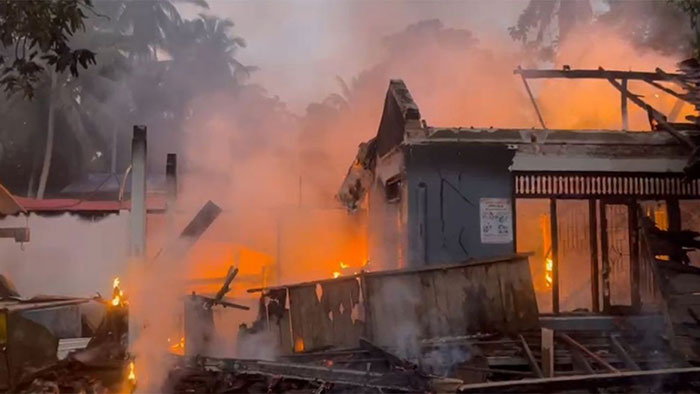
The death toll from the fire at an elders’ home in Batagoda, Anguruwatota, has risen to 13 after another resident succumbed to injuries while receiving treatment at the Horana Hospital, Police said yesterday.
Six others remain hospitalised with serious injuries.
The fire, which broke out on June 3 at the facility housing nearly 70 elderly residents, left 10 people dead on the spot after they were trapped inside the building, according to Police. A total of 51 occupants were rescued as firefighters brought the blaze under control.
Following the incident, approximately 50 survivors were initially accommodated at Batagoda Junior School before being relocated, with the assistance of Sri Lanka Army personnel, to another branch of the same care organisation in Galpatha.
Police said a Magistrate’s inquiry was conducted at the scene on June 4, during which burnt remains were recovered, under judicial supervision.
Meanwhile, the director of the elders’ home was arrested in connection with the incident and produced before the Horana Magistrate’s Court. He was remanded until June 11.Investigations are continuing into the cause of the fire.
by Norman Palihawadane

PEOTV secures media rights for FIFA World Cup

Anthropic urges AI labs to pause, warns humans risk losing control

Iran footballers issued US visas for World Cup, says White House

Showers will occur at times in the Western, Sabaragamuwa and North-western provinces and in Galle, Matara, Kandy and Nuwara-Eliya districts

China, Lanka intensify cooperation to fight cross-border crimes spreading across Asia and beyond

Asst. Manager, security officer arrested over Rs 30 mn snatch at Horana PB branch

‘Dates have the highest sugar content to fight Coronavirus’

Sunday Island 27 December – Headlines

#SundayIsland 17th December – Headlines

Sunday Island – 28th March

Sunday Island Headlines – 21 March

Sunday Island – 21st February – Headlines
-

 News4 days ago
Lankan duo emerge winners in Latin dance championship held in Blackpool, UK
-

 Business5 days ago
IMF’s unstated rate:Sri Lanka’s $695m loan costs about 5.33% per annum
-

 Latest News2 days ago
Kusal Mendis, Pathum Nissanka, bowlers put Sri Lanka 1-0 up
-
 News2 days ago
New US tariffs proposed on 60 countries, including Sri Lanka
-

 Business5 days ago
Sri Lankan scientist-innovator Milinda Edirisinghe introduces AI-integrated gem testing system to gemological world
-

 Features6 days ago
Are threats to Buddha Sasana external or from within?
-

 News5 days ago
UNP challenges NPP move to amend Vihara – Devalagam Act
-

 News4 days ago
Sri Lankan teen killed in Chennai clash; three arrested