
News
Sri Lanka celebrates 74th of anniversary of independence




Frontline Socialist Party (FSP) yesterday urged the government to disclose the three agreements signed with India on defence matters.
Top FSP spokesman Pubudu Jayagoda, of the breakaway JVP group, said that the seven MoUs signed in early April 2025 when Indian Prime Minister Narendra Modi visited Colombo hadn’t been presented to Parliament yet. “We have to examine the latest agreements against that background, ” Jayagoda said.
Jayagoda pointed out that the declaration that Indian Defence Minister Rajnath Singh was here to exchange MoUs on upgrading of L70 guns earlier provided by India to Sri Lanka during the war and cooperation between National Cadet
Corps (NCC) and National Defence Colleges (NDC) of both the countries as well as an MoU on academic cooperation between NDC, India and NDC couldn’t be acceptable.
Such a high ranking politician couldn’t have undertaken a three-day visit to sign minor agreements, Jayagoda said. Altogether, since the last presidential election, nine MoUs had been signed and none of them made public so far, he added.
Jayagoda also questioned the government aligning itself with India and US thereby taking an extremely dangerous path. (SF)
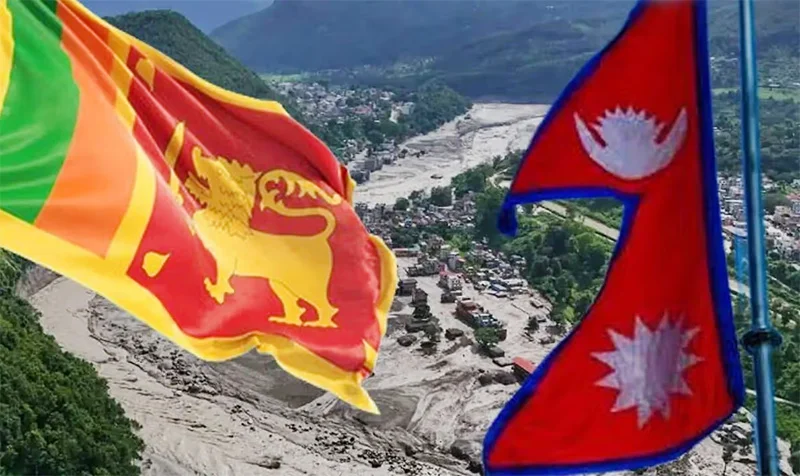
Sri Lanka’s Ambassador in Nepal Ruwanthi Delpitiya yesterday handed over a financial contribution of USD one million to the Government of Nepal.
The Foreign Ministry said that Sri Lanka stands in solidarity with the Government and people of Nepal following the devastating Bhote Koshi River floods on 26 August 2026, which resulted in significant loss of life and widespread damage in Rasuwa, Nuwakot, Dhading and other districts. The financial contribution is in fulfilment of the commitment made by the Government of Sri Lanka, under the direction of President Anura Kumara Dissanayaka, to extend support to Nepal.
The financial contribution was formally handed over to Foreign Minister of Nepal Shisir Khanal at the Ministry of Foreign Affairs in Kathmandu.
Sri Lanka has urged the Human Rights High Commissioner, Volker Türk, to end the country-specific mandate in respect of Sri Lanka where national processes demonstrated progress.
Addressing the 63rd Session of the United Nations Human Rights Council in Geneva, on 08 September, 2026, during the General Debate under the Agenda Item 2, Permanent Representative of Sri Lanka to the United Nations in Geneva, Ambassador Sumith Dassanayake emphasised that no Council mandate should be regarded as indefinite.
The written update on human rights situation in Sri Lanka was presented to the Council on 08 September and the General Debate was attended by the United Nations Human Rights High Commissioner, Volker Türk.
Dassanayake emphasised that at a time when the international community is confronted with grave and urgent human rights situations, including armed conflicts, displacement, and humanitarian crises, the Council must ensure its work and resources are directed towards the most pressing global challenges.
Dassanayake also emphasised to the High Commissioner that all mandates, particularly country-specific ones, should be subject to periodic review against clearly defined objectives and measurable outcomes. He called for sunset clauses and phase-out provisions to be explicitly incorporated into country-specific resolutions where appropriate.
Dassanayake stressed that when a country demonstrates progress through national processes, dialogue, cooperation, and technical assistance, the Council should provide a credible pathway towards concluding the relevant mandate.

If Sri Lanka wants ‘real’ stability, only one way to achieve it, in a short time

Human dignity comes centre stage in Afghan refugee deportation crisis

22A: Flawed logic and mistruths

Selectors play it safe, perhaps too safe

SLT-MOBITEL driving Sri Lanka’s economic resilience through digital infrastructure

Breakaway JVP group wants all nine MoUs with India released

‘Dates have the highest sugar content to fight Coronavirus’

Sunday Island 27 December – Headlines

#SundayIsland 17th December – Headlines

Sunday Island – 28th March

Sunday Island Headlines – 21 March

Sunday Island – 21st February – Headlines
-

 News7 days ago
22A: SC urged to suspend hearing, appoint full bench
-

 News5 days ago
Namal remanded until Sept. 18 over Airbus deal investigation
-

 Latest News4 days ago
Tharanga creates history with Diamond League crown in Brussels
-
 News7 days ago
Govt. seeks NATO assistance
-

 News4 days ago
Dispute which triggered listed company director being detained at BIA resolved
-

 Features3 days ago
After the parade: What a traffic OIC’s walk-out tells us
-
 Opinion6 days ago
In Memory of Dr Upatissa Pethiyagoda
-

 Editorial5 days ago
Power vs Equality