
Features
A President for all situations, but Sinharaja Forest needs more than roadside decisions

by Rajan Philips
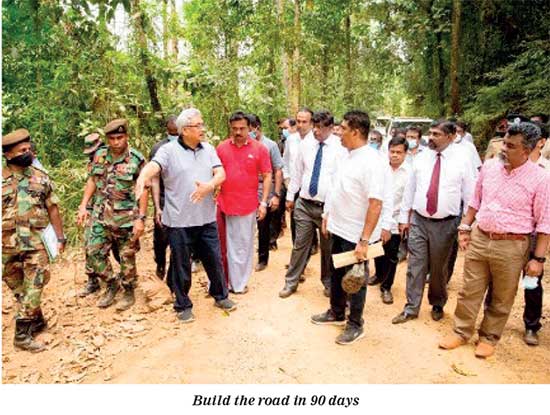
The pictures that have been circulating as part of the unfolding Sinharaja saga say more about the power-status of the Executive Presidency than all protestations about the alleged fetters of the 19th Amendment on the presidency. The pictures and the news reports tell a different story as well. It is the total absence of anything technically environmental or engineering informing the presidential visit. The omnipresent President landed on Lankagama, the newly storied village in the jungle, met with the villagers, and listened to them complain that the environmentalists are lying. He then went to the road site with half a dozen Ministers and even more officials following, surveyed the scene, and gave the order to build the road in 90 days, but without harming the environment. All of this has been photographed and reported.
But there were no pictures or reports of government officials explaining to the President the details of the project and how environmental impacts were identified and how they would be mitigated. It is not the best construction practice to avoid harming the environment without pre-identifying impacts and mitigation measures. Independent of the presidential visit, no government agency has provided clear and detailed information about the limits of the road work, who did the design, if an environmental assessment was undertaken, whether mitigation measures were identified, and how they will be implemented.
Not surprisingly, there are bouquets for the President’s hands-on mode of execution. Equally unsurprisingly, there will be brickbats as well, and petitions to UNESCO will follow from environmental activists (who are now being called terrorists by Mahinda Pathirana of the Sri Lanka People’s Front and Chairman of the Sri Lanka Press Council). Without showering flowers or throwing stones, it is reasonable to say that – what Sinharaja forest needs is not roadside decision making but organized and systematic care.
What is also missing is a single government agency that is exclusively responsible for the protection and stewardship of the island’s most pristine forest reserve. And that is after more than 40 years when Sinharaja forest was first recognized by UNESCO as a World Biosphere Reserve in 1978, and later as a World Heritage Site. What is even more surprising is that nobody seems to know how the current road construction got started, which agency is responsible for it, and how it will end.
According to reports, Sri Lanka Army Engineers started the road work on August 10, five days after the election. If that is true, that is a clever way of by-passing tender and avoiding government funds to pay a contractor. Give credit for cleverness, but Sri Lanka will benefit immensely if those who are clever in this government are also straight. Civil engineering work can be ideal for gainfully deploying the armed services when they are not militarily engaged. But that should not be for work that is normally done by government public works and private contractors. It should be for extraordinary work such as emergency restoration and disaster (i.e., floods, landslides) prevention. Not haphazard road building on a natural heritage terrain.

A haphazard project
The whole haphazardness of the project has become clear with the President first issuing a stop work order ten days after the road construction had started, and then reversing it after another ten days following his site visit. Which government agency or officials advised the President first to issue the stop work order, and then gave countervailing advice to rescind that order. It is also unfair to use the needs of people in the small, isolated villages in the buffer areas of the forest to justify infrastructure projects. Unlike the demands of the timber industry or tourist industry, the needs of the villages are not a significant burden on the Sinharaja natural environment. There have been plenty of studies, reports, and plans for just doing that. Emeritus Peradeniya Ecologists like Savitri and Nimal Gunatilleke have done their life work for the Sinharaja forest.
But there has been no corresponding follow up action by any government from 1978 when Sinharaja forest received world environmental attention. Even now, the respon
achers while sustaining the lives of people in the forest area villages.
sibility for the forest area is fractured administratively between Ratnapura, Galle and Matara districts, and between different line ministries and departments in the central government. God only knows what, if anything, the Southern and Sabaragamuwa provincial governments did for the forest. To repeat what I said earlier, Sinharaja deserves a single agency, like the Gal Oya Development Board or RVDB, not for developing and colonizing the area, but for protecting it from profit seek
ing encro
Sinharaja is not the only situation where the government was forced to put out environmental fires. While the President was visiting Lankagama last Saturday, Forest Conservation Minister C. B. Ratnayake went to Puttalam to stem the fallouts at the Anawilundawa wetlands where a business group with alleged political connections has been clearing sensitive areas for a prawn farm. Prawn farms have become a fancy but dubious business operation causing lasting ecological harm without creating jobs or foreign exchange in any significant measure. Studies have shown that most of them have been non-starters and area abandoned after digging up wetlands. River sand mining is another area where the government ignored all concerns and allowed unsupervised sand mining to be restarted. Similar to the human-elephant conflict, this government is poised to run into environmental conflicts if it begins to aggressively push its ‘development’ agenda. Launching major development or infrastructure projects without assured funding and adequate preparation will only exacerbate environmental harms.
On the other hand, the government seems all set to launch the 20th Amendment. This is one area, if not the only area, where the President may not be called upon to put out fires. From what is being reported, everything in the 19th Amendment other than the presidential term limit is ready to be tossed out. There is a historical cycle at work here. Every major constitutional change to the Soulbury Constitution has produced an equal and opposite reaction. The 1972 change begot its 1978 rejoinder. Similarly, the 18th Amendment scuppered the 17th Amendment, 18A was undone by 19A, and now the 20th Amendment (which in a different form was used by Ranil Wickremesinghe, the JVP and the TNA to fool everybody) is set to take out 19A. No one knows when and how the currently embryonic SLPP 20A will get its nemesis. But it will come.

Features
‘There are no private universities in Sri Lanka’ – some considerations for higher education reform

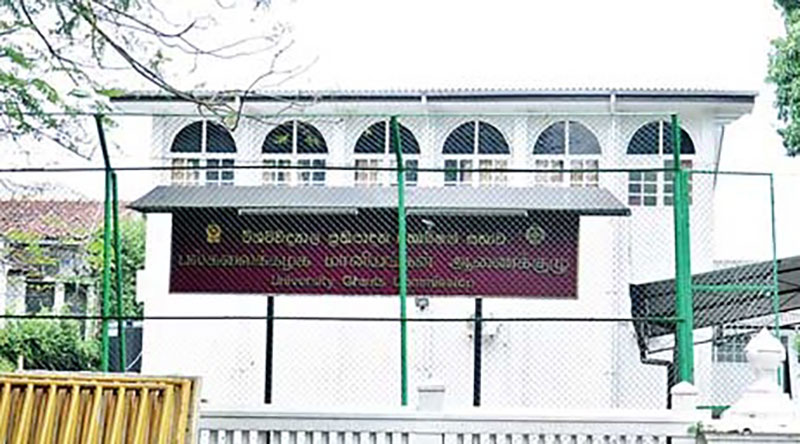
 Academics involved in education policy like to say that there is no such thing as a private university in Sri Lanka. The only ‘universities’ in the country are state universities; anything else offering degrees is a private higher education institution (HEI). This position is technically accurate. Yet, in the discourse and imagination of the public, private universities are very real – people teach in them, students register in them, families pay fees, and such degree holders enter job markets in Sri Lanka and outside.
For decades, activists concerned for public higher education have ignored or resisted looking at private HEIs, as if such scrutiny would taint them. Others have worked in both types of institutions, carrying practices from each to the other. The apex body governing state universities, the UGC, has, meanwhile, ignored the concept of conflict of interest and appointed individuals in private higher education in committees and leadership positions. It is unsurprising then that some of the ideologies informing private higher education appear in reform agendas in the state sector.
This is a good time then to consider the varying types of private HEIs around us, and to take a look at some of the issues within them in the hope that higher education reform agendas will include private, as well as state higher education.
What is a ‘private university’?
First, some clarifications. In the public imaginary, a ‘private university’ is typically an institution that provides a foreign or local degree for which the student makes a payment. But this broad classification encompasses a host of diverse institutions and types of degrees which I detail below.
The Non-State Higher Education Division (NSHE) of the Ministry of Education has recognised 295 degrees by 32 institutions. Most of these are private companies and include a handful of established, well-known private HEIs that are ‘university like’. The degrees are local degrees conferred by the institutions accredited by the NSHE Division. While private HEIs conferring local degrees must be accredited by the NSHE Division, there appears to be no legal consequence for not doing so. In addition, there are several permutations of the private degree that miss the net of this Division and the Standing Committee on Accreditation and Quality Assurance (SCAQA) that assists this Division.
For one, degrees conferred by foreign universities offered, via these same private HEIs, are not vetted by the NSHE Division. Secondly, there is a growing plethora of private HEIs which have either no physical presence locally or only a dubious presence. The University Grants Commission has notified the public, through their website, that foreign universities listed in the Commonwealth Universities Yearbook and the World Higher Education Database are recognised, but refrained from giving any other details – which degrees? Offered by what modes? These details are not known. Some of the foreign universities in the lists may be legitimate entities in their own land but the degrees conferred locally, in their name, may not adhere to curriculum or teaching specifications of the NSHE Division or the UGC.
Another troubling phenomenon is the ‘top up degree’, which appears to work on the same principle as that of a pre-paid mobile connection: if I have a Diploma or an HND of a sort, I am eligible to complete a course of study which provides me with a degree, usually from a foreign university. The idea that someone who does not initially qualify for a degree programme should be able to work their way towards one is a progressive notion. This is the concept that open and distance learning (ODL) was based on initially, but which is now sadly exploited. ODL models are expected to provide opportunity for learning for those who may be excluded from traditional learning institutions. In Sri Lanka, however, we have seen ODL become a marketplace offering easy to obtain, for-fee qualifications by institutions with little commitment to superior teaching and learning.
Finally, a perusal of the many types of private HEIs and their varied degrees bring to mind another question – how should the private degrees, provided by state institutions (that are not educational institutions), be regulated? Who should do so?
All of these create a host of problems for the public – for hopeful students and parents and trusting employers. For the higher education sector, recruitment of academic staff, too, has become difficult due to this plethora of ambiguous higher education qualifications, as I discussed in a previous Kuppi article (‘Recruiting academics to state universities’).
Some issues in private HEIs – a bellwether for change in state universities
In this second part of this article, I will discuss some aspects of work in private HEIs – albeit the more established institutions – given that such issues may appear in reform agendas in future.
Across state universities, all permanent staff of a specific category are paid according to the same criteria. The picture is not so clear when it comes to private HEIs since they are different entities legally, typically companies. Private HEIs have salary scales and financial incentives that are different to each other. The more established private HEIs reportedly have attractive renumeration packages, possibly a reason for academics of state universities migrating eagerly to such institutions during sabbatical years and on retirement. This may not of course be the case with other less established, or improperly registered HEIs of which we know little. Academic staff of these more accepted private HEIs seem to value the high financial remuneration they receive (in comparison to state universities) as something that makes their work rewarding.
Attractive remuneration is important to sustain the good life and is at times seen as the institution’s way of encouraging good work. Yet, this has implications for the future of the institution: to continue to deliver on promised financial packages, institutions must continue to have large profit margins. One strategy has been to enroll multiple cohorts of students per year, even up to three or four intakes per year. This can result in exploitative work conditions, since staff must cater to all these cohorts in that same year. If there is inadequate staff, employees are further burdened. On the other hand, if there is a sudden drop in enrolments (degrees can go out of fashion) unexpected layoffs occur. Similar to other sectors that employ short-term contract staff – including state universities – in private HEIs, too, individual teachers, who are on short term contracts that need regular renewal, can feel pressured to work under difficult or exploitative conditions.
At the same time, even in the more established private HEIs, work norms differ from those of state universities in that they include promotional work that keeps the institution’s name in the eye of the public. The Marketing (or similarly named) unit comes up in conversations as one of the most important departments. It appears to weigh in on decision-making related to the number of staff, the amount of re-sits per exams, and other pedagogically important matters. This is a worrying example of how financial rationales interfere with pedagogically or academically sound processes, resulting in problematic results in the classroom. On the plus side, junior colleagues, who had experience in both state and private HEIs, also felt that they faced less harassment in private HEIs – primarily due to the private HEIs ability to take swift action in reported cases of harassment. This is a real indictment on state institutions and their reluctance to address chronic issues of harassment in our universities.
Yet, while we hear much about problems in state universities, we hardly hear of problems that staff in private HEIs face. One rationale for a lack of public expressions by staff is that expressions of discontent might lead to trouble given the importance of reputation for private HEIs. The worry about reputational damage is a growing concern in state universities, too, as evidenced by social media policies and internal conversations on reputational damage, consequent to negative publicity. Institutional worries of reputational damage are harmful in the long run since these impact not only freedom of expression by student and staff, but also research that is possible in and about the education sector.
Some thoughts at the end…
A close look at the private higher education sector is important given its strong presence in the country. Impending reform needs to regulate this diverse array of higher education offerings in the private sector, as well as the state institutions that offer privately-funded options of higher education (a topic for a separate Kuppi on its own). It is time we carefully considered how to build a whole system of higher education out of this broken mess.
Kaushalya Perera is a senior lecturer at the University of Colombo.
Kuppi is a politics and pedagogy happening on the margins of the lecture hall that parodies, subverts, and simultaneously reaffirms social hierarchies.

Singer Nish Peiris is set to take the next big step in her music journey.
The talented vocalist, who has been seen and heard in the scene here for a short while, and was also featured with the now-defunct band, Inner Vision, has announced that she will be fully committing to her solo career, after completing her degree this year.
“I’m finishing my degree this year, and after that I’ll be fully committing to my solo music career,” Nish told The Island.
“I’ve already got a few tours lined up for next year, so I’m really excited for what’s ahead.”
Fans, no doubt, will remember Nish for her smooth voice and stage presence, and the good news is that she is now ready to chart her own path and bring new music to audiences at home and abroad.
With tours already planned for 2027, the year 2026 promises to be an exciting year for the young artiste as she steps into the spotlight on her own.
We wish Nish every success in this new chapter!

 While Sri Lankan music lovers, in Dubai, are eagerly looking forward to being a part of the action on Saturday, 25th July, with Rajiv Sebastian in the limelight, Sri Lankans, in Toronto, Canada, are equally excited and are anxiously awaiting the arrival of Sri Lanka’s famous singer/entertainer Sohan Weerasinghe.
Having done the needful with The X-Periments, the legendary performer has now embarked on an exciting new chapter – a solo career – and Toronto, Canada, will see him do the needful, on Friday, 31st July, 2026, from 8.00 pm to 12.00 am, at the Angus Glen Golf Club.

Sohan Weerasinghe: In Canada, and ready to do the needful on 31st July
Reports indicate that it’s a ‘sold out’ event – naturally with Sohan in the spotlight.

Gamini Hemalal: Creating all the excitement for Sri Lankans in Toronto
Having built his reputation through years of unforgettable performances, and hits that became part of our musical fabric, Sohan is ready to bring his own vision, sound, and stories directly to the audience, in Toronto, Canada, backed by the phenomenal Toronto Ceymphony Live Band.
Says Gamini Hemalal, who has been instrumental in reviving the Sri Lankan entertainment scene, in that part of the world:
“The countdown begins for the most exclusive musical event of the summer! Join us for a premium night of incredible music, elite hospitality, and a lavish buffet as the legendary Sohan Weerasinghe takes the stage live in Toronto!
“This is a high-end event, designed for those who appreciate exceptional entertainment and great food.”
Gamini, who is also a member of the Toronto Ceymphony Live Band, mentioned that it’s going to be an intimate musical evening with the celebrated Sohan Weerasinghe.
From packed auditoriums to intimate shows, Sohan continues to prove why he remains one of Sri Lanka’s most beloved entertainers.
For decades, Sohan Weerasinghe has been a household name in Sri Lankan entertainment.
Known for his captivating smooth voice and charismatic stage presence, Canada will experience it all on Friday, 31st July.
Next on the list of events, Gamini Hemal is working on, is Halloween night and he says “what we plan to do will be very interesting and unique … with a surprise guest star, as well!”

Trump slaps 50% tariffs on Canada and Carney vows to ‘intensify’ trade talks

Showers will occur in the Western, Sabaragamuwa and North-western provinces and in Kandy, Nuwara-Eliya, Galle and Matara districts

Move to extend judges’ retirement ages could damage Sri Lanka’s global image, warns Prof. Peiris

Dengue surge infects 76,000, claims about 53 lives

SC dismisses challenge to gender change procedures

BASL urges Justice Minister not to amend Constitution to increase retirement ages of superior court judges

‘Dates have the highest sugar content to fight Coronavirus’

Sunday Island 27 December – Headlines

#SundayIsland 17th December – Headlines

Sunday Island – 28th March

Sunday Island Headlines – 21 March

Sunday Island – 21st February – Headlines
-

 Business2 days ago
‘Giving up was never an option’: The fisherman who fought back after losing millions in SL
-
 Features2 days ago
Two memorable excerpts from a former SLAF commander’s memoir
-

 Latest News3 days ago
Davis cup Asia/Oceania Group IV 2026 to be held in Colombo from 20th to 25th July
-

 Features2 days ago
Erdoğan’s New Republic
-
 Life style2 days ago
Taste of the Swiss Alps comes to Colombo
-
 Features6 days ago
Dirty Money
-
 News3 days ago
Dengue outbreak gallops ahead: Infections surpasses 73,455, leaving 50 dead
-
 News3 days ago
Evidence recorded in money laundering case against Yoshitha Rajapaksa